You’re about to move dirt in Nevada. Maybe a lot of dirt. And before your first shovel hits the ground, there’s a question you need to answer: do you need a Stormwater Pollution Prevention Plan (SWPPP)? Miss this, and you could face fines, stop-work orders, and a headache that costs more than the permit itself. The good news?
Pro SWPPP – America’s #1 SWPPP Service has your back. Let’s break down exactly when Nevada law requires a SWPPP for your 2026 project—and how to get it done fast.
What Is a SWPPP and Why Does Nevada Care?
A SWPPP is your written game plan for keeping mud, chemicals, and trash out of rivers, lakes, and storm drains during construction. The Clean Water Act says polluted stormwater is illegal. The EPA created the NPDES program to stop it. Nevada runs its own version through the Nevada Division of Environmental Protection (NDEP).
Think of it like this: rain hits your site, picks up dirt and oil, and runs into a storm drain that flows straight to a creek. No filter. No treatment. That’s the problem. A SWPPP tells you where to put silt fences, gravel bags, and other Best Management Practices (BMPs) so you catch the mess before it leaves your site.
When Does Nevada Require a SWPPP?
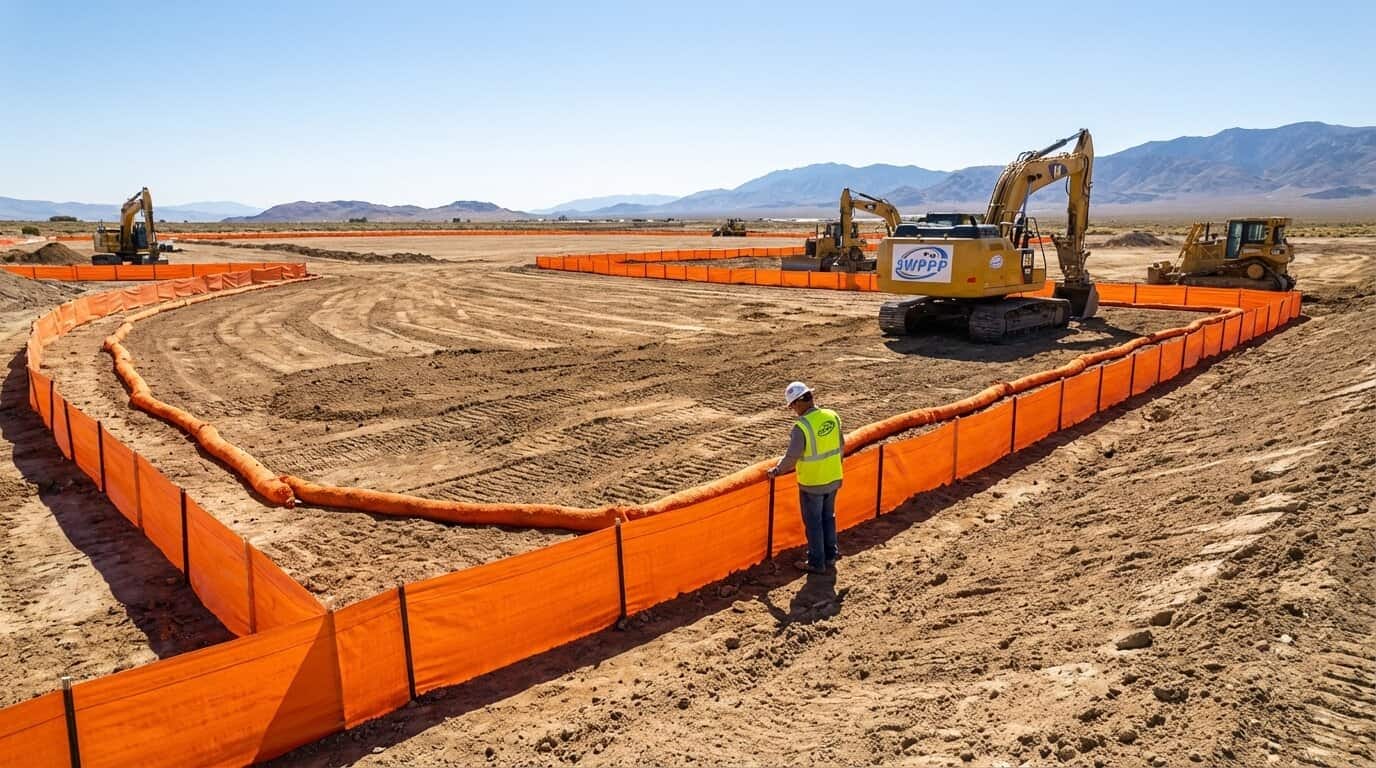
Here’s the trigger: if you disturb one acre or more of land, you need coverage under Nevada’s Construction General Permit (CGP). That includes grading, trenching, demolition, or clearing trees. Even if your lot is 0.8 acres but it connects to a larger project that totals over one acre, you’re in.
You file a Notice of Intent (NOI) with NDEP’s Bureau of Water Pollution Control in Carson City. They issue permit coverage. Then you write (or hire someone to write) your SWPPP before dirt moves. No permit? Big fines. States like Texas and Georgia have similar rules, so if you work across state lines, you already know the drill.
Industrial Sites Need SWPPPs Too
Construction isn’t the only reason you’d need a plan. Nevada’s Industrial General Permit (IGP NVR050000) covers facilities like lumber mills (SIC 2411), pulp operations (SIC 2611), and certain mining activities (NAICS 1021). If your site stores raw materials outdoors or has industrial stormwater discharge, you file an NOI and maintain a SWPPP year-round.
What Goes Into a Nevada SWPPP?
Your SWPPP isn’t a one-page checklist. It’s a living document with site maps, BMP descriptions, inspection schedules, and contact info. Here’s what NDEP and federal rules require:
- Site description: Acreage, soil type, existing vegetation, nearby water bodies.
- Erosion and Sediment Control BMPs: Silt fences, fiber rolls (wattles), construction entrances, slope stabilization.
- Good housekeeping: Trash bins, material storage covers, vehicle washing areas.
- Inspection and monitoring: Weekly walkthroughs, rain-event checks, photo logs.
- Spill response: What to do if diesel leaks or paint spills.
- Final stabilization: How you’ll seed, mulch, or pave before you close out the permit.
NDEP points contractors to the NDOT Construction Site BMPs Manual, updated February 2025 and mandatory for state highway projects starting March 7, 2025. Even if you’re not building a road, this manual is gold—it lists approved BMPs like flocculant socks, oil-solidifying booms, and mechanical sediment filters. You can download free templates, including a SWPPP.docx and inspection forms (NDOT Form 018-001EP and 018-002SWPPP).
Don’t want to mess with all the paperwork and requirements? Check out Order your SWPPP now with Pro SWPPP Professional CPESC Certified SWPPP Services.
Who Writes the SWPPP?
You can write it yourself if you know erosion control inside and out. But most builders hire a Qualified SWPPP Practitioner (QSP) or Certified Professional in Erosion and Sediment Control (CPESC). Why? Because one mistake—wrong BMP placement, missing inspection log, no secondary containment for fuel tanks—can trigger a violation.
Pro SWPPP – America’s #1 SWPPP Service employs CPESC-certified experts who’ve written thousands of plans across the country. They know Nevada’s permit language, NDOT standards, and how to tailor BMPs to desert soils, flash-flood risk, and high winds. You get a compliant plan fast, so you can focus on building.
Key Nevada Rules for 2026
Nevada’s permits don’t expire the way you might think. Under NAC 445A.241, if NDEP hasn’t reissued a permit by its expiration date, your coverage auto-continues. That means your CGP or IGP stays valid until the state publishes a new version. For 2026 projects, you’re still operating under current NDEP permits.
One quirk: Nevada has no statewide post-construction stormwater standards. But if you’re in a Municipal Separate Storm Sewer System (MS4) area—Las Vegas Valley, Reno/Sparks (Truckee Meadows), or NDOT highways—you must follow local rules for permanent BMPs like detention basins and vegetated swales. NDOT holds statewide MS4 Permit NV0023329 and publishes annual Stormwater Management Program (SWMP) reports every October 1.
The 2026 Water Quality Integrated Report is also coming. NDEP is collecting surface-water data from October 2019 through September 2024 to update the Clean Water Act Section 303(d) impaired-waters list and Section 305(b) assessments. If your site drains to a listed stream, expect extra scrutiny on sediment and turbidity.
BMPs That Work in Nevada
Nevada’s climate is tough on erosion control. Low humidity, intense summer storms, and wind mean you can’t rely on a single silt fence and call it done. Here are BMPs that hold up:
- Fiber rolls (wattles): Straw or coconut-fiber tubes staked along slopes.
- Flocculant socks: Release polymers that clump fine sediment so it settles in basins.
- Rock check dams: Slow water in ditches, preventing gullies.
- Stabilized construction entrances: Gravel pads that knock mud off tires before trucks hit public roads.
- Dust control: Water trucks or tackifiers to stop wind erosion.
- Oil-solidifying booms and pillows: Absorb fuel and hydraulic fluid in equipment areas.
- Stormwater sand filters: Treat runoff before it leaves the site, especially for high-TSS (total suspended solids) discharge.
The 2025 NDOT manual emphasizes mechanical filtration and updated product specs. If you’re near Lake Tahoe or other sensitive waters, you may need to monitor pH, turbidity, and oil & grease against numeric benchmarks.
Inspections and Monitoring
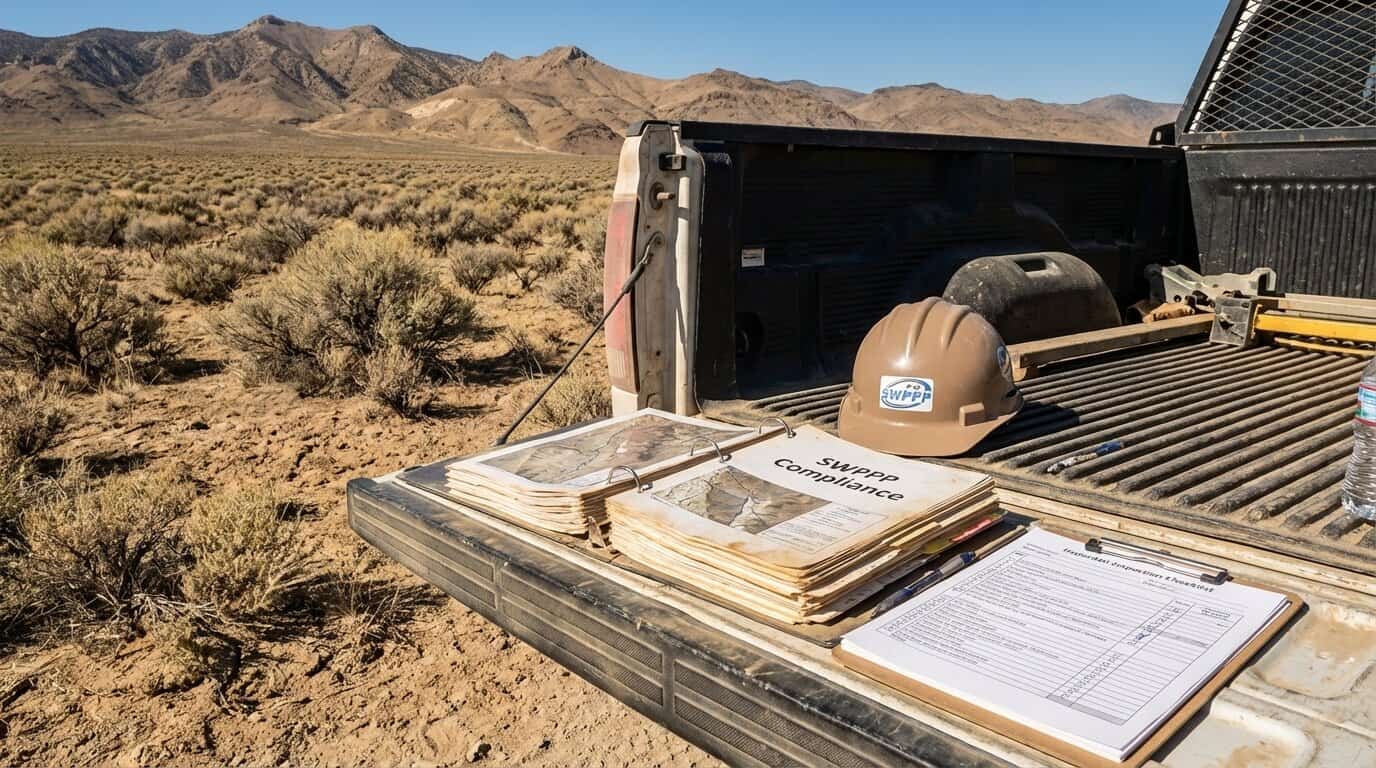
Your SWPPP isn’t a file-and-forget document. Nevada’s CGP requires weekly inspections and within 24 hours after any storm that produces runoff. You log:
- Date, time, inspector name
- Weather conditions
- BMP condition (working, damaged, missing)
- Corrective actions taken
- Photos
Keep logs on-site and available for NDEP inspectors. If you spot an illicit discharge—someone dumping paint, a broken sewer line, or an oily sheen—report it. NDOT has a hotline and field guide for this.
Not sure what your project needs? Take our SWPPP Quiz or Schedule a Free SWPPP Consultation with CPESC Certified SWPPP Expert Derek E. Chinners.
Common Mistakes and How to Avoid Them
Here’s what trips up Nevada contractors:
- Waiting too long to file the NOI. Submit at least 48 hours before you start work. Better yet, file two weeks early.
- Using outdated BMP specs. The February 2025 NDOT manual is now the standard. Old methods may not pass inspection.
- Ignoring off-site run-on. If water flows onto your site from a neighbor’s lot or a highway, you must control it. Add berms or diversion channels.
- Skipping final stabilization. You can’t close out your permit until grass is growing or pavement is down. Hydroseeding alone isn’t enough in Nevada’s heat—you need mulch and irrigation.
- No trained person on-site. Designate a QSP or CPESC to oversee the SWPPP. Foremen and operators need basic stormwater training so they know what a silt fence is and when to call for help.
MS4 and Post-Construction Rules
If you’re building in an MS4 jurisdiction, your work doesn’t stop when construction ends. Local ordinances may require permanent stormwater features: bioswales, permeable pavement, detention ponds. NDOT, Clark County, Washoe County, and the cities of Las Vegas, Reno, Sparks, and Henderson all have MS4 permits with unique standards.
For example, NDOT’s statewide permit covers all state highways. If you’re widening a road or building an interchange, you’ll follow the NDOT Planning & Design Guide (PDG) for structural BMPs. The 2024 Climate Vulnerability Evaluation of Watersheds and 2025 Environmental Justice Delineation are shaping how the state prioritizes green infrastructure and flood risk.
Training and Resources
Knowledge is cheap insurance. The Associated General Contractors (AGC) Reno chapter runs a “Storm Water Compliance & BMPs” class every January. NDEP offers a Contractor’s Field Guide and free downloadable templates. If your crew hasn’t seen a wattle before, a half-day training can save you a $10,000 fine.
For industrial sites, look into Qualified Industrial Stormwater Practitioner (QISP) certification. It’s the industrial equivalent of a QSP and shows NDEP you’re serious about compliance.
Why Hire a Pro?
Regulations change. NDOT updates the BMP manual. MS4 permits get reissued. The 2026 Integrated Report could add new impaired waters. Keeping up takes time you don’t have when you’re managing equipment, labor, and schedules.
Pro SWPPP – America’s #1 SWPPP Service stays current on every Nevada rule, from CGP triggers to NDOT’s latest flocculant specs. We write your plan, train your crew, and handle inspections if you want. You get a SWPPP that passes audits and a team that answers the phone when an inspector shows up. Learn more about our process and team or reach out to us.
What Happens If You Skip the SWPPP?
NDEP can issue a Notice of Violation, levy fines up to $10,000 per day per violation, and order you to stop work until you’re compliant. If sediment reaches a waterway, you may face federal EPA enforcement under the Clean Water Act. Insurance won’t cover it—pollution liability is excluded from most general liability policies.
Beyond fines, you lose time. Re-mobilizing crews, installing BMPs after the fact, and dealing with legal paperwork eats profit and delays your schedule. It’s cheaper and faster to do it right from day one.
2026 Trends and What’s Next
Nevada is pushing green infrastructure and climate-resilient design. The 2024 watershed vulnerability study and 2025 environmental-justice mapping mean future permits will likely include equity and climate-adaptation language. Expect more emphasis on low-impact development (LID) BMPs—rain gardens, permeable pavers, green roofs—especially in MS4 areas.
Flocculants and mechanical filters are becoming standard on large sites. Oil & grease benchmarks are tightening. If you’re in mining or heavy industrial work, prepare for enhanced monitoring and reporting.
SWPPP FAQs
Do I need a SWPPP for a half-acre lot in Nevada?
Not unless it’s part of a larger common plan of development that totals one acre or more. If your half-acre connects to another phase or adjoining parcel, you need CGP coverage and a SWPPP.
How much does a SWPPP cost in Nevada?
Prices range from $1,500 to $5,000 depending on site size, complexity, and whether you need monitoring or inspection services. Pro SWPPP offers flat-rate packages so there are no surprises.
Can I use the same SWPPP for multiple projects?
No. Each site needs its own NOI and site-specific SWPPP with unique maps, BMPs, and contact info. Copy-paste plans get flagged by inspectors.
What’s the difference between a QSP and a CPESC?
A QSP (Qualified SWPPP Practitioner) is a general term for someone trained in stormwater compliance. A CPESC (Certified Professional in Erosion and Sediment Control) is a nationally recognized credential that requires experience, training, and passing an exam. CPESCs bring deeper expertise.
How long does NOI approval take in Nevada?
NDEP typically processes NOIs within a few business days, but plan for up to two weeks during busy seasons. Submit early to avoid delays.
What happens if it rains before my BMPs are installed?
You’re liable for any discharge. Have at least perimeter controls—silt fence, fiber rolls, inlet protection—in place before grading starts. If a surprise storm hits, document it, deploy emergency BMPs, and report the event in your inspection log.
Do I need a SWPPP for demolition?
Yes, if you disturb one acre or more of soil during or after demo. Removing a building and grading the pad counts as land disturbance.
Can I close out my permit before final landscaping?
No. Final stabilization means 70 percent vegetative cover (or equivalent hardscape) across all disturbed areas. Temporary seeding isn’t enough.
Where can I download free Nevada SWPPP templates?
NDEP and NDOT publish templates on their websites, including the NVR050000 SWPPP.docx and inspection forms 018-001EP and 018-002SWPPP. The February 2025 NDOT BMP Manual includes sample plans and field guides.
Bottom line: if your Nevada project moves dirt on one acre or more, you need a SWPPP and CGP coverage before you start. Skip it, and fines pile up faster than your equipment can grade. Partner with us to get compliant fast, stay compliant through construction, and close out clean—so you can focus on building, not paperwork. Get started today.