We’ve helped industrial facilities nationwide stay compliant with stormwater permits. But here’s the thing: most companies don’t even know if they need a permit until they get hit with a fine. If you run a factory, warehouse, landfill, or any industrial operation, the EPA’s 2026 Multi-Sector General Permit (MSGP) could change everything for you. Let’s break down what you need to know and how to stay out of trouble.
What Is the 2026 MSGP and Why Should You Care?
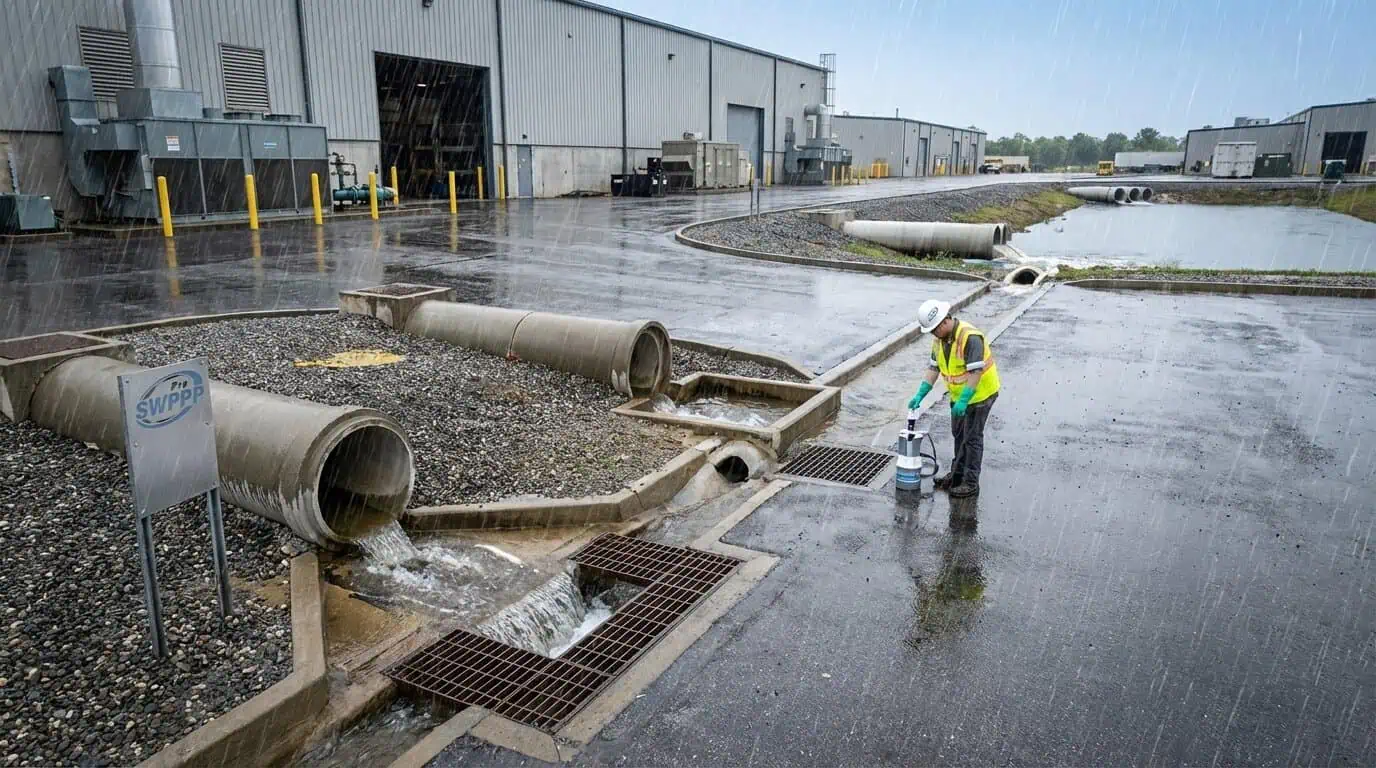
The Multi-Sector General Permit is a federal permit under the Clean Water Act that covers stormwater discharges from 30 different industrial sectors. Think timber yards, chemical plants, mining operations, metal fabricators, recycling centers, and more. If rain or snow touches your industrial property and runs off into a storm drain, ditch, or waterway, you’re probably covered.
The EPA proposed the 2026 version in December 2024 to replace the 2021 permit (docket EPA-HQ-OW-2024-0481). Public comments closed May 19, 2025, and as of late 2026 EPA has still not issued the final permit or announced an effective date. That gap is the single most important thing for an industrial operator to understand right now: the 2021 MSGP expired February 28, 2026 and is running on administrative continuance. Facilities that already had coverage keep it automatically and should carry on meeting every monitoring and reporting requirement. Facilities that did not have coverage before that date cannot file an NOI at all until the new permit issues; EPA’s No Action Assurance memorandum, effective March 1, 2026 and terminating February 28, 2027 or 120 days after the next MSGP takes effect, is the only interim path, and it expressly does not grant permit coverage. This new permit applies in states where the EPA runs the NPDES permitting program, like Massachusetts, New Hampshire, New Mexico, and Washington D.C. But even if your state runs its own program (like Texas or Georgia), your rules are usually based on the federal model.
Here’s the big deal: the 2026 MSGP has tougher rules. No visible solids, scum, sheen, foam, or weird colors in your stormwater. You’ll need to monitor for PFAS (40 different compounds using EPA Method 1633). And if you’re in an area with impaired waters, you’ll face quarterly monitoring and corrective action if you exceed benchmarks.
Do You Need an NOI or a SWPPP?
Let’s clear this up fast. You need both in most cases. The Notice of Intent (NOI) is your application to get covered under the MSGP. You file it with the EPA (or your state) to say, “Hey, I’m an industrial site and I need permit coverage.” The Stormwater Pollution Prevention Plan (SWPPP) is your playbook for how you’ll keep pollutants out of stormwater at your specific site.
Here’s how it works step by step:
- Check if your facility is in one of the 30 covered sectors
- Determine if EPA or your state is the NPDES permitting authority
- File your NOI at least 30 days before you start discharging stormwater
- Create your SWPPP before you submit the NOI
- Keep your SWPPP on-site and update it whenever site conditions change
There is one exception: the No Exposure Certification (NEC). If all your industrial materials and activities are completely covered (like inside a building or under a roof), and rain never touches them, you can file an NEC instead of an NOI. But you still need to maintain that certification and prove no exposure year after year.
What Goes Into a SWPPP for Industrial Sites?
Your SWPPP is not a one-size-fits-all document. It’s custom to your site. Pro SWPPP – America’s #1 SWPPP Service builds these plans every day for facilities across the country. Here’s what you need:
- Site map showing drainage patterns, outfalls, and industrial areas
- List of potential pollutants (chemicals, oils, metals, sediment)
- Best Management Practices (BMPs) like containment berms, covers, and filters
- Inspection schedule (usually quarterly or after major storms)
- Sampling and monitoring plan (quarterly benchmark monitoring for some sectors)
- Employee training plan
- Corrective action procedures for exceedances
The 2026 permit adds some new twists. You’ll need to evaluate how your BMPs will hold up under extreme weather like floods and big storms. If you’re in an area with impaired waters (rivers or lakes that are already polluted), you’ll have stricter monitoring and faster corrective action requirements.
Don’t want to mess with all the paperwork and requirements? Check out Order your SWPPP now with Pro SWPPP Professional CPESC Certified SWPPP Services.
Key Changes in the 2026 MSGP You Can’t Ignore
Let’s get real about what’s different. The EPA is tightening the screws. Here are the big changes:
No Visible Pollutants: Your discharge can’t have any observable solids, scum, sheen, foam, or discoloration. Period. This means your inspections need to catch problems before they hit the drain.
PFAS Monitoring: You’ll need to monitor for 40 PFAS compounds using EPA Method 1633. There are no benchmarks yet, but the EPA is collecting data. Expect stricter limits down the road.
Quarterly Benchmark Monitoring: For the first three years (or 12 quarters) of permit coverage, certain sectors must do quarterly monitoring. If you exceed a benchmark, you trigger a Level 1 or Level 2 Additional Implementation Measures (AIM) inspection and report.
Impaired Waters Rules: If you discharge to an impaired waterway, you’ll monitor quarterly for the specific pollutants causing the impairment. Exceed the benchmark? You need corrective action fast.
Weather-Resilient BMPs: You’ll need to assess whether your controls can handle future storms and floods. This means thinking about climate and weather patterns, not just what worked last year.
How to Stay Compliant Without Losing Your Mind
Compliance sounds scary, but it’s not if you have a system. Here’s the simple game plan that Pro SWPPP uses for clients:
Step 1: Get Your SWPPP Right the First Time. A solid SWPPP is your shield. It needs to be site-specific, not copied from a template. Cover all your materials, activities, and drainage points.
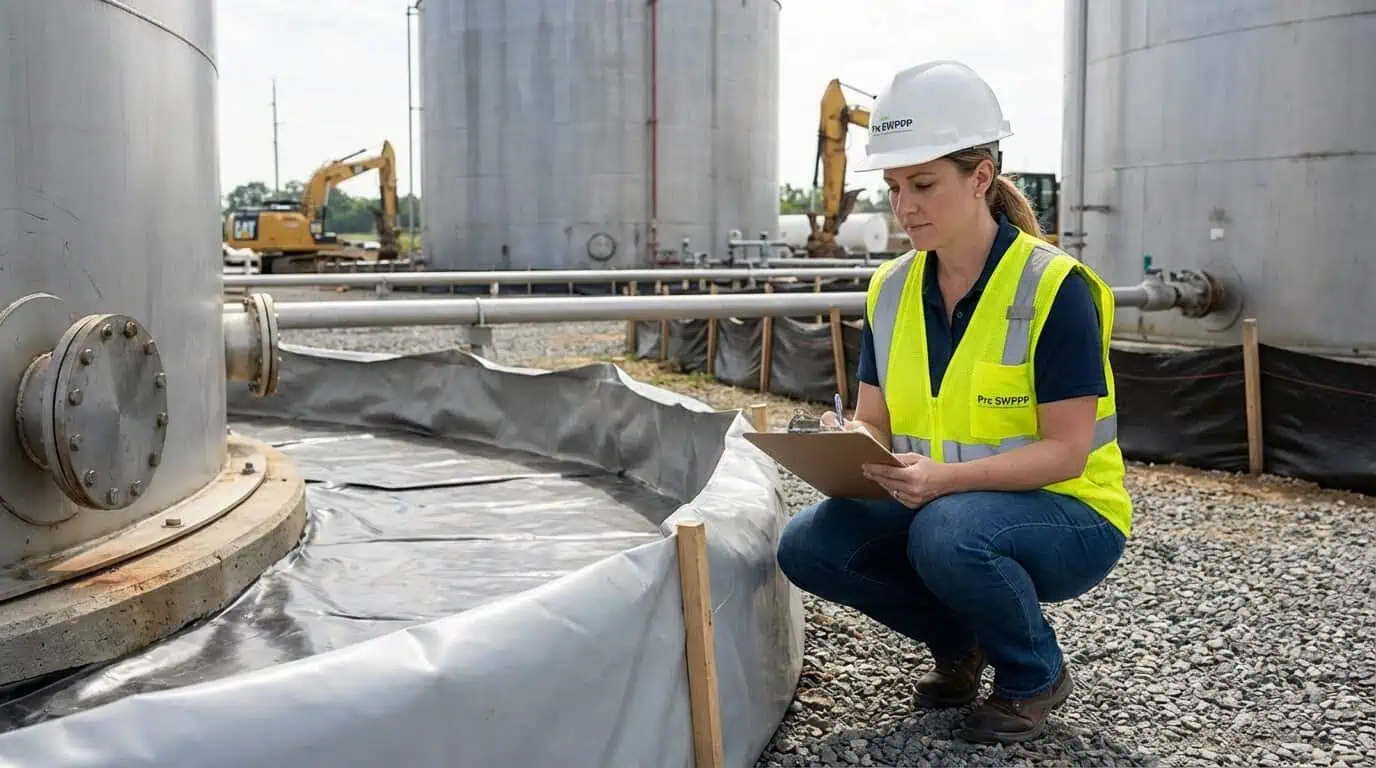
Step 2: Install BMPs That Actually Work. Containment berms around drums, covered storage for materials, oil-water separators, sediment basins, and regular sweeping all count. Best Management Practices are your first line of defense. Erosion Control and Sediment Control keep dirt and pollutants from washing away.
Step 3: Inspect Regularly. Walk your site every quarter (or after big storms). Check for leaks, spills, erosion, and clogged drains. Document everything with photos and notes.
Step 4: Monitor and Sample. Collect stormwater samples during discharge events. Test for pH, Total Suspended Solids (TSS), oil and grease, metals, and any sector-specific pollutants. Log results in EPA’s SMARTS database.
Step 5: Train Your Team. Your crew needs to know what BMPs are, how to spot problems, and who to call if something goes wrong. Training should happen at hire and annually.
Step 6: Fix Problems Fast. If you exceed a benchmark, don’t wait. Update your SWPPP, upgrade your BMPs, and file an ERA (Exceedance Report and Assessment) or AIM report as required.
Not sure what your project needs? Take our SWPPP Quiz or Schedule a Free SWPPP Consultation with CPESC Certified SWPPP Expert Derek E. Chinners.
Real-World Lessons: What Happens When You Don’t Comply
A California container terminal got hit with a $47,100 fine for a weak SWPPP and failed BMPs. They didn’t keep up with inspections, their controls weren’t working, and pollutants made it into the harbor. That’s a big check to write.
Law firms like Beveridge & Diamond have defended facilities in California citizen suits over MSGP violations. These lawsuits come from environmental groups that monitor discharge reports. If you’re out of compliance, you’re an easy target.
On the flip side, facilities that work with Pro SWPPP stay ahead of inspections and avoid fines. One Texas manufacturing plant updated its SWPPP and installed secondary containment around chemical storage. When the TCEQ inspector showed up, they passed without a single issue.
State Variations: Texas, Georgia, and Beyond
If you’re in a state with its own NPDES program, your permit might have a different name. In Texas, it’s the TXR050000 Multi-Sector General Permit, administered by the TCEQ. In Louisiana, it’s LAR050000. But the framework is the same: file an NOI, create a SWPPP, monitor, and report.
State permits often add extra layers. You might need to check for endangered species, historic sites, or coastal zones before you can get coverage. In Georgia, the EPD has its own forms and deadlines. The Construction General Permit (CGP) is separate from the MSGP, but the principles are the same: control stormwater, protect waterways, and document everything.
Common Mistakes and How to Avoid Them
Here are the top mistakes companies make with the MSGP:
- Filing the NOI but never updating the SWPPP
- Copying a SWPPP from another site without customizing it
- Skipping inspections after storms
- Ignoring benchmark exceedances and hoping they go away
- Not training new employees on stormwater rules
- Assuming “no exposure” means you don’t need to do anything (you still need to certify)
The fix? Work with experts. Pro SWPPP handles SWPPPs, NOIs, sampling, reporting, and inspections for industrial clients nationwide. You focus on running your business. We keep you compliant.
Emerging Trends: PFAS, 6PPD-Quinone, and Stricter Limits
The EPA is watching PFAS closely. These “forever chemicals” are in firefighting foam, coatings, and manufacturing processes. The 2026 permit requires indicator monitoring (no action levels yet), but expect numeric limits in the next revision.
6PPD-quinone, a tire additive that’s toxic to salmon, is also under review. If your facility stores tires, recycles rubber, or has heavy truck traffic, you might face new monitoring requirements.
Technology is helping too. New sampling equipment, real-time sensors, and data platforms make it easier to track discharge quality and catch problems early. Some facilities are using Low Impact Development (LID) techniques like tree wells, modular wetlands, and porous pavers to treat stormwater on-site.
How Pro SWPPP Makes Compliance Easy
Let’s be honest: you didn’t start your business to become a stormwater expert. You want to make products, move goods, and grow. That’s where Pro SWPPP comes in. We handle the hard stuff so you don’t have to.
We’ve worked with over 4,000 facilities across the country. From timber yards in New Hampshire to recycling centers in New Mexico, we know the MSGP inside and out. Our CPESC-certified team builds custom SWPPPs, files NOIs, conducts inspections, collects samples, and manages reporting in the SMARTS database.
We also train your staff, respond to exceedances, and update your plan when rules change. You get a single point of contact who knows your site and your permit. No surprises. No scrambling when the inspector shows up. Just peace of mind.
Action Steps to Get Compliant Now
Here’s what you should do today:
- Check if your facility is covered under the MSGP (look up your SIC or NAICS code)
- Find out if EPA or your state is the permitting authority
- Review your current SWPPP (or create one if you don’t have it)
- Schedule a site inspection to identify gaps
- Set up a monitoring and sampling schedule
- Train your team on spill response and BMP maintenance
- Mark deadlines for NOI renewal and SMARTS reporting
If that list feels long, we get it. That’s why companies hire Pro SWPPP. We do the heavy lifting. You stay focused on your core work.
Want to learn more? Contact us for a free consultation. Or check out the EPA’s stormwater guidance for more background.
Common Questions
What is the difference between the MSGP and the Construction General Permit?
The MSGP covers existing industrial operations like factories, warehouses, and landfills. The Construction General Permit (CGP) covers land disturbance and building projects. If you’re an industrial site doing construction, you might need both permits at the same time.
How long does MSGP coverage last?
The MSGP runs for five years. The 2021 MSGP expired February 28, 2026, and because EPA did not reissue it in time it has been administratively continued under 40 CFR 122.6. If you held coverage before that date, it continues automatically: you do not need to amend or re-file your NOI, and your facility’s status in NeT-MSGP has already switched to “Admin. Continued.” Once EPA issues the final 2026 permit, existing operators will have 90 days from its effective date to submit a new NOI.
Can I write my own SWPPP or do I need a professional?
You can write your own SWPPP, but it needs to meet all permit requirements. Most companies hire a Certified Professional in Erosion and Sediment Control (CPESC) to make sure nothing is missed. A bad SWPPP can lead to fines, exceedances, and failed inspections.
What happens if I exceed a benchmark?
If you exceed a benchmark, you must complete an Exceedance Report and Assessment (ERA) and update your SWPPP within 60 days. If you exceed again, you may need to complete a Level 1 or Level 2 AIM inspection and report. Repeated exceedances can trigger enforcement action.
Do I need to monitor for PFAS under the 2026 MSGP?
Yes. The 2026 permit requires indicator monitoring for 40 PFAS compounds using EPA Method 1633. There are no action levels yet, but the EPA is collecting data to set future limits. You’ll report PFAS results in the SMARTS database.
What is a No Exposure Certification and do I qualify?
A No Exposure Certification (NEC) means all industrial materials and activities are protected from rain and stormwater. If you qualify, you file an NEC instead of an NOI and skip the SWPPP. But you must maintain the certification and re-certify every five years. Any exposure voids the NEC and requires an NOI.
How much does it cost to stay compliant with the MSGP?
Costs vary by facility size, sector, and monitoring needs. A basic SWPPP might cost $2,000 to $5,000. Ongoing monitoring, sampling, and reporting can run $5,000 to $15,000 per year. Fines for non-compliance start at $10,000 per day, so investing in compliance is much cheaper than getting caught.
Pro SWPPP – America’s #1 SWPPP Service helps industrial facilities across the country stay compliant, avoid fines, and protect waterways. Visit Pro SWPPP to get started today.
A Quick Word About the 2026 MSGP 🏭
The 2026 MSGP brought new PFAS reporting, tightened benchmark thresholds, and the same NeT portal everyone loves to hate. Between NOI filing, sector determinations, and quarterly visual and analytical monitoring, the paperwork can outweigh the actual stormwater controls.
That’s the entire point of Pro SWPPP. We handle all of it — your industrial SWPPP, the permit filing, and the CPESC certification it requires — done in 72 hours, with 24-hour expedited turnaround when the clock’s against you. You build; we wrestle the bureaucracy.
Let the MSGP Be Our Problem, Not Yours.
Your industrial SWPPP, permit filing, and CPESC certification — done for you in 72 hours, 24-hour rush available, or it’s FREE.
✅ Order Your industrial SWPPP — The Easy Way →
📞 Talk to THE SWPPP Authority →
Schedule a call with Derek E. Chinners — Founder & Stormwater Consultant, CPESC · 833-GET-SWPPP