Pro SWPPP – America’s #1 SWPPP Service helps contractors across Hawaii stay compliant with state stormwater regulations. Hawaii’s unique environment demands strict pollution controls to protect its waters. If you’re planning construction or industrial work that disturbs one acre or more, you need a Storm Water Pollution Prevention Plan (SWPPP) before breaking ground. This guide walks you through everything Hawaii requires so you can avoid fines and keep your project moving.
Hawaii enforces both federal and state stormwater rules through the Clean Water Branch of the Department of Health. The state takes water quality seriously. Missing a step in your permit application or inspection schedule can cost you thousands of dollars per day in penalties. Pro SWPPP has helped thousands of contractors get it right the first time.
Don’t want to mess with all the paperwork? Order your SWPPP now with Pro SWPPP Professional CPESC Certified SWPPP Services.
SWPPP Requirements in Hawaii: What You Need to Know
A SWPPP is your written plan for controlling stormwater runoff and preventing pollution during construction or industrial activities. Hawaii requires a detailed, site-specific SWPPP before you even submit your Notice of Intent (NOI) for permit coverage. You cannot start land-disturbing work without an approved permit and a finished SWPPP on site.
The Clean Water Branch administers Hawaii’s National Pollutant Discharge Elimination System (NPDES) program under Hawaii Administrative Rules (HAR) Chapter 11-55. These rules mirror federal standards but add state-specific requirements that make Hawaii’s program stricter than many mainland states. For example, you must have your SWPPP complete before you apply for coverage.
Pro SWPPP writes SWPPPs for construction and industrial sites across Hawaii every week. Our CPESC-certified experts know every rule in HAR 11-55 and can deliver a compliant plan in 72 hours. You get a plan that passes inspection and protects your project from costly delays.
Who Needs a SWPPP in Hawaii
You need a SWPPP if your project disturbs one acre or more of land. This includes construction sites, grading, excavation, demolition, and clearing. The one-acre threshold includes all phases of your project that add up to one acre, even if you’re only disturbing a quarter-acre at a time.
Industrial facilities also need SWPPPs if they discharge stormwater associated with specific industrial activities listed in federal regulations. Hawaii uses the same categories as 40 CFR §122.26(b)(14). Manufacturing plants, chemical storage facilities, and heavy equipment yards are common examples.
Smaller projects under one acre can still need a permit if they’re part of a larger common plan of development. If your quarter-acre lot is part of a 10-acre subdivision, you’re covered under the one-acre rule. Check with the Clean Water Branch if you’re unsure.
Key Differences in Hawaii
Hawaii’s program has a few twists that catch out-of-state contractors by surprise:
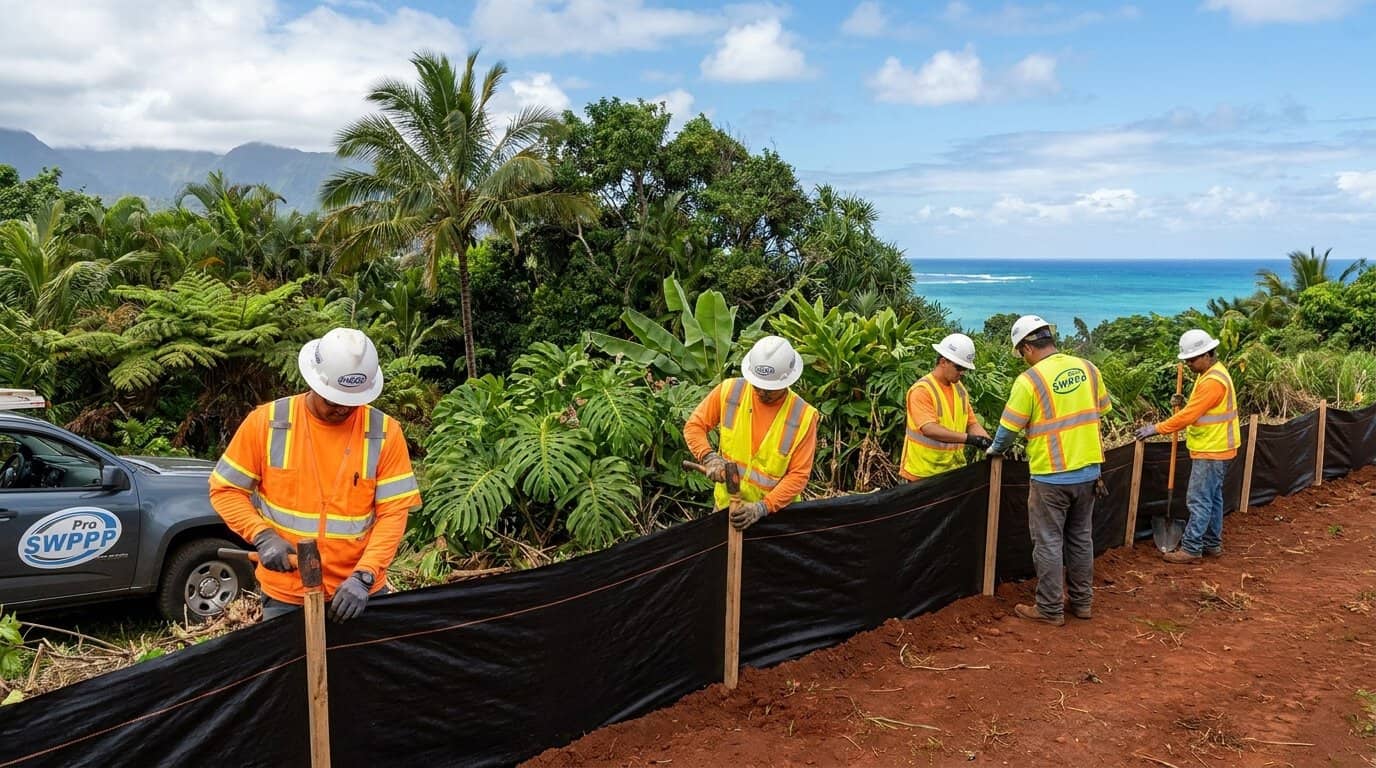
- You must prepare your SWPPP before submitting your NOI, not after.
- Discharges to sensitive waters (Class AA marine or Class 1 inland) require individual permits, not general permit coverage.
- Inspection frequencies are stricter in impaired waters, requiring weekly inspections plus storm event inspections.
- Pre-construction BMP inspections must be scheduled three weeks in advance with the Department of Health.
These rules mean you need to plan ahead. Waiting until the last minute can delay your project by weeks. Pro SWPPP helps contractors avoid these delays by preparing compliant SWPPPs fast.
Hawaii Stormwater Regulatory Framework
The Clean Water Branch (CWB) of the Hawaii Department of Health (DOH) runs the state’s NPDES program. Hawaii received delegation from the EPA to administer its own permit program under the federal Clean Water Act. That means Hawaii enforces both federal and state rules, with state rules filling in details the federal government leaves to each state.
Hawaii Administrative Rules Chapter 11-55 contains the state’s stormwater regulations. This chapter lists all the general permits, standard conditions, and specific requirements for construction and industrial discharges. Appendix C covers construction general permits, and Appendix B covers industrial general permits.
The CWB reviews NOIs, issues permits, conducts inspections, and enforces violations. They can deny permit coverage, issue stop-work orders, and pursue civil or criminal penalties for serious violations. Hawaii takes water quality seriously because the state’s economy and environment depend on clean oceans and streams.
Federal vs. State Rules
Federal regulations set the baseline for stormwater permits under 40 CFR Part 122. Hawaii adopts these rules and adds state-specific requirements in HAR 11-55. For example, federal rules require a SWPPP, but Hawaii specifies that you must complete it before submitting your NOI.
Hawaii also has stricter triggers for individual permits. If your site discharges to Class AA marine waters or Class 1 inland waters, you cannot use the construction general permit. You must apply for an individual permit with site-specific limits and monitoring.
Another difference is inspection frequency. Hawaii requires weekly inspections or a combination of biweekly and post-storm inspections. The state also requires signed reports within 48 hours of each inspection. These details go beyond what the EPA requires in most states.
For more on federal stormwater rules, visit the EPA NPDES stormwater page.
Construction General Permit (CGP) in Hawaii
Hawaii’s Construction General Permit covers stormwater discharges from construction activities that disturb one acre or more. The permit is found in HAR 11-55, Appendix C. You apply for coverage by submitting a Notice of Intent (NOI) to the Clean Water Branch, but only after you have a complete SWPPP ready.
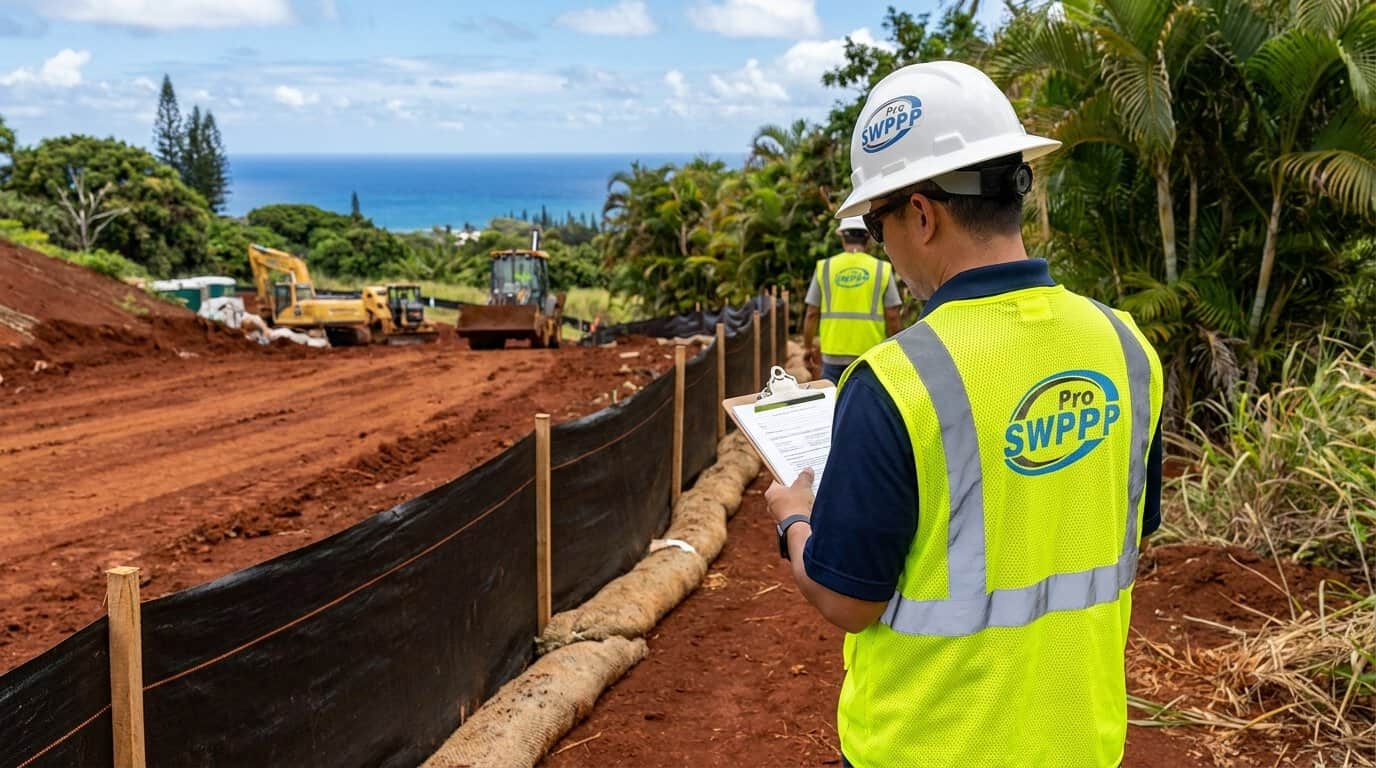
The CGP requires you to install and maintain Best Management Practices (BMPs) to control erosion, sediment, and other pollutants. Your SWPPP must describe these BMPs in detail, including site maps, construction schedules, and inspection checklists. The plan must be on site before you start disturbing soil.
Pro SWPPP prepares construction SWPPPs for projects across Hawaii every week. We know what the Clean Water Branch looks for and deliver plans that pass review the first time. Our 72-hour turnaround keeps your project on schedule.
Who Must File for a CGP
Any construction activity that disturbs one acre or more of land requires CGP coverage. This includes:
- New building construction and site development.
- Grading, excavation, and earthwork.
- Demolition and clearing.
- Road and highway construction.
- Utility installation and trenching.
If your project is part of a larger common plan of development that totals one acre or more, you need coverage even if your individual phase is smaller. For example, building one home in a five-home subdivision requires a permit if the total disturbance exceeds one acre.
Contractors are usually responsible for obtaining the CGP, but owners and developers share liability. Make sure you know who is filing the NOI before work begins. Pro SWPPP can guide you through the process and ensure the right party gets coverage.
Permit Thresholds and Exemptions
Projects under one acre generally do not need a CGP unless they’re part of a larger plan. Hawaii does not offer a waiver for small sites the way some states do. If you hit the one-acre threshold, you need a permit.
Some sites may qualify for a Conditional No Exposure Exclusion if they can demonstrate that no industrial materials or activities are exposed to stormwater. This is rare for construction sites but common for certain industrial facilities. You still need to apply for the exclusion and document your controls.
If your site discharges to sensitive waters, you cannot use the CGP. You must apply for an individual permit. Sensitive waters include Class AA marine waters and Class 1 inland waters. The Clean Water Branch maintains a list of these waters on their website.
Pre-NOI SWPPP Requirement
Hawaii requires you to prepare a complete SWPPP before submitting your NOI. This is different from many states where you can submit the NOI first and finalize the SWPPP later. Failure to have a SWPPP ready can result in denial of coverage and enforcement action.
Your SWPPP must include site maps, construction schedules, BMP descriptions, and inspection procedures. The Clean Water Branch does not review your SWPPP before issuing coverage, but inspectors will check it during site visits. If your plan is incomplete or inaccurate, you can face penalties.
Pro SWPPP takes the guesswork out of SWPPP preparation. We write site-specific plans that meet HAR 11-55 requirements and include all the maps, checklists, and schedules Hawaii inspectors expect to see. You get peace of mind and a plan that works.
Industrial Stormwater Permits in Hawaii
Industrial facilities that discharge stormwater associated with industrial activity need coverage under Hawaii’s Industrial General Permit (HAR 11-55, Appendix B). This includes facilities in categories listed in 40 CFR §122.26(b)(14), such as manufacturing, chemical storage, scrap yards, and heavy equipment facilities.
The Industrial General Permit requires a site-specific SWPPP that identifies potential pollutant sources, describes control measures, and establishes inspection and monitoring procedures. You must update your SWPPP annually and whenever site conditions change.
Some facilities may qualify for a Conditional No Exposure Exclusion if they can demonstrate that no industrial materials or activities are exposed to stormwater. This requires documentation and certification. If you qualify, you avoid the need for permit coverage, but you must renew the exclusion periodically.
Who Needs Industrial Permit Coverage
Facilities in the following categories typically need industrial stormwater permits:
- Manufacturing plants and processing facilities.
- Chemical storage and distribution.
- Scrap yards and recycling centers.
- Heavy equipment storage and maintenance yards.
- Transportation facilities with outdoor material handling.
If your facility stores raw materials, chemicals, or waste outdoors where stormwater can contact them, you likely need a permit. The Clean Water Branch provides a full list of industrial categories on their website. Check your SIC code to see if you’re covered.
Pro SWPPP prepares industrial SWPPPs for facilities across Hawaii. We assess your site, identify pollutant sources, and design control measures that meet HAR 11-55 standards. Our plans help you avoid violations and protect Hawaii’s waters.
No Exposure Exclusion
Hawaii offers a Conditional No Exposure Exclusion for industrial facilities that can prove no exposure of industrial materials to stormwater. To qualify, all materials, equipment, and activities must be indoors or under cover. You cannot have any outdoor storage or loading areas exposed to rain.
Applying for the exclusion requires submitting a certification form and supporting documentation. The Clean Water Branch reviews your application and may request additional information or an inspection. If approved, you avoid the need for permit coverage, but you must maintain no exposure conditions and recertify periodically.
Not sure if you qualify? Schedule a Free SWPPP Consultation with CPESC Certified SWPPP Expert Derek E. Chinners.
Required BMPs for Hawaii Construction Sites
Best Management Practices (BMPs) are the controls you use to prevent stormwater pollution. Hawaii requires site-specific BMPs tailored to your project’s soil, slope, weather, and construction phases. Your SWPPP must describe each BMP, show locations on a site map, and include installation and maintenance instructions.
Hawaii’s climate and topography make erosion control especially important. Tropical rainstorms can produce intense runoff in minutes. Steep slopes and volcanic soils can erode quickly. Your BMPs must be designed for Hawaii’s conditions, not copied from a mainland template.
Pro SWPPP designs BMP plans for Hawaii construction sites every day. We know what works in tropical weather and steep terrain. Our plans include detailed maps, maintenance schedules, and inspection checklists that keep you compliant.
Erosion Control BMPs
Erosion control BMPs prevent soil from detaching and moving off site. Common erosion control measures in Hawaii include:
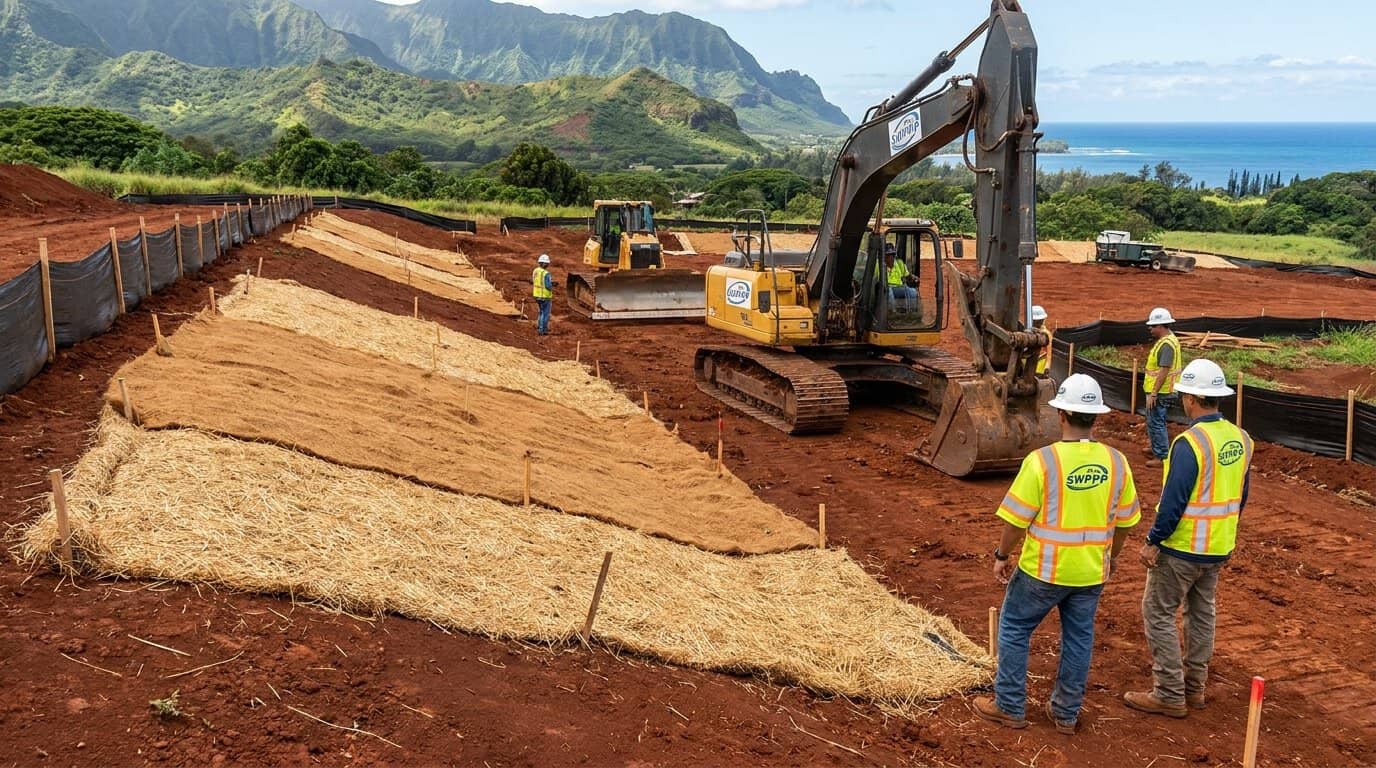
- Mulch and erosion control blankets on disturbed slopes.
- Temporary and permanent seeding to stabilize soil.
- Surface roughening and terracing on steep slopes.
- Diversion berms and swales to redirect runoff.
- Vegetative buffers around sensitive areas.
You must install erosion controls as soon as an area is disturbed and maintain them throughout construction. Hawaii’s frequent rain means you cannot wait days between grading and stabilization. Install BMPs immediately or you’ll lose soil and face violations.
Sediment Control BMPs
Sediment control BMPs trap soil that has already eroded before it leaves your site. Common sediment control measures include:
- Silt fences along the downslope perimeter.
- Sediment basins and traps to capture runoff.
- Check dams in swales and drainage channels.
- Inlet protection on storm drains and culverts.
- Construction entrance/exit stabilization to prevent tracking.
Sediment controls must be inspected weekly and after every storm. Silt fences need to be cleaned or replaced when sediment builds up to one-third the fence height. Sediment basins must be dredged when they lose storage capacity. Regular maintenance is required by your permit.
Additional Pollutant Controls
Hawaii requires controls for pollutants beyond sediment. Your SWPPP must address:
- Construction materials and waste stored under cover or with secondary containment.
- Fuel, oil, and chemical storage in designated areas with spill kits.
- Concrete washout areas away from storm drains.
- Portable toilet servicing and waste disposal.
- Vehicle and equipment maintenance in controlled areas.
Any spill must be cleaned immediately and reported to the Clean Water Branch if it reaches waters of the state. Your SWPPP must include spill response procedures and contact information for emergency response.
State-Specific BMP Requirements
Hawaii mandates pre-construction BMP inspections for certain projects. You must schedule the inspection three weeks in advance with the Department of Health. The inspector verifies that BMPs are installed correctly before you start land-disturbing work.
Hawaii Department of Transportation projects use a Site-Specific Construction BMP Plan or SWPPP template. These templates include additional details required for highway and harbor projects. Check with your agency contact to see if a specific template applies to your project.
Your SWPPP must include a construction schedule, site plans, all required permits, inspection checklists, and BMP maintenance schedules. The plan must be updated whenever site conditions change or new BMPs are added. Keep the current version on site at all times.
SWPPP Inspection Requirements in Hawaii
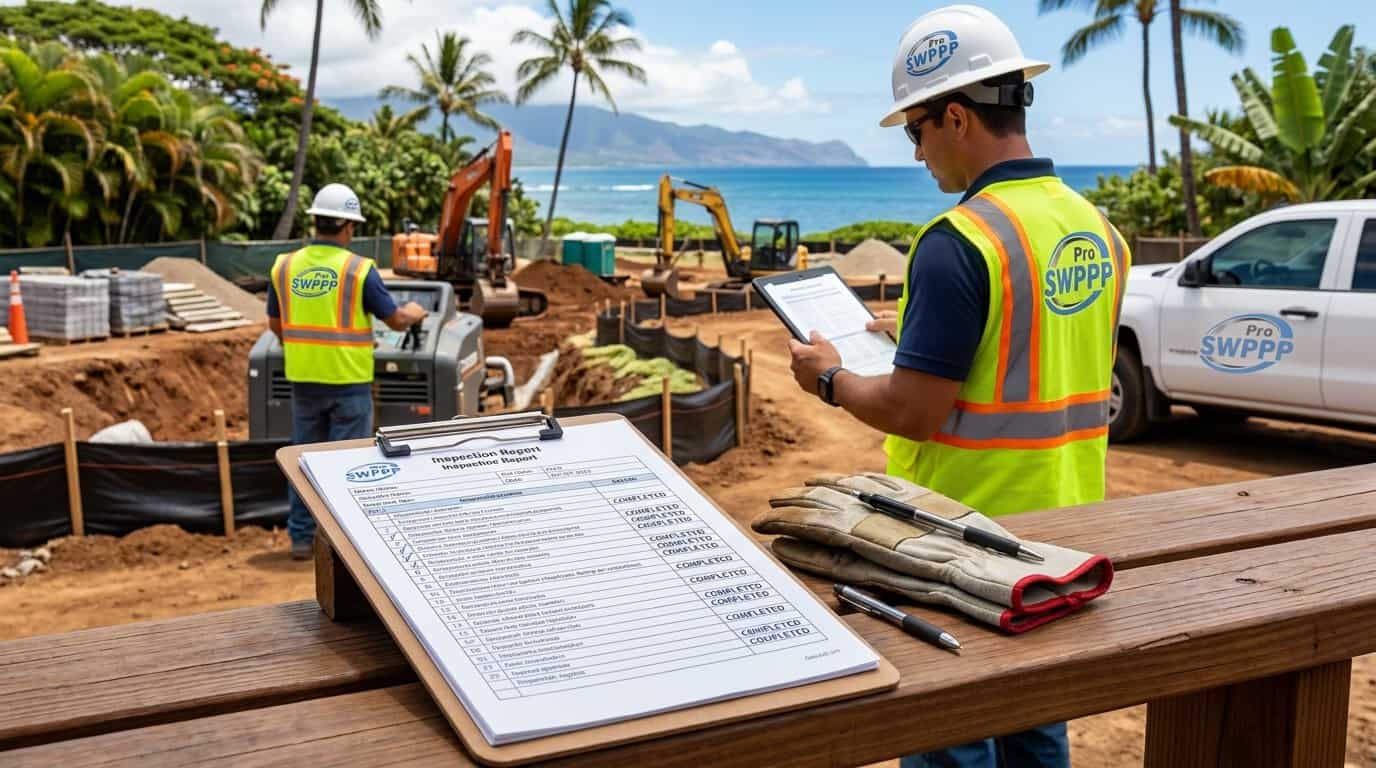
Hawaii requires regular inspections of your BMPs and discharge points. Inspection frequency depends on your site’s risk level and whether you discharge to impaired waters. You must document every inspection in a written report signed by a qualified person within 48 hours.
Inspections must cover all BMPs, discharge points, and areas where pollutants could enter stormwater. You must identify problems, document corrective actions, and verify that repairs are completed. Keep inspection reports on site and available for review by the Clean Water Branch.
Pro SWPPP provides inspection services across Hawaii. Our CPESC-certified inspectors know what to look for and document findings clearly. We help you stay compliant and catch problems before they become violations.
Standard Inspection Frequency
For most construction sites, Hawaii requires inspections at least once every seven calendar days. You can choose a weekly schedule or inspect every 14 days plus within 24 hours of any storm event that produces 0.25 inches or more of rain.
The biweekly-plus-storm option works well for sites with consistent BMP maintenance. If you choose this option, you must monitor rainfall and inspect within 24 hours after a qualifying storm ends. Keep rainfall records on site to prove compliance.
Weekly inspections are simpler to schedule and easier to document. Many contractors prefer the seven-day schedule because it’s predictable. Choose the schedule that fits your project and document your choice in your SWPPP.
Enhanced Inspection for Impaired Waters
Sites that discharge to impaired waters must inspect every seven days plus within 24 hours of any storm event producing 0.25 inches or more. This means you cannot use the biweekly option. You must inspect weekly and after every qualifying storm.
Once your site is stabilized and final BMPs are in place, you can reduce inspections to once per month. Stabilization means all disturbed areas have permanent cover and no more land disturbance is planned. Document stabilization in your inspection reports.
Impaired waters are listed on Hawaii’s 303(d) list. Check the Clean Water Branch website to see if your receiving waters are impaired. If you’re unsure, assume enhanced inspection requirements apply to avoid violations.
Pre-Construction BMP Inspection
Hawaii requires a pre-construction BMP inspection for certain projects before you begin land-disturbing activities. You must schedule the inspection at least three weeks in advance with the Department of Health. The inspector verifies that erosion and sediment controls are installed correctly and that your SWPPP is on site.
Missing this inspection can delay your project by weeks. Plan ahead and contact the Clean Water Branch as soon as your BMPs are installed. Have your SWPPP, site maps, and construction schedule ready for the inspector’s review.
Pro SWPPP helps contractors prepare for pre-construction inspections. We review your BMP installation, organize your documentation, and ensure everything is ready before the inspector arrives. Our preparation saves you time and prevents surprises.
Inspection Documentation
Every inspection must be documented in a written report completed within 48 hours. The report must be signed by the person who conducted the inspection and include:
- Inspection date and time.
- Weather conditions and recent rainfall.
- Condition of all BMPs and discharge points.
- Any problems identified and corrective actions taken.
- Photos of problem areas and completed repairs.
Keep inspection reports on site and organized chronologically. The Clean Water Branch can request reports during site visits or audits. Missing or incomplete reports can result in penalties even if your BMPs are working correctly.
Qualified Inspector Requirements
Hawaii requires inspections to be conducted by a qualified person with knowledge of stormwater controls and the ability to assess BMP effectiveness. The person does not need to be CPESC-certified, but they must have training and experience in erosion and sediment control.
Many contractors designate a site superintendent or foreman as the qualified inspector. Provide training on BMP inspection, report writing, and corrective actions. Document the inspector’s qualifications in your SWPPP and update the information if the inspector changes.
For industrial sites, inspections must be conducted by a qualified stormwater pollution prevention team. The team must include at least one person with expertise in industrial processes and stormwater controls. Document team members and their qualifications in your SWPPP.
Enforcement and Penalties in Hawaii
The Clean Water Branch enforces stormwater violations through inspections, notices of violation, administrative orders, and civil or criminal penalties. Hawaii takes enforcement seriously because water quality is critical to the state’s economy and environment. Violations can result in fines, stop-work orders, and project delays.
Common violations include starting work without permit coverage, failing to install BMPs, missing inspections, and allowing sediment to discharge off site. Each violation can result in penalties of thousands of dollars per day. Repeated violations or serious pollution events can lead to criminal prosecution.
Pro SWPPP helps contractors avoid violations by preparing compliant SWPPPs and conducting thorough inspections. Our plans include all required elements, and our inspectors catch problems before they become enforcement actions. Prevention is cheaper than penalties.
Types of Violations
The most common stormwater violations in Hawaii include:
- Disturbing land without permit coverage or an approved SWPPP.
- Failing to install or maintain BMPs as described in the SWPPP.
- Missing required inspections or failing to document corrective actions.
- Discharging sediment or other pollutants to waters of the state.
- Failing to update the SWPPP when site conditions change.
Starting work without a SWPPP is one of the most serious violations. Hawaii requires the SWPPP to be complete before you submit your NOI. If you start work without an approved permit and SWPPP on site, the Clean Water Branch can pursue criminal enforcement.
Penalty Ranges
Civil penalties for stormwater violations can reach thousands of dollars per day per violation. The Clean Water Branch calculates penalties based on the severity of the violation, harm to water quality, economic benefit gained by non-compliance, and the violator’s compliance history.
Missing inspections can result in daily penalties for each day the inspection was not conducted. Discharging sediment off site can result in separate penalties for each discharge event. Penalties add up quickly when violations continue over weeks or months.
Criminal penalties apply to willful violations that threaten public health or the environment. These can include fines and imprisonment. While criminal prosecution is rare, it has been pursued for egregious cases involving repeated violations or major pollution events.
Stop-Work Orders
The Clean Water Branch can issue stop-work orders for serious violations. A stop-work order halts all land-disturbing activities until you correct the violation and demonstrate compliance. This can delay your project by weeks or months and result in significant financial losses.
Stop-work orders are most common when contractors start work without permit coverage, fail to install BMPs, or cause significant off-site discharges. The order remains in effect until the Clean Water Branch verifies that corrective actions are complete and BMPs are functioning.
Avoiding stop-work orders is simple: get your permit before you start, install BMPs as planned, and conduct inspections on schedule. Pro SWPPP helps contractors stay ahead of compliance requirements so work never stops.
Enforcement History
Detailed enforcement statistics for Hawaii are not widely published, but the Clean Water Branch conducts regular inspections and pursues enforcement actions for non-compliance. Contractors who fail to obtain permits or maintain BMPs face notices of violation and penalties.
The Department of Health encourages voluntary compliance through education and outreach. They provide guidance documents, templates, and workshops to help contractors understand their obligations. However, the agency does not hesitate to enforce when voluntary compliance fails.
Pro SWPPP keeps up with Hawaii enforcement trends and regulatory updates. We know what inspectors look for and help contractors avoid common mistakes. Our clients stay compliant and avoid the stress of enforcement actions.
How to File Your NOI in Hawaii
Filing your Notice of Intent (NOI) is the first step to obtaining permit coverage in Hawaii. You must complete your SWPPP before submitting the NOI. Once your SWPPP is ready, you submit the NOI to the Clean Water Branch using the CWB Individual NPDES Form. Coverage begins when the Department of Health approves your NOI, not when you submit it.
The NOI process is straightforward if you follow the steps and prepare your documents correctly. Missing information or submitting before your SWPPP is complete can result in denial and delay your project. Pro SWPPP handles NOI submissions for contractors across Hawaii and ensures everything is correct the first time.
Step-by-Step NOI Filing Process
Follow these steps to file your NOI in Hawaii:
- Step 1: Prepare a complete, site-specific SWPPP following HAR 11-55, Appendix C. Include site maps, construction schedules, BMP descriptions, and inspection procedures.
- Step 2: Install initial BMPs such as perimeter silt fencing, inlet protection, and construction entrance stabilization.
- Step 3: Complete the CWB Individual NPDES Form. Provide accurate project information, site location, receiving waters, and operator details.
- Step 4: Submit the NOI electronically to the Clean Water Branch. If required, follow up with a hard copy within seven days.
- Step 5: Wait for approval from the Department of Health. Coverage begins when you receive approval, not when you submit the NOI.
- Step 6: Keep a copy of the approved NOI and your SWPPP on site at all times.
Do not start land-disturbing activities until you receive approval. Starting work without coverage is a serious violation that can result in penalties and stop-work orders. Plan ahead and allow time for the approval process.
Required Forms and Information
Hawaii uses the CWB Individual NPDES Form for NOI submissions. The form requires the following information:
- Project name, location, and total acres to be disturbed.
- Operator contact information, including name, address, phone, and email.
- Description of construction activities and project phases.
- Receiving waters and outfall locations.
- Certification that a SWPPP has been prepared and will be on site before work begins.
You must provide accurate coordinates for your site and outfalls. Use GPS or online mapping tools to determine latitude and longitude. Incorrect coordinates can delay approval or result in permit coverage that does not match your site.
If you’re adding disturbance areas to an existing project, you must update your SWPPP first and then submit a new NOI specifying your prior coverage. The Clean Water Branch will link the new coverage to your existing permit.
Online Filing Portal
Hawaii accepts NOI submissions electronically through the Clean Water Branch website. Visit health.hawaii.gov/cwb to access the NOI form and submission instructions. Electronic submission is faster and provides confirmation that your NOI was received.
Some submissions may require a hard copy follow-up within seven days. Check the instructions on the Clean Water Branch website to see if a hard copy is needed for your project. Mail hard copies to the address listed on the form.
Keep a copy of your submitted NOI and the approval letter in your project files. Inspectors will ask to see these documents during site visits. Having them organized and ready saves time and demonstrates professionalism.
Approval Timeline
The Clean Water Branch reviews NOIs and issues approvals within a few weeks under normal circumstances. The timeline can vary depending on the complexity of your project and the Branch’s workload. Allow at least three weeks from submission to approval when planning your project schedule.
If your NOI is incomplete or your SWPPP is not ready, the Branch will deny coverage and request corrections. This can delay your project by weeks or months. Submit a complete NOI with a finished SWPPP to avoid delays.
Pro SWPPP prepares SWPPPs and submits NOIs for contractors across Hawaii. We ensure all information is accurate and complete before submission. Our clients get approvals faster and avoid frustrating back-and-forth with the regulators.
Why Pro SWPPP is Hawaii’s Best SWPPP Service
Pro SWPPP – America’s #1 SWPPP Service has been helping contractors across Hawaii and 30+ states for over 15 years. Our CPESC-certified experts know Hawaii’s stormwater rules inside and out. We deliver compliant SWPPPs in 72 hours so your project stays on schedule.
We’ve prepared thousands of SWPPPs for construction and industrial sites. Our clients trust us because we get it right the first time. No guesswork, no delays, no violations. Just a solid plan that keeps you compliant and protects Hawaii’s waters.
Choosing Pro SWPPP means you get a CPESC-certified expert who understands Hawaii’s unique climate, terrain, and regulations. We know what works in tropical rainstorms and steep volcanic soils. Our plans include detailed maps, maintenance schedules, and inspection checklists tailored to your site.
CPESC Certification and Expertise
Our lead expert, Derek E. Chinners, is a Certified Professional in Erosion and Sediment Control (CPESC). This certification is the gold standard for stormwater professionals. It means Derek has passed rigorous exams and maintains continuing education to stay current on best practices and regulations.
CPESC certification is not required to prepare a SWPPP in Hawaii, but it makes a difference. Certified professionals understand the science behind erosion control, know how to design effective BMPs, and can troubleshoot problems before they become violations. You get a plan that works, not just a document that checks boxes.
Pro SWPPP’s team has worked on projects across Hawaii, from Oahu to the Big Island. We understand local conditions and know what inspectors expect. Our experience gives you confidence that your SWPPP will pass review and keep you compliant.
72-Hour Turnaround
Construction schedules are tight. Waiting weeks for a SWPPP can delay your project and cost you money. Pro SWPPP delivers compliant SWPPPs in 72 hours or less. We know you need your plan fast, and we deliver without cutting corners.
Our 72-hour turnaround includes a complete SWPPP with site maps, BMP descriptions, inspection checklists, and maintenance schedules. We review your project details, assess your site, and design BMPs that meet HAR 11-55 requirements. You get a finished plan ready to submit with your NOI.
Fast turnaround does not mean low quality. Every Pro SWPPP plan is reviewed by a CPESC-certified expert before delivery. We catch mistakes before they reach your site and ensure every detail is accurate. You get a plan you can trust.
Nationwide Experience, Local Knowledge
Pro SWPPP works in 30+ states, giving us a deep understanding of how different states enforce stormwater rules. We’ve seen what works and what doesn’t across the country. This experience helps us prepare better plans for Hawaii contractors.
Hawaii’s rules are unique, but they share common principles with other states. Our experience in places like Texas and Georgia gives us insight into effective BMP design and inspection procedures. We bring best practices from across the nation to every Hawaii project.
At the same time, we know Hawaii is different. The climate, soil, and water quality concerns are unique. We design BMPs that work in tropical rainstorms and steep terrain. Our plans reflect Hawaii’s conditions, not generic templates copied from the mainland.
Full-Service Support
Pro SWPPP offers more than just SWPPP preparation. We provide full-service stormwater support, including:
- SWPPP preparation for construction and industrial sites.
- NOI filing and permit application assistance.
- On-site BMP inspections and reporting.
- SWPPP updates and amendments when site conditions change.
- Training for site staff on BMP maintenance and inspection procedures.
- Compliance audits to identify and fix problems before inspectors find them.
We’re with you from project start to final stabilization. Need an inspector? We’ve got you covered. Need to update your SWPPP for a new phase? We handle it. Need training for your crew? We provide it. One call gets you everything you need to stay compliant.
Visit our about page to learn more about our team and services. Or contact us to discuss your project.
FAQ
Do I need a SWPPP in Hawaii if my project is under one acre?
Generally, no. Hawaii requires a SWPPP for construction projects that disturb one acre or more. However, if your smaller project is part of a larger common plan of development that totals one acre or more, you need a SWPPP. For example, building one home in a five-home subdivision may require coverage if the total disturbance exceeds one acre. Check with the Clean Water Branch if you’re unsure.
Can I start construction before my NOI is approved?
No. Hawaii requires you to wait for approval from the Clean Water Branch before starting land-disturbing activities. Coverage begins when the Department of Health approves your NOI, not when you submit it. Starting work without coverage is a serious violation that can result in penalties and stop-work orders. Plan ahead and allow time for the approval process.
How often do I need to inspect my BMPs in Hawaii?
Most construction sites must inspect at least once every seven calendar days. You can choose to inspect every 14 days plus within 24 hours of any storm event producing 0.25 inches or more of rain. Sites that discharge to impaired waters must inspect every seven days plus within 24 hours of qualifying storms. Industrial sites typically inspect monthly, with more frequent inspections during discharge periods. Document every inspection in a signed report within 48 hours.
What happens if I miss an inspection?
Missing an inspection is a violation of your permit. The Clean Water Branch can issue a notice of violation and assess daily penalties for each missed inspection. Penalties can reach thousands of dollars per day. If you miss an inspection, conduct it as soon as possible and document the reason for the delay in your report. Contact the Clean Water Branch if you have questions about making up missed inspections.
Do I need an individual permit if my site discharges to the ocean?
It depends on the classification of the receiving waters. If your site discharges to Class AA marine waters, you cannot use the construction general permit and must apply for an individual permit. Class AA waters are Hawaii’s highest quality waters and receive extra protection. Check the Clean Water Branch website or contact the agency to determine the classification of your receiving waters.
Can Pro SWPPP handle my industrial facility’s SWPPP?
Yes. Pro SWPPP prepares SWPPPs for both construction and industrial sites. We assess your facility, identify pollutant sources, and design control measures that meet HAR 11-55, Appendix B requirements. Our plans help you stay compliant and avoid violations. We also provide inspection services and SWPPP updates as your operations change.
How long does it take to get a SWPPP from Pro SWPPP?
Pro SWPPP delivers compliant SWPPPs in 72 hours or less. We review your project details, design site-specific BMPs, and prepare a complete plan with maps, schedules, and checklists. Our fast turnaround keeps your project on schedule without sacrificing quality. Every plan is reviewed by a CPESC-certified expert before delivery.
Ready to get started? Order your SWPPP now or schedule a free consultation with Pro SWPPP.
Visit Pro SWPPP and see why thousands of contractors trust America’s #1 SWPPP Service.
Stop Babysitting Hawaii’s Stormwater Paperwork
Here’s the open secret of construction stormwater compliance: every state and county runs its own version of the same headache — a clunky permit portal, a Notice of Intent that has to be filed just so, fees, inspection logs, and a review team that loves bouncing things back “with revisions.” Hawaii is no exception. You didn’t get into construction to moonlight as a stormwater clerk at 9 PM.
That’s the entire point of Pro SWPPP. We handle all of it — your Hawaii SWPPP, the permit filing, and the CPESC certification it requires — done in 72 hours, with 24-hour expedited turnaround when the clock’s against you. You break ground; we wrestle the bureaucracy.
Skip the Paperwork. Get Back to Your Build.
Your Hawaii SWPPP, permit filing, and CPESC certification — done for you in 72 hours, 24-hour rush available, or it’s FREE.
✅ Order Your Hawaii SWPPP — The Easy Way →
📞 Talk to THE SWPPP Authority →
Schedule a call with Derek E. Chinners — Founder & Stormwater Consultant, CPESC · 833-GET-SWPPP