Pro SWPPP – America’s #1 SWPPP Service makes construction stormwater compliance simple. If you’re building in Dallas or Fort Worth, you need to know whether you need a SWPPP, an NOI, or both. Let’s break it down in plain English.
Most contractors get confused by stormwater rules. The state says one thing. The city says another. You just want to dig dirt and build your project. But if you skip the paperwork, you get fined. If you do the wrong paperwork, you get fined. This guide clears up the confusion so you can stay legal and avoid headaches.
The Quick Answer: Who Needs What?
Here’s the bottom line. If you disturb one acre or more of land in the Dallas Fort Worth area, you need a SWPPP. That’s a Stormwater Pollution Prevention Plan. It doesn’t matter if you’re in Dallas proper, Fort Worth, Plano, Arlington, or any suburb. The rule is the same across Texas.
If you disturb five acres or more, you also need to file a Notice of Intent with the Texas Commission on Environmental Quality. That’s the NOI. You file it through their online system called STEERS at least 48 hours before you start work.
So the trigger is simple:
- One acre or more: You need a SWPPP and a Construction Site Notice posted on your site.
- Five acres or more: You need a SWPPP, an NOI filed with TCEQ, and a Large Construction Site Notice posted on your site.
- Less than one acre: You usually don’t need a SWPPP unless your project is part of a larger plan that adds up to one acre or more.
That last point trips up a lot of builders. If you’re doing a half-acre lot but it’s part of a 50-lot subdivision, you still need a SWPPP. The state looks at the whole plan, not just your piece.
Why Dallas and Fort Worth Add Extra Steps
Texas runs its stormwater program under the federal Clean Water Act and the NPDES permit system. The state calls it the Construction General Permit, or CGP. But Dallas and Fort Worth are both Municipal Separate Storm Sewer Systems, or MS4s. That means they have their own local rules on top of the state rules.
In Dallas, you submit your SWPPP documentation to Dallas Stormwater Services. They review it through something called the Stormwater Development Review Committee. Expect extra questions about your Best Management Practices, your drainage analysis, and how you’re protecting the existing storm drains. This review can take two to four weeks if your plans aren’t complete.
Fort Worth requires a local stormwater construction permit for most projects over one acre. You deal with Public Works and Environmental Management. They want detailed erosion control designs, inspection logs, and sometimes monthly reports. The city can issue its own violations even if TCEQ hasn’t said anything yet.
Don’t want to mess with all the paperwork and requirements? Check out Order your SWPPP now with Pro SWPPP Professional CPESC Certified SWPPP Services.
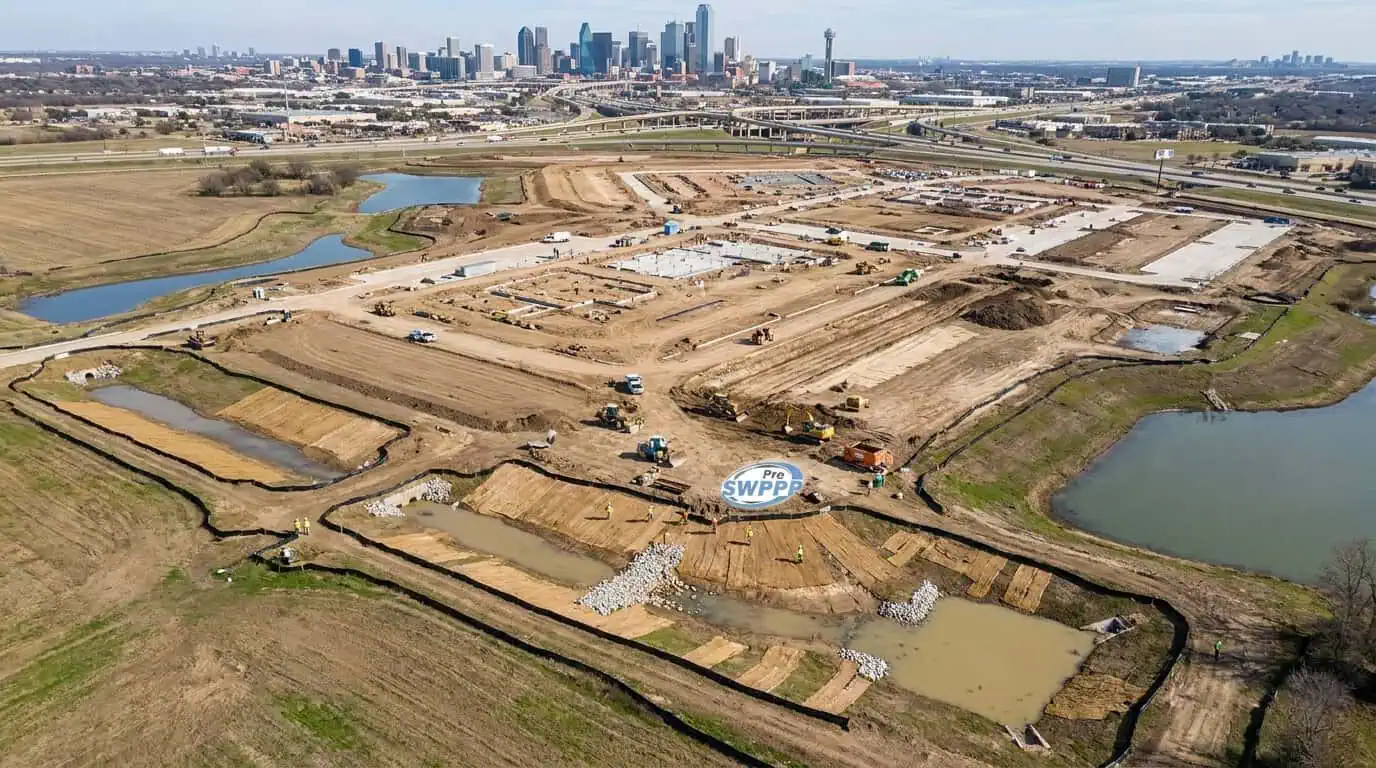
Beyond city submittals, most Metroplex municipalities have adopted the integrated Stormwater Management (iSWM) criteria developed by the North Central Texas Council of Governments (NCTCOG). iSWM sets regional standards for construction-phase erosion control, drainage, and water-quality protection, so your Texas SWPPP and on-site BMPs must line up with both the TCEQ Construction General Permit (TXR150000) and the local iSWM manual your city enforces.
What Goes in a SWPPP for DFW?
Your SWPPP is not a one-page form. It’s a real plan. TCEQ and the cities want to see specific things.
Site Maps and Descriptions
You need a map showing your limits of disturbance, the topography, soil types, and where water flows. Mark your storm drains, creeks, ponds, and any wetlands. Show where your sediment will go and where it absolutely cannot go.
Best Management Practices
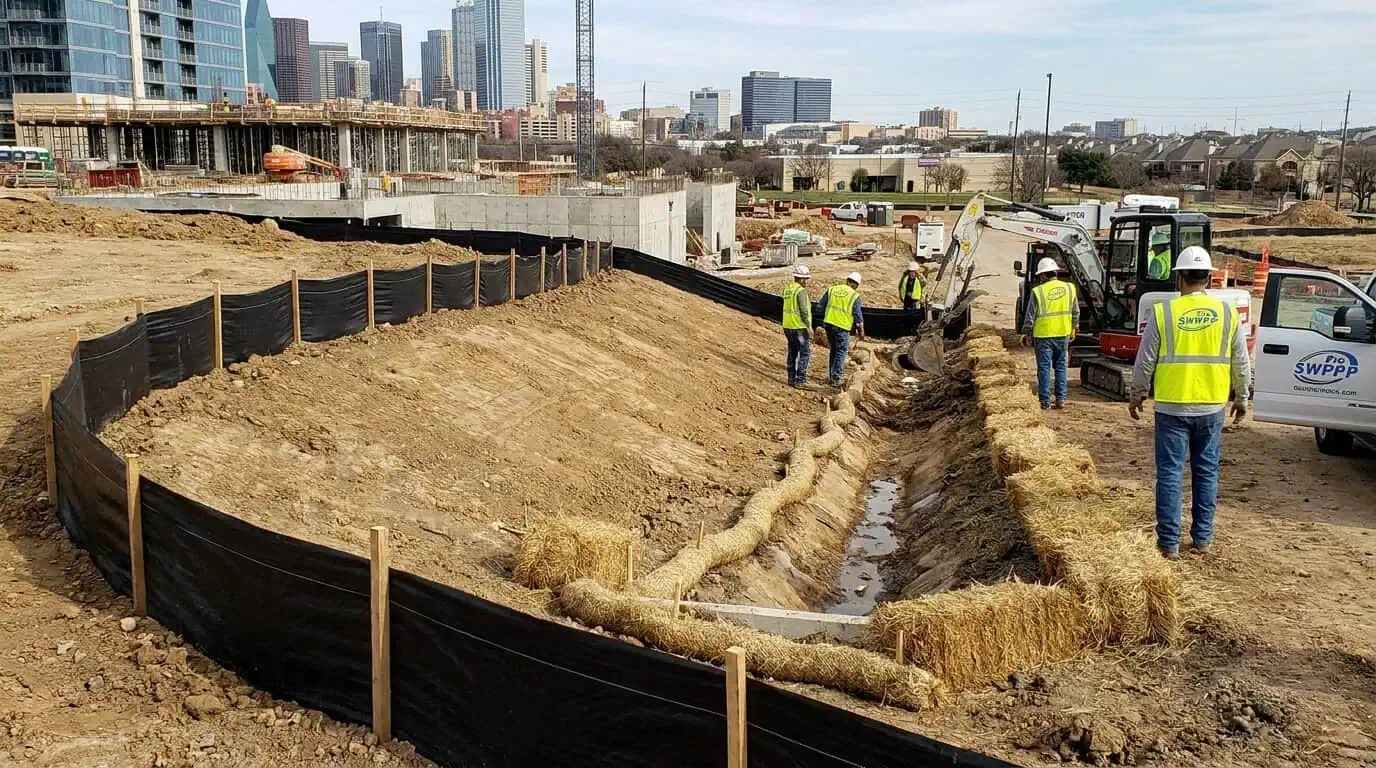
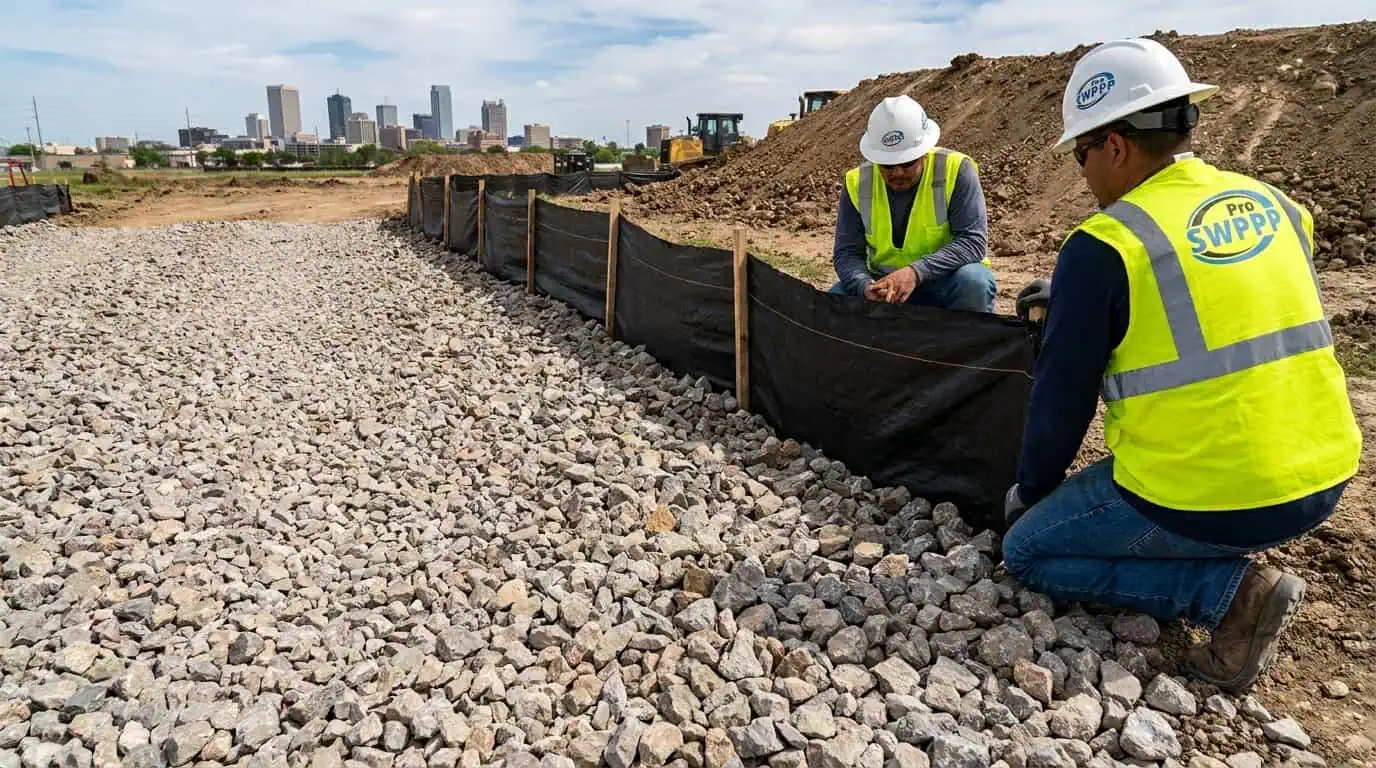
BMPs are your erosion and sediment controls. Think silt fence, stabilized construction entrances, inlet protection, and sediment basins. Your SWPPP must explain which BMPs you’ll use and where you’ll put them. Generic templates don’t cut it. Inspectors compare your plan to what’s actually installed on the ground.
Construction Sequencing
You can’t clear the whole site at once and let it sit bare for months. Your SWPPP must show how you’ll phase the work, minimize disturbed areas, and stabilize sections as you finish them. TCEQ wants inactive areas stabilized within 14 days. Areas near creeks or ponds must be stabilized within seven days.
Inspection Schedule
You pick one of two inspection schedules:
- Inspect at least once every seven days, or
- Inspect once every 14 days plus within 24 hours after any storm that drops half an inch or more of rain.
You must document what you see. Generic notes like “looks good” or “all BMPs in place” are now red flags for enforcement. Inspectors want specifics: which BMPs you checked, what condition they’re in, any problems, and what you fixed with dates.
Spill Prevention and Waste Management
Your SWPPP must cover how you handle fuel, oil, concrete washout, paints, and other chemicals. You need a plan for spills and a way to keep trash and construction waste out of the storm drains.
Roles and Responsibilities
Who’s in charge? The owner, the general contractor, and any subcontractors all need clear written roles. This is critical on subdivisions where you have a developer, a site contractor, and individual lot builders. If nobody knows who maintains the silt fence, it doesn’t get maintained and everyone gets cited.
Common Mistakes That Get DFW Contractors in Trouble
Here are the top mistakes we see at Pro SWPPP:
- Thinking the NOI is the only requirement: The NOI is just a notice you file. The SWPPP is the actual plan. You need both if you’re over five acres. You still need the SWPPP even if you’re between one and five acres and don’t file an NOI.
- Treating the SWPPP like a binder on a shelf: Your SWPPP must be updated when things change. If you shift your phasing or move a sediment basin, update the plan. Inspectors look at your current site and compare it to your current SWPPP. If they don’t match, that’s a violation.
- Skipping the local review: Contractors design for state minimums and get surprised when Dallas or Fort Worth kicks back their plans. Budget time for local reviews and be ready to add more controls than you planned.
- Waiting too long to stabilize: You can’t leave dirt bare for months. The 14-day and seven-day stabilization rules are real. Seed, mulch, or cover it. Permanent grass doesn’t count as stabilized until it hits 70 percent cover.
- Installing BMPs after grading starts: Silt fence and construction entrances must go in before you move dirt. Inspectors cite this all the time.
Not sure what your project needs? Take our SWPPP Quiz or Schedule a Free SWPPP Consultation with CPESC Certified SWPPP Expert Derek E. Chinners.
How to Stay Compliant Without Losing Your Mind
Stormwater compliance doesn’t have to slow you down. Here’s how smart contractors handle it:
Start Early
Don’t wait until you’re ready to dig to think about stormwater. Start your SWPPP and local permit applications during the design phase. This gives you time to handle review comments without delaying your dirt work.
Use Certified Help
Pro SWPPP – America’s #1 SWPPP Service employs CPESC certified professionals who know TCEQ rules and local DFW requirements. We write SWPPPs that pass review the first time. We know what Dallas and Fort Worth inspectors look for. We can also handle your inspections if you don’t have someone trained on staff.
Train Your Crews
Your field guys need to understand why BMPs matter, not just where to install them. When they know a silt fence stops sediment from reaching the creek, they take it seriously. When they think it’s just a box to check, they cut corners.
Keep Good Records
Take photos during inspections. Log every repair and every storm. Keep rainfall data if you’re on the 14-day-plus-storm schedule. TCEQ and local MS4s can audit you anytime during construction and for three years after you close out the permit. Good records protect you.
Update as You Go
If your phasing changes or you add a new outfall, update your SWPPP right away. Mark it on your site map. Tell your inspector. This keeps you legal and shows good faith if a problem comes up.
What Happens If You Skip It?
Penalties for stormwater violations add up fast. TCEQ can fine you. Dallas or Fort Worth can issue stop-work orders. If sediment leaves your site and damages a neighbor’s property or a stream, you’re liable. Insurance often won’t cover stormwater fines because they’re considered regulatory penalties, not accidents.
Beyond fines, violations delay your project. You have to stop work, fix the problem, update your SWPPP, and wait for approval to restart. That costs more than doing it right the first time.
Why Pro SWPPP Is the Best Choice for DFW Projects
Pro SWPPP – America’s #1 SWPPP Service has helped thousands of contractors in Texas stay compliant. We know the TCEQ Construction General Permit inside and out. We know how Dallas reviews plans. We know what Fort Worth expects in a local permit application. We’ve seen every type of project from small infill lots to massive subdivisions.
When you order your SWPPP from us, you get a plan written by a Certified Professional in Erosion and Sediment Control. You get site-specific BMPs that match your soil, your slope, and your drainage. You get a plan that passes city and state review without endless back-and-forth. And you get support during construction if questions come up.
We also offer inspection services. If you don’t have someone on staff who knows how to document a proper stormwater inspection, we’ll do it for you. Our inspectors know what to look for and how to write reports that satisfy TCEQ and local MS4s.
Learn more about Pro SWPPP and see why contractors across the country trust us. We work in Georgia, Texas, and many other states. Stormwater rules vary by location, but our expertise travels.
What’s Changing in 2025 and Beyond?
Enforcement is getting stricter. TCEQ and local MS4s are tired of seeing sediment in creeks and generic inspection logs. They’re focusing on real-world performance. Does your silt fence actually stop sediment? Are your stabilization timelines realistic? Is your SWPPP up to date or three phases behind?
More cities in the DFW Metroplex are adding local requirements. Some are talking about triggers below one acre for sensitive watersheds. Digital tools are becoming the norm. Cloud-based SWPPP platforms and mobile inspection apps make it easier to keep records current and accessible.
The bottom line: stormwater compliance is not getting easier. But with the right partner, it doesn’t have to slow you down.
FAQ
Do I need a SWPPP in Texas?
Yes, if you disturb one acre or more of land, or if your project is part of a larger common plan that adds up to one acre or more. This applies statewide, including all cities in the Dallas Fort Worth area.
What’s the difference between a SWPPP and an NOI?
A SWPPP is your pollution prevention plan. An NOI is a notice you file with TCEQ to get coverage under the Construction General Permit. Projects over five acres need both. Projects between one and five acres need a SWPPP and a Construction Site Notice but usually no NOI unless they’re part of a larger plan.
Does Dallas have different rules than the state?
Dallas follows state law but adds local review and submittal requirements. You must submit your SWPPP to Dallas Stormwater Services and go through their Development Review Committee. Fort Worth has similar local processes.
How long does it take to get a SWPPP approved in DFW?
State TCEQ coverage is automatic once you file your NOI, but local city reviews in Dallas or Fort Worth can take two to four weeks or more if your plans need revisions. Start early.
Can I write my own SWPPP?
Legally, yes. Practically, it’s risky. Most contractors don’t know the latest TCEQ rules, local requirements, or how to size BMPs correctly. A bad SWPPP leads to violations and delays. Pro SWPPP – America’s #1 SWPPP Service writes plans that pass review and keep you legal.
What happens if I don’t file an NOI?
If you’re over five acres and don’t file, you’re in violation of the Clean Water Act and state law. TCEQ can fine you and make you stop work until you comply. The same goes for not having a SWPPP when you need one.
How often do I have to inspect my site?
You choose one schedule: inspect every seven days, or inspect every 14 days plus within 24 hours after any rain event of half an inch or more. Document everything you see.
What’s a Construction Site Notice?
It’s a sign you post on your site that lists your project info, the permit you’re under, and contact information for the responsible party. Small projects (one to five acres) post a Small Construction Site Notice. Large projects (five acres or more) post a Large Construction Site Notice and the first page of their NOI.
Do I need a SWPPP for a half-acre lot in a subdivision?
If the subdivision as a whole is one acre or more, yes. The state looks at the entire common plan of development, not just your individual lot. The subdivision SWPPP should define who’s responsible for BMPs on each lot.
Can Pro SWPPP help with inspections?
Absolutely. We offer inspection services across Texas and other states. Our certified inspectors know what to document and how to keep you compliant. Contact us to learn more.
Ready to get started? Order your SWPPP now or schedule a free consultation with Pro SWPPP.
Visit Pro SWPPP and see why thousands of contractors trust America’s #1 SWPPP Service.
Do I Need a SWPPP in Dallas-Fort Worth?
If your project disturbs one acre or more of land anywhere in the Dallas-Fort Worth Metroplex—or less than an acre but part of a larger common plan of development—you need a SWPPP and coverage under the TCEQ TPDES Construction General Permit (TXR150000). This applies to commercial builds, residential subdivisions, roadway work, and utility projects across Dallas, Tarrant, Collin, Denton, and surrounding counties. On top of the state permit, Dallas and Fort Worth each enforce their own MS4 stormwater rules, so most DFW sites carry both a state and a local obligation.
How to Get Compliant: SWPPP + NOI
Getting compliant in DFW follows three core steps. First, have a CPESC-certified professional prepare a site-specific SWPPP that maps your BMPs, drainage, and construction sequencing. Second, file your Notice of Intent (NOI) for the Construction General Permit through the TCEQ STEERS electronic system and post your site notice before any earth-disturbing work begins. Third, keep the plan live on site: inspect every seven calendar days and within 24 hours of any rain event of 0.5 inches or more, and document every inspection and correction. Need the NOI walkthrough? See our complete guide to the Notice of Intent.
Get Your Dallas-Fort Worth SWPPP in 72 Hours
Get a TCEQ-compliant, CPESC-certified SWPPP for your Dallas-Fort Worth project in 72 hours—or it’s free.
Order Your SWPPP Now Schedule a Free Consultation
Derek E. Chinners — Founder & Stormwater Consultant, CPESC · 833-GET-SWPPP
Related SWPPP Compliance Resources
- Texas SWPPP Requirements: Statewide Compliance Guide
- TCEQ SWPPP Requirements & Construction General Permit
- Bexar County SWPPP Requirements
- What Is a Notice of Intent (NOI) for Construction?
- What Is a SWPPP?
Need a SWPPP for a Dallas project? Pro SWPPP writes CPESC-certified Stormwater Pollution Prevention Plans for Dallas and Dallas County construction sites — delivered in 72 hours or it’s free.