
Colorado does not call it a SWPPP. Construction disturbing 1 acre or more in Colorado Springs needs a Stormwater Management Plan (SWMP) under CDPHE construction general permit COR400000, plus city grading and erosion control approval from the Colorado Springs Stormwater Enterprise. The SWMP must be written before the state permit application is submitted.
That terminology difference matters on paperwork. A document titled SWPPP is not automatically rejected, but Colorado permit conditions, city checklists, and inspector language all reference the Stormwater Management Plan, and the two documents are not built from identical outlines.
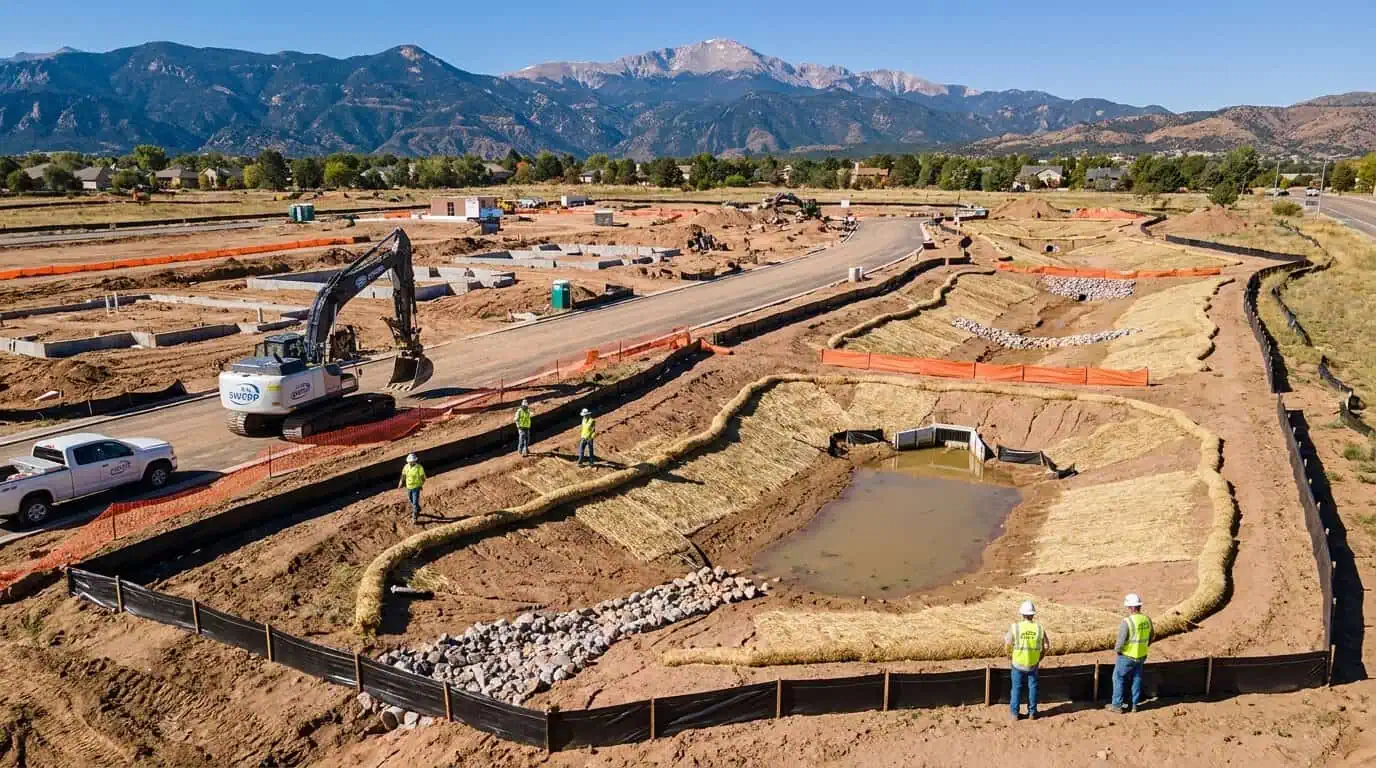
What is a Stormwater Management Plan, and how is it different from a SWPPP?
A SWMP is the site-specific document required by the Colorado Discharge Permit System construction general permit. It identifies every potential pollutant source on the site, the control measures selected for each one, the phasing and sequencing of those controls, the inspection and maintenance schedule, and the person responsible for each task.
Functionally it does the same job a SWPPP does in Texas or Florida, but the outline follows Colorado permit structure: potential pollutant sources, site description, control measures, final stabilization criteria, inspection procedures, and SWMP administrator. The Colorado Department of Public Health and Environment Water Quality Control Division administers the program.
The SWMP is a living document. Colorado requires it to be kept current with actual site conditions and amended whenever control measures, phasing, or the responsible party change. Pro SWPPP prepares that documentation; physical installation of BMPs is handled by your site contractor.
Not sure if you even need one?
Answer a few questions about your site and find out in under two minutes.
Who needs a SWMP and a state permit in Colorado Springs?
State coverage under permit COR400000 is required for construction that disturbs 1 acre or more, and for any smaller parcel that is part of a larger common plan of development or sale totaling 1 acre or more. A 0.5-acre lot inside a 5-acre subdivision is covered, because the acreage is counted across the whole plan.
CDPHE asks that the permit application be submitted at least 10 calendar days before construction begins, and the SWMP has to be complete when the application goes in. Land disturbance cannot start until the certification is issued.
Below 1 acre, the state permit generally does not apply, but the City of Colorado Springs can still require erosion and sediment control and a local plan through its grading permit process. Sub-acre does not mean control-free. For the statewide picture, see our Colorado 1-acre requirements guide.
What does the City of Colorado Springs require on top of the state permit?
The state permit and the city approval are two separate obligations. The City of Colorado Springs Stormwater Enterprise operates under its own MS4 permit and enforces the City Engineering Criteria and Drainage Criteria Manual, which govern grading, erosion control, and permanent water quality facilities.
City review applies the Four Step Process for water quality: reduce runoff volume, treat the water quality capture volume, stabilize drainageways, and implement long-term source controls. That framework shapes site design before a single control measure is specified.
Enforcement is not theoretical. A federal settlement resolved United States and State of Colorado claims over the city’s MS4 program in 2019, and the city tightened its construction site inspection and illicit discharge enforcement afterward. City code prohibits any non-stormwater discharge to the municipal storm sewer system.
| Item | State: CDPHE permit COR400000 | City: Colorado Springs Stormwater Enterprise |
|---|---|---|
| Trigger | 1 acre or more disturbed, or part of a 1-acre common plan | Grading and erosion control required below 1 acre at city discretion |
| Core document | Stormwater Management Plan (SWMP) | Grading and erosion control plan per City Engineering Criteria |
| Design framework | Control measures selected for identified pollutant sources | Four Step Process, including water quality capture volume treatment |
| Ends when | Final stabilization at 70 percent of pre-disturbance vegetative cover, then inactivation notice | Never fully: permanent facilities carry a recorded maintenance agreement |
How often must a Colorado construction site be inspected, and what does it cost?
Permit COR400000 requires site inspections at least once every 7 calendar days. The permit also allows a reduced schedule of at least once every 14 calendar days combined with a post-storm inspection within 24 hours after the end of any precipitation or snowmelt event that causes surface erosion.
Every inspection is documented: date, inspector, weather, condition of each control measure, deficiencies found, and the corrective action with its completion date. Records stay with the SWMP and are available on site for review.
CDPHE charges an application fee and a recurring annual fee for construction stormwater certifications, set by the division’s current fee schedule rather than by the permit itself. Confirm the amount on the CDPHE Water Quality Control Division fee page before you budget, because the schedule is revised by statute periodically.
Just want a number first?
Tell us about your project and we will send a written estimate, no obligation.

When can you close out a Colorado construction stormwater permit?
Colorado sets a specific vegetative standard rather than a vague finish line. CDPHE’s construction general permit defines the endpoint this way: “Final stabilization is reached when all ground surface disturbing activities at the site have been completed, and uniform vegetative cover has been established with an individual plant density of at least 70 percent of pre-disturbance levels.” That language comes from the CDPHE construction stormwater general permit COR400000.
On the Front Range that 70 percent target is the schedule risk. Semi-arid conditions, short establishment windows, and a growing season that closes early mean seeding late in the year often leaves a site under permit through the following spring.
Once final stabilization is documented, the permittee submits an inactivation notice to CDPHE. Until that notice is accepted, inspection and reporting obligations continue and annual fees keep accruing.
What happens to permanent stormwater facilities after construction ends?
Colorado Springs requires permanent stormwater facilities to be inspected and maintained by the property owner in perpetuity. Detention ponds, filtration systems, and structural water quality facilities all stay on the owner’s books.
Projects permitted after June 4, 2008 must submit annual inspection and maintenance reports to the Stormwater Enterprise Manager by May 31 each year. The city records a maintenance agreement against the deed so that future owners inherit the obligation.
The annual report covers the condition of each permanent facility, sediment accumulation and damage, maintenance performed such as cleanout and re-vegetation, photographs, and certification by a qualified inspector or professional engineer. Missing the May 31 date is an enforcement trigger, not a formality.
Which control measures work best on Colorado Springs sites?
Steep foothill slopes, decomposed granite soils, and intense short-duration summer storms make Colorado Springs sites erode fast. These are the specifications a SWMP should call out for the contractor to build and maintain.
- Silt fence and sediment control logs at the perimeter and along contours, placed before clearing begins.
- Stabilized construction entrance sized to remove track-out before vehicles reach a public street.
- Inlet protection on every storm drain that could receive site runoff.
- Surface roughening and erosion control blankets on slopes, which matter more here than in flat states.
- Vegetated swales and detention sized for the water quality capture volume under the city’s Four Step Process.
- Temporary and permanent seeding planned around a short establishment window, so the 70 percent cover standard is achievable.
Physical installation of BMPs is handled by your site contractor. The SWMP defines what goes where, to what standard, when it is inspected, and who signs the record.

Why work with Pro SWPPP on a Colorado Springs project?
Pro SWPPP, LLC prepares construction stormwater documentation nationwide, led by Derek E. Chinners, CPESC. For Colorado projects the deliverable is a Colorado-structured SWMP: site description, pollutant source inventory, control measure narrative, phasing, site maps, inspection forms, and the CDPHE application package.
Plans are prepared by a Certified Professional in Erosion and Sediment Control and turned around in days rather than weeks, written so a superintendent can follow them without translation. Amendment support continues as phasing shifts.
Scope is deliberately narrow: Pro SWPPP is the paperwork, permitting, and inspection-documentation expert, and does not perform field construction or place control measures. Learn more on our About page or reach the team through Contact Us. We also serve contractors in Texas and Georgia.
Frequently asked questions about Colorado Springs stormwater management plans
Is a SWMP the same thing as a SWPPP?
They serve the same purpose, but Colorado uses the term Stormwater Management Plan. CDPHE permit COR400000 requires a SWMP built on the Colorado outline: pollutant source inventory, control measures, phasing, inspection procedures, and final stabilization criteria. Submitting a generic out-of-state SWPPP usually means rewriting sections to match Colorado permit structure.
Do I need a SWMP if my Colorado Springs project is under 1 acre?
The state permit generally applies at 1 acre or more, or at any size inside a common plan totaling 1 acre. Below that, the City of Colorado Springs can still require erosion and sediment control and a plan through its grading permit. Confirm with the Stormwater Enterprise before assuming an exemption.
How far in advance do I apply to CDPHE?
Submit the construction stormwater permit application at least 10 calendar days before construction begins, with the SWMP already complete. Land disturbance cannot start until CDPHE issues the certification. Building the schedule around a same-week approval is the most common cause of a delayed groundbreaking in Colorado.
How often do I have to inspect the site?
At least once every 7 calendar days under permit COR400000, or on the reduced schedule, once every 14 calendar days plus within 24 hours after the end of any precipitation or snowmelt event that causes surface erosion. Every inspection is documented with conditions, deficiencies, and corrective actions.
What does final stabilization mean in Colorado?
All ground disturbing activity is complete and uniform vegetative cover is established at an individual plant density of at least 70 percent of pre-disturbance levels. On Front Range sites with short growing seasons, reaching 70 percent frequently pushes permit closeout into the next spring, so plan seeding timing accordingly.
Do my obligations end when construction ends?
No. After the inactivation notice closes the state permit, Colorado Springs still requires permanent stormwater facilities to be maintained by the property owner. Projects permitted after June 4, 2008 file annual inspection and maintenance reports with the Stormwater Enterprise Manager by May 31 each year, and the obligation runs with the deed.
Does Pro SWPPP install control measures on my site?
No. Pro SWPPP prepares the documentation: the SWMP narrative, site maps, control measure specifications, CDPHE application package, and inspection forms. Physical installation of BMPs is handled by your site contractor. Keeping those roles separate keeps the plan objective and your compliance record clean.
Complicated site? Talk it through.
Speak directly with a CPESC-certified stormwater expert with 20+ years of experience.