Last verified: June 2026 against TCEQ (Texas Commission on Environmental Quality) and the U.S. EPA.
Pro SWPPP – America’s #1 SWPPP Service helps contractors every day figure out one big question: Do I need a SWPPP for my Austin construction project? If you’re moving dirt in Austin, you need to understand the rules. Miss them and you can get hit with fines, stop-work orders, and a lot of stress. This guide breaks down exactly when you need a SWPPP, when you need an NOI, and how to stay legal without losing your mind.
What Is a SWPPP and Why Does Austin Care?
A Stormwater Pollution Prevention Plan (SWPPP) is a written plan that shows how you will keep dirt, mud, and pollutants from washing off your construction site into streets, creeks, and storm drains. It’s required by the Clean Water Act and enforced by the Texas Commission on Environmental Quality (TCEQ) through the state’s Construction General Permit (CGP).
Austin sits on top of sensitive karst aquifers. Rain hits your site, picks up sediment, and can pollute water people drink and creeks people love. The city, Travis County, and state regulators all work together to make sure construction sites control runoff. If you disturb soil and don’t have the right permits and plans, you can be fined or shut down.
When Do You Need a SWPPP in Austin?
Here’s the simple rule: If your project disturbs one acre or more of soil, you need a SWPPP and TPDES permit coverage. That one-acre rule includes projects that are part of a larger common plan of development. So even if your lot is only half an acre, if it’s part of a 10-acre subdivision, you still need a SWPPP.
Travis County and the City of Austin follow the state rules but add local requirements on top. Even if you disturb less than one acre and aren’t part of a bigger plan, you still must use Best Management Practices (BMPs) to prevent runoff from hurting nearby properties and waterways. Think of it this way: state law sets the floor, local rules raise the bar.
What About Projects Under One Acre?
If you’re under one acre and not part of a larger plan, you don’t need a formal SWPPP or TPDES permit. But you still need erosion and sediment control measures. Travis County requires BMPs wherever needed to protect water quality. Many Austin projects use silt fences, rock berms, and inlet protection even on small sites. It’s smart and it keeps inspectors happy.
Also, if your project is in a sensitive watershed or near critical environmental features, local rules may be stricter. Some Austin watersheds have thresholds as low as 0.25 acres. Always check with city and county staff before you start. Pro SWPPP can help you figure out what applies to your site in minutes.
What Is an NOI and Do You Need One?
A Notice of Intent (NOI) is a form you file with TCEQ to get coverage under the Texas Construction General Permit. If your project disturbs five acres or more, you must file an NOI. For projects between one and five acres, you file a Construction Site Notice (CSN) instead of an NOI. Both tell the state you’re starting work and that you have a SWPPP in place.
Travis County ties these filings to its own permit process. If your project starts within 30 days of getting a county permit, you must give the county your CSN (and NOI if over five acres) before the county issues your final permit. If you start later, you must send the NOI at least seven days before you begin and the CSN at least two days before. Missing these deadlines can delay your whole job.
The City of Austin also requires you to send copies of your NOI and CSN to the city’s TPDES Coordinator in the Watershed Protection Department. This is part of the city’s MS4 (Municipal Separate Storm Sewer System) permit obligations. It’s not hard to do, but you must do it or you’re out of compliance.

What Goes Into a SWPPP for Austin Projects?
A good SWPPP is more than a binder that sits in a truck. It’s a working plan that tells everyone on site how to control erosion, manage sediment, and prevent pollution. Here’s what a compliant SWPPP includes:
- Site description with topography, soil types, drainage patterns, and nearby waterways
- Detailed site map showing construction areas, stockpiles, inlets, outfalls, and BMP locations
- List of erosion and sediment control BMPs you will use (silt fence, mulch, rock berms, inlet protection)
- Pollution prevention measures for trash, chemicals, fueling, concrete washout, and spill response
- Inspection and maintenance schedule with clear roles and responsibilities
- Documentation procedures for inspections, corrective actions, and plan updates
Travis County requires your SWPPP to be prepared by a Professional Engineer (PE) or Certified Professional in Erosion and Sediment Control (CPESC). This ensures the plan is based on real engineering and local knowledge, not just copied templates. Pro SWPPP uses CPESC-certified experts who know Austin’s soils, slopes, and storm patterns inside and out.
Common BMPs You’ll Use in Austin
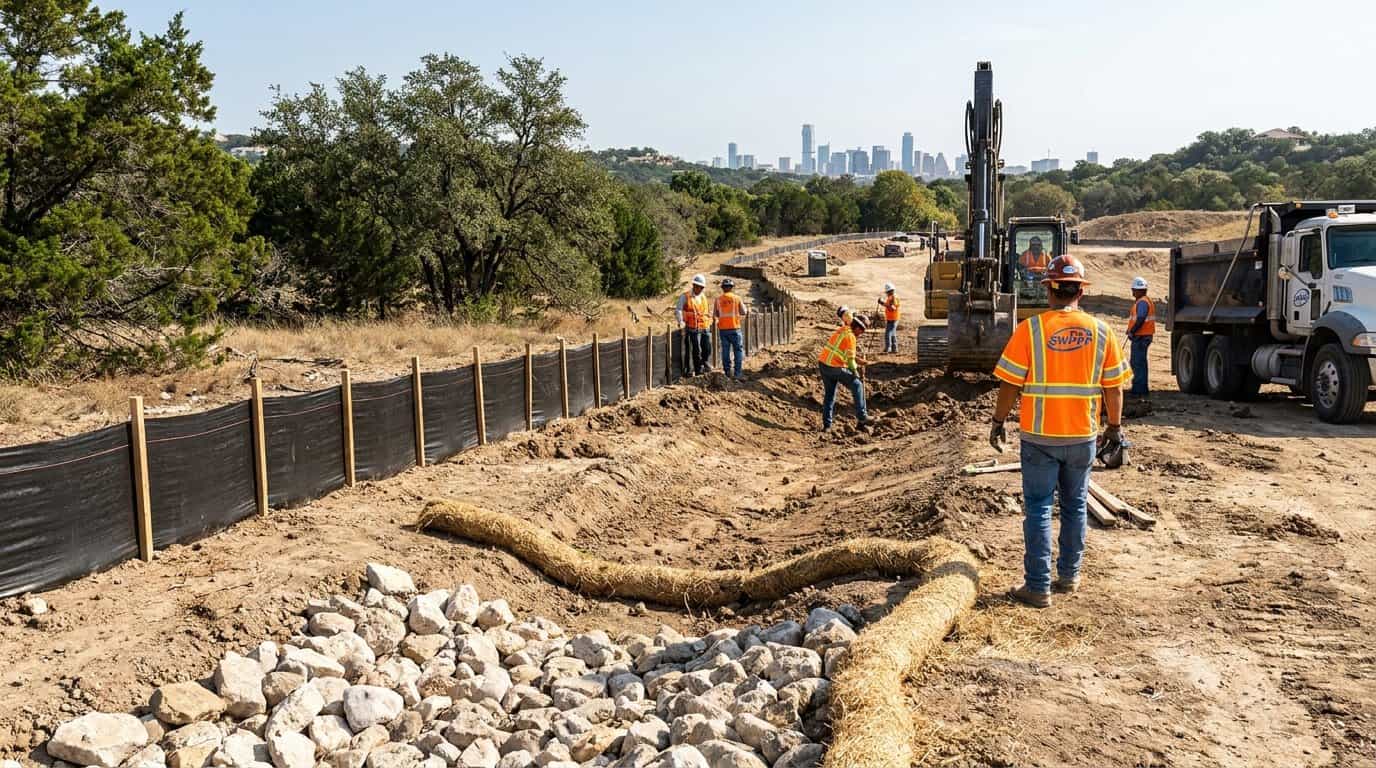
Austin projects typically use a combination of temporary and permanent controls. Temporary controls include silt fences, sediment basins, rock check dams, stabilized construction entrances, inlet protection, and concrete washout areas. Permanent controls include re-vegetation with native grasses, mulch blankets on slopes, and permanent landscaping around drainage structures.
Because Austin has intense but short storms, your BMPs need to handle big volumes fast. Undersized sediment basins or poorly anchored silt fences fail quickly. Smart contractors layer multiple controls and inspect them constantly.
Don’t want to mess with all the paperwork and requirements? Order your SWPPP now with Pro SWPPP and get a site-specific, PE or CPESC-certified plan ready in days.
Inspections and Maintenance: The Make-or-Break Part
Writing a SWPPP is step one. Keeping it working is step two. Texas and Travis County require inspections at least every seven days and within 24 hours after any rain event of half an inch or more. Most Austin contractors inspect weekly and after every significant storm to stay safe.
During inspections, a qualified person checks that all BMPs are installed correctly, working, and maintained. They look for erosion, sediment deposits, damaged silt fences, clogged inlets, and any signs of pollutants leaving the site. Every inspection must be documented with a signed report noting what was found and what was fixed.
Travis County and TCEQ enforce these inspection rules. If an inspector shows up and your silt fence is down, your washout area is overflowing, or you have no inspection logs, you can be cited on the spot. Keeping up with inspections and fixing problems fast is the single best way to avoid fines.
What Happens If You Fail an Inspection?
Violations can result in notices of violation (NOVs), stop-work orders, and penalties up to thousands of dollars per day. Common violations include failure to install BMPs, lack of a SWPPP on site, missing inspection records, and visible sediment discharges. The good news is most violations can be fixed quickly if you catch them early. The bad news is repeat violations or big sediment spills can lead to serious enforcement and bad publicity.

Austin-Specific Rules You Can’t Ignore
Austin is not like other cities. The city operates a regulated MS4 and must meet strict federal and state requirements for construction stormwater. That means tighter plan reviews, more inspections, and higher expectations for BMP performance. The city also has sensitive watersheds with extra protections.
If your project is in or near the Barton Springs zone, Edwards Aquifer recharge zone, or other critical areas, expect additional review and possibly more stringent controls. Always consult the city’s Watershed Protection Department early in your project. They can tell you what applies and save you from costly surprises later.
Travis County also has its own stormwater ordinance and SWP3 (Stormwater Pollution Prevention Plan) requirements that mirror but sometimes exceed state rules. For example, the county requires a PE or CPESC to prepare your plan and mandates specific submittal timelines tied to permit issuance. Missing these can delay your entire project schedule.
Who Can Perform SWPPP Inspections in Austin and Travis County?
Austin and Travis County require stormwater inspections to be performed by a qualified, certified inspector. Travis County recognizes the Certified Erosion, Sediment and Stormwater Inspector (CESSWI) credential for SWP3 inspections. Pro SWPPP performs every Austin and Travis County inspection with credentialed professionals — our CPESC (Certified Professional in Erosion and Sediment Control) inspectors meet and exceed the county certified-inspector requirement.
Under the TCEQ TPDES Construction General Permit (TXR150000), construction sites must be inspected at least once every 14 calendar days, and within 24 hours of the end of any rainfall event of 0.5 inches or greater. In the Barton Springs Zone and the Edwards Aquifer Recharge Zone, the City of Austin Watershed Protection Department and Travis County may require additional inspection and water-quality controls.
Travis County SWP3 Summary Checklist and MyPermitNow.org Submission
Beyond the TCEQ TXR150000 permit and your on-site SWPPP, Travis County requires a Storm Water Pollution Prevention Plan (SWP3) Summary for residential development permit applications. The completed SWP3 Summary is submitted in lieu of the full SWP3 document and uploaded to your MyPermitNow.org account, alongside your TCEQ and SWPPP paperwork.
The Travis County SWP3 Summary checklist captures:
- Property address and legal description (subdivision, lot, and block, or TCAD parcel)
- The on-site location where the SWP3 will be kept
- SWP3 type — new or existing — with the Construction Site Notice (CSN) or Notice of Intent (NOI) submission dates
- SWP3 Preparer name, position, and qualifications
- SWP3 Inspector name, position, and qualifications
- Estimated construction start and end dates
- Owner and Primary Operator authorized-representative contact information
Pro SWPPP prepares your SWPPP, completes the Travis County SWP3 Summary, files your CSN or NOI with TCEQ, and supplies the certified preparer and inspector credentials the form requires — so your MyPermitNow.org submission clears the first time.
Common Mistakes Austin Contractors Make
Even experienced crews make mistakes when it comes to stormwater. Here are the most common ones we see:
- Thinking “under one acre means no rules” – Even small sites need BMPs if runoff could impact neighbors or waterways.
- Using a generic SWPPP template – Austin’s karst geology, steep slopes, and intense storms require site-specific plans, not copy-paste documents.
- Installing BMPs once and forgetting them – Silt fences tear, inlets clog, and washout areas overflow. You must inspect and maintain constantly.
- Not updating the SWPPP as work changes – Your SWPPP is a living document. When you change phasing, move stockpiles, or add new areas, update your plan.
- Ignoring final stabilization – You can’t close out your permit until at least 70% of disturbed areas have permanent vegetation or other stabilization.
These mistakes lead to most enforcement actions. The fix is simple: plan well, inspect often, document everything, and update your SWPPP as needed. Pro SWPPP helps contractors avoid these pitfalls with clear plans, inspection checklists, and expert support throughout the project.
How Pro SWPPP Makes Austin Compliance Easy
Pro SWPPP specializes in Texas projects and knows Austin’s unique requirements inside and out. We prepare site-specific SWPPPs that meet TCEQ, Travis County, and City of Austin rules. Our plans are prepared by CPESC-certified professionals and licensed engineers, so they pass review the first time.
We also provide inspection training, digital documentation tools, and ongoing support. If an inspector shows up or you need to amend your plan mid-project, we’re a phone call away. We’ve helped thousands of contractors stay compliant, avoid fines, and finish on time.
Not sure what your project needs? Take our SWPPP Quiz or schedule a free SWPPP consultation with CPESC Certified SWPPP Expert Derek E. Chinners. We’ll review your site, explain your options, and give you a clear path forward.
What’s New in Austin Stormwater Compliance?
Austin’s stormwater program is getting more sophisticated every year. TCEQ now uses the STEERS online system for all NOIs and CSNs, making filings faster but also more visible. The city is pushing harder on post-construction controls and green infrastructure, so your SWPPP needs to think beyond just construction-phase BMPs.
Enforcement is also tightening around concrete washout, chemical storage, and spill response. Inspectors are looking for proper washout containment, spill kits, and covered dumpsters just as much as silt fences. Digital inspection apps and cloud-based SWPPP management are becoming standard, especially for larger projects and repeat clients.
We’re also seeing more use of baseline water quality data and turbidity monitoring on larger or sensitive sites. This data-driven approach helps you prove compliance and adapt BMPs in real time. Pro SWPPP stays on top of these trends so your plans are always current and defensible.
FAQ
Do I need a SWPPP if my Austin project is under one acre?
If you disturb less than one acre and are not part of a larger common plan, you don’t need a formal SWPPP or TPDES permit. But you still must use BMPs to control runoff and prevent sediment from leaving your site. Travis County and the City of Austin require erosion and sediment controls on all projects that could impact water quality.
What’s the difference between an NOI and a CSN?
An NOI (Notice of Intent) is required for projects disturbing five acres or more. A CSN (Construction Site Notice) is required for projects between one and five acres. Both are filed with TCEQ and notify the state that you have TPDES permit coverage and a SWPPP in place. Travis County and the City of Austin also require you to provide copies.
How often do I have to inspect my BMPs in Austin?
At least once every seven days and within 24 hours after any rainfall of half an inch or more. Travis County and the Texas CGP both require this schedule. Each inspection must be documented with a signed report showing what was checked and what was fixed.
Who can prepare a SWPPP in Travis County?
Travis County requires your SWPPP to be prepared by a licensed Professional Engineer (PE) or a Certified Professional in Erosion and Sediment Control (CPESC). This ensures the plan is based on sound engineering and local knowledge. Pro SWPPP uses both PEs and CPESCs for all Austin-area plans.
What happens if I don’t have a SWPPP on site during an inspection?
You can be cited for a violation on the spot. Inspectors from TCEQ, Travis County, or the City of Austin can issue notices of violation, stop-work orders, and daily penalties. Always keep your SWPPP on site or readily available and make sure your crew knows where it is.
Can I use the same SWPPP for multiple Austin projects?
No. Each site needs a site-specific SWPPP that addresses its unique topography, soils, drainage, and BMPs. Generic templates don’t meet TCEQ or local requirements and often fail during inspections. Pro SWPPP prepares custom plans for every project, so you pass review the first time.
How long do I need to keep SWPPP records after the project is done?
At least three years after final stabilization and permit termination. This includes inspection logs, maintenance records, and any amendments to your SWPPP. Keep digital and paper copies in case TCEQ or local authorities request them during an audit.
Does Pro SWPPP work in other states besides Texas?
Yes. We serve contractors all over the country, including Georgia and many other states. Our team understands state and local rules wherever you build. Visit our About page to learn more or contact us directly.
Ready to get started? Order your SWPPP now or schedule a free consultation with Pro SWPPP.
Visit Pro SWPPP and see why contractors nationwide have given us 180+ five-star Google reviews.
Official Austin Stormwater Resources
Confirm current Austin SWPPP and TPDES requirements directly with the regulating authorities:
- TCEQ — TPDES Construction General Permit (TXR150000)
- EPA — Stormwater Discharges from Construction Activities
- City of Austin Watershed Protection Department
Get Your Austin SWPPP in 72 Hours
Pro SWPPP prepares Austin construction SWPPPs remotely and fast. Most site-specific plans are turned around in 72 hours, prepared by CPESC-certified professionals to meet TCEQ Construction General Permit TXR150000, Travis County, and City of Austin requirements. Order your Austin SWPPP now or schedule a free SWPPP consultation.
Derek E. Chinners — Founder & Stormwater Consultant, CPESC · 833-GET-SWPPP
Related SWPPP Compliance Resources
- Texas SWPPP Requirements: Complete 2026 Guide
- What Is an SWPPP and What Are Its Requirements?
- San Antonio SWPPP Requirements: 2026 Compliance Guide
- Get Your SWPPP
Need a SWPPP for a Austin project? Pro SWPPP writes CPESC-certified Stormwater Pollution Prevention Plans for Austin and Travis County construction sites — delivered in 72 hours or it’s free.