
Pro SWPPP – America’s #1 SWPPP Service helps builders across Bexar County skip the headache of stormwater permits every single day. If you’re planning to move dirt on one acre or more in 2026, you’re probably wondering: “Do I need a permit? How do I stay legal? And how do I avoid fines?” The answer is simple – yes, you need a permit, and this guide will walk you through exactly how to comply without losing your mind or your money.
Why Bexar County Has Stormwater Rules
Back in 1972, Congress passed the Clean Water Act to protect rivers, lakes, and groundwater from pollution. When rain washes over construction sites, it picks up dirt, oil, chemicals, and trash, dumping all that junk into local waterways. In Bexar County, that’s a big deal because the Edwards Aquifer sits right underneath – the drinking water source for millions of people.
The Texas Commission on Environmental Quality (TCEQ) runs the state’s NPDES stormwater program under permit TXR150000. Bexar County adds its own layer of rules for unincorporated areas to keep runoff clean during and after construction. If you ignore these rules, you risk stop-work orders, fines up to $25,000 per day, and a reputation nobody wants.
Which Projects Need a Bexar County Stormwater Permit?
You need a Post-Construction Storm Water Control Measure Permit if your project disturbs one acre or more in unincorporated Bexar County. You also need it if you disturb less than one acre but you’re part of a larger common plan that totals one acre or more. Think subdivisions, shopping centers, or phased developments.
During construction, you’ll need a Storm Water Quality Site Development Permit to manage runoff while you’re moving dirt. Both permits work hand-in-hand with TCEQ’s Construction General Permit TXR150000, which requires a Stormwater Pollution Prevention Plan (SWPPP) and either a Notice of Intent (NOI) or Small Site Notice filed at least 48 hours before you start work.
Understanding Impervious Cover Targets
Bexar County sets limits on how much of your site can be covered by concrete, asphalt, roofs, and other hard surfaces. These “impervious cover” thresholds vary by project type:
- Single-family residential: 30%
- Multi-family residential: 50%
- Commercial or industrial: 65%
- Transportation projects: 85%
If you stay under your threshold, the permit costs nothing beyond the application fee. Go over, and you’ll pay into the Storm Water Mitigation Fund – a one-time fee based on how much extra pavement you’re adding. Projects over the Edwards Aquifer recharge zone get a pass on mitigation fees if you already have a TCEQ Water Pollution Abatement Plan (WPAP) or Contributing Zone Plan (CZP) approval, but you still need the county permit.
Step-by-Step: Pre-Construction Compliance in 2026
Before you can break ground, follow these steps to get your Bexar County stormwater permit approved:
1. Prepare Your Application Package
Gather a signed application form, mitigation scoring sheet, Best Management Practices (BMPs) calculations, design drawings, and a site location map. If your site is over the Edwards Aquifer, include your WPAP or CZP approval letter from TCEQ. You’ll also need any required tree permits.
2. Submit Fees
Pay $50 for the application fee and $200 for the review fee (total $250). Edwards Aquifer sites skip the $200 review fee, so you only pay $50.
3. Wait for Review
Bexar County has 30 days to review your submission. They’ll check your BMP designs, drainage calculations, and compliance with TCEQ rules. If something’s missing or wrong, they’ll ask for revisions.
4. Get Approval Before Construction
You must receive written approval before you start any land disturbance. Remember, other county permits from Development Services may also apply – the stormwater permit alone doesn’t give you the green light to start digging.
Don’t want to mess with all the paperwork and requirements? Check out Order your SWPPP now with Pro SWPPP Professional CPESC Certified SWPPP Services.
During Construction: SWPPP and Site Inspections
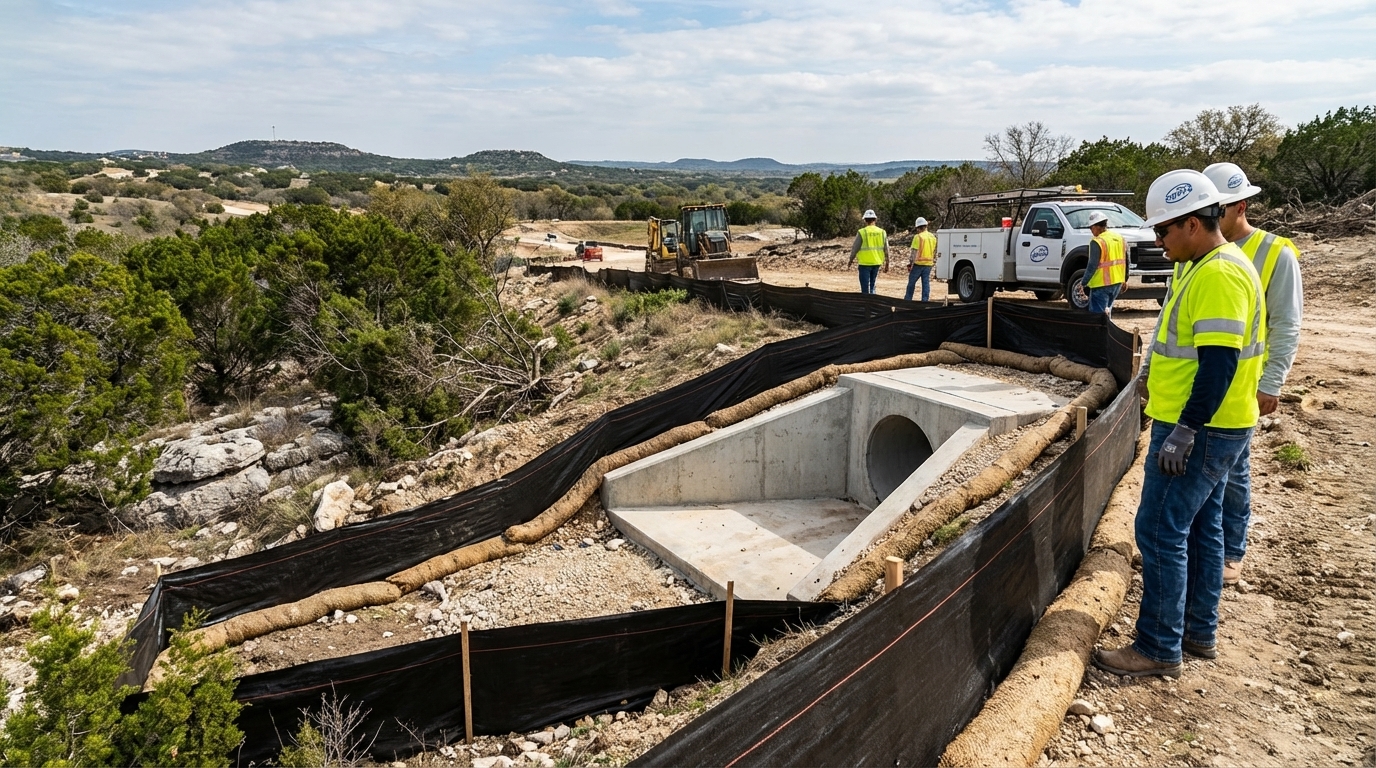
Once you start work, you’ll operate under both Bexar County rules and TCEQ’s Construction General Permit TXR150000. That means you need a Stormwater Pollution Prevention Plan (SWPPP) on-site at all times. Your SWPPP describes how you’ll control erosion and sediment using BMPs like silt fences, rock check dams, sediment basins, and stabilized construction entrances.
You must inspect your site weekly and within 24 hours after any rain event that drops half an inch or more. Document every inspection in writing and store records for at least three years. TCEQ and Bexar County can show up unannounced to verify your BMPs are working and your paperwork is current.
Erosion Control and Sediment Control Basics
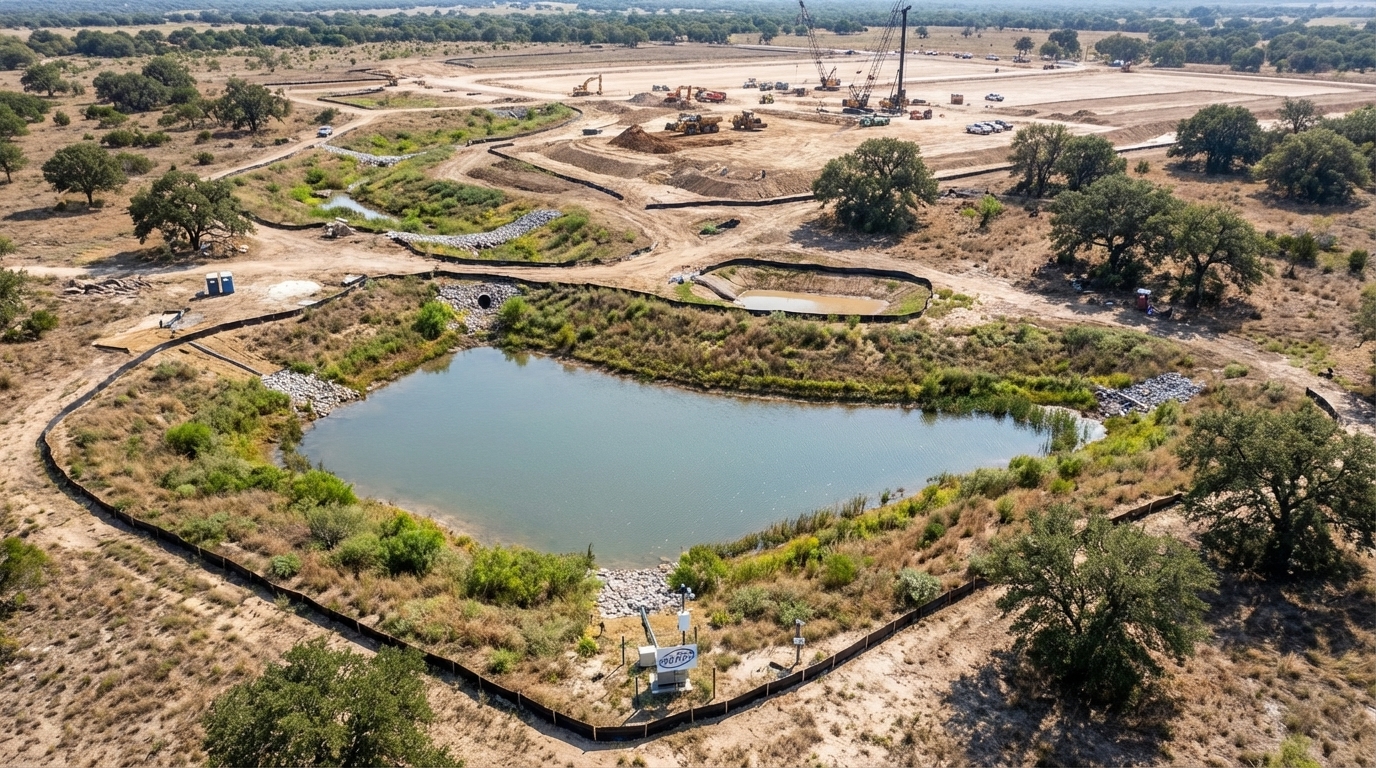
Erosion Control keeps soil in place so rain can’t wash it away. Common practices include mulching, seeding, erosion control blankets, and temporary or permanent vegetation. Sediment Control captures dirt that’s already moving, using barriers like silt fences, wattles, sediment traps, and basins.
Your SWPPP must include both types of controls. Pro SWPPP – America’s #1 SWPPP Service designs site-specific plans that meet TCEQ and Bexar County standards, so you don’t have to guess which BMPs to use or where to place them.
For example, a five-acre residential subdivision in unincorporated Texas might use perimeter silt fencing, a temporary sediment basin at the low point, stabilized construction access onto the main road, and hydroseed on slopes steeper than 3:1. Each BMP gets sized based on your site’s drainage area, soil type, and expected rainfall intensity.
Post-Construction: Closing Your Permit
After you finish grading and your permanent BMPs are stabilized, you can’t just walk away. Bexar County requires a formal closeout process:
- Submit as-built design drawings showing final BMP locations and dimensions
- Provide a licensed engineer’s certification that BMPs were built according to approved plans
- Record a maintenance affidavit with the county clerk, binding future property owners to ongoing maintenance
- Hire a certified maintenance provider and submit their contact information
- Pass a final site inspection by county staff
Only after the county approves your closeout package is your permit officially closed. If you skip this step, you remain liable for violations even after construction ends.
Lifelong Maintenance Obligations
Here’s the part many builders forget: stormwater BMP maintenance runs with the property forever. Whoever owns the land must submit quarterly reports to Bexar County, renew their maintenance provider certification annually for $50, and keep BMPs functioning.
Certified providers complete a course offered by the San Antonio River Authority (SARA) or equivalent training. If you let your provider certification lapse, the county sends a violation notice. To fix it, you’ll pay a $250 renewal fee and submit a new engineer’s certification proving your BMPs still work.
Homeowners in unincorporated areas pay a small stormwater fee ($10 to $14 per year) through their property taxes. That money funds inspections, public education, and illegal discharge detection. The county takes enforcement seriously – they respond to complaints about oil leaks, construction site runoff, and illegal dumping under the MS4 Permit TXR040000.
Edwards Aquifer Sites: Special Rules
If your project sits over the Edwards Aquifer recharge or contributing zones, you already know TCEQ requires an Edwards Aquifer Protection Program (EAPP) review. Your WPAP or CZP approval includes detailed BMPs like retention ponds, bioswales, and water quality treatment measures.
The good news: Bexar County accepts those TCEQ-approved BMPs for the stormwater permit. You still need to apply and pay the $50 application fee, but you skip the extra $200 review fee and additional mitigation calculations. Just attach your TCEQ approval letter to your county application, and you’re halfway done.
The Edwards Aquifer is one of the most productive aquifers in the world, supplying drinking water to San Antonio and surrounding communities. Protecting it from construction runoff isn’t optional – it’s the law, and it’s the right thing to do.
Common Mistakes and How to Avoid Them
Mistake 1: Assuming Pre-Construction Approval Means You Can Start Work
Your stormwater permit is just one piece of the puzzle. You still need building permits, grading permits, and approval from Bexar County Development Services. Check the jurisdiction map to confirm you’re in unincorporated territory – some areas fall under city limits with different rules.
Mistake 2: Filing Your NOI with TCEQ But Forgetting Bexar County
TCEQ’s Construction General Permit and Bexar County’s local permit are separate requirements. You must submit your SWPPP and NOI (or Small Site Notice) to TCEQ and apply for the county permit. Miss either one, and you’re out of compliance.
Mistake 3: Ignoring Maintenance After Construction Ends
Retention ponds fill with sediment. Vegetation dies. Inlets clog. If you don’t maintain your BMPs, they fail – and you’re liable. Hire a certified provider, submit quarterly reports, and renew annually. It’s cheaper than a violation.
Not sure what your project needs? Take our SWPPP Quiz or Schedule a Free SWPPP Consultation with CPESC Certified SWPPP Expert Derek E. Chinners.
What’s New in 2026?
TCEQ’s Multi-Sector General Permit (MSGP) TXR050000 renews in August 2026. Recent amendments target quarries in aquifer protection areas and expand coverage for oil and gas facilities under HB 1688 and HB 2771. Expect stricter inspections and better enforcement of certified provider requirements.
Cloud-based record-keeping is becoming standard. Keep your SWPPP, inspection logs, and NOI documents accessible online for at least three years. Inspectors can request them anytime, and you need to produce records within 24 hours.
Climate change is driving more intense storms, which means bigger runoff volumes and higher erosion risk. BMPs designed for historical rainfall data may not handle future storms. Pro SWPPP – America’s #1 SWPPP Service uses the latest rainfall data and design standards to keep your project compliant now and into the future.
Why Work with Pro SWPPP?
Pro SWPPP – America’s #1 SWPPP Service takes the confusion out of stormwater compliance. We’ve helped thousands of builders in Texas, Georgia, and across the country secure permits, avoid fines, and close projects on time.
Our CPESC-certified experts know Bexar County rules inside and out. We prepare your SWPPP, calculate BMP sizing, design site-specific erosion and sediment controls, and coordinate with TCEQ and county staff. You get a professional plan delivered fast, so you can focus on building instead of bureaucracy.
Learn more at our About page or reach out directly with questions. We’re here to help.
External Resources
For more guidance on stormwater compliance, visit the EPA’s Construction Stormwater page. You’ll find federal rules, sample SWPPPs, and links to state programs.
FAQs
Do I need a Bexar County stormwater permit if I’m only disturbing half an acre?
Maybe. If your half-acre project is part of a larger common plan of development that totals one acre or more, you need a permit. For example, if you’re building one lot in a 10-lot subdivision, the entire subdivision counts. Check with Bexar County to confirm.
What’s the difference between a SWPPP and a NOI?
A SWPPP is your written plan describing how you’ll control erosion and sediment. A Notice of Intent (NOI) is a form you file with TCEQ to notify them you’re starting a project covered by the Construction General Permit. You need both – the SWPPP guides your work, and the NOI registers your project.
How long does it take to get a Bexar County stormwater permit approved?
Bexar County has up to 30 days to review your application. Submit a complete, accurate package the first time to avoid delays. Missing documents or incorrect calculations will push your approval date back.
Can I do my own SWPPP or should I hire a professional?
You can prepare your own SWPPP, but mistakes lead to violations, fines, and project delays. A certified professional ensures your plan meets TCEQ and Bexar County standards, sizes BMPs correctly, and passes inspection the first time. Pro SWPPP – America’s #1 SWPPP Service delivers professional plans fast and affordably.
What happens if I don’t maintain my post-construction BMPs?
You’ll receive a violation notice from Bexar County. To fix it, you must pay a $250 renewal fee, hire a certified maintenance provider, and submit an engineer’s certification proving your BMPs work. Ongoing violations can result in fines up to $25,000 per day.
Do I need both a TCEQ permit and a Bexar County permit?
Yes. TCEQ’s Construction General Permit TXR150000 covers state requirements. Bexar County’s local permit adds extra rules for unincorporated areas. You must comply with both to stay legal.
Bottom line: Bexar County stormwater compliance in 2026 isn’t optional, but it doesn’t have to be hard. Get your permit, build your BMPs, inspect your site, and maintain your controls. Or let Pro SWPPP – America’s #1 SWPPP Service handle it for you at https://proswppp.com.