A QSD (Qualified SWPPP Developer) writes and amends your SWPPP. A QSP (Qualified SWPPP Practitioner) implements it in the field and performs the inspections. California is one of the few states that mandates both roles by name — under the 2022 Construction General Permit (Order WQ 2022-0057-DWQ, NPDES CAS000002), a project cannot be compliant without them. Both credentials are administered through CASQA, carry a two-year term, and require ongoing continuing education.
This guide covers what each role does, who needs which, how inspections work under the current permit, and how the two credentials differ. For general California SWPPP requirements — thresholds, Risk Levels, and filing — see our California SWPPP Requirements guide.
Who Are QSD and QSP?
California requires two important people on every covered construction site: the QSD and the QSP. These are not optional roles. They are part of the permit. The QSD is the Qualified SWPPP Developer. This person writes your SWPPP. The QSP is the Qualified SWPPP Practitioner. This person inspects the site and makes sure the plan is working in the real world.
What Does a QSD Do?
The QSD builds your SWPPP from the ground up. They review your grading plans, look at the soil, check the drainage, and figure out where stormwater might cause problems. Then they write a site-specific plan that lists every BMP you will install. That includes things like silt fences, gravel bags, inlet protection, stabilized entrances, and concrete washout areas. The QSD also updates the SWPPP when conditions change. If you add a new phase or change your grading, the QSD must revise the plan and report those changes in SMARTS.
What Does a QSP Do?
The QSP walks the site. They check that every BMP in the SWPPP is installed correctly and working. They inspect before rain, during rain, and after rain. They also do weekly checks during the rainy season. If something is broken or missing, the QSP logs it and makes sure it gets fixed fast. The QSP also collects water samples if the permit requires it. All of their inspection reports must be uploaded to SMARTS.
How Do You Become a QSD or QSP?
California has strict rules for who can be a QSD or QSP. Licensed professional engineers and geologists can self-register in SMARTS. Everyone else must go through the California Stormwater Quality Association, or CASQA. You have to meet prerequisites, take approved training, and pass an exam. Once you are certified, you must complete six hours of continuing education every year. You also have to take a review course whenever the Construction General Permit is updated. This keeps QSDs and QSPs current with the latest rules.
Pro SWPPP has CPESC-certified experts who handle QSD and QSP roles every day. We know the California CGP inside and out. We write SWPPPs, file NOIs, run inspections, and keep everything current in SMARTS so your project stays compliant from start to finish.
What Is a QSD and What Do They Inspect?
The QSD writes your Stormwater Pollution Prevention Plan (SWPPP), picks your Best Management Practices (BMPs), and figures out your project’s risk level. They design the erosion control and sediment control systems that keep dirt out of rivers and drains.
California law says the QSD must personally inspect your site at these times:
- Within 30 days of construction starting
- Twice every year (once between August and October, once between January and March)
- Within 14 days after any Numeric Action Level (NAL) exceedance for turbidity or pH
- Within 30 days of replacing the QSD
- Whenever a Water Board inspector asks in writing
These inspections check if your BMPs are installed correctly, if your SWPPP matches what’s happening on the ground, and if erosion or sediment is leaving the site. The QSD cannot hand these inspections off to anyone else. They are non-delegable duties.
Need help finding a certified QSD? Pro SWPPP connects you with CPESC-certified experts who handle every inspection requirement. Learn more about our California SWPPP requirements services.
What Is a QSP and What Do They Inspect?
The QSP runs the day-to-day stormwater controls. They walk the site, test water samples, fix broken BMPs, and keep records. The QSP is your boots-on-the-ground person.
The QSP must personally perform these inspections:
- At least one weekly inspection per month (the other weekly checks can be delegated)
- Pre-storm inspections within 72 hours before a Qualifying Precipitation Event (QPE)
- Inspections within 14 days after any NAL exceedance
- Final inspection before you file a Notice of Termination (NOT) or Change of Information (COI)
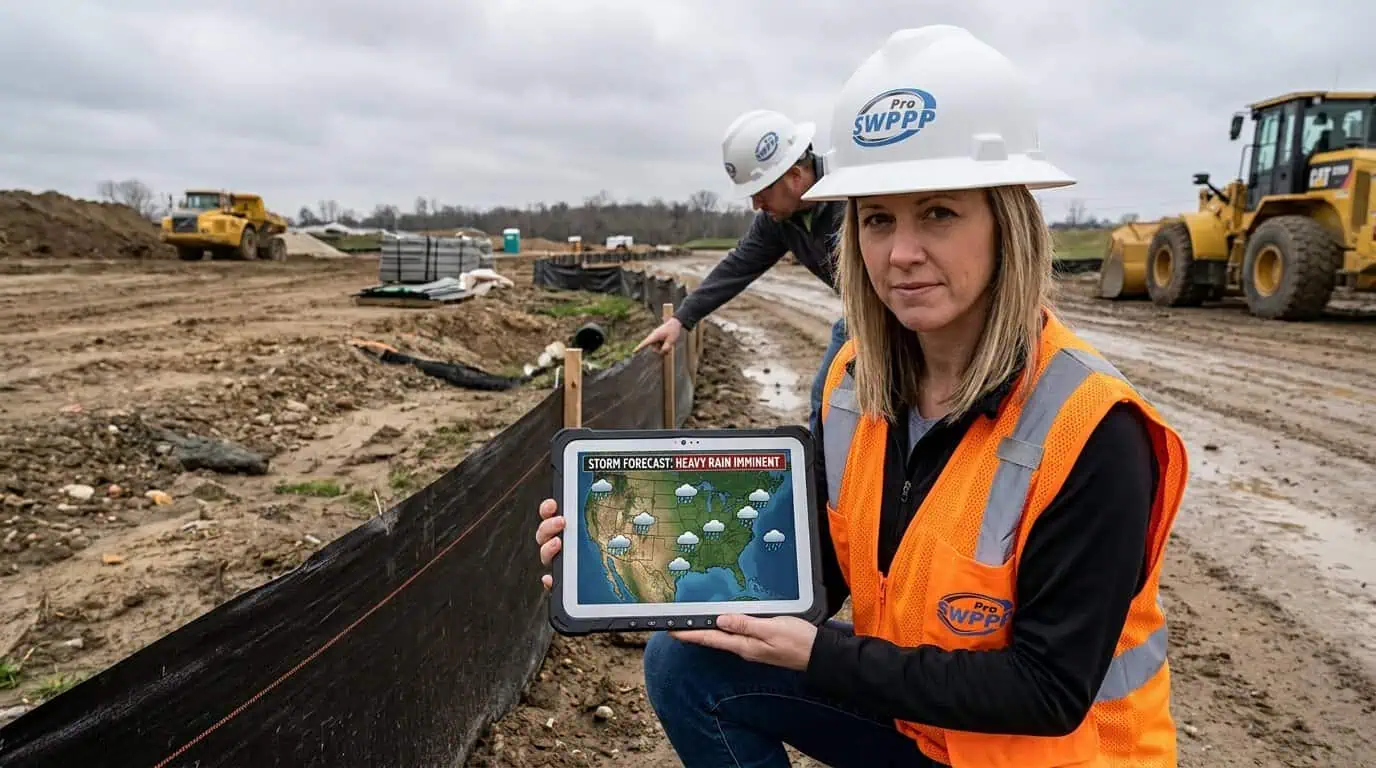
A QPE happens when weather forecasts show a 50 percent or higher chance of 0.5 inches or more rain in 24 hours. You watch the National Weather Service forecast. If the probability and amount meet the threshold, your QSP must inspect within 72 hours (or up to 120 hours if you use longer-range forecasts).
Weekly Inspections
Every site needs at least one inspection per week. The QSP can train and supervise delegates to handle most weekly checks, but the QSP must personally do at least one per month. Weekly inspections look at BMP condition, housekeeping, sediment buildup, and any new work that might need SWPPP updates.
Storm Inspections
Storm inspections are where most projects slip up. You need three types:
- Pre-QPE: Check BMPs, cover stockpiles, secure materials, and confirm discharge points are ready
- During QPE: Inspect at least once every 24 hours while discharge is happening. Watch for erosion, sediment leaving the site, and BMP failures
- Post-QPE: Inspect within 96 hours of the last 24-hour period with 0.25 inches or more rain. Document damage, sediment issues, and needed repairs
Many local agencies (like Los Angeles County or Caltrans) require faster post-storm inspections, often within 48 hours. Always check your local rules on top of the state CGP.
QSP Delegates: What Can They Do?
The 2022 CGP introduced QSP delegates. These are trained workers who can perform routine inspections, sampling, and BMP maintenance under the QSP’s supervision. Delegates help you cover large sites and keep up with weekly checks.
But delegates have limits. They cannot do:
- QSD inspections (startup, semiannual, NAL follow-up, QSD replacement)
- QSP-required monthly inspections
- Final NOT or COI inspections
- Any inspection the CGP explicitly assigns to a QSD or QSP
CASQA published training guidelines in 2024 that explain what delegates need to learn: inspection protocols, SWPPP basics, BMP evaluation, and sampling methods. The QSP must document the delegate’s training and competency.
Don’t want to mess with all the paperwork and requirements? Check out Order your SWPPP now with Pro SWPPP Professional CPESC Certified SWPPP Services.
What Changed in the 2022 CGP?
California reissued its Construction General Permit in 2022. The new permit got rid of the old Rain Event Action Plan, or REAP. But it kept strict inspection requirements before, during, and after storms. The 2022 CGP also added stronger rules for dewatering discharges, demolition pollutants, and passive treatment systems. If you hire contractors or delegate tasks, those workers need training too. The permit made it clear that the discharger is always responsible, even if you hire a QSD or QSP. That means you cannot pass the blame if something goes wrong.
The 2022 permit also pushed projects toward risk-based stormwater management. High-risk sites must collect water samples and respond if turbidity or pH levels cross action thresholds. This is not optional. If you miss a sample or ignore a high reading, you can face enforcement action.
What Inspectors Look For
Every inspection, whether by QSD, QSP, or delegate, covers the same core areas:
- Erosion Control: Are slopes stabilized? Are blankets, hydroseed, or mulch in place and working?
- Sediment Control: Are silt fences, fiber rolls, and sediment basins installed correctly? Is sediment staying on site?
- Perimeter Protection: Are barriers at the property line intact and effective?
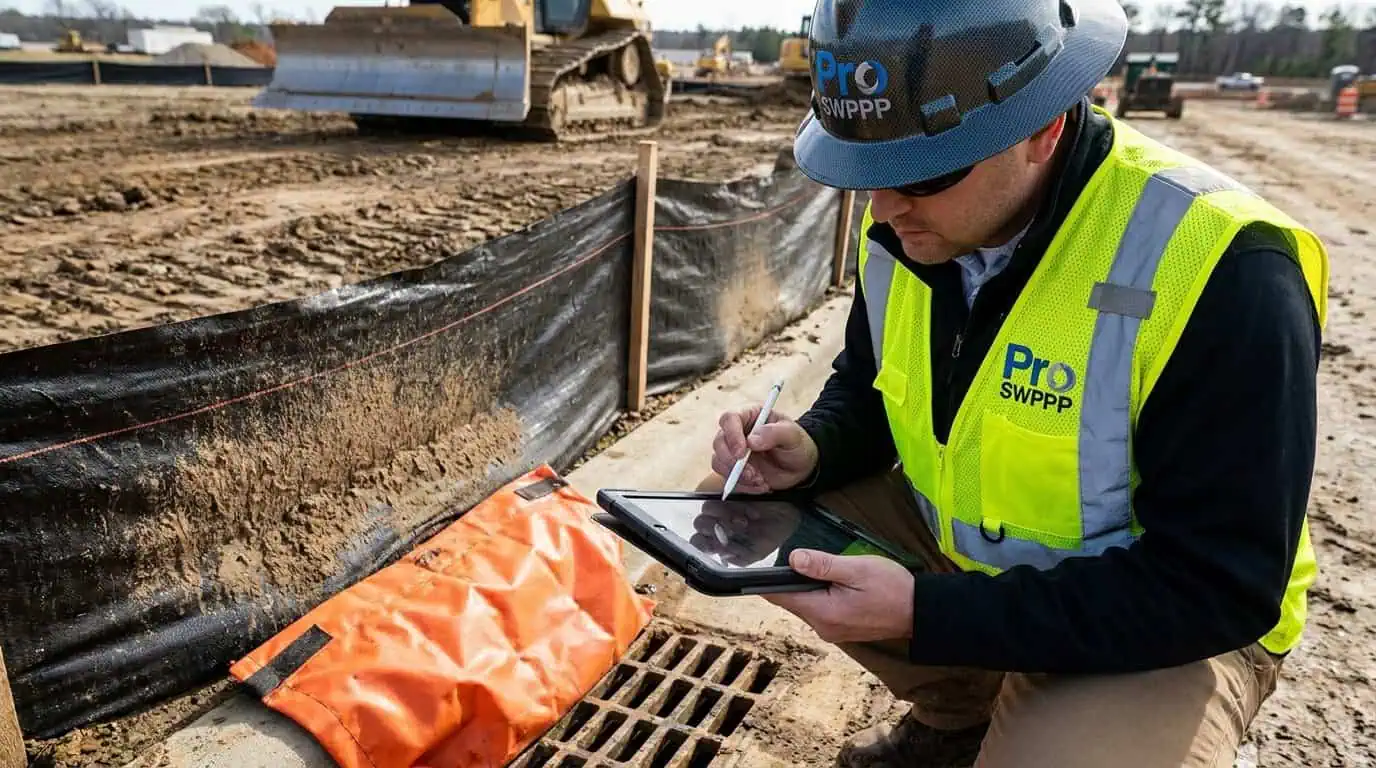
- Inlet Protection: Are storm drain covers, gravel bags, or filter inserts in place and clear of sediment?
- Stabilized Entrance: Is the construction entrance rock pad preventing mud tracking onto public roads?
- Concrete Washout: Is the washout area lined, marked, and used? No concrete rinse water going to drains?
- Stockpile Covers: Are soil and aggregate piles tarped or surrounded by berms?
- Housekeeping: Are materials stored neatly? Is trash picked up? Are spill kits accessible?
- Non-Stormwater Discharges: Any vehicle washing, equipment leaks, or irrigation runoff leaving the site?
Inspectors also check conveyance systems like ditches, swales, and detention basins for sediment buildup or damage. If your site is Risk Level 2 or 3, they verify sampling locations and review turbidity and pH results.
Numeric Action Levels and Follow-Up Inspections
California uses NALs for turbidity and pH. If your sample exceeds the action level, you have 14 days to inspect the drainage area, figure out why, and document corrective actions. Both the QSD and QSP must inspect within that window.
Common NAL triggers include:
- Turbidity above 250 NTU (or 500 NTU depending on risk level)
- pH below 6.5 or above 8.5
NAL exceedances often point to poor BMP performance, insufficient erosion control, or sediment bypassing your basins. The inspection must identify the source and your SWPPP must document what you’ll fix and when.
How SMARTS Works
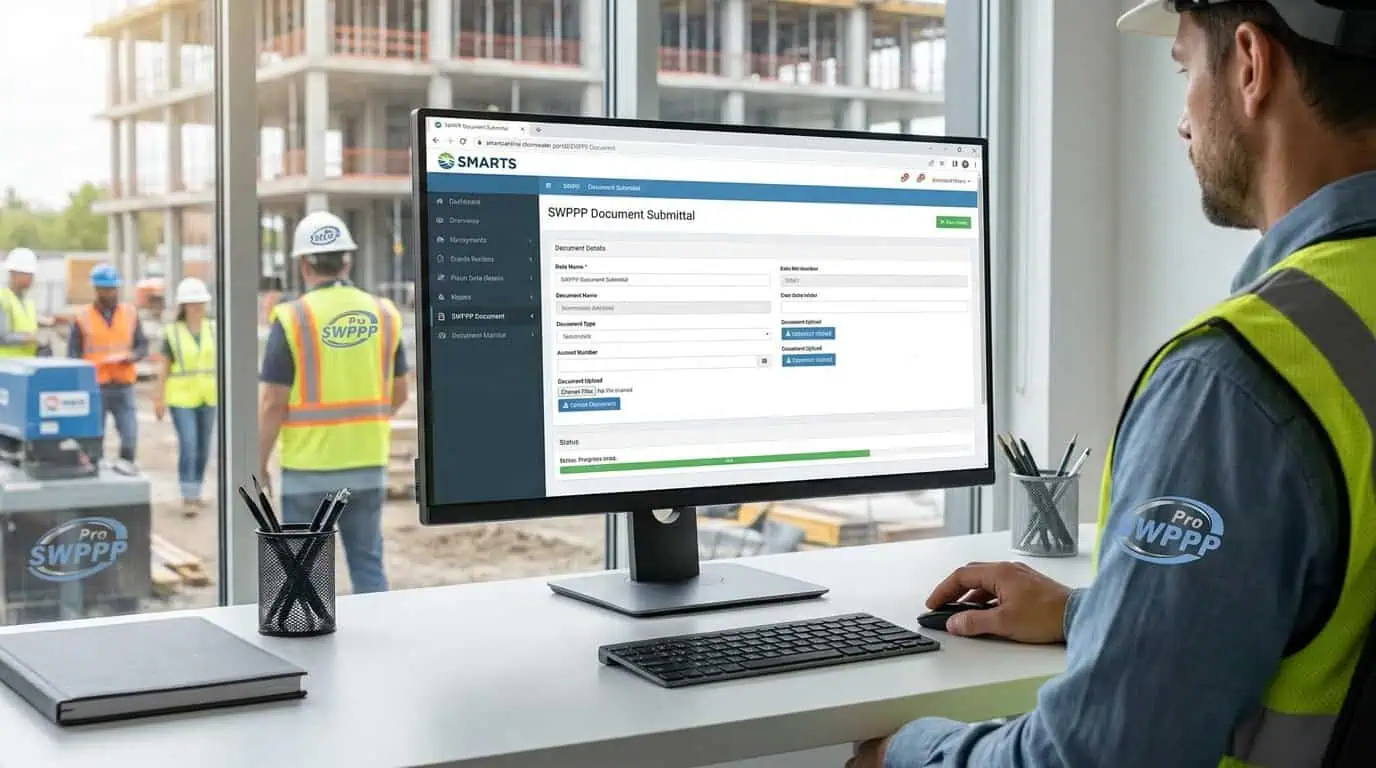
SMARTS is California’s online portal for stormwater permits. You use SMARTS to file your NOI, upload your SWPPP, report inspections, submit water samples, and make revisions. Every document lives in SMARTS. If inspectors show up, they will check your SMARTS account. Missing uploads or outdated info can mean fines, even if your site looks good.
Pro SWPPP manages SMARTS for you. We upload your NOI, post your SWPPP, file inspection reports, and track every deadline. You get a clean audit trail without lifting a finger. Learn more about our team at Pro SWPPP About page.
Continuing Education for QSDs and QSPs
CASQA requires six hours of continuing education every year for registered QSDs and QSPs. Topics include site assessment, BMP design, inspection techniques, and monitoring updates. Renewal happens every two years, and you upload proof of your training hours.
Engineers and geologists can self-certify as QSD or QSP if they meet the 2022 CGP prerequisites. This gives more flexibility but still requires annual education to stay current.
Not sure what your project needs? Take our SWPPP Quiz or Schedule a Free SWPPP Consultation with CPESC Certified SWPPP Expert Derek E. Chinners.
Local Rules: Caltrans and County Manuals
State rules set the floor, but cities and counties often add stricter requirements. Caltrans projects need daily inspections for some activities, pre-QPE checks within 72 hours, and post-storm inspections within two days if rainfall hits 0.5 inches.
Los Angeles County and San Diego County templates mirror the CGP but clarify delegate limits and require standardized inspection forms. Always confirm what your local MS4 co-permittee or public works department expects.
If you work in other states, rules differ. Texas follows TCEQ guidance, and Georgia has its own NPDES permit structure. Pro SWPPP covers projects nationwide with certified professionals who know local and federal rules.
Common SWPPP Mistakes in California
Even experienced contractors make mistakes with SWPPPs. Here are the biggest ones we see.
- Waiting too long to hire a QSD: Your SWPPP must be done before you file your NOI. If you wait until the last minute, you delay your whole project.
- Thinking small projects do not count: If your project is part of a common plan that crosses one acre, you need a SWPPP. Period.
- Forgetting to update the SWPPP: When you change your grading or add a new phase, you must update your plan and report it in SMARTS.
- Skipping inspections: QSP inspections are required. If you skip them, you are out of compliance.
- Ignoring SMARTS deadlines: Late uploads, missing contact info, and old records can trigger enforcement even if your BMPs are perfect.
Pro SWPPP handles all of this for you. We write the plan, file the NOI, run inspections, and keep your SMARTS account up to date. You focus on building. We handle the compliance.
Best Practices for Inspection Programs
Set up a clear calendar that lists every required inspection: weekly, monthly QSP, semiannual QSD, pre-QPE, during-QPE, post-QPE, and NAL follow-up. Assign names and dates. Update it weekly.
Use digital tools or apps that let you capture GPS-tagged photos, fill forms on a tablet, and push data to cloud storage. This makes audits easier and gives regulators instant proof of compliance.
Train all site workers on SWPPP basics. Run toolbox talks on BMP maintenance, spill response, and where not to dump waste. When everyone knows the rules, inspections go faster and violations drop.
Treat post-storm inspections as chances to improve BMPs, not just patch damage. If a basin filled with sediment, figure out why and redesign the inlet or add a forebay.
Schedule regular QSD-QSP coordination meetings. Virtual check-ins work fine. Share inspection findings, review SWPPP amendments, and plan for upcoming site phases.
How Pro SWPPP Helps California Contractors
Pro SWPPP works with California contractors every day. We know the Construction General Permit. We know SMARTS. We know what inspectors look for. Our CPESC-certified team writes site-specific SWPPPs, files NOIs, runs QSP inspections, and keeps your records clean. We also offer consulting if you just need guidance. Whether you are building in Los Angeles, San Diego, Sacramento, or the Bay Area, we have you covered.
We also serve other states. If you have projects in Texas or Georgia, we handle those permits too. Every state has different rules. We make sure your SWPPP matches local requirements so you stay compliant no matter where you build. Have questions? Visit our contact page and we will get back to you fast.
FAQ
Do I need a SWPPP if my project is under one acre?
Maybe. If your project is part of a larger common plan that totals one acre or more, you need a SWPPP and CGP coverage. Smaller standalone projects might need a WPCP instead. Check with a QSD to be sure.
Can I write my own SWPPP?
Only if you are a licensed California professional engineer or geologist. Otherwise, you must hire a certified QSD. Even licensed professionals need to register in SMARTS and stay current with continuing education.
How long does it take to get an NOI approved?
Once you submit your NOI in SMARTS, approval is usually fast. But you cannot submit the NOI until your SWPPP is complete. Plan ahead. Last-minute filings can delay your start date.
What happens if I skip a QSP inspection?
You fall out of compliance. The CGP requires inspections before, during, and after storms, plus weekly checks in the rainy season. Missing inspections can trigger enforcement action and fines.
Do I need a QSP if I already have a QSD?
Yes. The QSD writes the plan. The QSP inspects the site. Both roles are required under the California Construction General Permit. The same person can be both if they hold both certifications.
Can Pro SWPPP handle projects in other states?
Absolutely. We serve California, Texas, Georgia, and more. Each state has unique permit rules. We write SWPPPs that match local regulations so you stay compliant everywhere you build.
Who can perform QSD inspections in California?
Only the QSD listed on your SWPPP can perform the required startup, semiannual, NAL follow-up, and replacement inspections. These duties cannot be delegated to anyone, including the QSP or trained delegates.
How often must a QSP inspect my site?
The QSP must personally inspect at least once per month, plus pre-QPE checks within 72 hours of forecasted rain, post-QPE inspections within 96 hours, and follow-up inspections within 14 days of any NAL exceedance. Other weekly inspections can be delegated.
What is a Qualifying Precipitation Event (QPE)?
A QPE is any forecasted storm with a 50 percent or higher probability of 0.5 inches or more rain in 24 hours. You trigger pre-storm inspections based on National Weather Service forecasts, not on actual rainfall totals.
Can I use delegates for all inspections?
No. QSP delegates can handle routine weekly inspections, sampling, and BMP checks, but they cannot perform the QSD’s semiannual inspections, the QSP’s monthly inspection, NAL follow-ups, or final NOT inspections. Those are non-delegable.
What happens if I miss an inspection deadline?
Missing required inspections is a permit violation. You risk enforcement actions, fines, stop-work orders, and project delays. Inspectors from regional water boards check documentation during audits, so missing records stand out immediately.
Do local agencies have stricter rules than the state CGP?
Yes. Caltrans, Los Angeles County, San Diego County, and many MS4 co-permittees add daily or more frequent inspections, shorter post-storm windows, and specific form requirements. Always check local manuals on top of the state Construction General Permit.
How do I document inspections correctly?
Use standardized forms that record date, inspector name, location, BMP status, deficiencies, corrective actions, deadlines, and photos. Link findings to specific SWPPP sections. Keep all records for at least three years after project termination.
Does Pro SWPPP cover projects outside California?
Yes. Pro SWPPP works nationwide. We know federal NPDES rules, state-specific permits like TCEQ in Texas, and local MS4 requirements. Contact us for nationwide coverage.
Ready to get started? Order your SWPPP now or schedule a free consultation with Pro SWPPP.
Visit Pro SWPPP and see why contractors nationwide rely on America’s #1 SWPPP Service.
Need a QSD-prepared California SWPPP?
Pro SWPPP are the paperwork and permitting experts. QSD-prepared SWPPP, filed through SMARTS, delivered in 72 hours — or it’s free. Physical installation of BMPs is handled by your site contractor.