Do You Need an E&SC Plan in Charlotte or Mecklenburg County?
Charlotte requires an approved Erosion and Sediment Control (E&SC) Plan before any land-disturbing activity that uncovers one acre or more — 43,560 square feet — under Article 28 of the Charlotte Unified Development Ordinance. Lands developed as a unit aggregate regardless of ownership, and Charlotte-Mecklenburg Storm Water Services reviews that plan as a delegated local program.
Who Regulates Erosion Control in Charlotte and Mecklenburg County?
North Carolina’s Sedimentation Pollution Control Act lets local governments run their own erosion programs in place of state review. The NCDEQ Division of Energy, Mineral and Land Resources (DEMLR) delegates that authority, and Mecklenburg County operates one of the oldest delegated local programs in the state.
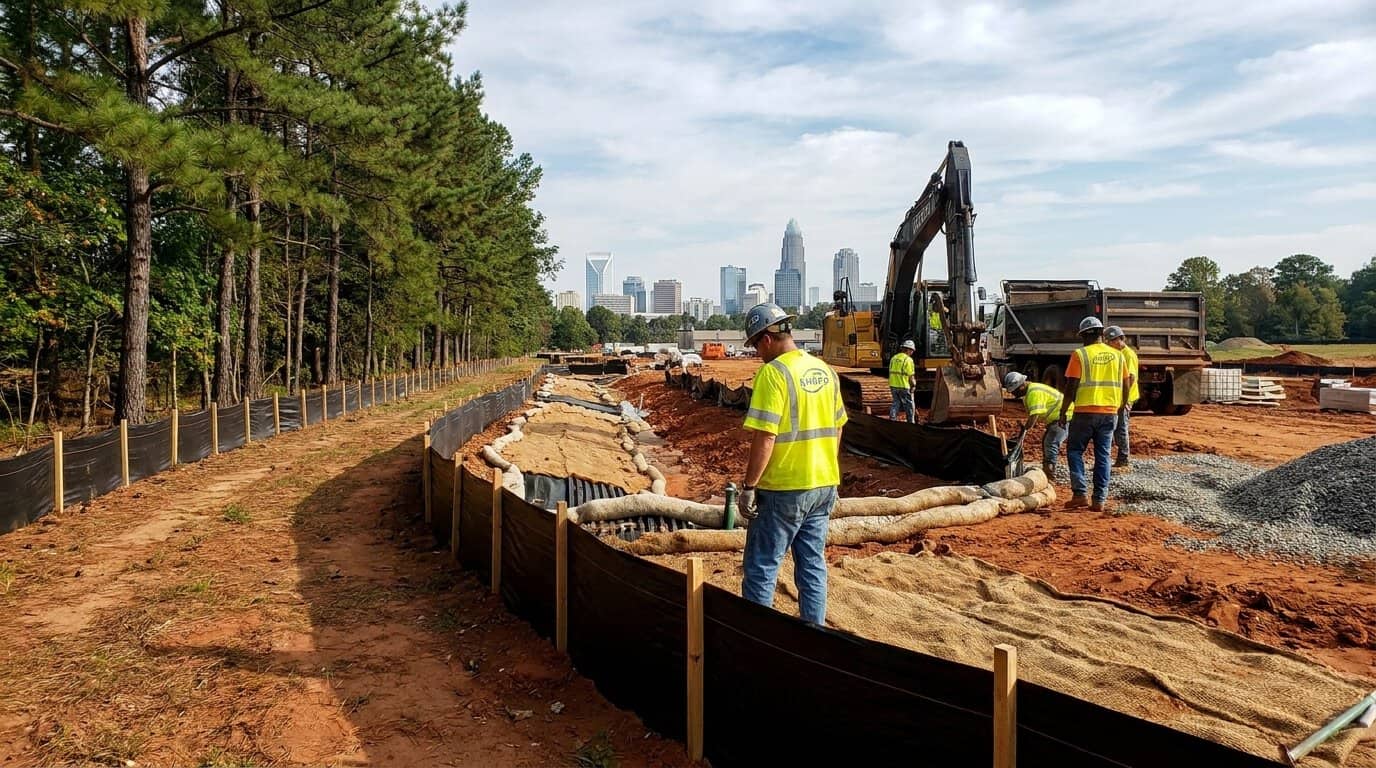
Inside the city limits, the City of Charlotte Storm Water Services program administers Article 28 of the Unified Development Ordinance for privately funded development. Outside the city limits, and for six towns, Mecklenburg County Storm Water Services handles land development review. Your parcel address, not your mailing address, decides which desk your plan lands on.
This local-delegation structure is the single biggest difference between Charlotte and every non-delegated county in North Carolina. You do not submit to Raleigh’s DEMLR regional office. You submit to a local reviewer applying a local ordinance that is at least as strict as the state minimum.
Not sure if you even need one?
Answer a few questions about your site and find out in under two minutes.
What Is the Land-Disturbance Threshold in Charlotte?
Charlotte’s trigger is one acre — 43,560 square feet — of uncovered land. The number that catches developers is not the acre itself but the aggregation rule. Article 28 of the Charlotte UDO states that “lands being developed as a unit shall be aggregated regardless of ownership” (Charlotte Unified Development Ordinance, Article 28).
That means three separately owned 0.4-acre lots inside one subdivision plan total 1.2 acres and require a plan. Phasing does not reset the count either. If a reviewer can see one development, the acreage adds up.
Once you cross one acre you also pick up automatic coverage under North Carolina’s NCG01 construction stormwater general permit, which DEMLR issues for the April 1, 2024 through March 31, 2029 term. Charlotte’s ordinance additionally requires the responsible party to contact the Stormwater Administrator at least 48 hours before land-disturbing activity begins on a permitted site.
How Does Charlotte’s Threshold Compare to Other NC Jurisdictions?
| Jurisdiction | Plan Trigger | Review Authority | Published Fee |
|---|---|---|---|
| NC state minimum | 1 acre (43,560 sq ft) | NCDEQ DEMLR | $100 per disturbed acre |
| City of Charlotte | 1 acre, aggregated as a unit | Charlotte Storm Water Services | $655 per acre |
| Mecklenburg County | 1 acre, aggregated as a unit | Mecklenburg Storm Water Services | $710 per acre |
| City of Raleigh | 12,000 sq ft (0.28 acre) | City of Raleigh Stormwater | $157 review + $317 permit per acre |
Fee figures come from the NCDEQ local erosion and sedimentation control program fee list. Charlotte and Mecklenburg County hold the one-acre line; Raleigh does not. If you build in both markets, do not carry a Wake County assumption into a Mecklenburg parcel.
What Must a Charlotte E&SC Plan Package Include?
Charlotte reviewers expect a sealed, internally consistent drawing set, not a marked-up survey. Article 28 requires that every plan carry “an authorized statement of financial responsibility and ownership signed by the person financially responsible for the land-disturbing activity” (Charlotte Unified Development Ordinance, Article 28). A missing or unsigned financial responsibility and ownership form is one of the fastest ways to lose a review cycle.
A complete Charlotte or Mecklenburg submittal generally contains:
- Project narrative with parcel ID, total site acreage, and total disturbed acreage
- Existing conditions map showing slopes, blue-line streams, wetlands, and drainage areas
- Proposed grading plan with the limits of disturbance clearly bounded
- BMP layout locating silt fence, sediment basins or traps, construction entrances, and inlet protection
- Standard detail sheets for every BMP the plan calls for
- A phased construction sequence placing perimeter controls ahead of mass grading
- Sediment basin and trap sizing calculations with supporting drainage area maps
- Signed financial responsibility and ownership form
- SWIM buffer, floodplain, and watershed overlay mapping where applicable
The construction sequence is a design document, not a work order. It tells your site contractor the order in which controls must go in the ground; physical installation of BMPs is handled by your site contractor.
What Causes the Most Resubmittals in Charlotte?
Numeric mismatch between sheets. If the erosion sheet says 2.5 disturbed acres and the post-construction sheet says 3.1, the reviewer stops and asks. Keep acreage, tract boundary, drainage direction, buffer limits, and phase numbering identical on every sheet in the set.
The second most common cause is missing calculations. A basin shown on a plan without a sizing calculation behind it is an incomplete submittal, not a design decision.

How Do You Submit an E&SC Plan in Mecklenburg County?
Mecklenburg County Land Development moved plan review, permits, and bonds onto Accela, and floodplain and erosion control applications are filed there. You upload the complete PDF set, pay the per-acre fee, and the system routes the package to a named reviewer who returns comments in the same portal.
North Carolina’s Sedimentation Pollution Control Act requires the plan to be filed 30 or more days before the anticipated start of land-disturbing activity. Build 30 to 45 calendar days into your schedule for the first review, one comment cycle, and a resubmittal, then add the 48-hour pre-construction notification Charlotte requires before dirt moves.
Clean file naming matters more than it should. Use plain names such as Erosion_Plan_Rev2.pdf so a reviewer opening 40 attachments can find your revision without guessing. For statewide context, see the full guide to North Carolina SWPPP requirements.
What Does a Charlotte Erosion Control Permit Cost?
The published grading and erosion control review and inspection fee for the City of Charlotte is $655 per disturbed acre. Mecklenburg County’s erosion control permit fee is $710 per disturbed acre, and county land development projects carry additional review fees that scale with project type and size. Both figures are listed on the NCDEQ local program fee list.
Compare that to the state’s own $100 per disturbed acre and the reason is straightforward: a delegated local program funds its own reviewers and field inspectors. On a 5-acre Charlotte site, the erosion control review and inspection fee alone runs about $3,275 before any post-construction stormwater or plan preparation cost.
Budget separately for surety or bonding where the ordinance requires it, and for a resubmittal cycle. A rejected package rarely costs a new fee, but it always costs two to four weeks of schedule.
Just want a number first?
Tell us about your project and we will send a written estimate, no obligation.
How Often Must You Inspect Erosion Controls in Charlotte?
Two inspection clocks run at once, and Charlotte contractors regularly get the rain trigger wrong because they carry an EPA number into a North Carolina site.
Under NCG01, the state construction stormwater general permit, self-inspections are required “at least once per 7 calendar days and within 24 hours of a rain event ≥ 1.0 inch in 24 hours” (NCDEQ Division of Energy, Mineral and Land Resources, NCG01 Inspection, Recordkeeping and Reporting). North Carolina uses a 1.0-inch trigger — not the 0.5-inch trigger used in Ohio and under the federal EPA construction general permit.
Charlotte’s Article 28 sets its own local rhythm: inspection at least once a week and within 24 hours after any storm event of greater than one inch of rain per 24-hour period. NCG01 also requires a rain gauge on site with daily rainfall recorded, and days with no rain logged as zero. Blank days in a rain log read as missed inspections during an audit.
Keep the approved plan, the inspection records, and the rain log on site for the life of the project. Pro SWPPP prepares the inspection forms and documentation package; physical installation of BMPs is handled by your site contractor.
What Does Charlotte Require Beyond Erosion Control?
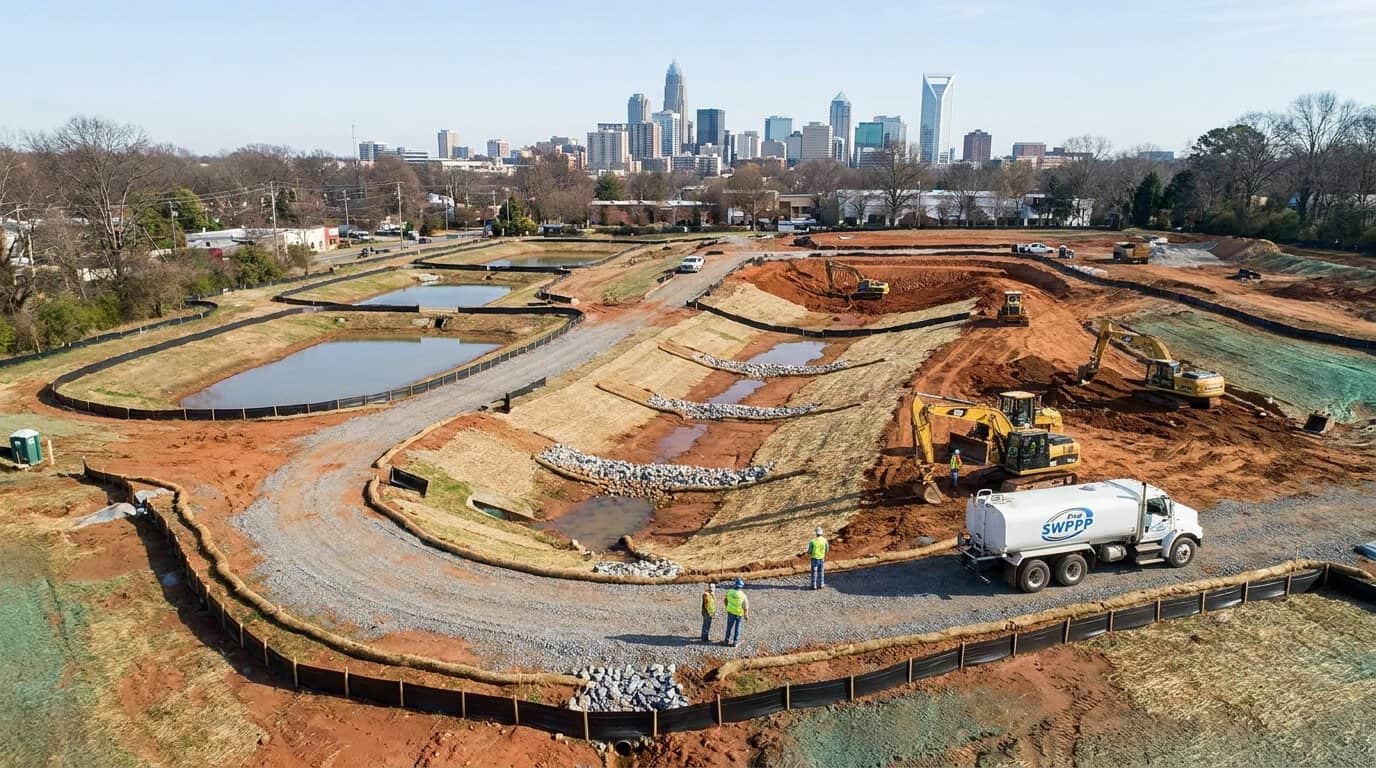
Charlotte’s Post-Construction Stormwater Ordinance is a separate approval from Article 28 and can be triggered by built-upon area or redevelopment scope rather than by disturbed acreage. Erosion control keeps sediment on site during construction; post-construction stormwater control measures manage runoff volume, peak flow, and water quality permanently.
Charlotte’s SWIM buffer rules apply to many stream segments, with buffer widths keyed to upstream drainage area. Grading inside a protected buffer generally requires separate authorization, and the buffer line must appear identically on the erosion sheet, the grading sheet, and the post-construction sheet.
Practical sequence for 2026: pull the parcel, check the City’s GIS for SWIM zones and floodplain, confirm whether the address is city or county jurisdiction, then design erosion control, post-construction, buffers, and tree save as one coordinated package. Splitting them into separate submittals is what creates the conflicting-acreage problem reviewers reject.
Why Work With Pro SWPPP on a Charlotte Project?
Pro SWPPP, LLC is a documentation and permitting firm. We prepare the E&SC Plan set, the narrative, the drainage area maps, the basin sizing calculations, the phased sequence, the financial responsibility and ownership form, and the inspection recordkeeping package, and we carry the submittal through Accela comment cycles. We do not perform field construction, and physical installation of BMPs is handled by your site contractor.
Plans are prepared under CPESC-certified review by Derek E. Chinners, CPESC, with 20-plus years in stormwater compliance. Standard delivery is 72 hours. We also prepare post-construction stormwater documentation, buffer analyses, and combined submittals when a project needs several approvals reviewed together.
Working outside North Carolina? The same documentation service covers Texas and Georgia. Learn more on our About page or reach us through the Contact page.
Where Can You Verify Charlotte E&SC Requirements Yourself?
- City of Charlotte Erosion and Sedimentation Control
- Charlotte Unified Development Ordinance, Article 28
- Mecklenburg County Storm Water Services, Land Development
- NCDEQ DEMLR NPDES Construction Program (NCG01)
- EPA NPDES Stormwater Construction guidance
Charlotte E&SC Plan FAQ
Do I need an E&SC Plan if I disturb less than one acre in Charlotte?
If the site is genuinely under 43,560 square feet and is not part of a larger development, Charlotte does not require a plan submittal. Erosion control measures are still required on the ground. The one-acre figure is the paperwork trigger, not the BMP trigger, and enforcement still applies to sediment leaving a small site.
Does Charlotte aggregate multiple small lots toward the one-acre threshold?
Yes. Article 28 of the Charlotte Unified Development Ordinance states that lands being developed as a unit are aggregated regardless of ownership. Four separately owned 0.3-acre lots inside one subdivision plan total 1.2 acres and require an approved plan. Separate deeds and separate builders do not break the aggregation.
How much does a Charlotte erosion control permit cost?
The City of Charlotte grading and erosion control review and inspection fee is $655 per disturbed acre, and Mecklenburg County charges $710 per disturbed acre for its erosion control permit, per the NCDEQ local program fee list. A 5-acre Charlotte site therefore carries roughly $3,275 in city erosion control fees.
How far in advance must I submit my E&SC Plan in Charlotte?
North Carolina requires the plan to be filed 30 or more days before the anticipated start of land-disturbing activity. Allow 30 to 45 calendar days for review, comments, and one resubmittal. Charlotte also requires the responsible party to notify the Stormwater Administrator at least 48 hours before work begins.
How often must I self-inspect a Charlotte construction site?
NCG01 requires self-inspection at least once per 7 calendar days and within 24 hours of a rain event of 1.0 inch or more in 24 hours. North Carolina uses a 1.0-inch trigger, not the 0.5-inch trigger used federally. A site rain gauge must be read daily, with zero-rain days logged as zero.
What is the financial responsibility and ownership form?
It is the signed statement identifying who owns the land and who is legally and financially liable for erosion control on the site. Article 28 requires it with every plan, and Mecklenburg County expects ownership documentation before approval. An unsigned form is one of the most common causes of a rejected first submittal.
Is Charlotte’s threshold the same as Raleigh’s?
No, and assuming so is expensive. Charlotte and Mecklenburg County hold the state one-acre line of 43,560 square feet. Raleigh requires a plan above 12,000 square feet, roughly 0.28 acre. A townhome pad that needs no Charlotte submittal can require a full Raleigh grading permit.
Do I need post-construction stormwater approval in addition to E&SC?
Often yes. Charlotte’s Post-Construction Stormwater Ordinance is triggered by built-upon area and redevelopment scope, not disturbed acreage, so a project can need permanent stormwater control measures even when erosion thresholds are marginal. Submit both packages together so acreage and drainage areas match across every sheet.
Complicated site? Talk it through.
Speak directly with a CPESC-certified stormwater expert with 20+ years of experience.