Do You Need a SWP3 for a Construction Project in Columbus, Ohio?
Ohio requires a Storm Water Pollution Prevention Plan (SWP3) for any construction project disturbing one acre or more, including a smaller site inside a larger common plan of development. Coverage comes from Ohio EPA general permit OHC000006, and the Notice of Intent is filed electronically through the Ohio EPA eBusiness Center before ground is broken.
Who Needs a SWP3 in Columbus?
Ohio uses the term SWP3, not SWPPP. It is the same category of document the federal rules call a stormwater pollution prevention plan, but every Ohio EPA form, permit condition, and Columbus submittal checklist uses SWP3, so match the terminology on your cover sheet.
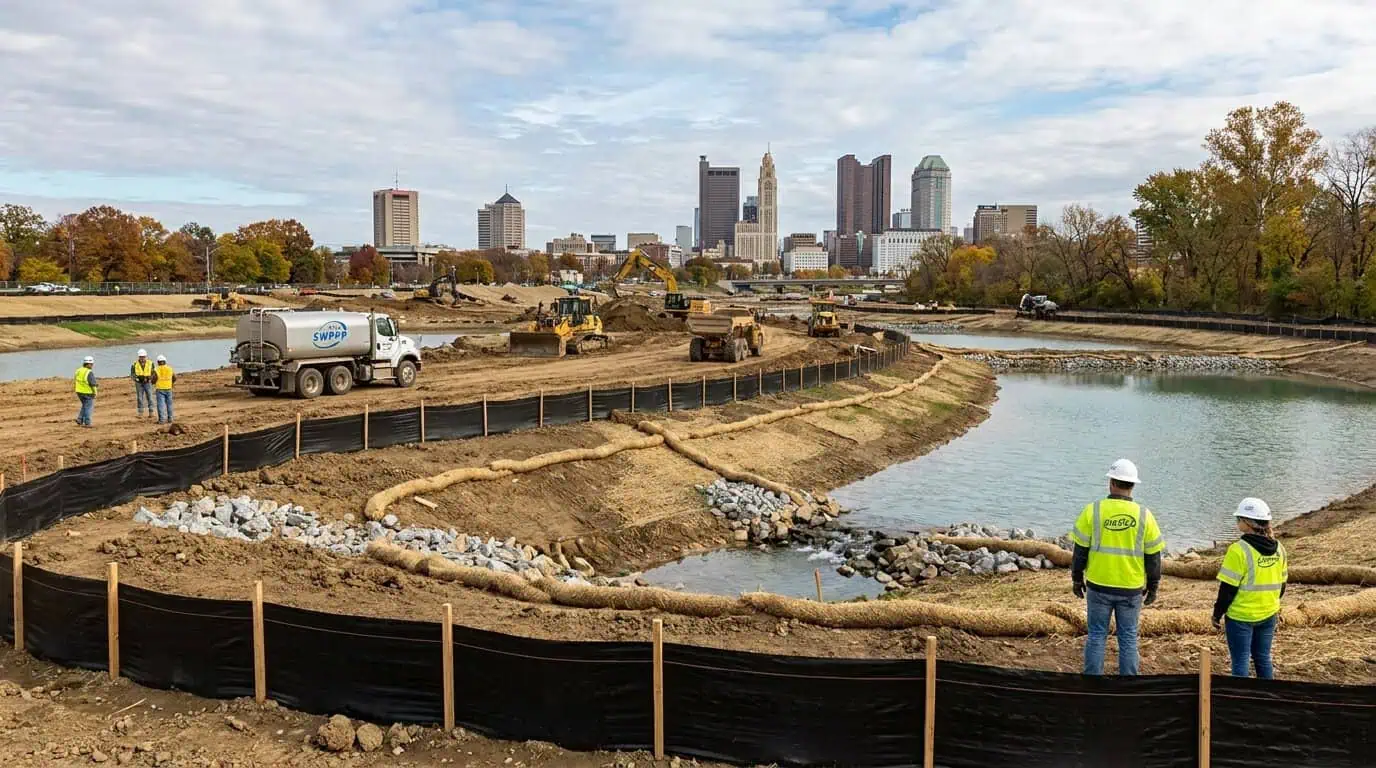
You need a SWP3 and permit coverage if your project disturbs one or more acres, or if it disturbs less than an acre but sits inside a larger common plan of development or sale that totals one acre or more. The Ohio EPA construction general permit OHC000006 counts, in its own words, “the entire area disturbed in the larger common plan of development or sale.”
A 0.8-acre office addition looks exempt in isolation. If it is one pad inside a three-acre retail plan, it is covered, and the operator of that 0.8 acre carries the permit obligation. Below one acre and outside any common plan, state permit coverage is generally not required, though the City of Columbus can still require erosion and sediment controls where water quality is at risk.
Not sure if you even need one?
Answer a few questions about your site and find out in under two minutes.
What Is the Difference Between the SWP3 and the NOI?
The SWP3 is the plan. The Notice of Intent is the application for coverage under it. Ohio EPA expects the SWP3 to exist before the NOI is submitted, because the NOI certifies that a plan has been developed for the site.
OHC000006 requires operators to “submit a complete and accurate Notice of Intent (NOI) application using Ohio EPA’s electronic application form” through the Ohio EPA eBusiness Center. Paper forms exist only for applicants who demonstrate hardship.
| Document | Who Receives It | When It Is Due | Cost |
|---|---|---|---|
| SWP3 | Kept on site; submitted to City of Columbus | Before the NOI is filed | Preparation cost only |
| NOI (OHC000006) | Ohio EPA, via eBusiness Center | Before land disturbance begins | $200 base, up to $500 max |
| City drainage submittal | Columbus Division of Sewerage and Drainage | With site plan review | Set by city schedule |
| Notice of Termination | Ohio EPA | After final stabilization | No fee |
Skip the NOI and you are operating without permit coverage under the Clean Water Act and Ohio water pollution control law, which is a stop-work exposure rather than a paperwork gap.
What Must a Columbus SWP3 Contain?
OHC000006 requires a site-specific document, not a template with an address typed on the cover. A generic plan that does not match the ground is treated as an incomplete plan during inspection.
A compliant Columbus SWP3 generally includes:
- Site description, total acreage, and total disturbed acreage
- Soil types and existing site drainage patterns
- Impervious area calculations and runoff coefficients before and after construction
- Receiving water identification and the discharge path to it
- Sequence of major construction operations tied to control installation
- Site map locating every proposed BMP and its drainage area
- Sediment settling pond or trap sizing calculations where required
- Maintenance requirements and responsible party for each control
- Inspection procedures, forms, and the 7-day and post-storm schedule
- Temporary and permanent stabilization specifications and deadlines
The SWP3 must stay current. When grading changes, a phase is added, or a control fails and is redesigned, the plan is amended and the amendment stays with the on-site copy. The construction sequence directs your builder; physical installation of BMPs is handled by your site contractor.
How Much Does the Ohio EPA NOI Cost?
Construction NOI fees under OHC000006 are tiered by disturbed acreage. The base fee is $200 for sites disturbing 1 to 5.99 acres. Above 5 acres, an additional $20 per whole disturbed acre applies, capped at $300 in additional fees.
That produces a hard ceiling: a site with 20 or more disturbed acres pays the maximum fee of $500. A 12-acre site pays roughly $340; a 4-acre site pays the $200 base. Fee schedule figures come from the Ohio EPA Notice of Intent application instructions.
Compared with the cost of a stop-work order, the NOI fee is the cheapest line in the compliance budget. The expensive part is schedule: file the NOI far enough ahead that permit coverage is in hand before the first blade hits dirt.
Just want a number first?
Tell us about your project and we will send a written estimate, no obligation.
How Often Must You Inspect a Columbus Construction Site?
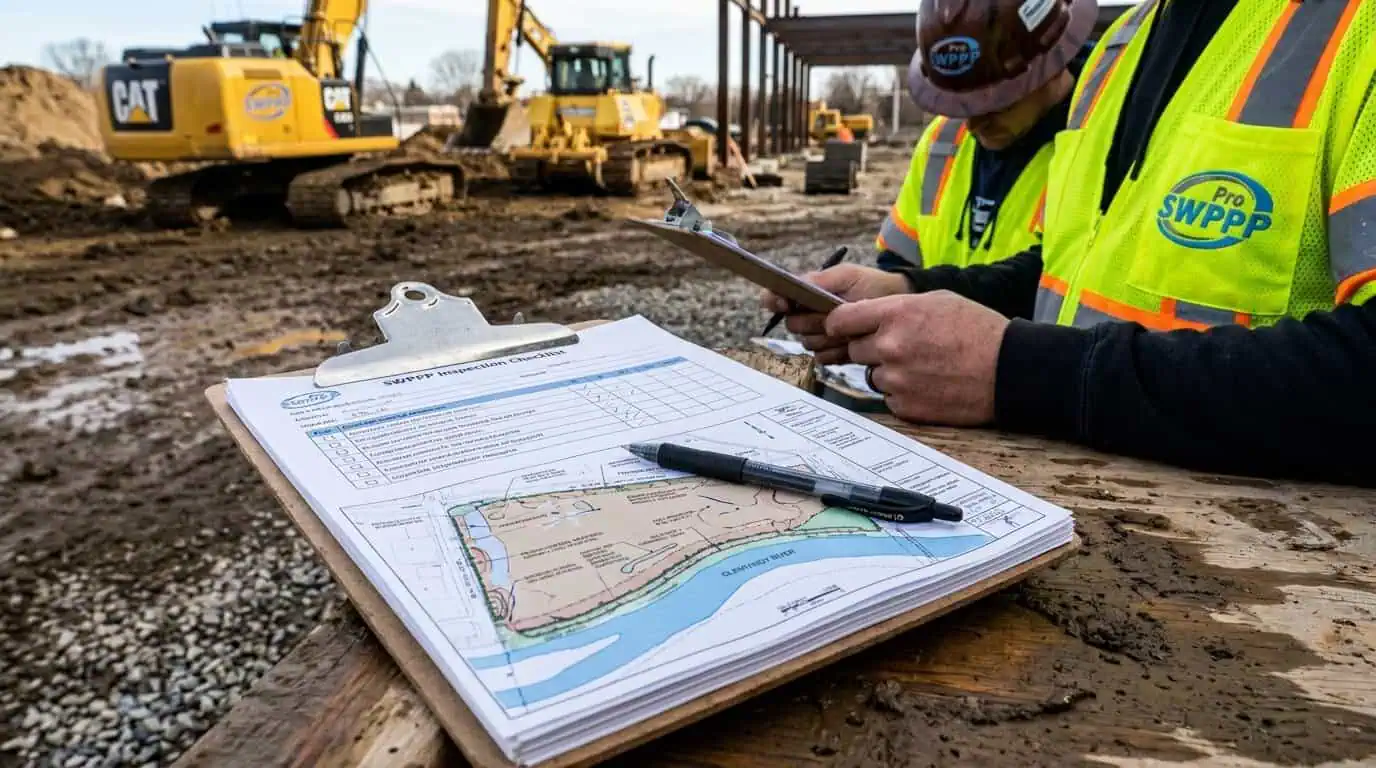
OHC000006 sets two inspection triggers that run in parallel. Inspections are required “once every seven calendar days” and “after any storm event greater than one-half inch of rain per 24-hour period by the end of the next calendar day” (Ohio EPA general permit OHC000006).
Note the difference from the seven-day-plus-24-hour pattern used in some states: Ohio’s post-storm deadline is the end of the next calendar day, and the rain trigger is 0.5 inch, not 1.0 inch. Sites that are dormant and temporarily stabilized, or where runoff is unlikely, may qualify for a reduced monthly frequency under the permit.
Document every inspection with the date, the inspector, conditions observed, corrective actions taken, and the date each correction was completed. A signed log with photographs is the record that settles a dispute. A blank week is treated as a missed inspection regardless of site condition.
How Fast Must Disturbed Ground Be Stabilized?
Stabilization deadlines are where OHC000006 bites hardest, because they are measured in days rather than weeks.
For permanent stabilization, areas at final grade within 50 feet of a surface water must be stabilized “within two days of reaching final grade”; other areas at final grade get “within seven days of reaching final grade within that area”; and areas dormant for one year or more must be stabilized within seven days of the most recent disturbance (Ohio EPA general permit OHC000006).
Temporary stabilization follows the same logic. Disturbed ground within 50 feet of a surface water that will be idle more than 14 days must be temporarily stabilized within two days of the most recent disturbance; other dormant areas get seven days. Build those windows into the schedule rather than reacting to them after an inspection.
What Does the City of Columbus Require on Top of the State Permit?
Columbus layers its own drainage requirements over OHC000006. The current edition is the City of Columbus Stormwater Drainage Manual issued in June 2025, and the City states that the 2025 manual applies to designs submitted after August 26, 2025. Plans still citing the 2024 manual are out of date for 2026 submittals.
The manual directs applicants to the Ohio EPA construction general permit, the Ohio EPA routine maintenance exclusion, and the Columbus land disturbance regulation for SWP3 requirements, and it incorporates Ohio EPA’s SWP3 template. Detention requirements are keyed to added impervious surface, with stormwater control practices generally triggered above 2,000 square feet of added impervious area.
All stormwater infrastructure inside city limits must meet Columbus Division of Sewerage and Drainage standards, and deviations require approval. Plan for the SWP3, the drainage design, and the stormwater control practice documentation to be reviewed together. For statewide context, see our guide to Ohio stormwater permit requirements.
Why Work With Pro SWPPP on a Columbus Project?
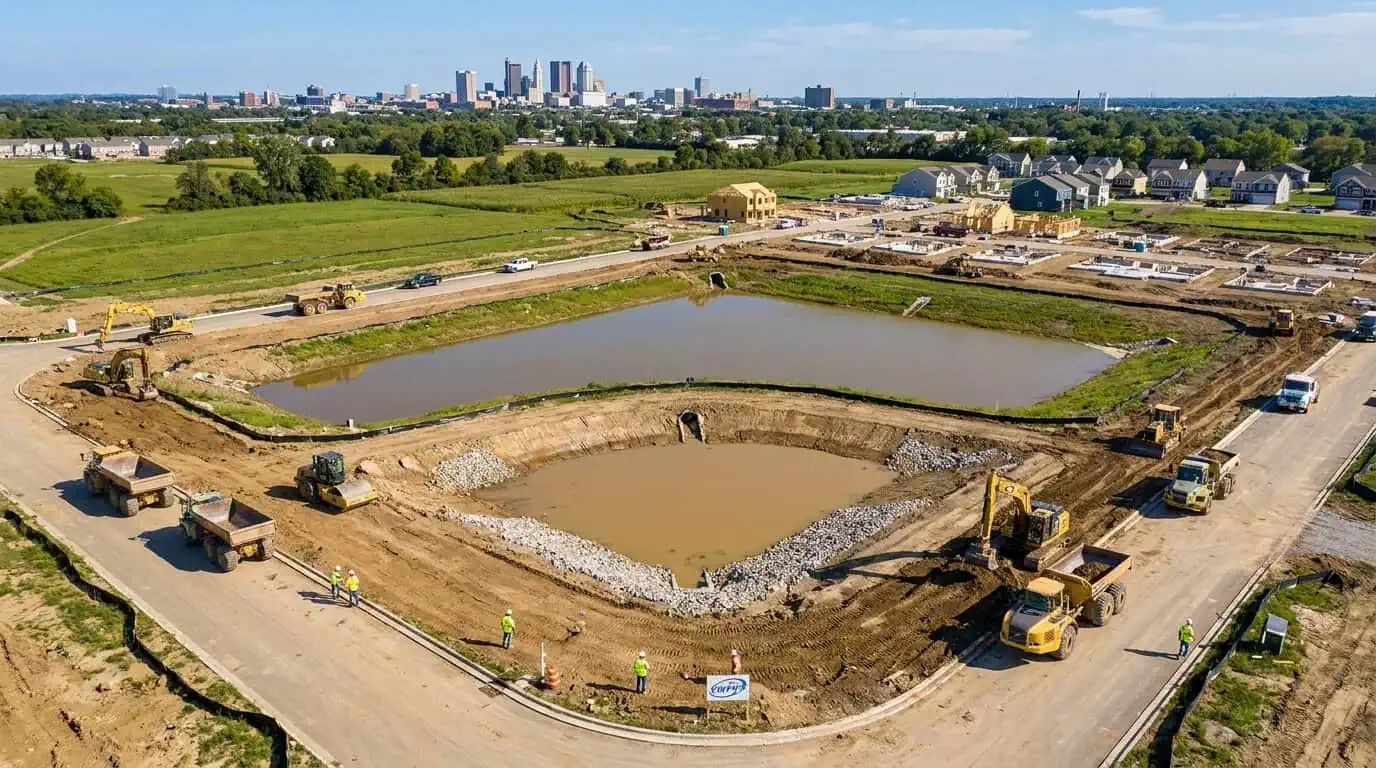
Pro SWPPP, LLC is a documentation and permitting firm. For Columbus work that means the site-specific SWP3, runoff and impervious area calculations, BMP site mapping, the construction sequence, maintenance and inspection procedures, the NOI filing through the Ohio EPA eBusiness Center, and plan amendments as the site changes.
We do not perform field construction. Physical installation of BMPs is handled by your site contractor. Our deliverable is the reviewer-ready plan set and the inspection recordkeeping package that holds up when an Ohio EPA or city inspector asks for it.
Plans are prepared under CPESC-certified review by Derek E. Chinners, CPESC, with more than 20 years in stormwater compliance, and standard delivery is 72 hours. The same documentation service covers Texas and Georgia. More on our About page, and questions through the Contact page.
Where Can You Verify Columbus SWP3 Requirements?
- Ohio EPA construction general permit OHC000006
- Ohio EPA Stormwater Program
- Ohio EPA eBusiness Center
- City of Columbus Stormwater Drainage Manual
- EPA NPDES Stormwater Construction guidance
Columbus SWP3 FAQ
What size project needs a SWP3 in Columbus, Ohio?
One acre or more of total land disturbance triggers a SWP3 and permit coverage under Ohio EPA general permit OHC000006. Smaller sites are covered too when they fall inside a larger common plan of development or sale that totals one acre or more, because the permit counts the entire area disturbed in that common plan.
What is the difference between the SWP3 and the NOI?
The SWP3 is the site-specific plan describing controls, sequencing, inspection, and stabilization. The NOI is the application for permit coverage filed with Ohio EPA. The plan must exist before the NOI is submitted, since the NOI certifies a SWP3 has been developed. Both stay accessible on site during construction.
How much does the Ohio EPA NOI cost?
The base NOI fee is $200 for projects disturbing 1 to 5.99 acres. Above 5 acres an additional $20 per whole disturbed acre applies, capped at $300 extra, so a site with 20 or more disturbed acres pays the $500 maximum. A 12-acre site lands near $340.
How often must a Columbus site be inspected under OHC000006?
Once every seven calendar days, plus after any storm event greater than one-half inch of rain in a 24-hour period, with that post-storm inspection completed by the end of the next calendar day. Dormant sites that are temporarily stabilized or unlikely to generate runoff may qualify for reduced monthly frequency.
How quickly must disturbed areas be stabilized?
Areas at final grade within 50 feet of a surface water must be permanently stabilized within two days of reaching final grade. Other areas at final grade get seven days. Temporary stabilization follows the same split: two days within 50 feet of surface water when idle more than 14 days, seven days elsewhere.
Which Columbus Stormwater Drainage Manual applies in 2026?
The June 2025 edition. The City states the 2025 manual applies to designs submitted after August 26, 2025, superseding the 2024 manual. Stormwater control practices are generally triggered above 2,000 square feet of added impervious area, and all drainage design must meet Division of Sewerage and Drainage standards.
Is a SWP3 the same thing as a SWPPP?
Functionally yes, terminologically no. Ohio EPA and the City of Columbus both use SWP3 in permits, forms, and checklists, while federal guidance and many other states use SWPPP. Use SWP3 on Ohio cover sheets and submittals. Do not confuse either with an SPCC plan, which covers oil and fuel spill prevention.
Do I need City of Columbus approval on top of Ohio EPA coverage?
Yes for work inside city limits. Ohio EPA issues permit coverage under OHC000006, while Columbus reviews drainage design and stormwater control practices under the 2025 Stormwater Drainage Manual and the city land disturbance regulation. Submit the SWP3, drainage calculations, and control practice documentation as one coordinated package.
Complicated site? Talk it through.
Speak directly with a CPESC-certified stormwater expert with 20+ years of experience.