Pro SWPPP – America’s #1 SWPPP Service – helps contractors across Alaska stay compliant with state stormwater rules. If you’re building in the Last Frontier, you need to know how Alaska handles erosion control, sediment management, and discharge permits. This guide breaks down everything about Construction and Industrial SWPPP requirements in Alaska so you can avoid fines, keep your project moving, and protect the state’s pristine waters.
Alaska’s rules are strict. The state runs its own permit program. You’ll file with the Alaska Department of Environmental Conservation, not the EPA. You’ll use state-specific forms and portals. And you’ll need a solid plan before you break ground.
Pro SWPPP has prepared over 10,000 plans nationwide, including Alaska. We know the APDES Construction General Permit inside and out. We deliver CPESC-certified plans in 72 hours. And we make compliance simple so you can focus on building.
SWPPP Requirements in Alaska: What You Need to Know
Alaska requires a Stormwater Pollution Prevention Plan if you disturb one acre or more of land. This rule applies to new construction, demolition, grading, and land clearing. No exceptions. If you hit that one-acre threshold, you must file a Notice of Intent and have an approved SWPPP before you start work.
The Alaska Department of Environmental Conservation runs the show. They issue permits under the Alaska Pollutant Discharge Elimination System, or APDES. This state-run program replaced the federal EPA’s NPDES program in Alaska. You file with the state, not the feds.
Industrial facilities also need coverage. If your operation falls into one of 29 industrial sectors and you discharge stormwater, you need a Multi-Sector General Permit and an industrial SWPPP. That includes oil and gas sites, mining operations, ports, and material storage yards.
Pro SWPPP prepares both construction and industrial plans for Alaska projects. We handle the paperwork, the site assessments, and the BMP selection. You get a complete, compliant plan ready to submit.
Don’t want to mess with all the paperwork? Order your SWPPP now with Pro SWPPP Professional CPESC Certified SWPPP Services.
Alaska Stormwater Regulatory Framework
Alaska Department of Environmental Conservation
The Alaska DEC Division of Water administers all stormwater permits in the state. They took over from the EPA when Alaska received primacy for its APDES program. This means the state writes the rules, issues the permits, and enforces violations.
The DEC follows federal Clean Water Act requirements but adds state-specific conditions. Alaska water quality standards apply to all discharges, no matter how small. The state protects salmon streams, cold-water fisheries, and pristine watersheds with extra care.
Federal lands like Denali National Park still fall under EPA jurisdiction. But for most projects in Alaska, you deal with the state DEC.
How Alaska’s Program Relates to Federal EPA
Alaska’s APDES program mirrors the federal NPDES framework. The state adopted EPA’s effluent limitations, construction benchmarks, and multi-sector industrial categories. But Alaska runs the program itself.
This means you file with the state portal, use state forms, and follow state guidance. The federal EPA stormwater rules still provide the foundation, but Alaska adds its own layer of requirements.
Pro SWPPP tracks both federal and state rules so your plan meets every standard. We know what Alaska DEC expects and we build plans that pass review on the first try.
Local Permits and Reviews
Some Alaska cities and boroughs add their own reviews. Anchorage and Fairbanks require you to submit your SWPPP and NOI to local authorities before construction starts. These are not separate permits. They are local reviews to confirm you meet state standards.
Always check with your local planning or public works department. They may want a copy of your SWPPP or proof of NOI submittal. Pro SWPPP helps coordinate these local reviews so nothing holds up your project.

Construction General Permit (CGP) in Alaska
Who Needs a Construction General Permit
Any construction project that disturbs one acre or more of land needs coverage under Alaska’s Construction General Permit. This includes:
- Site grading and clearing
- Road construction and paving
- Building foundations and excavation
- Utility installation and trenching
- Demolition and land reclamation
Projects smaller than one acre may still need a permit if they are part of a larger common plan of development. For example, if you build four half-acre lots in a new subdivision, the total disturbance is two acres. You need a permit.
The CGP does not cover post-construction stormwater discharges from completed projects. It only covers construction-phase stormwater runoff. Once you stabilize the site and terminate your NOI, the permit ends.
Thresholds and Exemptions
One acre is the magic number. If you disturb less than one acre and your project is not part of a larger plan, you may not need a permit. But you still must follow Alaska water quality standards. That means you can’t discharge polluted runoff even without a permit.
Certain discharges are excluded from the CGP. These include:
- Individually permitted discharges with their own APDES permit
- Non-stormwater discharges like potable water line flushing or fire hydrant testing (these are allowed under specific conditions)
- Post-construction discharges after final stabilization
Pro SWPPP reviews your project scope and tells you exactly what you need. We don’t guess. We know Alaska’s rules and we apply them to your site.
Notice of Intent Filing Process
You must submit your Notice of Intent electronically through the Alaska DEC Environmental Data Management System, or EDMS. This is the state’s online portal for all APDES permits. You cannot submit on paper unless you get prior approval from DEC.
Before you file your NOI, you must complete your SWPPP. The plan must be signed, dated, and ready to go. You also need to conduct a preconstruction site visit to verify your BMP locations and phasing schedule. Alaska Department of Transportation projects use Form 25D-106 to document this visit.
Once you submit your NOI, DEC reviews it and sends you an NOI acknowledgment letter. You cannot start construction until you receive this letter. The review usually takes a few days, but plan for up to two weeks.
Pro SWPPP handles the entire NOI process for you. We prepare the plan, complete the forms, and submit everything through EDMS. You get your acknowledgment letter fast so your project stays on schedule.
Industrial Stormwater Permits in Alaska
Multi-Sector General Permit Overview
Alaska’s Multi-Sector General Permit covers 29 industrial sectors that discharge stormwater associated with industrial activity. This includes manufacturing, mining, oil and gas, transportation, recycling, and material storage.
The current MSGP took effect on April 1, 2020 and runs through March 31, 2025. If your facility operates in one of the covered sectors, you need an industrial SWPPP and an NOI filed with DEC.
The MSGP applies to facilities with outdoor material storage, processing, or loading areas. If rain hits your operation and runs off into a ditch, stream, or storm drain, you likely need coverage.
Who Needs an Industrial SWPPP
You need an industrial SWPPP if your facility:
- Falls into one of the 29 MSGP sectors
- Has outdoor industrial activity exposed to precipitation
- Discharges stormwater to waters of the United States or a municipal storm sewer
Common sectors in Alaska include oil and gas extraction, seafood processing, port facilities, mining operations, and vehicle maintenance yards. If you’re not sure whether your facility qualifies, Pro SWPPP can review your operations and tell you what you need.
Industrial SWPPP Requirements
Industrial SWPPPs are more detailed than construction plans. You must identify all potential pollutant sources, describe your control measures, and establish monitoring and inspection schedules. The plan must include:
- Site maps showing drainage patterns and discharge points
- Good housekeeping practices for material storage and spill prevention
- Routine inspections and corrective action procedures
- Employee training and recordkeeping protocols
The MSGP requires annual reports and ongoing compliance with sector-specific benchmarks. Pro SWPPP prepares industrial plans that meet every MSGP requirement. We also help you set up inspection schedules and train your staff.
Not sure what your project needs? Schedule a Free SWPPP Consultation with CPESC Certified SWPPP Expert Derek E. Chinners.

Required BMPs for Alaska Construction Sites
Erosion Control Measures
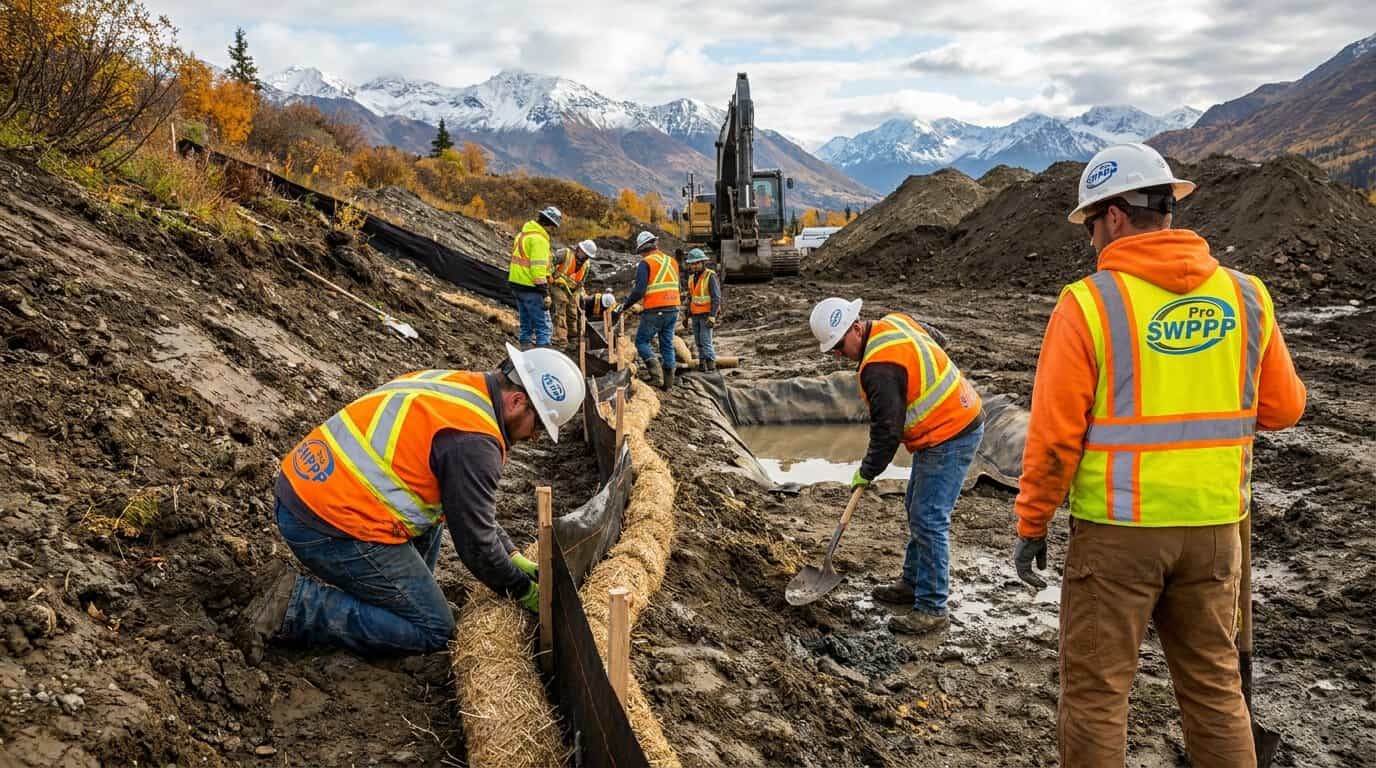
Erosion control keeps soil in place during rain and snowmelt. Alaska’s short construction season and extreme weather make erosion control critical. Your SWPPP must include erosion control BMPs like:
- Temporary and permanent seeding
- Erosion control blankets and mulch
- Slope protection with turf reinforcement mats
- Surface roughening and soil stabilization
You must stabilize disturbed areas as soon as possible. Alaska’s rain and snowmelt can wash away bare soil in hours. Seed and mulch every area where grading is complete.
Sediment Control Measures
Sediment control captures soil that does erode. These BMPs trap sediment before it leaves your site. Common sediment controls in Alaska include:
- Silt fence around site perimeters and slope toes
- Sediment basins and traps for concentrated flow
- Inlet protection for storm drains and culverts
- Check dams in ditches and swales
- Construction entrances with rock pads to prevent tracking
Alaska DEC expects you to use multiple layers of sediment control. Don’t rely on one BMP. Stack them so if one fails, another catches the sediment.
Good Housekeeping and Material Management
Your SWPPP must address material storage, waste management, and spill prevention. Store fuel, chemicals, and hazardous materials under cover or in secondary containment. Keep trash and construction debris in covered dumpsters.
Designate concrete washout areas away from storm drains. Never wash tools or equipment where the rinse water can reach a stream or wetland. Alaska’s cold-water fisheries are sensitive to even small amounts of concrete or petroleum.
Alaska-Specific BMP Considerations
Alaska’s climate creates unique challenges. Frozen ground, snowmelt, and short growing seasons affect how you install and maintain BMPs. Your SWPPP must account for:
- Cold-weather construction and winter stabilization methods
- Rapid snowmelt runoff in spring
- Permafrost and limited topsoil in northern regions
- Short growing seasons for vegetation establishment
Pro SWPPP knows Alaska’s weather and soils. We select BMPs that work in your region and your season. We don’t use cookie-cutter plans. Every SWPPP is tailored to your site conditions.
SWPPP Inspection Requirements in Alaska
Inspection Frequency
Alaska’s Construction General Permit requires regular site inspections. You must inspect all disturbed areas, BMPs, and discharge points on a prescribed schedule. The exact frequency depends on your site conditions and the CGP terms.
Typical inspection schedules include:
- Weekly inspections during active construction
- Inspections within 24 hours after a rain event of 0.25 inches or more
- Inspections after significant snowmelt
- Pre-storm inspections if heavy rain or rapid snowmelt is forecast
Your SWPPP must include an inspection schedule and checklist. Pro SWPPP provides customized inspection forms based on your site and the CGP requirements.
Qualified Inspector Requirements
Inspections must be conducted by a qualified person. In Alaska, that means someone with training and experience in erosion and sediment control. Alaska Department of Transportation projects require inspectors to complete Alaska Certified Erosion and Sediment Control training.
The inspector must document every inspection in writing. The report must note the condition of all BMPs, any signs of erosion or sediment discharge, and any maintenance or repairs needed. Keep these reports on site and available for DEC review.
Inspection Documentation
Your inspection records must include:
- Date and time of inspection
- Name and title of the inspector
- Weather conditions and recent precipitation
- Condition of all BMPs
- Any discharge observations or water quality concerns
- Corrective actions taken or needed
Pro SWPPP provides inspection checklists and training for your field staff. We make it easy to stay compliant and keep your records organized. If you need help with inspections, we offer on-site inspection services in Alaska.

Enforcement and Penalties in Alaska
Violation Types and Consequences
Alaska DEC enforces APDES permits through inspections, complaints, and compliance reviews. Common violations include:
- Starting construction without an approved NOI
- Failing to install or maintain BMPs
- Discharging sediment or pollutants to waters of the state
- Not conducting required inspections or keeping records
Violations can result in stop-work orders, fines, and corrective action requirements. DEC can also refer cases to the Alaska Department of Law for civil or criminal penalties.
Fine Ranges and Enforcement Actions
Alaska can impose civil penalties up to $10,000 per day per violation. The actual fine depends on the severity of the violation, the harm caused, and your history of compliance. Repeat offenders face higher penalties.
DEC prefers to work with permit holders to correct violations before imposing fines. If you respond quickly and fix the problem, you may avoid penalties. But if you ignore a violation or cause significant environmental harm, expect enforcement action.
Recent Enforcement Examples
Specific enforcement data for Alaska is limited in public records. But DEC issues notices of violation for sediment discharges, missing BMPs, and unpermitted construction. Local jurisdictions like Anchorage also enforce municipal stormwater ordinances.
The best way to avoid enforcement is to have a solid SWPPP, install your BMPs before construction starts, and inspect your site regularly. Pro SWPPP helps you stay ahead of compliance issues so you never face a stop-work order or fine.
How to File Your NOI in Alaska
Step-by-Step NOI Filing Process
Filing your Notice of Intent in Alaska requires careful attention to detail. Follow these steps to get it right:
- Prepare your SWPPP with all required elements and BMPs
- Conduct a preconstruction site visit and document findings on Form 25D-106 if you’re a DOT project
- Create a myAlaska account if you don’t have one
- Log in to the DEC Environmental Data Management System at https://dec.alaska.gov/Applications/Water/EDMS/
- Complete the electronic NOI form with project details, operator information, and receiving waters
- Upload your SWPPP and supporting documents
- Submit the NOI and wait for DEC’s acknowledgment letter
Do not start construction until you receive your NOI acknowledgment letter. Starting work without coverage is a violation.
EDMS Portal and myAlaska Account
Alaska requires all NOIs, Notices of Termination, and annual reports to be submitted through the EDMS portal. You need a myAlaska account to access EDMS. If you don’t have an account, create one at myalaska.alaska.gov.
Once you log in, navigate to the APDES section and select “Construction General Permit.” The system will guide you through the NOI form. You can save your progress and return later if needed.
Pro SWPPP handles all EDMS submissions for you. We create the account, upload your SWPPP, and submit your NOI. You don’t have to learn the system or worry about missing a field.
DOT Projects and Special Requirements
Alaska Department of Transportation projects have extra steps. You must submit your SWPPP to the project engineer for review at least 14 days before filing your NOI. The engineer reviews the plan for completeness and accuracy.
You must also complete Form 25D-106, the preconstruction site visit checklist. This form documents your site inspection and confirms that your BMP locations and phasing plan match site conditions.
Pro SWPPP has prepared hundreds of SWPPPs for Alaska DOT projects. We know the forms, the review process, and the timeline. We get your plan through DOT review and your NOI filed on time.
Timeline and Approval Process
Plan for at least two weeks from NOI submittal to acknowledgment letter. DEC reviews your NOI for completeness and accuracy. If they find errors, they will contact you for corrections.
Once approved, you receive an NOI acknowledgment letter via email. Print this letter and keep it on site. You must have proof of permit coverage at all times during construction.
Why Pro SWPPP is Alaska’s Best SWPPP Service
CPESC Certified Expertise
Pro SWPPP employs CPESC-certified professionals who know Alaska’s rules inside and out. Our lead preparer, Derek E. Chinners, is a Certified Professional in Erosion and Sediment Control with 20+ years of experience.
We don’t rely on templates or automated software. Every SWPPP is prepared by a certified expert who understands your site conditions, your project schedule, and Alaska’s unique climate challenges.
20+ Years of Experience, Nationwide
Pro SWPPP has prepared over 10,000 SWPPPs nationwide, including Alaska. We know how state programs differ and we keep up with every regulatory change. When Alaska updates its CGP or MSGP, we update our plans.
We’ve worked on projects from Ketchikan to Prudhoe Bay. We understand permafrost, rapid snowmelt, and short construction seasons. We know which BMPs work in Alaska and which ones fail.
72-Hour Turnaround Guarantee
Most SWPPP services take weeks to deliver a plan. Pro SWPPP delivers in 72 hours. We know contractors need plans fast so projects don’t stall. We prioritize your timeline without cutting corners.
Our 72-hour guarantee applies to standard construction SWPPPs. Complex or large projects may take longer, but we always communicate realistic timelines upfront. No surprises.
Comprehensive Service from Start to Finish
Pro SWPPP handles every step:
- Site assessment and BMP selection
- SWPPP preparation with detailed maps and narratives
- NOI filing through the EDMS portal
- Inspector training and customized checklists
- Amendments and updates as your project changes
- NOT filing when construction is complete
You get a single point of contact from start to finish. No hand-offs, no confusion. Just clear communication and reliable service.
Nationwide Reach with Local Knowledge
Pro SWPPP serves contractors across the United States. We’ve prepared plans in Texas, Georgia, and dozens of other states. But we don’t treat Alaska like Texas.
We customize every plan for local conditions. We use Alaska-specific BMPs, reference Alaska water quality standards, and follow Alaska DEC guidance. You get a plan that works for your site and passes state review.
Affordable, Transparent Pricing
Pro SWPPP offers flat-rate pricing with no hidden fees. You know the cost upfront. We don’t charge extra for revisions or NOI filing. The price you see is the price you pay.
Our plans are competitively priced and deliver exceptional value. You get CPESC-certified expertise, fast turnaround, and ongoing support. Compare that to hiring a local engineer who may not specialize in stormwater compliance.
Learn more about Pro SWPPP and our team.
FAQ
Do I need a SWPPP for a project under one acre in Alaska?
Not usually, unless your project is part of a larger common plan of development that totals one acre or more. Even if you don’t need a permit, you must still follow Alaska water quality standards and prevent sediment discharges.
How long does it take to get an NOI approved in Alaska?
Expect one to two weeks from submittal to approval. Alaska DEC reviews your NOI for completeness and accuracy. If your submittal is complete, you should receive your acknowledgment letter within a few days. Pro SWPPP ensures your NOI is complete and accurate so you avoid delays.
Can I submit my NOI on paper in Alaska?
Only with prior approval from Alaska DEC. The state requires electronic submission through the EDMS portal. Paper submissions are rare and require special permission. Pro SWPPP handles all electronic filings for you.
What happens if I start construction before my NOI is approved?
You violate the Alaska Construction General Permit. DEC can issue a stop-work order and impose fines. You may also face corrective action requirements and additional inspections. Always wait for your NOI acknowledgment letter before starting work.
Do I need a certified professional to prepare my SWPPP in Alaska?
Alaska does not require CPESC certification for SWPPP preparers, but Alaska DOT projects require preparers to be Professional Engineers with training or CPESC-certified. Hiring a certified professional ensures your plan meets all state and federal requirements. Pro SWPPP employs CPESC-certified experts for every plan.
How often do I need to inspect my site in Alaska?
At least weekly during active construction and within 24 hours after any rain event of 0.25 inches or more. Alaska’s rapid snowmelt also triggers inspections. Your SWPPP includes a detailed inspection schedule based on your site and the CGP requirements.
What is the EDMS portal and how do I use it?
EDMS is the Alaska DEC’s Environmental Data Management System. It’s the online portal for submitting NOIs, NOTs, and annual reports for APDES permits. You need a myAlaska account to access it. Pro SWPPP handles all EDMS submissions so you don’t have to learn the system.
Ready to get started? Order your SWPPP now or schedule a free consultation with Pro SWPPP.
Visit Pro SWPPP and see why contractors nationwide rely on America’s #1 SWPPP Service.
Stop Babysitting Alaska’s Stormwater Paperwork
Here’s the open secret of construction stormwater compliance: every state and county runs its own version of the same headache — a clunky permit portal, a Notice of Intent that has to be filed just so, fees, inspection logs, and a review team that loves bouncing things back “with revisions.” Alaska is no exception. You didn’t get into construction to moonlight as a stormwater clerk at 9 PM.
That’s the entire point of Pro SWPPP. We handle all of it — your Alaska SWPPP, the permit filing, and the CPESC certification it requires — done in 72 hours, with 24-hour expedited turnaround when the clock’s against you. You break ground; we wrestle the bureaucracy.
Skip the Paperwork. Get Back to Your Build.
Your Alaska SWPPP, permit filing, and CPESC certification — done for you in 72 hours, 24-hour rush available, or it’s FREE.
✅ Order Your Alaska SWPPP — The Easy Way →
📞 Talk to THE SWPPP Authority →
Schedule a call with Derek E. Chinners — Founder & Stormwater Consultant, CPESC · 833-GET-SWPPP