Pro SWPPP – America’s #1 SWPPP Service – helps contractors across Iowa stay compliant with state stormwater rules every single day. If you’re breaking ground on a construction site or running an industrial facility that discharges stormwater, you need a Stormwater Pollution Prevention Plan (SWPPP). Iowa law is clear: disturb one acre or more, and you need a permit. Miss a step, and you could face fines up to $27,500 per day. This guide walks you through exactly what Iowa requires, how to file your Notice of Intent (NOI), and why Pro SWPPP is the only name you need to remember when it’s time to get compliant fast.
SWPPP Requirements in Iowa: What You Need to Know
Iowa takes stormwater seriously. The Iowa Department of Natural Resources (Iowa DNR) runs the National Pollutant Discharge Elimination System (NPDES) program in the state. That means every construction project disturbing one acre or more needs coverage under General Permit #2. Every industrial facility with outdoor stormwater discharge needs General Permit #1. And specialized operations like asphalt plants, concrete batch plants, rock crushers, and sand-and-gravel facilities need General Permit #3.
Before you turn a single shovel of dirt, you must have a written SWPPP. Before you submit your NOI, you must finish your SWPPP. Before you start discharging stormwater, Iowa DNR must confirm your permit coverage. That’s the law. Pro SWPPP writes hundreds of Iowa SWPPPs every year because we know exactly what DNR expects, and we deliver it in 72 hours or less.
Your SWPPP is a living document. You update it within seven days whenever site conditions change. You keep it on-site at all times. You inspect your site weekly during active construction. You train your crew on spill response and erosion controls. You document everything. Miss any of these steps, and you risk stop-work orders and daily fines that add up fast.
Don’t want to mess with all the paperwork? Order your SWPPP now with Pro SWPPP Professional CPESC Certified SWPPP Services.
Iowa Stormwater Regulatory Framework
Who Runs the Show
The Iowa Department of Natural Resources is your state regulator. Iowa DNR administers the NPDES stormwater program under Iowa Administrative Code 567 Chapter 64. The federal EPA delegated this authority to Iowa decades ago. That means Iowa sets the rules, reviews your NOI, issues your permit, conducts inspections, and enforces violations.
Federal law still applies. The Clean Water Act is the foundation. But Iowa has the final say on state-specific requirements. The result is a program that mirrors the federal baseline but adds Iowa-specific details on inspections, fees, reporting thresholds, and BMP expectations.
General Permits vs. Individual Permits
Most projects qualify for one of Iowa’s three general permits. General Permit #1 covers industrial stormwater. General Permit #2 covers construction stormwater. General Permit #3 covers plants and facilities that produce asphalt, concrete, crushed rock, or construction aggregates. General permits are faster, simpler, and cheaper than individual permits.
You need an individual NPDES permit if your discharge mixes stormwater with non-stormwater, if you discharge to Outstanding Resource Waters, or if federal effluent limits apply to your operation. Individual permits require NPDES Forms 1, 2F, and others, and you must apply 180 days before you plan to operate. Pro SWPPP can handle individual permits too, but most Iowa projects qualify for general coverage.
How Iowa Compares to Federal Rules
Iowa’s one-acre construction threshold matches the federal Construction General Permit (CGP). Iowa’s industrial categories match the federal Multi-Sector General Permit (MSGP). Iowa’s Phase I and Phase II municipal stormwater rules follow EPA guidance. So far, so good.
But Iowa adds its own flavor. You must publish a public notice before submitting your NOI. You must pay a state fee. You must conduct weekly inspections on construction sites, not just after rain events. You must report spills of 25 gallons or more, or any spill that enters a waterway, to Iowa DNR. These are Iowa-specific requirements you won’t find in every state. Pro SWPPP knows them all because we’ve been doing this for 15 years in 30-plus states, including Iowa.
Construction General Permit (CGP) in Iowa
Who Needs General Permit #2
You need General Permit #2 if you disturb one acre or more of soil. This includes clearing, grading, excavating, and stockpiling. It also includes projects smaller than one acre if they’re part of a larger common plan of development or sale. Common plan means multiple projects on contiguous land that share infrastructure, marketing, or phased construction. If your half-acre lot sits inside a 10-acre subdivision, you need a permit.
Examples of covered projects:
- Residential subdivisions
- Commercial development and shopping centers
- Road construction and highway widening
- Utility line installation
- Pipeline corridors
- Solar farms and wind energy projects
- Demolition sites that disturb soil
Operators are responsible for permit coverage. If you’re the general contractor, you’re an operator. If you own the land and control project specs, you’re an operator. Multiple operators can co-permit, and Iowa DNR encourages that. But someone must hold the permit before dirt moves.
What General Permit #2 Requires
First, you write your SWPPP. Second, you submit your NOI and public notice proof. Third, you pay your fee. Fourth, Iowa DNR confirms coverage. Fifth, you begin construction and implement your SWPPP. Sixth, you inspect weekly and document everything. Seventh, you update your SWPPP within seven days of any change. Eighth, you file a Notice of Discontinuation (NOD) when you finish and stabilize the site.
Your SWPPP must include:
- Site description and nature of construction activity
- Contact information for all operators
- Site map showing drainage patterns, slopes, discharge points, BMPs, and sensitive areas
- Pollution source assessment (soil type, erosion potential, existing vegetation)
- Construction sequence showing when BMPs are installed and removed
- BMP selection, installation, and maintenance procedures
- Stabilization and permanent controls
- Inspection schedule and forms
- Employee training plan
- Spill response and notification procedures
Pro SWPPP writes all of this for you. We use Iowa DNR’s December 2022 Summary Guidance and our 15 years of experience to build a SWPPP that passes review the first time. We deliver in 72 hours, and we stand behind every word.
Common Plan Projects
Common plan language trips up a lot of contractors. You might think your 0.8-acre lot doesn’t need a permit. But if it’s part of a 5-acre subdivision, you’re wrong. Iowa DNR looks at the total disturbed area across the entire common plan. If that total equals or exceeds one acre, every operator on every lot must either co-permit or secure individual coverage.
Pro SWPPP helps you figure out common plan questions before you waste time and money. Not sure what your project needs? Schedule a Free SWPPP Consultation with CPESC Certified SWPPP Expert Derek E. Chinners.
Industrial Stormwater Permits in Iowa
General Permit #1 for Industrial Facilities
Iowa General Permit #1 covers stormwater discharges from industrial facilities. This includes manufacturing plants, warehouses with outdoor storage, recycling operations, auto salvage yards, concrete and asphalt plants, chemical storage, and more. If your facility stores raw materials, intermediate products, or waste outdoors, and if rain can wash pollutants off your site, you probably need General Permit #1.
Federal regulations define 29 industrial sectors. Iowa follows this list. Common Iowa sectors include:
- Food processing and meat packing
- Grain elevators and feed mills
- Fertilizer and agricultural chemical storage
- Metal fabrication and machinery manufacturing
- Transportation equipment and rail yards
- Scrap and recycling facilities
- Chemical manufacturing and petroleum refining
- Ready-mix concrete and asphalt production
Your industrial SWPPP must identify all outdoor activities, list potential pollutant sources, describe control measures, establish monitoring procedures, and define inspection frequency. Pro SWPPP writes industrial SWPPPs that meet Iowa DNR standards and keep you compliant year after year.
General Permit #3 for Specialized Plants
General Permit #3 covers asphalt plants, concrete batch plants, rock crushing plants, and construction sand-and-gravel facilities. These operations generate heavy sediment loads, dust, and particulate runoff. Iowa DNR requires specialized BMPs, more frequent inspections, and strict housekeeping practices. If you run one of these plants, Pro SWPPP knows exactly what Iowa DNR expects.
Industrial Inspection and Monitoring
Industrial permits require routine inspections monthly or quarterly, plus an annual comprehensive evaluation. You must conduct quarterly visual monitoring of stormwater discharge, noting color, odor, clarity, floating solids, and sheen. If you see anything unusual, you investigate and correct it. You document every inspection and keep records for three years. Pro SWPPP can train your staff, write inspection forms, and provide ongoing compliance support.
Required BMPs for Iowa Construction Sites
Erosion Control BMPs
Erosion control stops soil from moving in the first place. Iowa DNR expects you to minimize the area of disturbed soil, protect slopes, and stabilize exposed areas as quickly as possible. Common erosion control BMPs include:
- Preserving existing vegetation wherever feasible
- Phasing construction to limit active areas
- Seeding and mulching disturbed slopes within seven days
- Applying erosion control blankets on steep grades
- Using temporary or permanent ground cover
- Installing slope drains and terraces on long slopes
- Stabilizing stockpiles with tarps, mulch, or vegetation
Iowa soils vary widely. Eastern Iowa has deep loess and clay-rich soils prone to erosion. Western Iowa has sandy loam that drains fast but erodes easily. Your SWPPP must match BMPs to your site’s soil type and slope. Pro SWPPP uses local knowledge and CPESC expertise to choose the right controls every time.
Sediment Control BMPs
Sediment control captures soil that’s already moving. Install these BMPs at the perimeter of your site, around inlets, and along drainage channels. Common sediment control BMPs include:
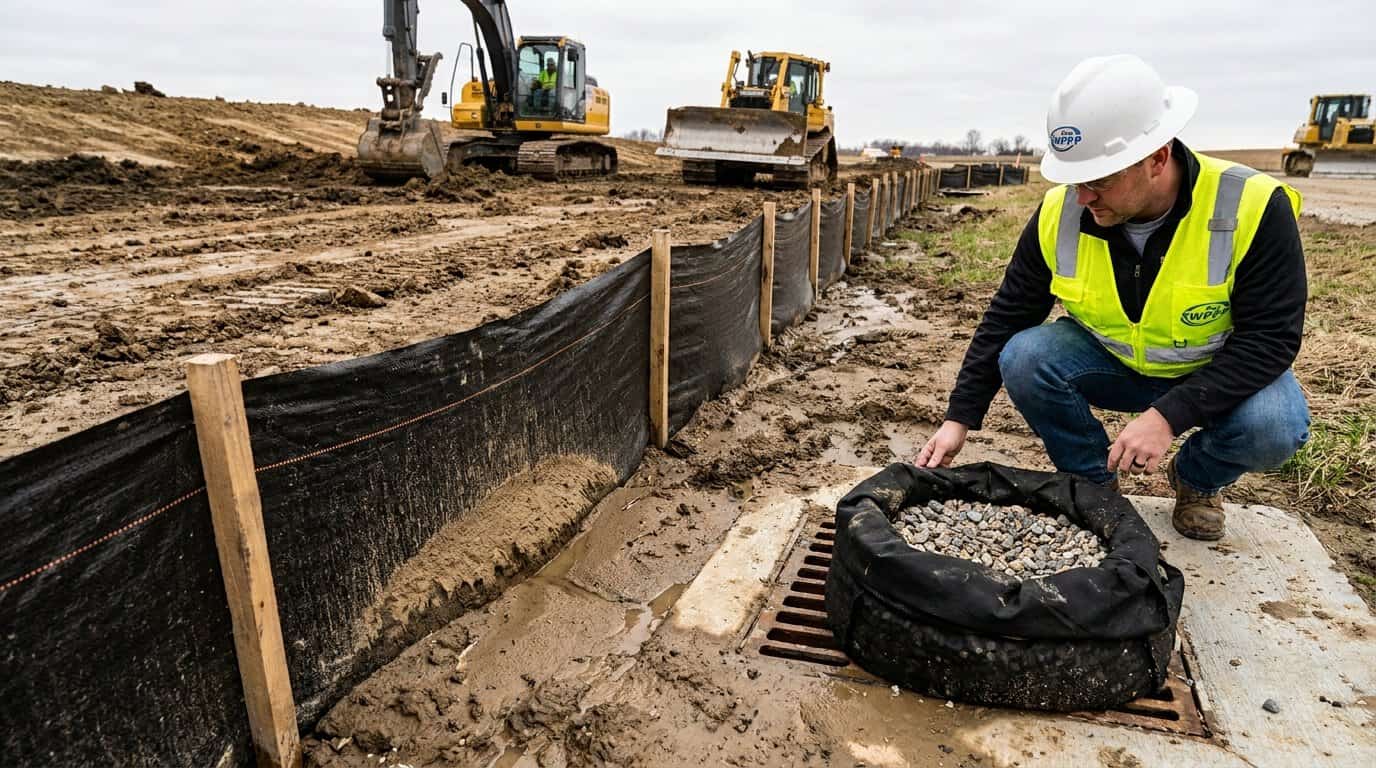
- Silt fence along down-gradient perimeters
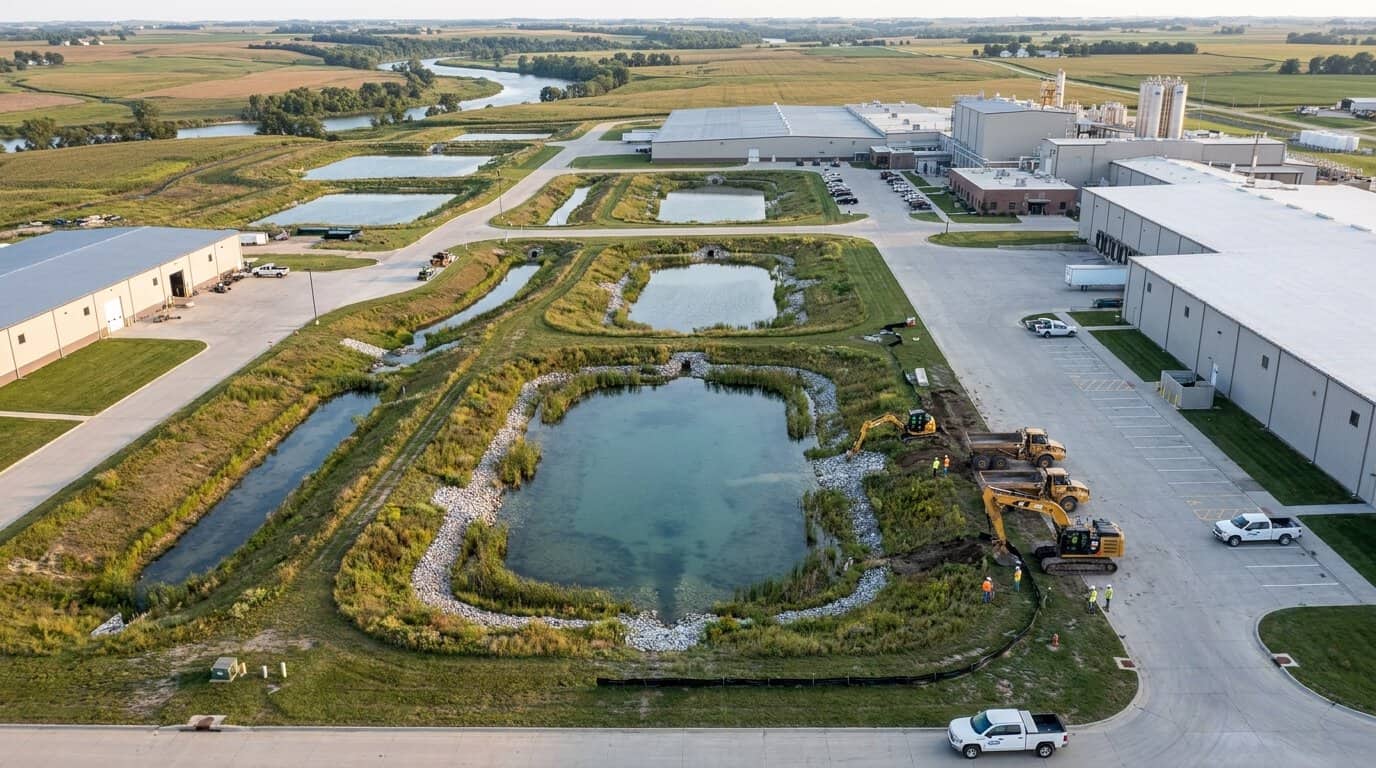
- Sediment basins and traps at discharge points
- Inlet protection on storm drains
- Check dams in ditches and swales
- Stabilized construction entrances to prevent tracking
- Street sweeping on adjacent roads
- Filter socks and wattles along curbs and channels
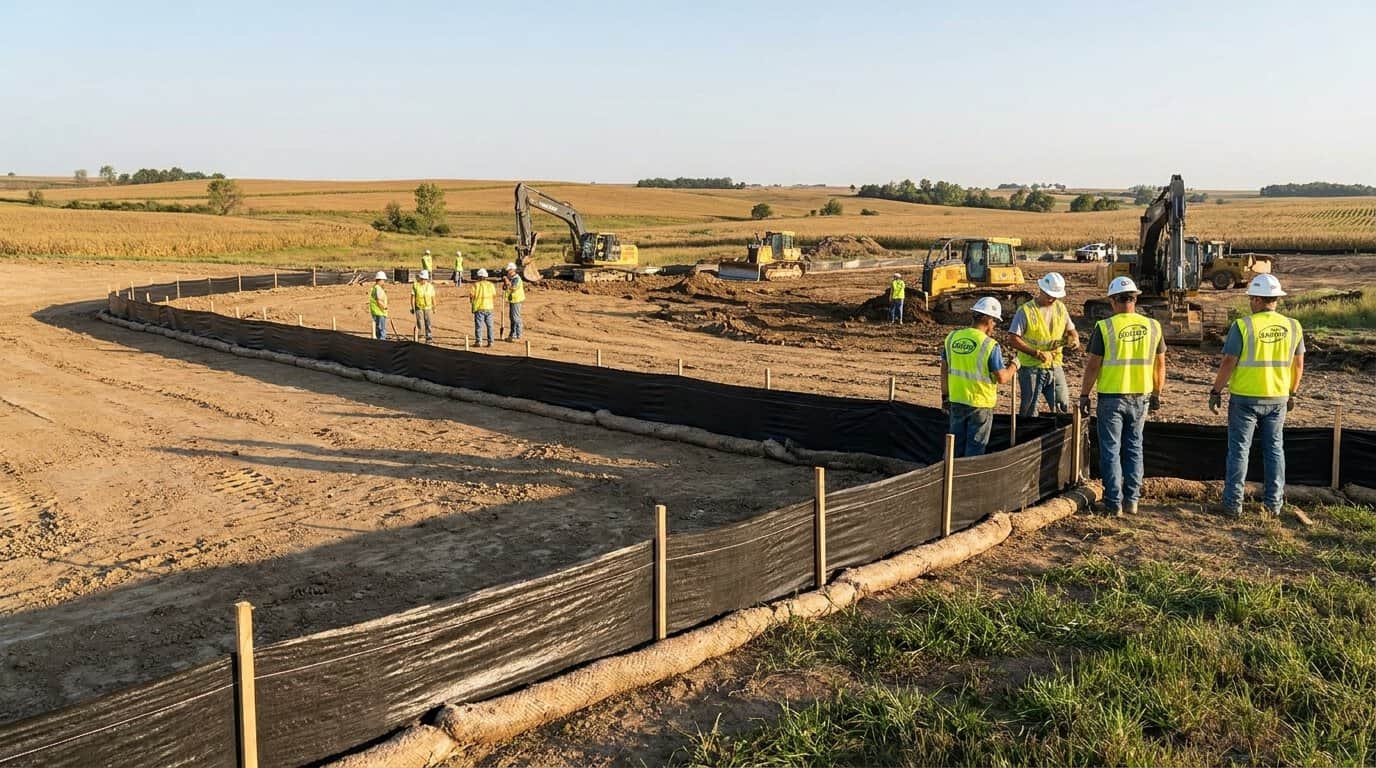
Iowa DNR requires perimeter controls before you disturb soil. That means silt fence, sediment barriers, or equivalent measures must be in place on day one. You inspect them weekly, repair damage within seven days, and replace them when they fail. Pro SWPPP details every BMP installation and maintenance procedure in your SWPPP so there’s no confusion on-site.
Stabilization Requirements
Iowa requires temporary or permanent stabilization within seven days after construction activity ceases in any area. Final stabilization means establishing uniform perennial vegetative cover with density and cover sufficient to control erosion, or equivalent permanent measures like pavement, rip-rap, or geotextiles.
You can’t file your Notice of Discontinuation until you achieve final stabilization. Iowa DNR will inspect your site or review photos. If they see bare soil or active erosion, your NOD gets rejected and your permit stays active. That means more inspections, more liability, and more headaches. Pro SWPPP helps you plan stabilization from day one so you can close out your permit fast and move on to the next job.
State-Specific BMP Details
Iowa emphasizes construction sequencing. Your SWPPP must show when you install perimeter controls, when you clear and grade each phase, when you stabilize disturbed areas, and when you remove temporary BMPs. This sequence proves you’re minimizing exposure time and protecting water quality at every stage.
Iowa also requires spill kits on-site and immediate spill response. If you spill 25 gallons or more of fuel, oil, chemicals, or other pollutants, you must notify Iowa DNR. If any amount enters a waterway, you notify immediately. Your SWPPP must document spill response procedures and contact numbers. Pro SWPPP includes spill response in every Iowa SWPPP we write.
SWPPP Inspection Requirements in Iowa
Construction Site Inspections
Iowa requires weekly inspections on all active construction sites covered by General Permit #2. Weekly means every seven calendar days, starting from the date of initial soil disturbance. You continue weekly inspections until you achieve final stabilization and file your NOD.
Inspections must be conducted by qualified personnel. Qualified means someone who understands erosion and sediment control, can identify BMP failures, and knows how to fix them. Many general contractors designate a site superintendent or foreman. Larger projects hire third-party inspection firms. Pro SWPPP offers inspection services and inspector training across Iowa.
What You Inspect
Every inspection covers:
- Condition and performance of all installed BMPs
- Evidence of erosion, sediment discharge, or off-site tracking
- Adequacy of stabilization measures
- Proper housekeeping (clean site, no loose trash or debris)
- Spill cleanup and containment
- Compliance with SWPPP specifications
You document every inspection on a formal inspection form. You note deficiencies and corrective actions. You correct deficiencies within seven days. You keep all inspection records on-site and available for Iowa DNR review. Pro SWPPP provides custom inspection forms with every Iowa SWPPP, so your crew knows exactly what to check and how to document it.
Rainfall Inspection Changes
Iowa used to require inspections within 24 hours of every measurable rain event. That rule has been removed. You now conduct weekly inspections regardless of rainfall. This simplifies scheduling and reduces the burden on contractors, but it also means you can’t skip a week just because it didn’t rain. Pro SWPPP tracks Iowa rule changes and updates our templates so you’re always compliant with the latest requirements.
Industrial Facility Inspections
Industrial facilities under General Permit #1 conduct routine inspections monthly or quarterly, depending on the facility’s industrial sector. You also complete an annual comprehensive site evaluation. Quarterly visual monitoring of stormwater discharge is required. You document everything and keep records for three years. Pro SWPPP writes industrial inspection schedules and trains your staff so you never miss a deadline.
Consequences of Missed Inspections
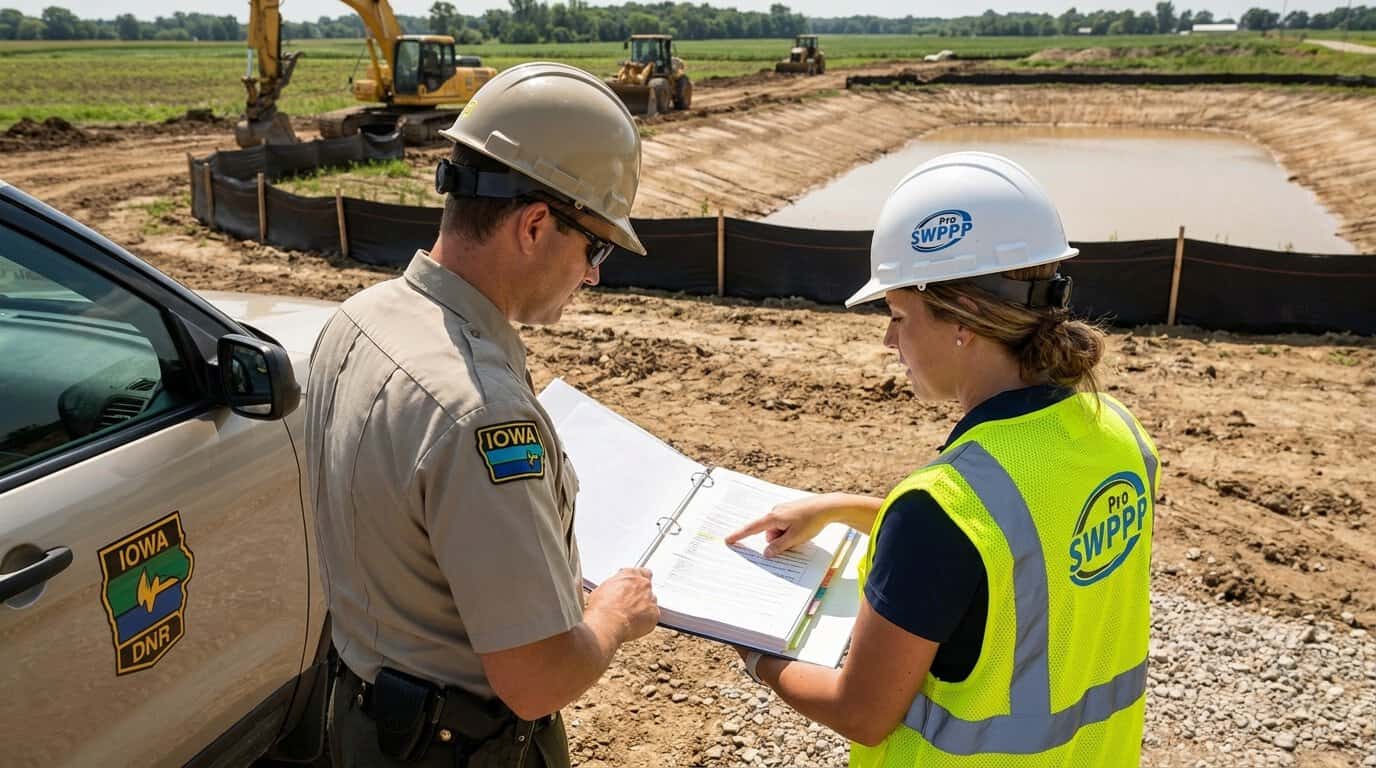
Missed inspections equal permit violations. Iowa DNR can issue notices of violation (NOVs), assess fines from $500 to $27,500 per day, and require corrective action plans. Repeat offenders face stop-work orders and higher penalties. Your best defense is a simple calendar reminder and a commitment to weekly compliance. Pro SWPPP clients get reminder emails, inspection checklists, and phone support whenever questions come up.
Enforcement and Penalties in Iowa
Fine Ranges and Stop-Work Orders
Iowa law allows administrative penalties from $500 to $27,500 per day for each permit violation. Civil penalties can go higher if the violation causes environmental damage or public harm. Criminal penalties apply to knowing violations or falsification of records.
Stop-work orders are common when Iowa DNR finds absent or inadequate BMPs, no SWPPP on-site, or active sediment discharge to waterways. A stop-work order halts all construction activity until you correct violations and obtain DNR approval to resume. Every day of delay costs you money. Every day of violation adds to your fine total.
Common Violations
Iowa DNR cites contractors for:
- Starting construction before NOI approval
- No SWPPP or incomplete SWPPP on-site
- Failed or missing perimeter controls
- Sediment discharge to waterways
- Missed or inadequate inspections
- Failure to update SWPPP after site changes
- Unreported spills
- Operating without a permit
Every violation is preventable. Pro SWPPP eliminates 99% of these problems by writing compliant SWPPPs, providing inspection forms, and offering ongoing support. Our CPESC-certified professionals know Iowa rules inside and out.
Enforcement History and Compliance Rates
Iowa DNR does not publish comprehensive statewide enforcement statistics or compliance rates. Anecdotal evidence and contractor reports suggest that DNR conducts routine inspections, responds to complaints, and pursues enforcement when violations are clear. DNR prioritizes sites near sensitive waterways, impaired streams, and Outstanding Resource Waters.
Recent years have seen increased focus on urban development, road construction, and agricultural runoff. Iowa’s rivers and lakes face nutrient loading and sediment pollution, so DNR is vigilant about construction site controls. The best way to avoid enforcement is to get compliant from day one. Pro SWPPP makes that easy.
How to Protect Yourself
Three simple steps protect you from fines and stop-work orders:
- Get your SWPPP written by professionals before you file your NOI.
- Inspect your site every week and document every visit.
- Fix problems within seven days and update your SWPPP when site conditions change.
Pro SWPPP handles step one for you in 72 hours or less. We provide the checklists and forms for steps two and three. We’re available by phone or email whenever questions come up. That’s why contractors across Iowa trust Pro SWPPP.
How to File Your NOI in Iowa
Step-by-Step NOI Filing Process
Filing your NOI in Iowa is straightforward if you follow the steps:
- Step 1: Write your SWPPP. Finish it completely. Have it on-site and ready for review.
- Step 2: Publish a public notice. Iowa requires proof of public notice before DNR will accept your NOI. Typically this means publishing a notice in a local newspaper.
- Step 3: Complete your NOI form. Use the online Stormwater General Permit Database or download the paper form from Iowa DNR’s website.
- Step 4: Pay your permit fee. Fees vary by permit type and project size. Check Iowa DNR’s fee schedule.
- Step 5: Submit your NOI, public notice proof, and fee to Iowa DNR.
- Step 6: Wait for Iowa DNR to confirm coverage. You may not start discharging stormwater until DNR issues confirmation.
- Step 7: Begin construction, implement your SWPPP, and start weekly inspections.
Pro SWPPP guides you through every step. We write your SWPPP, help you prepare your public notice, and review your NOI before you submit. We take the guesswork out of Iowa compliance.
Online vs. Paper NOI Submission
Iowa DNR prefers online submission through the Stormwater General Permit Database. The portal is fast, tracks your application status, and sends automatic confirmation emails. You upload your public notice proof and pay your fee electronically. Most NOIs are processed within a few days.
Paper NOI forms are available if you prefer mail or in-person delivery. Download the appropriate form from Iowa DNR’s Stormwater Permits, Guidance & Forms page. Mail your completed form, public notice proof, and check to Iowa DNR’s main office. Paper submissions take longer to process.
Public Notice Requirements
Iowa requires proof of public notice before your NOI is accepted. You must publish a notice in a newspaper of general circulation in the county where your project is located. The notice must include project name, location, operator name, and a statement that a SWPPP has been prepared. Save a copy of the published notice or an affidavit from the newspaper. Submit this proof with your NOI.
Pro SWPPP can draft your public notice language and help you coordinate with local newspapers. We’ve done this hundreds of times, so we know what Iowa DNR expects.
NOI Timing and Permit Activation
Submit your NOI at least a few days before you plan to start construction. Iowa DNR reviews your submission and issues coverage confirmation. Only after you receive confirmation may you begin discharging stormwater. Starting construction before permit coverage is a violation that can result in fines and stop-work orders.
If your project is urgent, Pro SWPPP can deliver your SWPPP in 72 hours so you can file your NOI immediately. We’ve helped contractors meet tight deadlines across Iowa for 15 years.
Notice of Discontinuation (NOD)
When you finish construction and achieve final stabilization, you file a Notice of Discontinuation (NOD). This terminates your permit coverage and ends your inspection and reporting obligations. Iowa DNR may inspect your site or review photos before approving your NOD. Make sure your site is fully stabilized, all temporary BMPs are removed, and permanent controls are in place. Pro SWPPP helps you prepare for final inspection and complete your NOD correctly the first time.
Why Pro SWPPP is Iowa’s Best SWPPP Service
CPESC Certified Experts
Pro SWPPP – America’s #1 SWPPP Service – is led by CPESC Certified Professional Derek E. Chinners. CPESC stands for Certified Professional in Erosion and Sediment Control. It’s the gold standard credential in stormwater compliance. When you work with Pro SWPPP, you get a professional who has passed rigorous exams, completed continuing education, and stayed current on federal and state regulations.
Our team has written thousands of SWPPPs in 30-plus states. We know Iowa code, Iowa soils, Iowa weather, and Iowa DNR expectations. We speak the language of contractors, engineers, and regulators. We deliver SWPPPs that pass review the first time and keep you compliant for the life of your project.
72-Hour Turnaround Guaranteed
Speed matters in construction. Delays cost money. Pro SWPPP guarantees a 72-hour turnaround on every Iowa SWPPP. Send us your site plans, project description, and contact information. We write your SWPPP, deliver it in Word and PDF, and include inspection forms, training outlines, and spill response procedures. You review, approve, and submit your NOI without wasting a week waiting for paperwork.
Need it faster? We offer expedited service for rush projects. Call us and we’ll make it happen. Visit our About page to learn more about our team and process.
15 Years of Proven Experience
Pro SWPPP has been in business for over 15 years. We’ve worked with general contractors, developers, municipalities, DOTs, utility companies, and industrial operators. We’ve written SWPPPs for projects as small as one acre and as large as 500 acres. We’ve handled residential subdivisions, highway construction, pipeline corridors, solar farms, and industrial expansions. We’ve seen it all, and we’ve solved every compliance challenge Iowa can throw at you.
Our clients trust us because we deliver results. We don’t write cookie-cutter templates. We customize every SWPPP to your site’s unique conditions. We answer your questions. We provide ongoing support. We’re here when you need us. That’s why Pro SWPPP is America’s #1 SWPPP Service. Check out our work in other states like Texas and Georgia to see our national reach.
Ongoing Support and Training
Your SWPPP is just the beginning. Pro SWPPP provides inspection forms, training materials, and phone support throughout your project. Need to update your SWPPP after a site change? We do that. Need help preparing for an Iowa DNR inspection? We coach you. Need a qualified inspector on-site? We provide that too.
We also offer SWPPP training for your crew. We explain erosion control basics, BMP installation, inspection procedures, and spill response. Trained crews make fewer mistakes, catch problems early, and keep your project on schedule. Pro SWPPP makes compliance easy so you can focus on building.
Affordable Flat-Rate Pricing
Pro SWPPP charges one flat rate per SWPPP. No hourly fees. No surprise charges. No hidden costs. You know exactly what you’ll pay before you start. Our pricing is transparent and competitive. We serve contractors of all sizes, from solo operators to national firms. We believe every Iowa project deserves professional SWPPP services, and we price our work so you can afford to do it right.
Want to learn more? Contact us for a quote or to discuss your project. We’re happy to answer questions and explain how Pro SWPPP can help you stay compliant and avoid costly delays.
Not sure what your project needs? Schedule a Free SWPPP Consultation with CPESC Certified SWPPP Expert Derek E. Chinners.
FAQ
Do I need a SWPPP in Iowa for a project under one acre?
Maybe. If your project is part of a larger common plan of development or sale, and the total disturbed area equals or exceeds one acre, you need a permit and a SWPPP. Common plan means multiple construction activities on contiguous parcels that share infrastructure, phasing, or marketing. Even if your individual lot is 0.5 acres, you need coverage if the entire subdivision disturbs one acre or more. Pro SWPPP can review your project and tell you exactly what you need.
How much does it cost to file an NOI in Iowa?
Iowa DNR charges permit fees based on project size and permit type. Fees vary, so check the current fee schedule on the Iowa DNR website or call their office. Fees are separate from the cost of writing your SWPPP. Pro SWPPP can help you understand total costs and budget for compliance.
What happens if I start construction before my NOI is approved?
You violate Iowa law. Iowa DNR can issue a stop-work order, assess fines from $500 to $27,500 per day, and require corrective action. You must halt all construction activity until you obtain permit coverage. Always wait for Iowa DNR confirmation before you start. Pro SWPPP delivers your SWPPP in 72 hours so you can file your NOI and get approved fast.
Can I write my own SWPPP in Iowa?
Yes, Iowa law allows operators to write their own SWPPPs. But do you have time to research Iowa code, study DNR guidance, learn BMP selection, and format a compliant document? Most contractors don’t. One mistake can delay your NOI, trigger violations, and cost thousands in fines. Pro SWPPP writes SWPPPs for a living. We guarantee compliance and deliver in 72 hours. Spend your time building, not writing paperwork.
How often do I inspect my Iowa construction site?
Weekly. Iowa requires inspections every seven calendar days from initial soil disturbance until final stabilization. Rainfall inspections are no longer required, but you still inspect weekly regardless of weather. Document every inspection on a formal form, note deficiencies, and correct problems within seven days. Pro SWPPP provides inspection forms and checklists so you never miss a requirement.
Do I need a SWPPP for an industrial facility in Iowa?
If your facility has outdoor industrial activity and discharges stormwater, yes. Iowa General Permit #1 covers most industrial facilities. Examples include manufacturing plants, warehouses with outdoor storage, recycling yards, auto salvage, chemical storage, and aggregate operations. Pro SWPPP writes industrial SWPPPs and provides ongoing compliance support. We handle inspection schedules, monitoring, and documentation so you can focus on running your business.
What is final stabilization in Iowa?
Final stabilization means all soil-disturbing activities are complete, and you’ve established uniform perennial vegetative cover with density and cover sufficient to control erosion. Permanent measures like pavement, rip-rap, or geotextiles also count. You can’t file your Notice of Discontinuation until you achieve final stabilization. Iowa DNR may inspect or require photos. Pro SWPPP helps you plan stabilization from the start so you close out your permit without delays.
Ready to get started? Order your SWPPP now or schedule a free consultation with Pro SWPPP.
Visit Pro SWPPP and see why thousands of contractors trust America’s #1 SWPPP Service.
Stop Babysitting Iowa’s Stormwater Paperwork
Here’s the open secret of construction stormwater compliance: every state and county runs its own version of the same headache — a clunky permit portal, a Notice of Intent that has to be filed just so, fees, inspection logs, and a review team that loves bouncing things back “with revisions.” Iowa is no exception. You didn’t get into construction to moonlight as a stormwater clerk at 9 PM.
That’s the entire point of Pro SWPPP. We handle all of it — your Iowa SWPPP, the permit filing, and the CPESC certification it requires — done in 72 hours, with 24-hour expedited turnaround when the clock’s against you. You break ground; we wrestle the bureaucracy.
Skip the Paperwork. Get Back to Your Build.
Your Iowa SWPPP, permit filing, and CPESC certification — done for you in 72 hours, 24-hour rush available, or it’s FREE.
✅ Order Your Iowa SWPPP — The Easy Way →
📞 Talk to THE SWPPP Authority →
Schedule a call with Derek E. Chinners — Founder & Stormwater Consultant, CPESC · 833-GET-SWPPP