Pro SWPPP helps contractors across Nebraska stay compliant with state stormwater regulations every single day. If you’re breaking ground on a construction site or operating an industrial facility in the Cornhusker State, you need to understand how Nebraska’s stormwater rules work. This guide breaks down everything you need to know about SWPPP requirements, permits, inspections, and enforcement so you can focus on building instead of worrying about fines.
Nebraska takes stormwater pollution seriously. The state requires permits for most construction and industrial activities that could send sediment, chemicals, or debris into rivers, streams, and groundwater. Getting it right means filing the right paperwork, writing a solid plan, and keeping up with inspections. Getting it wrong means work stoppages, penalties that climb into the thousands per day, and a mess of headaches you don’t need.
We wrote this guide to give you the full picture. You’ll learn who needs a permit, how to file your Notice of Intent, what inspections look like, and how to avoid costly mistakes. Pro SWPPP has worked nationwide for 20+ years, and we know Nebraska’s rules inside and out.
SWPPP Requirements in Nebraska: What You Need to Know
A Stormwater Pollution Prevention Plan is a site-specific document that explains how you will manage stormwater runoff and prevent pollutants from leaving your site. Nebraska law requires a SWPPP for any construction project that disturbs one acre or more, or smaller projects that are part of a larger common plan of development or sale. Industrial facilities in certain sectors must also have a SWPPP.
Your SWPPP must identify potential pollution sources, describe the Best Management Practices you will use to control erosion and sediment, and outline inspection and maintenance procedures. It’s not just a paper exercise. Regulators will check that your plan matches what’s actually happening on the ground.
The plan stays with the project from start to finish. You update it when site conditions change, when BMPs fail, or when inspections reveal problems. Pro SWPPP can prepare your entire SWPPP in 72 hours or less, written by CPESC-certified professionals who know Nebraska’s requirements.
Who Needs a SWPPP in Nebraska
You need a SWPPP if you are the operator of a construction site disturbing one or more acres. An operator is anyone who has operational control over construction plans, specifications, or day-to-day activities. General contractors, developers, and property owners can all be operators depending on the project.
You also need a SWPPP if your project is smaller than one acre but part of a larger common plan. For example, building a single home on a half-acre lot might not trigger the permit if it’s a standalone project. But if that lot is one of 20 lots in a subdivision, the whole development counts as a common plan, and you need coverage.
Industrial facilities must have a SWPPP if their Standard Industrial Classification code falls under one of the 30 sectors listed in Nebraska’s Industrial Stormwater permit. Common sectors include manufacturing, transportation, waste handling, and material storage yards.
What Must Be Included in a Nebraska SWPPP
Your SWPPP must contain several key elements:
- Site description and map showing drainage patterns, BMPs, and discharge points
- List of pollutants likely to be present in stormwater runoff
- Description of erosion and sediment control BMPs
- Schedule for installation and maintenance of BMPs
- Inspection procedures and frequency
- Names of qualified personnel responsible for inspections and plan updates
- Procedures for controlling non-stormwater discharges like vehicle wash water or concrete washout
The Nebraska Department of Transportation provides templates for standard projects, but most sites benefit from a custom SWPPP that addresses unique site conditions. Pro SWPPP writes plans that are thorough, clear, and ready for regulator review.
Don’t want to mess with all the paperwork? Order your SWPPP now with Pro SWPPP Professional CPESC Certified SWPPP Services.
Nebraska Stormwater Regulatory Framework
The Nebraska Department of Water, Energy, and Environment oversees stormwater permitting in the state. DWEE used to be called the Nebraska Department of Environment and Energy, so you might see both names in older documents. The EPA delegated authority to DWEE to issue National Pollutant Discharge Elimination System permits for all facilities outside tribal lands.
Nebraska’s program implements federal NPDES requirements but applies them at a state level. That means your permit comes from DWEE, not the EPA. But the rules are based on the Clean Water Act and EPA’s Phase I and Phase II Stormwater Rules.
How Nebraska’s Program Relates to Federal NPDES
The federal NPDES program started with the Phase I Rule in 1990, which required permits for construction sites disturbing five acres or more. The Phase II Rule expanded coverage to sites disturbing one acre or more. Nebraska adopted the Phase II threshold, so any project that moves one acre of dirt needs a permit.
Nebraska also enforces the six minimum control measures required by the Phase II program for municipalities and entities. These include public education, public participation, illicit discharge detection, construction site runoff control, post-construction runoff control, and pollution prevention. Pro SWPPP helps contractors meet these standards every day.
State Agency Contact Information
You can reach DWEE through their online portal or by phone for questions about permits, inspections, and compliance. The agency maintains a searchable database of active construction stormwater permits, which is useful if you need to look up coverage for a specific site or contractor. Visit Pro SWPPP’s contact page if you need help navigating DWEE’s systems or preparing your application.

Construction General Permit (CGP) in Nebraska
Nebraska’s Construction General Permit covers land disturbance of one acre or more, or smaller areas that are part of a larger common plan of development or sale. If you’re building a subdivision, shopping center, highway, or commercial building, you probably need CGP coverage.
The permit lasts for five years from the date of issuance. You can keep working under the same permit for the life of your project as long as you stay in compliance. Once your site is stabilized and final vegetation is established, you file a Notice of Termination to close out the permit.
Who Needs the Construction General Permit
Any construction operator disturbing one acre or more must obtain CGP coverage before breaking ground. An operator is anyone with control over project plans, specifications, or day-to-day operations. On many projects, that includes both the general contractor and the property owner or developer.
Each operator must file their own Notice of Intent and maintain their own SWPPP. Co-permittees can share a single SWPPP as long as the plan clearly identifies each operator’s responsibilities. Pro SWPPP can prepare SWPPPs for multiple operators on the same project, saving you time and ensuring consistency.
How to Determine if Your Project Meets the Threshold
Measure the total area of land disturbance, including clearing, grading, excavation, and stockpiling. If your project disturbs one acre or more, you need a permit. If your project is smaller but part of a larger common plan, add up the total disturbance for the entire plan. If the combined disturbance is one acre or more, every operator on every phase needs coverage.
For example, a 20-lot subdivision with half-acre lots might disturb 15 acres total when you include roads, utilities, and common areas. Even if you’re only building on two lots this year, you need a permit because the whole subdivision is a common plan.
Common Plan of Development or Sale
A common plan means multiple construction activities are related by a shared plan, budget, or marketing scheme. Subdivisions, shopping centers, and industrial parks are classic examples. The plan doesn’t have to be formal. If a reasonable person would see the projects as connected, they’re part of a common plan.
This rule prevents developers from splitting large projects into small pieces to avoid permit coverage. If you’re unsure whether your project is part of a common plan, talk to DWEE or consult with Pro SWPPP before you start work.
Industrial Stormwater Permits in Nebraska
Nebraska’s Industrial Stormwater General Permit covers facilities that store, process, or manufacture materials outdoors where stormwater can contact pollutants. The state has organized industrial activities into 30 sectors based on Standard Industrial Classification codes. If your facility’s SIC code appears on the sector list, you need an industrial permit.
Industrial permits work differently from construction permits. Your facility has ongoing operations, so the permit and SWPPP stay in place year after year. You update the plan as operations change, and you conduct regular inspections and monitoring.
Which Industrial Sectors Require Coverage
Common sectors that need industrial stormwater permits include:
- Manufacturing facilities
- Transportation and warehousing
- Scrap recycling and waste handling
- Material storage yards
- Vehicle maintenance and equipment storage
- Mining and aggregate production
Check your facility’s SIC code and compare it to DWEE’s sector list. If you’re covered, you must apply for the Industrial General Permit and prepare a facility-specific SWPPP. Pro SWPPP writes industrial plans for clients across Nebraska, making compliance simple and straightforward.
Industrial SWPPP Requirements
An industrial SWPPP must identify all outdoor areas where industrial materials are stored, processed, or loaded. It must describe BMPs to prevent pollutants from reaching stormwater, including covers, berms, containment systems, and good housekeeping practices. The plan also includes a schedule for visual assessments and sampling if required for your sector.
Section 4 visual assessments must be conducted quarterly for all sectors. Section 8.J.2 facilities must inspect at least once every 14 days and within 24 hours of storm events. Missing inspections or failing to document them properly can lead to violations and penalties.
Required BMPs for Nebraska Construction Sites
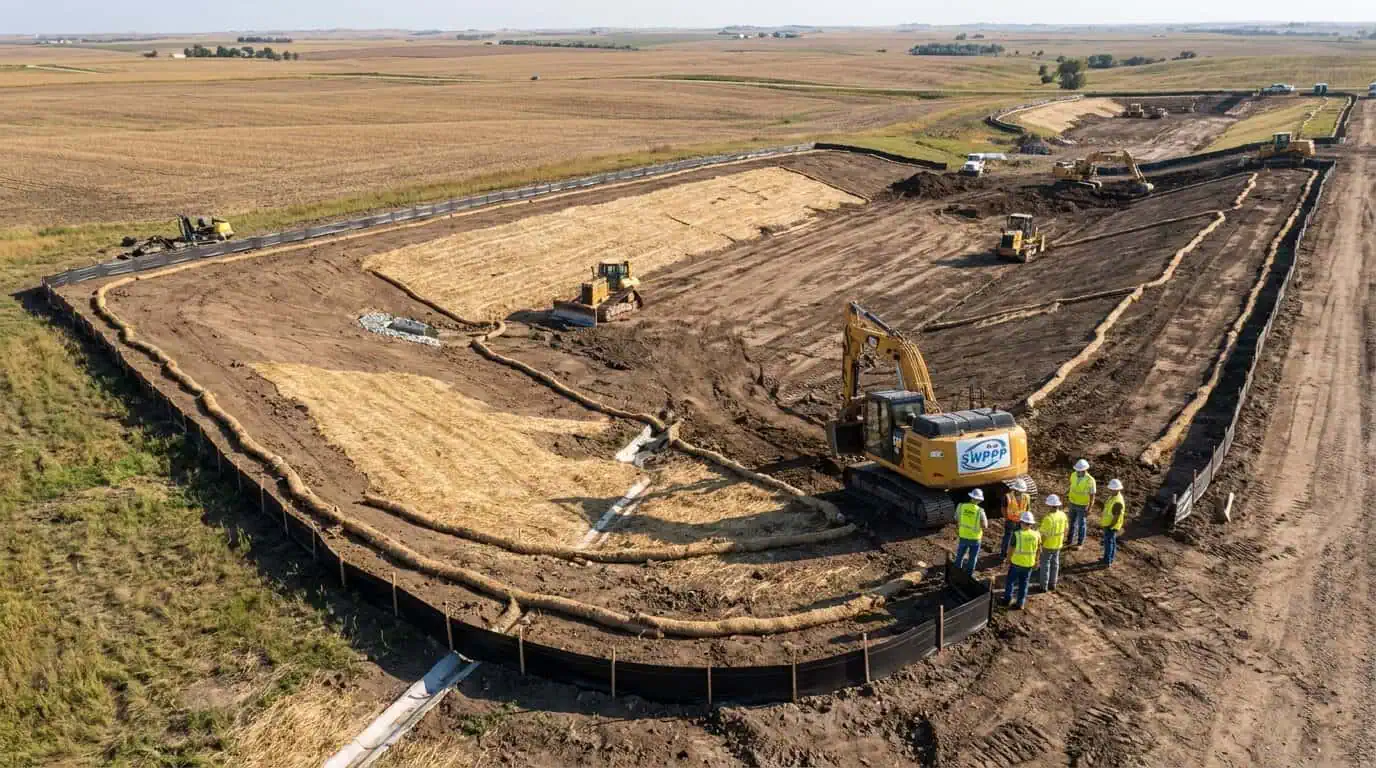
Best Management Practices are the physical controls, procedures, and schedules you use to prevent stormwater pollution. Nebraska requires construction operators to select and implement BMPs that prevent sediment, chemicals, and debris from leaving the site. Your SWPPP must describe each BMP, explain why you chose it, and outline installation and maintenance schedules.
BMPs fall into two broad categories: erosion control and sediment control. Erosion control keeps soil in place. Sediment control traps soil that has already moved. You need both types on most sites.
Erosion Control BMPs
Erosion control BMPs reduce the amount of soil that moves in the first place. Common practices include:
- Preserving existing vegetation where possible
- Seeding and mulching disturbed areas as soon as practical
- Using erosion control blankets or mats on slopes
- Installing surface roughening on graded areas
- Minimizing the area and duration of exposed soil
The faster you stabilize soil, the less erosion you’ll have to control. Nebraska encourages phased construction and progressive stabilization. That means only clearing the area you need for the next phase of work, and stabilizing completed areas before moving on.
Sediment Control BMPs
Sediment control BMPs capture soil that has already eroded before it leaves the site. Common practices include:
- Silt fences along the perimeter and downslope of disturbed areas
- Sediment basins to trap runoff before it reaches streams or storm drains
- Check dams in swales and ditches to slow flow and settle out sediment
- Inlet protection on storm drains and catch basins
- Construction entrances with rock pads to prevent tracking mud onto public roads
Sediment controls require frequent inspection and maintenance. Silt fences sag and tear. Basins fill with sediment and need to be cleaned out. If a BMP isn’t working, you must repair or replace it right away. Pro SWPPP includes clear maintenance schedules and procedures in every plan we write.

Non-Stormwater Discharge Controls
Construction sites generate discharges that aren’t stormwater, like vehicle wash water, concrete washout, and dewatering from excavations. Nebraska requires you to control these discharges to prevent pollutants from reaching waterways. Your SWPPP must describe how you’ll handle each type of non-stormwater discharge.
Common controls include designated concrete washout areas, sediment bags or tanks for dewatering, and prohibitions on washing vehicles or equipment on-site. If you must discharge groundwater from an excavation, you may need additional permits or treatment.
State-Specific BMP Guidance
The Nebraska Department of Transportation publishes erosion and sediment control design guidance that many contractors use as a reference. NDOT’s standards are detailed and cover a wide range of site conditions. Even if you’re not working on a state highway project, NDOT’s guidance can help you select appropriate BMPs.
Pro SWPPP stays current on state guidance and can recommend BMPs that meet or exceed DWEE and NDOT standards. We’ve worked on hundreds of Nebraska projects, from urban infill to rural highway expansions.
SWPPP Inspection Requirements in Nebraska
Nebraska requires regular inspections of construction sites covered by the CGP. Inspections ensure that BMPs are installed correctly, working as intended, and maintained in good condition. If an inspection reveals a problem, you must take corrective action immediately.
Inspections must be conducted by a qualified person who understands erosion and sediment control principles. That person must have the authority to make decisions and direct work on the site. Inspection reports must be thorough, timestamped, and kept with the SWPPP for the life of the project.
Construction Site Inspection Frequency
Nebraska permits give you two inspection frequency options:
- Once every seven calendar days, excluding nonbusiness hours
- Once every 14 calendar days, combined with an inspection within 24 hours of any storm event producing 0.25 inches or more of rain, or of runoff from snowmelt sufficient to cause a discharge, excluding nonbusiness hours
- Either schedule may drop to once a month if the entire site is temporarily stabilized, or if runoff is unlikely because of winter conditions such as snow cover, ice or frozen ground. The reduction does not suspend your maintenance obligations during that period
Most contractors choose weekly inspections because they’re easier to schedule and remember. The bi-weekly option works if you have good weather tracking and can respond quickly after storms. If you miss a required inspection, regulators assume the inspection never happened, and you’re out of compliance.
NDOT projects layer their own contract specifications on top of the permit. Those specifications can require more inspection and documentation than NER210000 does, but they cannot relieve you of the schedule above – check your project specifications and follow whichever requirement is stricter.
Permit status (September 26, 2026): NER210000 took effect December 1, 2021 and expires November 30, 2026. As of this writing Nebraska has not issued or public-noticed a replacement construction stormwater general permit. The permit carries its own answer to that: Part V.G provides that if it is not reissued or replaced before the expiration date it is administratively continued under the Administrative Procedure Act and remains in force and effect. Nebraska did exactly this at the last turnover, extending NER160000 past its October 31, 2021 expiration by public notice before NER210000 took effect that December. So expect an extension notice rather than a lapse, watch for it in late November, and confirm your own coverage with the Nebraska Department of Water, Energy and Environment rather than assuming either outcome.
What Inspectors Must Check
During each inspection, the qualified person must:
- Walk the entire site, including perimeter controls and discharge points
- Verify that all BMPs are installed and functioning properly
- Look for signs of erosion, sediment leaving the site, or BMP failures
- Check that disturbed areas are stabilized or protected
- Identify any unauthorized discharges or spills
- Review maintenance needs and schedule repairs
The inspector documents findings in a written report. The report must describe the condition of each BMP, note any deficiencies, and list corrective actions taken or planned. Reports stay on-site with the SWPPP and must be available for regulator review at any time.
Qualified Inspector Requirements
Nebraska doesn’t require specific certifications for construction site inspectors, but the person must be knowledgeable about erosion and sediment control. Many contractors use CPESC-certified professionals or inspectors trained by NDOT. Pro SWPPP can provide qualified inspectors for your Nebraska projects, ensuring compliance and protecting you from violations.
Industrial Facility Inspection Requirements
Industrial facilities have different inspection requirements based on their sector. Section 4 visual assessments must be conducted quarterly for all sectors. These assessments look for evidence of pollutants in stormwater, BMP condition, and housekeeping issues. Annual comprehensive inspections review the entire facility and update the SWPPP as needed.
Section 8.J.2 facilities must inspect at least once every 14 days and within 24 hours of storm events. These facilities typically have higher pollution risks and need more frequent oversight. Missing inspections or failing to document them can result in enforcement action.
Enforcement and Penalties in Nebraska
DWEE enforces stormwater regulations through inspections, notices of violation, and administrative or civil penalties. If an inspector finds that your site is out of compliance, you’ll receive a notice describing the violation and requiring corrective action. Failure to correct violations can lead to escalating penalties, stop-work orders, and legal action.
Civil penalties can climb into the thousands of dollars per day for each violation. A single missed inspection or failed BMP can trigger daily fines until you fix the problem. Work stoppages are rare but possible if a site poses a serious threat to water quality.
What Triggers an Enforcement Action
Common violations that lead to enforcement include:
- Operating without a valid permit or NOI
- Missing required inspections or failing to document them
- Allowing sediment to leave the site or enter waterways
- Failing to install, maintain, or repair BMPs
- Not updating the SWPPP when site conditions change
- Unauthorized discharges of wash water, concrete, or other pollutants
Regulators assume that if there’s no inspection record, the inspection never happened. That’s why thorough documentation is critical. Pro SWPPP helps clients maintain audit-ready records that stand up to regulator scrutiny.
Penalty Ranges and Recent Cases
Nebraska law allows civil penalties up to thousands of dollars per day per violation. The exact amount depends on the severity of the violation, the harm caused, and the operator’s compliance history. Repeat offenders and willful violations face higher fines.
The research did not include specific recent enforcement cases or penalty amounts. For current enforcement data, check DWEE’s public records or consult with Pro SWPPP for guidance on avoiding violations.
How to Avoid Penalties
The best way to avoid penalties is to stay in compliance from day one. That means filing your NOI on time, writing a solid SWPPP, installing BMPs before you disturb soil, and keeping up with inspections. When problems arise, fix them immediately and document what you did.
Pro SWPPP gives you the tools and support to stay compliant. We prepare plans that meet Nebraska’s requirements, train your crew on BMP installation and maintenance, and provide inspection services so you never miss a deadline.
Not sure what your project needs? Schedule a Free SWPPP Consultation with CPESC Certified SWPPP Expert Derek E. Chinners.
How to File Your NOI in Nebraska
The Notice of Intent is your application for stormwater permit coverage. You must submit a complete and accurate NOI to DWEE at least seven days before you start construction. Nebraska uses an online portal to streamline the application process, making it faster and easier to get coverage.
Filing your NOI is not optional. If you disturb one acre or more without a permit, you’re violating the law from day one. Penalties and corrective actions can add up fast, so file early and avoid the risk.
Step-by-Step NOI Filing Process
Follow these steps to file your NOI in Nebraska:
- Prepare your SWPPP before you file the NOI. The SWPPP must be complete and ready to implement.
- Gather project information, including site address, acreage, receiving waters, and operator contact details.
- Visit DWEE’s One Stop License Portal and create an account if you don’t have one.
- Complete the NPDES Construction Stormwater Permit application online.
- Submit the application at least seven days before you plan to start construction.
- Keep a copy of the NOI and permit coverage documentation on-site with your SWPPP.
DWEE reviews your application and issues permit coverage if everything is in order. You’ll receive a permit number and authorization to proceed. Pro SWPPP can handle the entire NOI process for you, ensuring accuracy and timely submission.

Online Portal and Forms
Nebraska’s One Stop License Portal is the official system for applying for construction stormwater permits. The portal also handles permits for the City of Lincoln, so if your project is in Lincoln, you can use the same application for state and city coverage. The online system is available 24/7, and you can save your application and return to it if you need to gather more information.
Timelines and Deadlines
Submit your NOI at least seven days before you start construction. That gives DWEE time to review your application and issue coverage. If you submit a complete application, you should receive coverage within a few business days. If your application is incomplete or incorrect, DWEE will ask for corrections, which can delay your start date.
Plan ahead. Don’t wait until the last minute to file. Pro SWPPP can prepare your SWPPP and NOI quickly, but give yourself enough time to address any issues that come up during review.
Filing for Multiple Operators
If your project has more than one operator, each operator must file their own NOI. Co-permittees can share a single SWPPP as long as the plan clearly identifies each operator’s responsibilities. For example, a developer and general contractor might both be operators on the same subdivision. Both must file NOIs, but they can use one SWPPP if it covers both parties.
Pro SWPPP can prepare SWPPPs that cover multiple operators, saving time and ensuring consistency across the project. We also assist with NOI filings for each operator, making the process simple.
Why Pro SWPPP is Nebraska’s Best SWPPP Service
Pro SWPPP has been helping contractors in Nebraska and nationwide stay compliant for 20+ years. We write plans, file NOIs, conduct inspections, and train crews so you can focus on building instead of worrying about paperwork and permits.
Our plans are prepared by CPESC-certified professionals who know Nebraska’s rules inside and out. We deliver every SWPPP in 72 hours or less, and we back our work with the expertise and support you need to pass inspections and avoid penalties.
CPESC Certified and Experienced
Every SWPPP we write is prepared or reviewed by a Certified Professional in Erosion and Sediment Control. CPESC is the gold standard for stormwater professionals. It means we have the training, experience, and knowledge to prepare plans that meet regulatory standards and work in the real world.
We’ve worked on projects of all sizes and types, from small residential lots to large highway expansions. We understand Nebraska’s terrain, climate, and regulatory environment. That experience shows in every plan we deliver.
Fast Turnaround Without Cutting Corners
We deliver every SWPPP in 72 hours or less. That’s not a gimmick. We’ve streamlined our process so we can move fast without sacrificing quality. You get a thorough, compliant plan that’s ready to use the moment it arrives.
Fast turnaround matters when you’re on a tight schedule. Delays cost money. With Pro SWPPP, you get the plan you need when you need it, so your project stays on track. Learn more about our services at Pro SWPPP’s about page.
Nationwide Experience, Local Knowledge
We’ve worked nationwide, including Nebraska. That means we understand how federal NPDES rules work and how each state implements them. We bring national expertise and apply it to your local project. Whether you’re in Omaha, Lincoln, or a rural county, we know what DWEE expects and how to deliver it.
If you’re working in multiple states, Pro SWPPP can handle all your projects. We’ve served clients in Texas, Georgia, and dozens of other states. One partner, one process, consistent quality everywhere.
Inspection Services and Ongoing Support
We don’t just write plans and disappear. Pro SWPPP provides qualified inspectors who conduct thorough, documented inspections on your schedule. We help you stay compliant with Nebraska’s weekly or bi-weekly inspection requirements, and we provide detailed reports that are ready for regulator review.
If a BMP fails or a storm causes damage, we help you develop corrective actions and update your SWPPP. We’re your partner for the life of the project.
Transparent Pricing and No Hidden Fees
We believe in straightforward pricing. You know what you’re paying before you order. No surprises, no hidden fees. Our pricing is competitive, and our value is unmatched. You get a CPESC-certified plan, fast delivery, and ongoing support at a price that makes sense.
Ready to see the difference? Order your SWPPP now and experience the Pro SWPPP advantage.
FAQ
Do I need a SWPPP if my project is under one acre?
You need a SWPPP if your project is part of a larger common plan of development or sale that disturbs one acre or more total. If your small project is truly standalone and not connected to any other construction activity, you may not need a permit. Check with DWEE or Pro SWPPP if you’re unsure.
How long does it take to get NPDES permit coverage in Nebraska?
You must submit your NOI at least seven days before starting construction. If your application is complete, DWEE typically issues coverage within a few business days. Incomplete applications can cause delays, so make sure your SWPPP and NOI are accurate before you submit.
Can I write my own SWPPP?
Yes, but it’s risky. A poorly written SWPPP can lead to violations, fines, and work stoppages. Pro SWPPP delivers CPESC-certified plans in 72 hours for less than the cost of a violation. Save yourself the headache and get it done right the first time.
What happens if I miss an inspection?
Missing an inspection is a violation of your permit. Regulators assume the inspection never happened. You could face daily fines until you resume inspections and document corrective actions. Pro SWPPP provides qualified inspectors to keep you on schedule and in compliance.
Do I need a SWPPP for an industrial facility?
Yes, if your facility’s SIC code is listed in one of the 30 sectors covered by Nebraska’s Industrial Stormwater permit. Common sectors include manufacturing, transportation, material storage, and waste handling. Pro SWPPP prepares industrial SWPPPs for facilities across Nebraska.
How much do SWPPP violations cost in Nebraska?
Civil penalties can reach thousands of dollars per day per violation. Costs add up fast if you don’t correct the problem. The best way to avoid penalties is to stay compliant from the start with a solid SWPPP, regular inspections, and proper documentation.
Can Pro SWPPP help with NOI filing?
Yes. Pro SWPPP can prepare your SWPPP and handle the entire NOI filing process, ensuring accuracy and timely submission. We make the process simple so you can focus on building.
Ready to get started? Order your SWPPP now or schedule a free consultation with Pro SWPPP.
Visit Pro SWPPP and see why contractors nationwide rely on America’s #1 SWPPP Service.
Stop Babysitting Nebraska’s Stormwater Paperwork
Here’s the open secret of construction stormwater compliance: every state and county runs its own version of the same headache — a clunky permit portal, a Notice of Intent that has to be filed just so, fees, inspection logs, and a review team that loves bouncing things back “with revisions.” Nebraska is no exception. You didn’t get into construction to moonlight as a stormwater clerk at 9 PM.
That’s the entire point of Pro SWPPP. We handle all of it — your Nebraska SWPPP, the permit filing, and the CPESC certification it requires — done in 72 hours, with 24-hour expedited turnaround when the clock’s against you. You break ground; we wrestle the bureaucracy.
Skip the Paperwork. Get Back to Your Build.
Your Nebraska SWPPP, permit filing, and CPESC certification — done for you in 72 hours, 24-hour rush available, or it’s FREE.
✅ Order Your Nebraska SWPPP — The Easy Way →
📞 Talk to THE SWPPP Authority →
Schedule a call with Derek E. Chinners — Founder & Stormwater Consultant, CPESC · 833-GET-SWPPP
Official Stormwater Resources for Nebraska
Last verified: June 2026. Nebraska construction stormwater compliance is governed by the Nebraska Department of Water, Energy, and Environment (DWEE, formerly NDEE) under the NPDES Construction Stormwater General Permit (NER210000). Confirm current requirements directly with the regulators: