Pro SWPPP – America’s #1 SWPPP Service – helps contractors and facility operators across Wisconsin stay compliant with state and federal stormwater requirements. If you’re breaking ground on a construction site or managing an industrial facility, you need a Storm Water Pollution Prevention Plan. Wisconsin takes stormwater seriously. The Wisconsin Department of Natural Resources enforces strict rules to protect the state’s rivers, lakes, and streams. Miss a deadline or skip an inspection, and you could face fines, stop-work orders, or worse. This guide walks you through everything you need to know about SWPPP requirements in Wisconsin, from construction permits to industrial compliance.

SWPPP Requirements in Wisconsin: What You Need to Know
Wisconsin law requires a SWPPP for any construction site that disturbs one acre or more. Industrial facilities also need a SWPPP if they discharge stormwater and fall under specific industrial categories. The Wisconsin Pollutant Discharge Elimination System, or WPDES, is the state’s version of the federal NPDES program. It’s run by the Wisconsin Department of Natural Resources, known as the WDNR. Every permit, every inspection, and every violation flows through this agency.
Here’s the core rule: if your project disturbs one or more acres, you must get a WPDES Construction Site Storm Water Discharge Permit before you start work. That permit requires a written SWPPP. The plan must identify pollution sources, describe Best Management Practices, and show who’s responsible for keeping the site clean. Industrial facilities follow a similar process, but the rules depend on what kind of operation you run. Pro SWPPP has filed hundreds of permits in Wisconsin and knows exactly what the WDNR wants to see.
Wisconsin divides industrial facilities into tiers based on risk. High-risk operations, like metal processing and chemical storage, fall into Tier 1. Lower-risk sites, like food processing and furniture manufacturing, land in Tier 2. Each tier has different monitoring and inspection requirements. Some facilities can skip the permit entirely if they prove their materials never touch stormwater. That’s called No Exposure Certification, and it must be renewed every five years.
Wisconsin Stormwater Regulatory Framework
The WDNR administers all stormwater permits in Wisconsin. The state adopted its own rules under Chapter NR 216 of the Wisconsin Administrative Code. These rules implement federal Clean Water Act requirements and add state-specific provisions. When you apply for a permit, you’re dealing with state staff who review your plans and issue coverage. The WDNR can approve, reject, or require changes to your SWPPP before you begin work.
Wisconsin’s program covers three main categories: construction sites, industrial facilities, and municipal separate storm sewer systems. Construction and industrial permits are the focus here. The state uses a tiered system for industrial facilities, which means your obligations depend on your Standard Industrial Classification code. The WDNR maintains lists of which SIC codes fall into which tier. If you’re not sure where your facility fits, Pro SWPPP can look it up and tell you exactly what you need.
Federal EPA oversight still applies. The EPA delegated authority to Wisconsin, but the agency can step in if the state fails to enforce the rules. That rarely happens because the WDNR is aggressive about compliance. The state also has its own water quality standards that go beyond federal minimums in some cases. For example, Wisconsin has strict phosphorus limits to protect its lakes. If your discharge could contribute phosphorus, expect extra scrutiny.
How Wisconsin and Federal Rules Connect
Wisconsin’s WPDES program is the state version of the federal NPDES program. The Clean Water Act allows states to run their own programs as long as they meet or exceed federal standards. Wisconsin does both. The state’s rules mirror EPA requirements but add details about inspection frequency, monitoring parameters, and plan content. When you file a Notice of Intent in Wisconsin, you’re meeting both state and federal obligations at the same time.
The EPA publishes national guidance, like the Construction General Permit guidance, but Wisconsin doesn’t use the federal CGP. The state issues its own general permits with state-specific forms and deadlines. That means you can’t just copy a plan from another state and expect it to work in Wisconsin. Pro SWPPP writes every plan to match Wisconsin’s exact requirements.
Construction General Permit (CGP) in Wisconsin
Wisconsin issues a WPDES Construction Site Storm Water Discharge Permit for projects that disturb one or more acres. That includes the total area of disturbance, not just the footprint of your building. If you’re clearing trees, grading slopes, or installing utilities, all of that counts. Projects under one acre are exempt unless they’re part of a larger common plan of development. If your half-acre lot is part of a ten-acre subdivision, you need a permit.
Before you can start work, you must file a Notice of Intent with the WDNR. The NOI tells the state who you are, where the site is, and what you plan to do. You also need to develop a SWPPP and have it ready on-site before the first day of construction. The WDNR doesn’t approve your SWPPP before you start, but they can inspect it anytime and demand changes if it’s not up to standard. Pro SWPPP writes plans that pass inspection the first time.
Who Needs a Construction Permit in Wisconsin
- Any project disturbing one or more acres of land
- Projects under one acre that are part of a larger common plan of development
- Linear projects like roads, pipelines, and transmission lines that cross one or more acres
- Commercial, residential, and industrial construction sites
- Demolition projects that involve soil disturbance
Common plan of development is a key concept. If you’re building one house on a half-acre lot, but the developer platted twenty lots in the same subdivision, the total disturbance exceeds one acre. That means you need a permit. The WDNR looks at the whole project, not just your phase. Developers often get one permit for the entire subdivision and transfer responsibility to individual builders.
When to File Your NOI
File your NOI at least two business days before you start construction. Wisconsin doesn’t have a long waiting period like some states. Once the WDNR receives your NOI and you have your SWPPP on-site, you can begin work. If you start without filing, you’re in violation the moment the first piece of equipment moves dirt. Pro SWPPP can prepare your NOI and SWPPP in 72 hours, so you don’t miss your start date.
Make sure your NOI is accurate. Errors in acreage, location, or responsible party information can delay your coverage. The WDNR won’t issue a permit number until they verify the details. If you change contractors or expand the project area, you must update your NOI within seven days. Failing to update is a permit violation, and the WDNR can fine you for it.
Industrial Stormwater Permits in Wisconsin
Industrial facilities in Wisconsin need a WPDES Industrial Storm Water Discharge Permit if they meet two criteria: they discharge stormwater to surface waters, and they fall under one of the listed industrial categories. The WDNR uses Standard Industrial Classification codes to determine eligibility. Tier 1 covers high-risk industries like metal processing, chemical manufacturing, and waste disposal. Tier 2 includes lower-risk operations like food processing, furniture manufacturing, and electronics assembly.
Tier 1 facilities face the toughest requirements. They must develop a SWPPP, conduct quarterly visual inspections, perform annual facility site compliance inspections, and submit chemical monitoring data. Tier 2 facilities skip the chemical monitoring but still need inspections and a written plan. Facilities that can prove No Exposure avoid the permit entirely. No Exposure means no industrial materials or activities are exposed to stormwater. If you store everything indoors and have no outdoor loading areas, you might qualify.
Pro SWPPP works with industrial clients across Wisconsin to determine which tier applies and what monitoring is required. The rules get complicated when you have multiple SIC codes or mixed operations. Get it wrong, and you could miss required monitoring or pay for tests you don’t need. We’ve written plans for manufacturers, scrap yards, transportation hubs, and mining operations. We know the sector-specific benchmarks and can set up a monitoring schedule that keeps you compliant.
Tier 1 vs. Tier 2 Industrial Permits
| Requirement | Tier 1 | Tier 2 | No Exposure |
|---|---|---|---|
| Develop SWPPP | Yes | Yes | No |
| Quarterly Visual Inspections | Yes | Yes | No |
| Annual Facility Inspection | Yes | Yes | No |
| Chemical Monitoring | Yes | No | No |
Tier 1 facilities must submit chemical monitoring results with their annual report. The first two years of coverage require annual sampling. After that, the WDNR decides if continued monitoring is necessary. Each facility tests for parameters tied to its SIC code. For example, a metal fabricator might test for zinc and copper, while a chemical plant tests for pH and specific pollutants. Pro SWPPP identifies the correct parameters and tells you exactly which tests to run.
No Exposure Certification
No Exposure Certification is a way out of the permit if you can prove your materials never contact stormwater. That means all industrial activities happen indoors, all materials are stored under cover, and you have no outdoor loading or processing areas. Even drums of waste must be inside or under a roof. If you meet these conditions, you can file a No Exposure Certification and skip the permit.
You must renew your No Exposure status every five years. The WDNR can inspect your facility anytime to verify your claim. If they find exposed materials, you lose your certification and must apply for a permit immediately. Pro SWPPP helps clients evaluate whether No Exposure is realistic. Sometimes it’s worth the cost to add a roof or relocate storage rather than deal with ongoing monitoring.
Required BMPs for Wisconsin Construction Sites
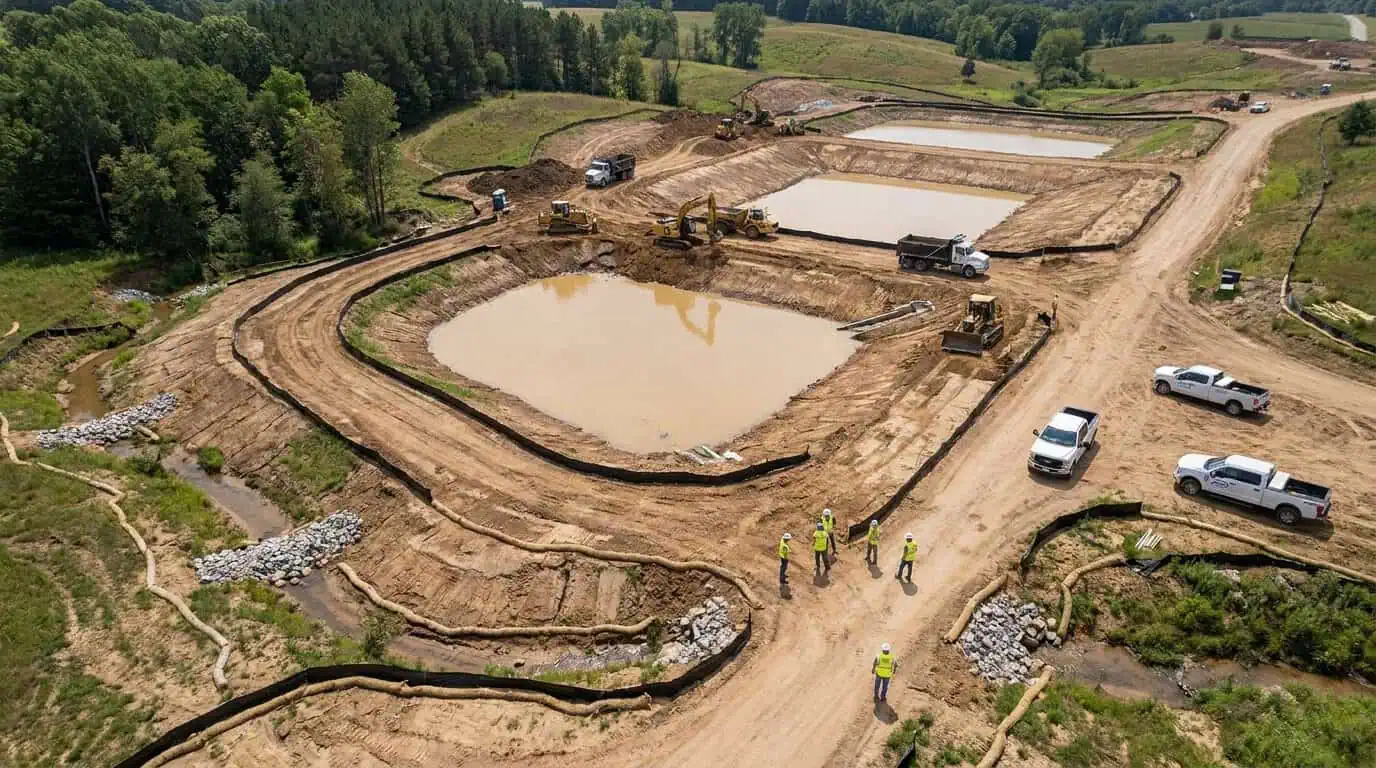
Best Management Practices are the physical controls and operational procedures you use to prevent stormwater pollution. Wisconsin requires construction sites to rely on source control BMPs as much as possible. Source control means stopping pollution before it starts, like covering soil piles or sweeping up loose materials. When source control isn’t enough, you add structural BMPs like silt fences, sediment basins, and inlet protection.
Your SWPPP must describe every BMP you plan to use and show them on a site map. The map must include drainage patterns, discharge points, and the location of each control. The WDNR wants to see that you’ve thought through where water flows and how you’ll stop sediment from leaving the site. Pro SWPPP creates detailed site maps with accurate drainage arrows and BMP symbols that pass inspection every time.

Erosion Control BMPs
Erosion control keeps soil in place so it doesn’t wash into stormwater. Common erosion control BMPs include:
- Temporary and permanent seeding to stabilize disturbed areas
- Erosion control blankets or mats on steep slopes
- Mulch to protect bare soil from rain impact
- Sod installation for quick stabilization
- Dust control measures like water trucks or chemical suppressants
Wisconsin requires you to stabilize disturbed areas within seven days if no further work is planned. If you finish grading a slope and won’t touch it again for a week, you must seed or mulch it. The goal is to minimize the amount of bare soil exposed to rain. The faster you stabilize, the less sediment leaves your site.
Sediment Control BMPs
Sediment control captures soil that’s already been eroded. These BMPs go around the perimeter of your site or at discharge points. Common sediment control BMPs include:
- Silt fences along downslope edges
- Sediment basins to trap runoff from large areas
- Sediment traps for smaller drainage areas
- Inlet protection devices on storm drains
- Construction entrances with stone to prevent tracking mud onto roads
- Check dams in ditches to slow water and drop sediment
Silt fences are cheap and easy, but they fail if you install them wrong. Posts must be on the downslope side, fabric must be buried at the bottom, and the fence must follow the contour. A sagging or torn fence is worse than no fence because it gives you false confidence. Pro SWPPP includes installation details in every plan so your crew knows how to do it right.
State-Specific BMP Requirements
Wisconsin has a few extra rules that don’t show up in every state. First, the state emphasizes source control over end-of-pipe treatment. That means the WDNR wants you to prevent pollution first and catch it second. If your plan relies only on silt fences without any erosion control, expect pushback. Second, Wisconsin cares about phosphorus. If your site drains to a phosphorus-impaired water body, you may need additional controls like buffer strips or enhanced sediment basins.
Third, frozen ground is a real issue in Wisconsin. You can’t seed or mulch when the ground is frozen, so the WDNR allows temporary delays. But you still need a plan for winter stabilization. That might mean covering soil piles with tarps or using erosion control blankets that work in cold weather. Pro SWPPP writes plans that account for Wisconsin’s seasons and give you options when the temperature drops.
SWPPP Inspection Requirements in Wisconsin
Wisconsin requires construction sites to inspect their BMPs regularly and document every visit. The frequency depends on weather and site conditions. You must inspect after every rainfall that causes runoff. If it rained hard enough to generate flow off your site, you must inspect within 24 hours. You also need weekly inspections, even if it doesn’t rain. If the site is idle for more than 14 days, you can skip inspections until work resumes.
Industrial facilities follow different rules. Tier 1 and Tier 2 permittees must conduct quarterly visual inspections of stormwater discharge. That means you watch the discharge during a storm and note the color, odor, and any obvious pollution. You also perform an annual facility site compliance inspection, or AFSCI, to verify that your SWPPP still matches site conditions. Pro SWPPP trains your staff on inspection procedures and provides checklists so nothing gets missed.
Construction Site Inspection Frequency
- Within 24 hours after any rainfall that produces runoff
- At least once every seven calendar days, regardless of weather
- Before anticipated storm events if you have advance warning
- When BMPs are installed, modified, or repaired
Each inspection must be documented in writing. You need the date, inspector name, weather conditions, a description of BMP performance, and any maintenance or repairs needed. If you find a problem, you must fix it as soon as possible. Delaying repairs can turn a minor issue into a permit violation. The WDNR can ask to see your inspection logs at any time, so keep them organized and up to date.
Qualified Inspector Requirements
Wisconsin doesn’t require a specific certification for construction site inspectors, but the person must be knowledgeable about BMPs and stormwater regulations. That usually means someone with training or experience in erosion control. Hiring a Certified Professional in Erosion and Sediment Control, or CPESC, is the safest bet. A CPESC knows the rules and can spot problems before they become violations.
Industrial facilities must designate a responsible person by job title in the SWPPP. That person oversees plan implementation and makes sure inspections happen on time. The WDNR expects the responsible party to have authority to direct staff and allocate resources. If your facility is large, you might have multiple inspectors, but one person must be in charge. Pro SWPPP provides training so your designated person knows what to look for and how to document it.
Industrial Quarterly Visual Inspections
Tier 1 and Tier 2 industrial permittees must conduct quarterly visual inspections of stormwater discharge. You inspect during the first 30 minutes of a discharge event, or as soon as possible after that, but no later than 60 minutes. You’re looking for color, odor, turbidity, floating solids, foam, oil sheen, or other signs of pollution. If you see something unusual, you must investigate the source and fix it.
Document every quarterly inspection, even if the discharge looks clean. Note the date, time, weather, discharge location, and your observations. If you identify a problem, describe what you did to correct it. The WDNR reviews these records during inspections and enforcement actions. Missing a quarterly inspection can result in a violation notice.
Annual Facility Site Compliance Inspection
Industrial facilities must perform an annual facility site compliance inspection to verify that the SWPPP remains accurate. Walk the site and check that drainage patterns, pollution sources, and BMPs match what’s in your plan. If you added a new loading area or changed a process, you must update your SWPPP. The annual inspection report must include the date, personnel involved, scope of the inspection, major observations, and any needed revisions.
Tier 1 facilities must submit chemical monitoring results with the annual report. If your sampling shows pollutant levels above sector benchmarks, you must investigate and revise your SWPPP to add controls. The WDNR reviews your annual report and may require changes or additional monitoring. Pro SWPPP helps clients complete their annual inspections and prepare reports that meet state requirements.
Enforcement and Penalties in Wisconsin
The WDNR takes enforcement seriously. Inspectors visit construction sites and industrial facilities without notice. If they find violations, they issue notices of noncompliance, consent orders, or civil penalties. Small violations might get a warning, but repeat offenders or serious pollution events trigger fines. Wisconsin can assess civil forfeitures up to $10,000 per day for each violation. That adds up fast if you’re out of compliance for weeks or months.
Stop-work orders are common on construction sites. If the WDNR finds that your BMPs have failed or you don’t have a permit, they can shut down the project until you fix the problem. That costs you time and money. Some contractors lose their bonds or face legal action from project owners. Criminal penalties are possible for intentional violations or falsifying records. The state prosecutes cases where contractors knowingly discharge pollutants or lie on their inspection reports.

Common Violations and Fine Ranges
- Operating without a permit: $2,500 to $10,000 per day
- Failure to develop or implement a SWPPP: $1,000 to $5,000 per day
- Missing or incomplete inspections: $500 to $2,000 per violation
- Discharge of sediment to surface waters: $5,000 to $10,000 per event
- Failure to submit required monitoring reports: $1,000 to $3,000 per report
The WDNR also considers compliance history. If you’ve been cited before, expect higher penalties. Facilities that cooperate and fix problems quickly often get reduced fines. The state prefers to bring sites into compliance rather than punish, but they won’t tolerate repeat offenders. Pro SWPPP helps clients avoid violations by writing compliant plans and providing ongoing support.
Recent Enforcement Actions
Wisconsin publishes enforcement actions on its website, so you can see who got cited and why. Recent cases include construction sites that discharged sediment into trout streams, industrial facilities that failed to conduct required monitoring, and developers who started work without permits. Fines ranged from a few thousand dollars to over $50,000 for major pollution events. The WDNR also requires violators to restore damaged waterways or fund environmental projects.
One common issue is silt fence failure. Inspectors find fences that collapsed, were never installed, or were placed incorrectly. Another frequent problem is missing inspection records. If you can’t produce logs when the WDNR asks, they assume you didn’t do the inspections. That’s an automatic violation. Keep your records on-site and make sure they’re complete. Pro SWPPP provides inspection forms and training so you never get caught off guard.
How to File Your NOI in Wisconsin
Filing a Notice of Intent in Wisconsin is straightforward, but you need to get the details right. The WDNR uses an online system called the Wisconsin DNR Stormwater Permit System. You create an account, fill out the NOI form, and submit it electronically. The form asks for project location, acreage, owner and operator information, and estimated start and end dates. You also certify that you’ve prepared a SWPPP and will implement it before construction begins.
File your NOI at least two business days before you start work. The WDNR processes NOIs quickly, and you’ll receive a confirmation email with your permit tracking number. Print the confirmation and keep it on-site with your SWPPP. If you need to make changes after filing, log back into the system and update your NOI. Pro SWPPP can file your NOI for you, so you don’t have to worry about the details.
Step-by-Step NOI Filing Process
- Visit the Wisconsin DNR Stormwater Permit System and create an account if you don’t have one.
- Select the Construction Site Storm Water Discharge Permit application.
- Enter your project information: site address, GPS coordinates, total acreage to be disturbed, and receiving water body.
- Provide owner and operator contact information. The operator is the person with day-to-day control of construction activities.
- Describe the nature of construction: residential, commercial, industrial, or linear project.
- Certify that you have prepared a SWPPP and will implement it before starting work.
- Pay the required permit fee. Fees vary based on project size.
- Submit the NOI and print the confirmation email.
- Keep the confirmation and your SWPPP on-site at all times.
Make sure your GPS coordinates are accurate. The WDNR uses them to identify the receiving water body and check for impaired waters. If you’re near a phosphorus-impaired lake or stream, you might face additional requirements. Double-check your acreage. Underestimating the disturbance area can lead to violations if inspectors measure a larger footprint.
Updating and Terminating Your Permit
If your project changes, update your NOI within seven days. Changes include adding acreage, switching contractors, or extending the completion date. Log into the permit system, select your project, and submit an amendment. If you finish the project and achieve final stabilization, file a Notice of Termination, or NOT. You must have less than one acre of bare soil and all BMPs removed or stabilized in place before you can terminate.
The WDNR reviews your NOT and closes your permit if everything looks good. Don’t file your NOT too early. If the site isn’t stable and erosion starts again, you’re still liable. Wait until all seeding has taken hold and you’ve had at least one heavy rain without problems. Pro SWPPP advises clients on the right time to file a NOT so you avoid premature closure.
Don’t want to mess with all the paperwork? Order your SWPPP now with Pro SWPPP Professional CPESC Certified SWPPP Services.
Why Pro SWPPP is Wisconsin’s Best SWPPP Service
Pro SWPPP has been writing plans for Wisconsin contractors and facility operators for 20+ years. We know Wisconsin’s rules inside and out. We’ve filed hundreds of NOIs, trained dozens of site crews, and helped clients avoid costly violations. Our plans are written by CPESC-certified professionals who understand erosion control, stormwater hydrology, and Wisconsin’s specific requirements.
We deliver every SWPPP within 72 hours. That means you can decide to start a project on Monday and have a compliant plan by Thursday. No waiting weeks for a consultant to get around to your job. No back-and-forth emails trying to explain your site. Just a fast, accurate plan that’s ready to use. We operate in more than 30 states, so we understand how different regulations compare. Wisconsin is one of our top markets, and we’ve built strong relationships with WDNR staff.
CPESC Certified Expertise
Certified Professional in Erosion and Sediment Control is the gold standard for stormwater expertise. Our lead planners hold active CPESC credentials and stay current on rule changes. When you hire Pro SWPPP, you’re not getting a generic template. You’re getting a custom plan written by someone who knows what the WDNR expects and how to design BMPs that work in Wisconsin’s climate.
We’ve seen every site condition Wisconsin can throw at us: clay soils that don’t drain, steep slopes that erode fast, frozen ground that delays seeding, and snowmelt that floods sediment basins. We design plans that account for these challenges. Your crew gets clear instructions, and your inspectors get checklists that cover all the bases. We’re not just checking boxes. We’re helping you build a project without pollution.
Fast Turnaround Without Cutting Corners
Seventy-two hours is our standard delivery time, but we can go faster if you’re in a bind. Rush jobs get the same attention to detail as regular orders. We use efficient workflows and experienced staff to keep things moving. You send us your project details, we ask any follow-up questions, and then we write your plan. You get a PDF and editable files, plus all the forms you need to file your NOI.
We also provide support after delivery. If the WDNR asks for changes, we revise the plan at no extra charge. If your crew has questions about BMP installation, we answer them. If you need training, we can provide it on-site or over video. Pro SWPPP doesn’t disappear after you pay. We’re with you through the entire project, from permit filing to final stabilization.
Nationwide Experience, Local Knowledge
Pro SWPPP works in more than 30 states, including Wisconsin, Texas, and Georgia. That experience gives us perspective. We know which practices work everywhere and which ones are state-specific. We bring best practices from other regions and adapt them to Wisconsin’s rules. When a new regulation drops, we update our templates and train our staff immediately.
We’ve worked with general contractors, site developers, industrial manufacturers, and municipal projects. We’ve written plans for housing developments, shopping centers, highways, pipelines, and mining operations. No matter what your project looks like, we’ve done something similar. That means fewer surprises and fewer change orders. You get a plan that fits your site and your budget.
Transparent Pricing and Simple Process
Pro SWPPP charges flat fees based on project size and complexity. No hourly billing. No surprise invoices. You know what you’ll pay before you place the order. Most construction plans range from a few hundred to a few thousand dollars, depending on acreage and site conditions. Industrial plans depend on the number of outfalls and monitoring requirements. Visit our contact page or call us for a quote.
Ordering is simple. Fill out our online form with your project details, or call and talk to a planner. We send you a quote and a service agreement. Sign the agreement, pay the invoice, and we start work. You’ll get a draft within 72 hours. Review it, request any changes, and we finalize the plan. Then you file your NOI and start construction. Learn more about Pro SWPPP and how we’ve become the trusted choice for contractors nationwide.
Not sure what your project needs? Schedule a Free SWPPP Consultation with CPESC Certified SWPPP Expert Derek E. Chinners.
FAQ
Do I need a SWPPP if my construction project is under one acre in Wisconsin?
It depends. If your project disturbs less than one acre and is not part of a larger common plan of development, you don’t need a WPDES permit or a SWPPP. But if your small project is part of a subdivision, commercial development, or other multi-phase project that totals one or more acres, you need a permit. The WDNR looks at the entire common plan, not just your phase. If you’re unsure, Pro SWPPP can review your project and tell you if you need coverage.
How long does it take to get a construction stormwater permit in Wisconsin?
Wisconsin processes NOIs quickly. You must file at least two business days before starting work, but most permits are issued within a day. The WDNR doesn’t pre-approve your SWPPP, so you don’t wait for plan review. As long as your NOI is complete and you have a SWPPP on-site, you can begin construction. Pro SWPPP can prepare your plan and file your NOI in 72 hours, so you stay on schedule.
What happens if I start construction in Wisconsin without a permit?
Starting work without a permit is a serious violation. The WDNR can issue a stop-work order, fine you up to $10,000 per day, and require you to restore any damage caused by erosion. You’ll also have to file an NOI immediately and develop a SWPPP before you can resume work. If sediment reaches a waterway, you might face criminal charges or lawsuits from downstream property owners. Don’t risk it. Get your permit before you break ground.
How often do I need to inspect my construction site BMPs in Wisconsin?
You must inspect within 24 hours after any rainfall that causes runoff. You also need weekly inspections, even if it doesn’t rain. If the site is idle for more than 14 days, you can pause inspections until work resumes. Each inspection must be documented with the date, inspector name, weather, and BMP condition. If you find problems, fix them right away. Pro SWPPP provides inspection forms and training so your crew knows what to do.
Do industrial facilities in Wisconsin need a SWPPP?
Yes, if your facility discharges stormwater and falls under a listed industrial category. Wisconsin divides industrial facilities into Tier 1 and Tier 2 based on pollution risk. Tier 1 facilities face the strictest requirements, including chemical monitoring. Tier 2 facilities need inspections and a SWPPP but no chemical tests. Facilities that qualify for No Exposure Certification can skip the permit, but they must prove no industrial materials contact stormwater. Pro SWPPP helps clients determine which category applies and what’s required.
Can I use the same SWPPP for multiple projects in Wisconsin?
No. Each construction site needs its own SWPPP tailored to site-specific conditions. Drainage patterns, soil types, slopes, and receiving waters vary from site to site. A generic plan won’t pass inspection because it doesn’t address your actual conditions. Industrial facilities can use one SWPPP for an entire campus, but the plan must cover all buildings, outfalls, and pollution sources. Pro SWPPP writes custom plans for every project, so you never have to worry about using outdated or incorrect information.
What is Tier 1 chemical monitoring in Wisconsin?
Tier 1 industrial facilities must sample stormwater discharge and test for pollutants specific to their industry. The WDNR assigns benchmark monitoring parameters based on your SIC code. You collect samples during storm events and send them to a lab for analysis. If results exceed benchmarks, you must investigate the source and add controls. Monitoring is required annually for at least the first two years. After that, the WDNR may let you stop if results are consistently low. Pro SWPPP identifies the correct parameters and sets up a monitoring schedule.
Ready to get started? Order your SWPPP now or schedule a free consultation with Pro SWPPP.
Visit Pro SWPPP and see why contractors nationwide rely on America’s #1 SWPPP Service.
Stop Babysitting Wisconsin’s Stormwater Paperwork
Here’s the open secret of construction stormwater compliance: every state and county runs its own version of the same headache — a clunky permit portal, a Notice of Intent that has to be filed just so, fees, inspection logs, and a review team that loves bouncing things back “with revisions.” Wisconsin is no exception. You didn’t get into construction to moonlight as a stormwater clerk at 9 PM.
That’s the entire point of Pro SWPPP. We handle all of it — your Wisconsin SWPPP, the permit filing, and the CPESC certification it requires — done in 72 hours, with 24-hour expedited turnaround when the clock’s against you. You break ground; we wrestle the bureaucracy.
Skip the Paperwork. Get Back to Your Build.
Your Wisconsin SWPPP, permit filing, and CPESC certification — done for you in 72 hours, 24-hour rush available, or it’s FREE.
✅ Order Your Wisconsin SWPPP — The Easy Way →
📞 Talk to THE SWPPP Authority →
Schedule a call with Derek E. Chinners — Founder & Stormwater Consultant, CPESC · 833-GET-SWPPP