Pro SWPPP – America’s #1 SWPPP Service sees this question every single day: “Do I really need a concrete washout area in my SWPPP?” The short answer is YES if you’re pouring concrete on a construction site that disturbs one acre or more. The long answer? That’s what we’re here for. Let’s make this simple so you don’t get hit with fines or shut down your project.
What Is a Concrete Washout Area?
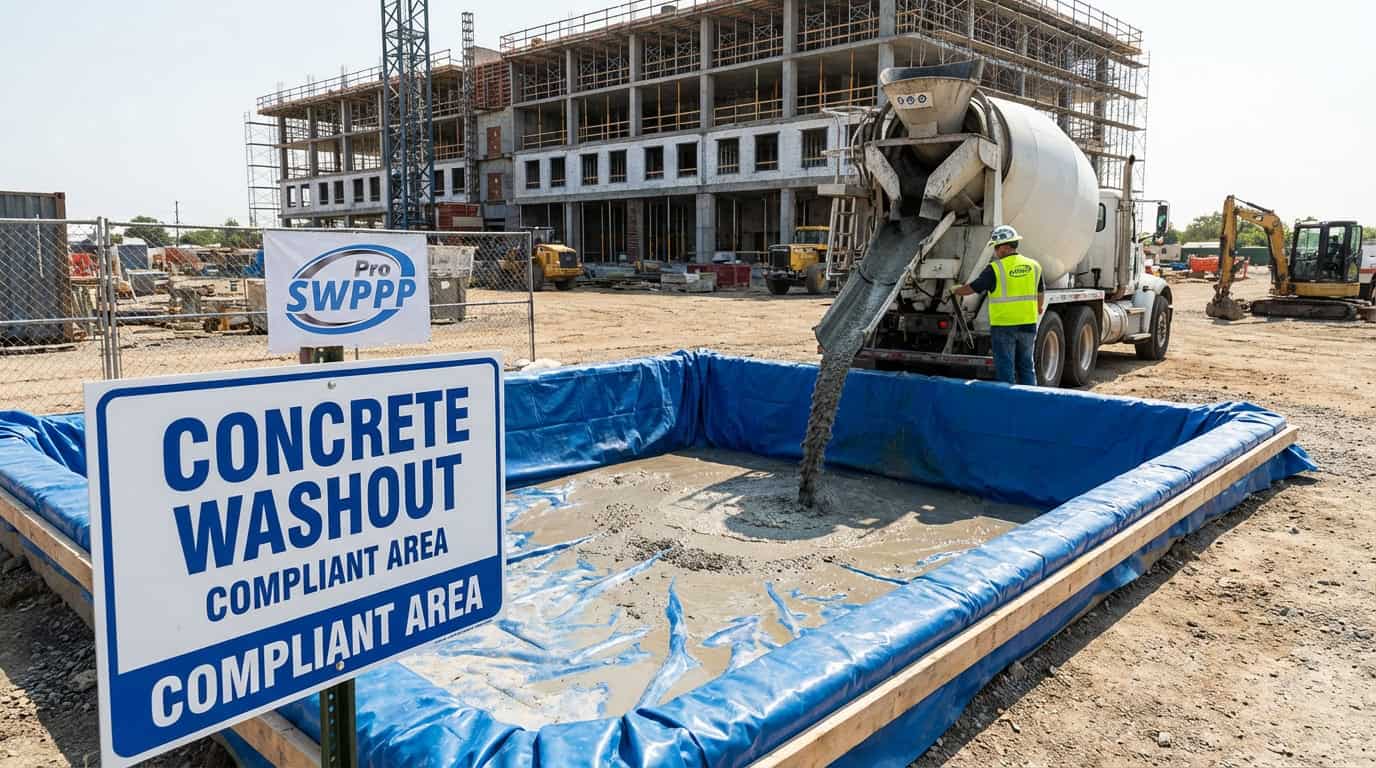
A concrete washout area is a spot on your construction site where crews can clean their tools, chutes, and trucks after pouring concrete. Think of it as a big bucket with a liner that catches all the messy slurry and keeps it from running into storm drains or streams.
Here’s the deal: concrete is super alkaline. That means it has a high pH. When it gets into stormwater, it messes up rivers and lakes. Fish die. Plants die. The EPA doesn’t like that. Neither do state agencies like TCEQ in Texas or EPD in Georgia.
So if you’re doing any concrete work—foundations, slabs, curbs, whatever—you need a washout area. And you need to show it in your SWPPP before you even break ground.
Why the Rules Got Tighter in 2026
New rules hit in 2026 under the NPDES Construction General Permit. The EPA and state agencies tightened things up. Now, if your site disturbs one acre or more (or less than one acre if it’s part of a bigger project), you need a detailed plan for concrete washouts.
For example, Washington’s 2026 permit now requires weekly pH sampling if you’re doing serious concrete work. The EPA’s proposed MSGP says you must document how you’re containing concrete wastewater in your SWPPP. You also need site maps showing where your washout areas are. No guessing allowed.
Even small sites under five acres now need pH and turbidity sampling if concrete is involved. The days of skipping this stuff are over.
What the Clean Water Act and NPDES Say About Concrete
The Clean Water Act is the big federal law that started all of this. It says you can’t dump pollutants into waterways. Concrete residue counts as a pollutant.
To enforce this, the EPA created the NPDES program. If you disturb soil on a construction site, you need coverage under the NPDES Construction General Permit (also called the CGP). That permit says you must have a Stormwater Pollution Prevention Plan—your SWPPP—and that plan must include Best Management Practices (BMPs) to stop pollutants.
Concrete washout areas are one of those BMPs. They’re not optional. They’re mandatory. And they have to meet specific standards.
How to Set Up a Concrete Washout Area (The Right Way)
Here’s what you need to do before the first concrete truck shows up:
- Pick a spot at least 50 feet away from storm drains, wetlands, or streams.
- Use a 10-mil polyethylene liner to cover the ground.
- Build berms around the area with straw bales, geotextile fabric, or gravel bags.
- Make it big enough: at least 10 feet by 15 feet if it’s above ground, or 14 feet by 9 feet and 3 feet deep if you dig a pit.
- Put up a sign so everyone knows what it is. Use standard signage like T-59 if your state requires it.
- Keep 4 to 12 inches of freeboard (space between the top of the slurry and the top of the berm).
Before it rains, cover the washout with a tarp. When it hits 75 percent full, empty it or build a new one. Inspect it every week. If the liner tears or a berm breaks, fix it the same day.
Don’t want to mess with all the paperwork and requirements? Check out Order your SWPPP now with Pro SWPPP Professional CPESC Certified SWPPP Services.
Common Mistakes (And How to Fix Them)
Mistake number one: people think small sites are exempt. Wrong. If you’re pouring concrete and your site is part of a larger common plan that disturbs one acre or more, you need a washout area. Even if your lot is tiny.
Mistake number two: under-sizing the washout. Crews fill it up in two days, then start rinsing trucks on the dirt. That’s a violation. Size it for your whole project. Monitor it. Empty it before it overflows.
Mistake number three: putting it too close to a storm drain. Inspectors will catch that fast. Keep it at least 50 feet away. Mark it on your site map.
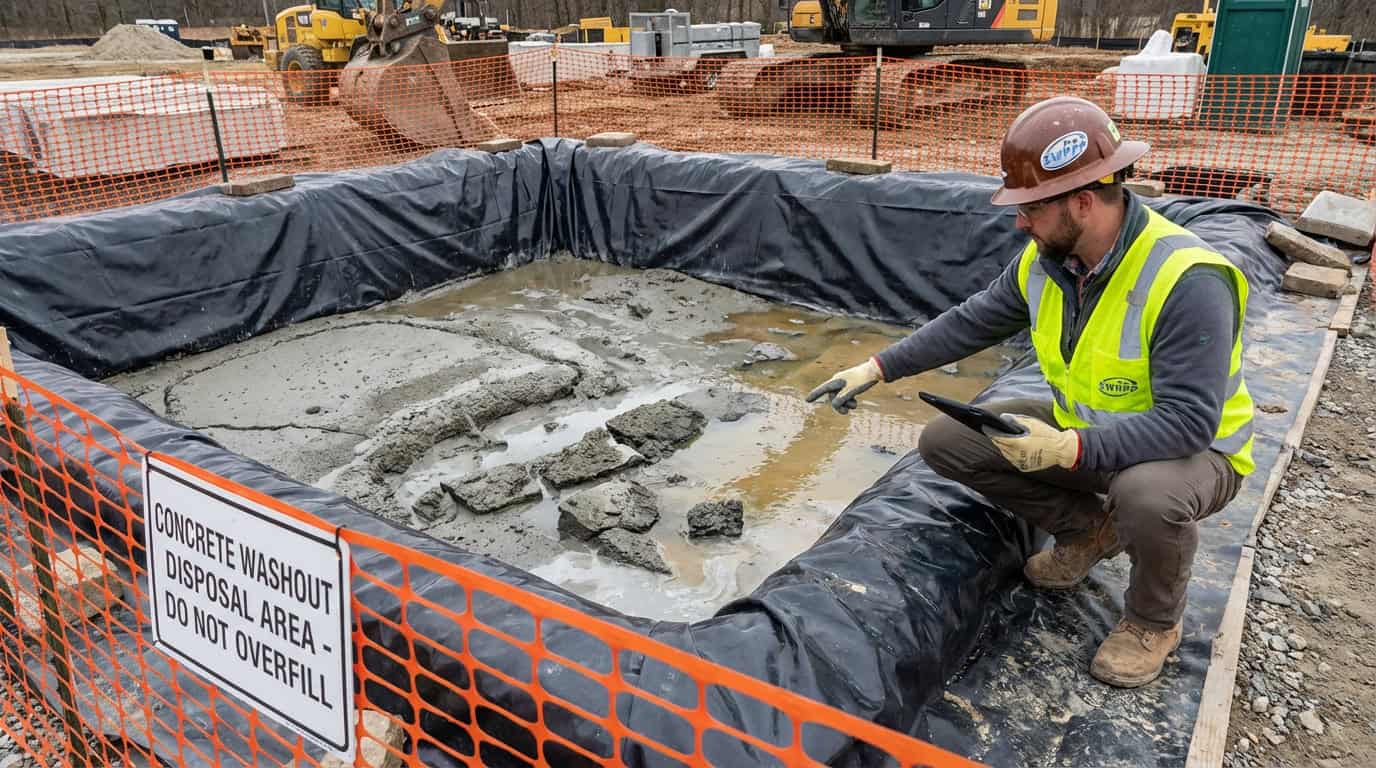
Mistake number four: liner tears. Rocks and debris poke holes in the plastic. Clear the area before you lay the liner down. Pin it with geotextile stakes. Check it every week during your Erosion Control and Sediment Control inspections.
What Your SWPPP Must Include for Concrete Washouts
Your SWPPP is your rulebook for the site. It has to show inspectors exactly how you’re handling concrete waste. Here’s what goes in:
- A site map with the location of every washout area.
- A description of the washout design (liner type, berm material, size).
- A maintenance plan: who checks it, how often, and what happens when it’s full.
- A disposal plan: where does the hardened concrete go? Who hauls it away?
- Good housekeeping BMPs: weekly sweeping or vacuuming around concrete work to stop cement dust from blowing into storm drains.
Pro SWPPP – America’s #1 SWPPP Service writes SWPPPs every day that meet all these requirements. We know what inspectors look for. We know what triggers violations. And we make sure your plan is bulletproof.
What Happens If You Skip the Washout Area?
Let’s say you don’t set one up. A crew rinses a chute on the ground. The slurry runs into a storm drain. An inspector shows up the next day.
First, you get a Notice of Violation. Then you might get a fine. Fines can run thousands of dollars per day. In some states, they can shut your site down until you fix it.
Even worse, if concrete waste gets into a waterway and causes damage, you could face federal penalties under the Clean Water Act. We’re talking serious money and serious legal trouble.
Not sure what your project needs? Take our SWPPP Quiz (link) or Schedule a Free SWPPP Consultation with CPESC Certified SWPPP Expert Derek E. Chinners.
How to Dispose of Concrete Waste After the Job
When the job is done, you need to clean up the washout area. Let the slurry harden. Break up the chunks. Backfill the pit if you dug one. Haul the concrete away.
Most of the time, the contractor owns the hardened concrete. You can’t just leave it there. And you can’t use crushed concrete for site access anymore—new 2026 rules ban that because it can leach alkaline chemicals.
Dispose of it at a landfill or recycling facility that accepts construction debris. Document it. Keep records. Inspectors love paperwork.
How Pro SWPPP Makes This Easy
We get it. You want to build, not babysit a plastic-lined hole in the ground. That’s why Pro SWPPP – America’s #1 SWPPP Service handles the whole thing.
We write your SWPPP. We put the washout areas on the map. We tell you exactly where to put them and how big to make them. We update your plan when things change on site. We even train your Water Pollution Control Manager or CESCL on what to check every week.
Our team is CPESC certified. That means we know the EPA rules, the state rules, and the local rules. We know what works in Texas with TCEQ and what works in Georgia with EPD. We’ve done thousands of plans. We’ve never had a client shut down for a concrete washout violation.
Want to learn more about our process? Visit our About page or reach out through our Contact page.
Tips to Stay Compliant in 2026 and Beyond
Things are changing fast. Here’s how to stay ahead:
- Update your SWPPP every time your site changes. New phase? New washout area? Document it.
- Use digital tools to track inspections. Paper logs get lost. Digital records don’t.
- Train your crew. Make sure everyone knows where the washout area is and what not to do.
- Check for past discharge evidence. Inspectors look for staining, erosion, or dried slurry. Clean it up before they arrive.
- Don’t use crushed concrete for haul roads or staging areas. It’s banned now in many permits.
For more guidance, check out the EPA’s stormwater page.
FAQ
Do I need a concrete washout area if my site is under one acre?
Yes, if your site is part of a larger common plan of development that disturbs one acre or more. The size of your individual lot doesn’t matter. Also, some states now require pH sampling and washout areas on sites under five acres if concrete work is happening.
How many concrete washout areas do I need?
It depends on the size of your site and how much concrete you’re pouring. A good rule: one washout for every major work zone. If trucks have to drive more than 200 feet to reach a washout, add another one.
Can I use a portable washout box instead of digging a pit?
Yes. Portable boxes are fine as long as they have a liner, freeboard, and clear signage. Just make sure they meet your permit’s size and capacity requirements.
What happens if it rains and my washout overflows?
You must report it to your NPDES coordinator right away. Clean up any discharge. Repair the washout or build a new one. Document everything. Overflows are serious violations.
Who is responsible for maintaining the washout area?
The contractor listed in your SWPPP. Usually, your Water Pollution Control Manager or CESCL inspects it weekly. They check for damage, capacity, and proper signage. If something is wrong, they fix it the same day.
Do I need a washout area for small concrete repairs or patching?
Yes. Any time you use wet concrete, you need a place to rinse tools and equipment. Even small jobs can create enough slurry to pollute stormwater.
Can I dump the concrete slurry in a sanitary sewer?
Only if your local wastewater treatment plant allows it. Most don’t. Check with them first. Never dump it in a storm drain.
Bottom line: if you’re pouring concrete, you need a washout area in your SWPPP. The rules are stricter in 2026, the fines are bigger, and inspectors are watching. Don’t guess. Don’t skip it. Get it done right the first time with Pro SWPPP – America’s #1 SWPPP Service at https://proswppp.com.