Pro SWPPP helps contractors all over Florida avoid big fines and project delays every single day. If you’re breaking ground on a construction site in the Sunshine State and disturbing one acre or more, you need to know what a Florida FSESCI NPDES certified inspector does and why that certification can save your project from a stop-work order or a five-figure penalty.
Florida doesn’t mess around when it comes to stormwater. The state’s construction general permit rules are strict. The Florida Department of Environmental Protection (FDEP) requires that every construction site covered under the NPDES program have inspections done by a qualified inspector. In Florida, that means someone with a Florida Stormwater, Erosion, and Sedimentation Control Inspector (FSESCI) certification. No credential, no compliant inspection. No compliant inspection, big problems.
This guide breaks down everything you need to know about FSESCI NPDES certified inspections. You’ll learn who needs them, what inspectors check, how often they inspect, and how to stay out of trouble with state regulators. Let’s keep it simple.
What Is FSESCI Certification and Why Does It Matter?
FSESCI stands for Florida Stormwater, Erosion, and Sedimentation Control Inspector. It’s a two-day training program and exam created by FDEP. The class teaches you how to inspect construction sites for stormwater violations, check if Best Management Practices (BMPs) are working, and write inspection reports that hold up under enforcement scrutiny.
At the end of the course, you take a one-hour proctored exam. You need to score at least 70 percent to pass. Once you do, you become a certified FSESCI inspector. That certification is the default credential Florida uses to prove you’re a “qualified inspector” under the state’s NPDES Construction General Permit (CGP). Without it, your inspections don’t count.
The certification isn’t just for consultants. Contractors, engineers, local government staff, and private environmental firms all send people through FSESCI training. If your job involves walking a construction site and checking erosion controls, you need this ticket.
What Triggers the Need for NPDES Coverage and FSESCI Inspections?
Any construction project that disturbs one acre or more of land must get coverage under Florida’s Construction General Permit. That includes projects that are part of a larger common plan of development or sale that will eventually disturb one acre or more. Think residential subdivisions, commercial buildings, road widenings, and utility installations.
To get CGP coverage, you file a Notice of Intent (NOI) with FDEP. You also pay a permit fee. For sites five acres or larger, that fee is currently around $400. Once your NOI is accepted, you’re operating under the permit. That permit requires you to develop a Stormwater Pollution Prevention Plan (SWPPP) and conduct regular inspections by a qualified inspector.
This is where Pro SWPPP comes in. We handle the entire SWPPP process, from writing the plan to coordinating inspections, so you can focus on building. Our team includes CPESC-certified professionals who know Florida’s rules inside and out. For more on statewide compliance, check out our Orange County Florida FDEP SWPPP guide.
Don’t want to mess with all the paperwork and requirements? Order your SWPPP now with Pro SWPPP Professional CPESC Certified SWPPP Services.
How Often Must FSESCI Inspectors Visit Your Site?
The Florida CGP is clear. You must inspect your site at least once every seven calendar days. You must also inspect within 24 hours after any storm event that drops 0.50 inches or more of rain. That 24-hour clock runs even if the rain falls on a weekend or holiday.
Missing an inspection is a permit violation. It doesn’t matter if your silt fence looks perfect. If you skip a required inspection, you’re out of compliance. That can trigger enforcement action, fines, or a stop-work order. Inspectors document every visit in a written report. Those reports become your proof of compliance if FDEP or a local MS4 (Municipal Separate Storm Sewer System) regulator comes knocking.

What Do FSESCI Inspectors Check During an NPDES Inspection?
Every FSESCI inspection covers the same core areas. The inspector walks the site and evaluates all stormwater discharges, BMPs, material storage areas, and disturbed ground. Here’s the checklist:
- All stormwater discharges leaving the site to make sure BMPs aren’t causing water quality violations or offsite sedimentation.
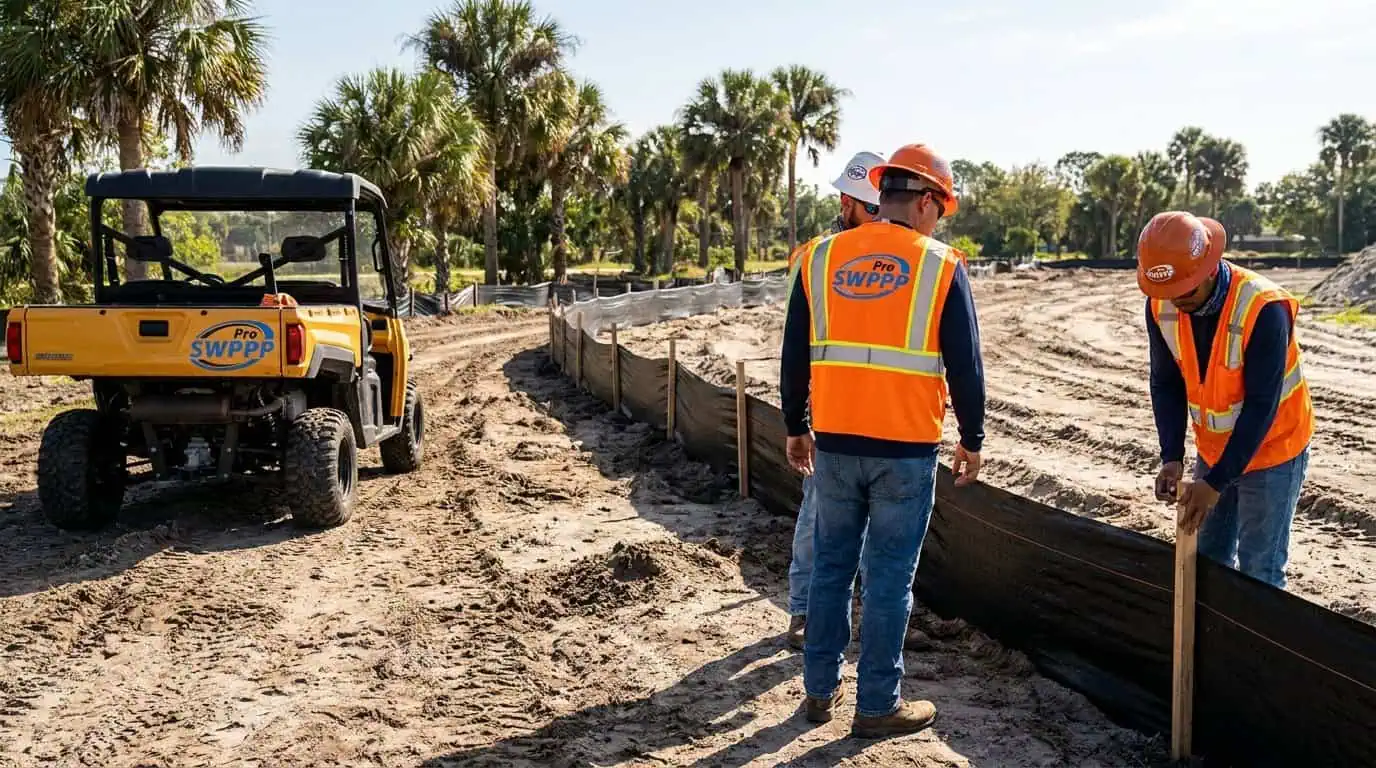
- Every BMP listed in your SWPPP, including silt fence, inlet protection, sediment basins, check dams, and perimeter controls, to confirm they’re installed correctly, maintained, and working.
- Material storage areas exposed to rain, such as fuel tanks, chemical containers, soil stockpiles, and waste dumpsters, to verify proper containment and spill prevention.
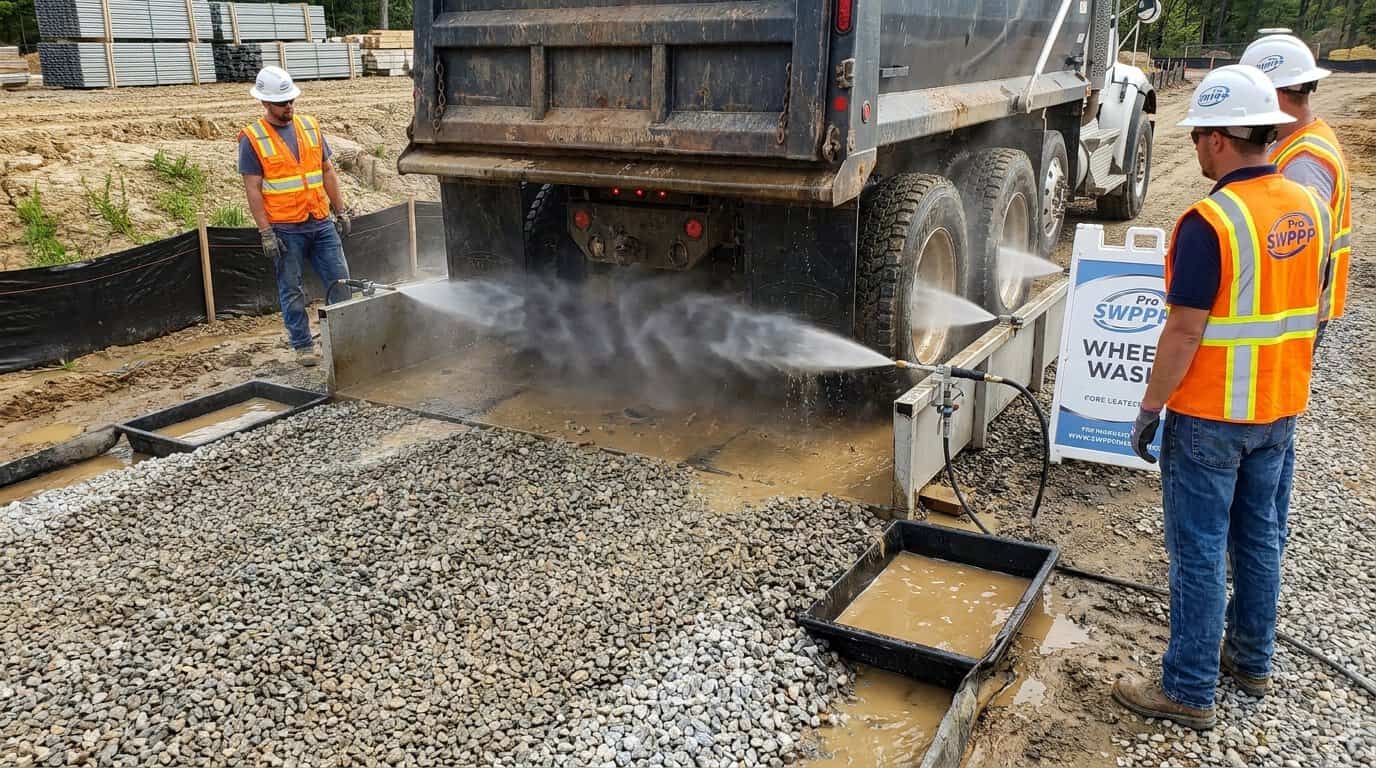
- Vehicle entry and exit points to check for sediment tracking onto public roads and to require cleanup if needed.
- All disturbed areas and discharge points to spot visible erosion or sedimentation and note corrective actions.
The inspector documents every issue in a written report. If a silt fence is torn or a sediment basin is full, the report lists the deficiency, the corrective action required, and the deadline for fixing it. Photos help prove that repairs were made on time.
Stormwater Discharges
Inspectors look at every place water leaves your site. They check for turbid water, sediment plumes, and trash or debris in runoff. If discharge looks dirty or carries sediment offsite, the inspector flags it and requires immediate action.
BMPs and Erosion Controls
Silt fences can sag or tear. Inlet protection bags can clog or overflow. Sediment basins can fill with silt and lose capacity. The inspector checks every control measure and makes sure it’s doing its job. If a BMP fails, the inspector documents it and sets a repair deadline.
Material Storage and Waste Management
Fuel, oil, chemicals, and waste materials must be stored in a way that prevents spills from reaching stormwater. Inspectors look for open containers, leaking equipment, and uncovered stockpiles. Poor storage practices can trigger immediate corrective action requirements.
Track-Out and Offsite Sediment
Construction vehicles track mud and sediment onto public roads. Inspectors check vehicle exit points and nearby streets. If they find sediment offsite, they require cleanup within 24 hours. Repeated track-out issues can lead to enforcement.
How FSESCI Inspections Tie Into Federal NPDES Standards
Florida’s FSESCI program aligns with EPA’s national NPDES Compliance Inspection Manual. That manual lays out standard inspection steps used at wastewater treatment plants, industrial facilities, and construction sites across the country. The process includes pre-inspection document review, an opening conference, a site walkthrough, and a closing conference, followed by a written report.
FSESCI-trained inspectors borrow these best practices. They use structured checklists, take photos, and review records to strengthen their reports and make them defensible if enforcement or citizen complaints arise. The more thorough your inspection documentation, the easier it is to prove compliance if regulators question your permits.
Recent Regulatory Changes in Florida Stormwater Rules
Florida updated its Environmental Resource Permit (ERP) stormwater criteria on June 28, 2024. The new rules include stricter performance standards, enhanced modeling requirements, and tougher inspection and maintenance expectations for stormwater systems. Starting June 28, 2025, stormwater system inspections must be done by a qualified inspector who is either a licensed professional, working under one, or has completed approved training within the last five years.
That training requirement closely mirrors FSESCI content. The rule changes also push for increased inspection frequency at MS4 outfalls, catch basins, and stormwater structures. Local governments are responding by requiring or recommending FSESCI certification for staff who review SWPPPs, conduct inspections, or enforce local stormwater ordinances.
The Florida Clean Waterways Act raised the stakes for enforcement. Violations can start around $1,500 each. If issues aren’t corrected, penalties can compound daily after 30 days. A single missed inspection or unaddressed deficiency can snowball into tens of thousands of dollars by project closeout.
Common Compliance Pitfalls and Misconceptions
Many contractors assume that any experienced construction person can perform NPDES inspections. That’s wrong. Florida enforcement and guidance expect inspections to be done by FSESCI-certified personnel. If the person signing reports isn’t DEP-certified, all their inspections can be considered invalid. That exposes the project to retroactive violations.
Another mistake is thinking that if BMPs look fine, paperwork doesn’t matter. Missing or incomplete inspection reports, SWPPP updates, or rainfall logs are independent violations. You can get fined even if your erosion controls are working perfectly.
Some people believe inspections are only weekly. The CGP requires both weekly inspections and inspections within 24 hours after any rain event that produces 0.50 inches or more. Miss the post-storm inspection and you’re out of compliance.
Final stabilization is another area of confusion. Putting seed on the ground isn’t enough. Inspectors must verify effective stabilization, such as uniform vegetative cover, and proper removal or conversion of temporary controls before recommending permit termination.
Common Operational Mistakes
- Failing to update the SWPPP when field conditions change, such as new stockpiles or shifted drainage paths.
- Inadequate track-out control and poor maintenance of construction entrances.
- Neglecting material and waste storage areas, including open dumpsters, uncovered stockpiles, and leaking fluids.
- Not integrating FSESCI inspectors into project scheduling, leading to missed inspections during holidays or rapid mobilizations.
Enforcement Landscape and Real-World Risk
FDEP and local MS4s actively use inspections and documentation checks to trigger enforcement. Stop-work orders and monetary penalties are common when construction sites lack qualified NPDES inspection coverage or have poor records. Third-party FSESCI inspection firms report that DEP has issued stop-work orders for projects that either skipped required inspections or used non-qualified personnel, especially on larger urban sites.
Cities like Fort Lauderdale and Miami treat NPDES compliance as a prerequisite for building and public works permits. They may require initial erosion and sediment control inspections before construction begins. The cost of non-compliance is real. One consultant noted that a single unaddressed deficiency can exceed $50,000 by project closeout when penalties compound daily.
Not sure what your project needs? Schedule a Free SWPPP Consultation with CPESC Certified SWPPP Expert Derek E. Chinners.
Just need a number? Request a project-specific SWPPP estimate.
Practical Best Practices for FSESCI NPDES Construction Inspections
Before Construction Starts
File your NPDES NOI through the FDEP Business Portal and complete your SWPPP before you break ground. The SWPPP must include site maps, BMPs, sequencing, dewatering plans, waste management procedures, and a training plan. Designate at least one FSESCI-certified inspector responsible for all NPDES inspections, report preparation, and SWPPP updates.
During Construction
Conduct and log inspections every seven days and within 24 hours after a 0.5-inch rain event. Missed inspections are permit violations even if BMPs are in good shape. Use standardized checklists based on the FSESCI manual or local MS4 forms to ensure all disturbed areas, BMPs, storage areas, and discharge points are covered every time.
Immediately document deficiencies and note specific corrective actions and deadlines in the inspection report. Maintain photo documentation before and after repairs to demonstrate timely corrective actions. This is critical if enforcement or citizen complaints arise.
At and After Final Stabilization
Confirm that all disturbed areas are stabilized with vegetative cover or other permanent measures. Remove or convert temporary BMPs to permanent controls. Submit your Notice of Termination within 14 days once final stabilization and permit conditions are met. Retain all SWPPP and inspection records for at least three years.
Training, Certification, and Renewal Trends
FSESCI training providers recognized by FDEP offer Tier I and Tier II courses using the official FDEP manual and proctored exam. Many providers now offer two-day online or hybrid formats that meet FDEP standards. This makes it easier for contractors and municipalities to maintain a pool of qualified inspectors statewide.
The ERP and handbook changes effective 2024 through 2025 strengthen the expectation of ongoing training. Inspectors submitting ERP stormwater inspection reports must have documented training within five years. That aligns with the need to periodically refresh FSESCI-like training. Local governments are requiring or strongly recommending FSESCI certification for staff who review SWPPPs, conduct construction inspections, or enforce local stormwater ordinances.
Emerging Trends and Innovations in FSESCI NPDES Inspections
New ERP rules focus on modeled load reductions and treatment performance. That requires more sophisticated inspection of stormwater systems, including verification of volume control, drawdown times, and maintenance of treatment media. Recent NPDES Phase I and II changes call for more frequent inspections of stormwater structures, minor outfalls, and catch basins. This drives higher expectations for inspection programs run or overseen by FSESCI-trained personnel.
Technology adoption is on the rise. GIS-based inspection apps, digital checklists, and mobile photo logging streamline stormwater inspection reporting and ease MS4 reporting burdens. Rainfall-triggered alert systems using local gauges or online tools prompt timely post-storm inspections to meet the 24-hour CGP requirement.
NPDES inspections are now tied to TMDL implementation, nutrient reduction strategies, and resilience planning for flood reduction and green infrastructure. The professionalization of the inspector role reflects a shift from ad-hoc inspections to professional, credentialed practice. The formal qualified inspector criteria in ERP rules raise the profile and expectations for FSESCI-certified inspectors.
Practical Recommendations for Contractors, Municipalities, and Educators
For Contractors and Developers
Budget for FSESCI training for at least one site supervisor on every CGP-covered project. Integrate inspection schedules into construction timelines and subcontracts. Treat inspection documentation as core project risk management, just as important as safety logs or pay applications. The scale of potential penalties and delay from stop-work orders makes this a no-brainer.
For Municipalities and MS4s
Require or incentivize FSESCI certification for staff performing construction site inspections and for plan reviewers checking SWPPPs. Align local construction inspection checklists with CGP and ERP requirements, including explicit verification of inspector qualifications and training dates.
For Educators and Trainers
Emphasize case-based learning showing how poor documentation or non-certified inspectors led to fines and project delays. Contrast those examples with projects where strong FSESCI-based programs prevented violations. Integrate recent ERP and NPDES rule changes from 2024 through 2025 so that students understand how FSESCI inspections fit into the broader stormwater regulatory framework in Florida, including long-term operation and maintenance of stormwater systems.
FAQ
Do I need an FSESCI-certified inspector for my Florida construction project?
Yes, if your project disturbs one acre or more and requires NPDES CGP coverage. Florida treats FSESCI certification as the default credential for meeting the qualified inspector requirement under the CGP.
How often must I inspect my site under the Florida CGP?
At least once every seven calendar days and within 24 hours after any storm event that produces 0.50 inches or more of rain. Both requirements apply throughout the life of the permit.
What happens if I miss a required inspection?
Missing an inspection is a permit violation. It can trigger enforcement action, fines, or a stop-work order, even if your BMPs are working properly.
Can any experienced construction person perform NPDES inspections in Florida?
No. Florida enforcement and guidance expect inspections to be done by FSESCI-certified personnel. If the person signing reports is not DEP-certified, all their inspections can be considered invalid.
What is final stabilization and when can I terminate my CGP coverage?
Final stabilization means all disturbed areas have effective vegetative cover or other permanent measures in place. Temporary BMPs must be properly removed or converted. Submit your Notice of Termination within 14 days after final stabilization is achieved.
What is the cost of non-compliance?
Violations under the Florida Clean Waterways Act can start around $1,500 each. If issues are not corrected, penalties can compound daily after 30 days. A single unaddressed deficiency can exceed $50,000 by project closeout.
Where can I get FSESCI training?
FDEP-recognized organizations such as the Florida Stormwater Association offer Tier I and Tier II courses using the official FDEP manual and proctored exam. Many providers offer two-day online or hybrid formats.
How does Pro SWPPP help with FSESCI NPDES inspections?
Pro SWPPP provides CPESC-certified professionals who handle SWPPP preparation, coordinate FSESCI inspections, and keep your project compliant with Florida’s CGP and ERP rules. Visit our about page to learn more about our team.
Pro SWPPP has boots on the ground in Florida and across the country. Whether you’re building in Georgia, Texas, or the Sunshine State, our CPESC-certified team writes SWPPPs, coordinates inspections, and keeps your project out of trouble. We know FSESCI, we know the CGP, and we know how to keep regulators happy. Contact us today and let us handle the paperwork so you can focus on building.
Ready to get started? Order your SWPPP now or schedule a free consultation with Pro SWPPP.
Visit Pro SWPPP and see why contractors nationwide have given us 180+ five-star Google reviews.
Ready to get compliant?
Pro SWPPP are the paperwork and permitting experts. We prepare your plan and file your Notice of Intent — delivered in 72 hours, or it’s free. Physical installation of BMPs is handled by your site contractor.