If you’re getting ready to break ground on a construction site in Georgia, you’re about to face a big problem: stormwater compliance. Miss one inspection, skip one rain event check, or fail to hire the right certified inspector, and you could be looking at fines up to $62,947 per day. That’s not a typo. The good news? Pro SWPPP is here to walk you through exactly what you need to know about Georgia ES&PC Plan Level 1B Certified Inspections so you can stay compliant, avoid penalties, and keep your project moving.

What Is a Level 1B Certified Inspector in Georgia?
Georgia doesn’t mess around when it comes to erosion and sediment control. The state runs a tiered certification program through the Georgia Soil and Water Conservation Commission (GSWCC). There are three levels: Level 1A for basic site workers, Level 1B for certified inspectors, and Level II for design professionals like engineers.
Level 1B is the core qualification you need to perform legal, regulatory inspections on construction sites. This is a two-day advanced course designed for people who inspect land disturbance areas for compliance with state erosion laws. If your project disturbs one acre or more, or if it’s part of a larger common plan, you need a Level 1B inspector on site.
Here’s the thing: you can’t just send any site supervisor to do these inspections. Georgia law requires GSWCC-certified inspectors. If you hire someone who isn’t certified, you’re putting your entire project at risk. Pro SWPPP works with certified professionals who know Georgia’s rules inside and out.
How Do You Become a Level 1B Certified Inspector?
To earn your Level 1B credential, you need to meet one of two paths:
- Complete 60 days of hands-on work experience in erosion and sediment control, then attend a GSWCC-approved Advanced Fundamentals Seminar and pass the exam with at least 70 percent.
- Hold a Level 1A certification instead of the 60-day experience, then attend the seminar and pass the exam.
Once you’re certified, your credential lasts three years. To renew, you must complete at least four hours of approved continuing education before it expires. This keeps inspectors current on new rules, BMP updates, and enforcement trends.
Why Georgia Requires ES&PC Plans and Certified Inspections
Every construction site in Georgia that disturbs one acre or more must have an Erosion, Sedimentation & Pollution Control Plan (ES&PC Plan). This plan is Georgia’s version of a SWPPP under the federal Clean Water Act. It must be designed and signed by a Level II Design Professional and submitted to Georgia EPD through the GEOS system at least 14 days before you start work.
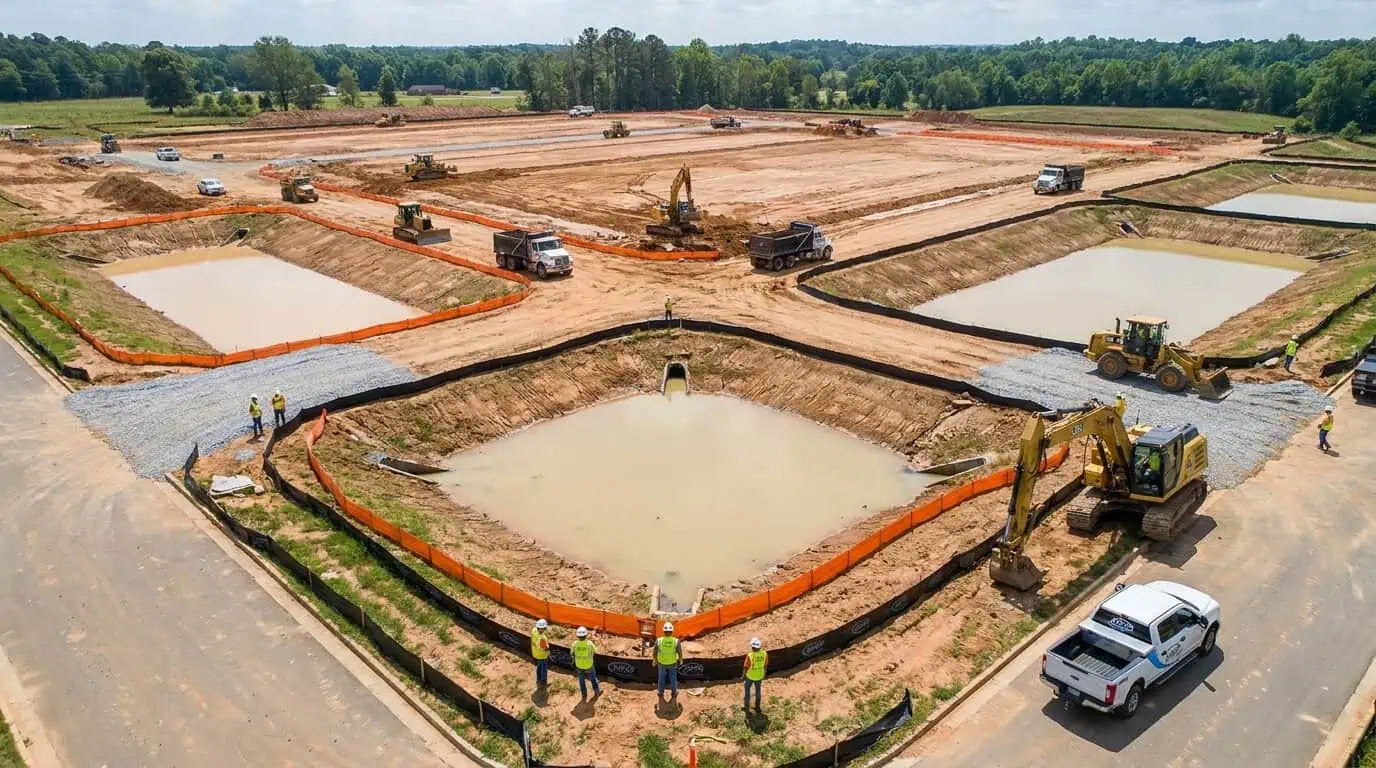
The ES&PC Plan lays out all your Best Management Practices (BMPs): silt fences, sediment basins, inlet protection, construction exits, and stabilization measures. It also identifies your inspection schedule, sampling locations, and corrective action procedures. For a full breakdown of Georgia’s state-level requirements, see our guide on Georgia SWPPP requirements.
Once your plan is approved and your Notice of Intent (NOI) is filed, the real work begins. You need a Level 1B certified inspector to verify that everything on paper matches what’s happening in the field. This isn’t optional. It’s required by Georgia’s NPDES Construction General Permit.
Inspection Frequency: The 7-Day and 0.5-Inch Rain Rule
Here’s where most contractors slip up. Georgia requires two types of inspections:
- At least once every seven calendar days during active land disturbance.
- Within 24 hours after any rainfall event that produces 0.5 inches or more.
And here’s the kicker: the post-rain inspection resets your seven-day clock. That means if it rains 0.5 inches on day five of your inspection cycle, you do a rain-triggered inspection within 24 hours. Then you start counting seven days from that rain inspection, not from your last weekly inspection.
This dual requirement catches a lot of people off guard. You can’t just check the box once a week and call it good. You need a system to track rainfall, trigger inspections, and document everything. Pro SWPPP helps you set up that system so nothing falls through the cracks.

What Does a Level 1B Inspector Actually Check?
A certified inspector doesn’t just walk the site and take notes. They have specific duties spelled out in Georgia’s NPDES permit and GSWCC guidance. Here’s what they’re responsible for:
- Verify that all BMPs match the approved ES&PC Plan. This includes perimeter controls, construction exits, sediment basins, and temporary and permanent stabilization measures.
- Document daily, weekly, and monthly inspection findings. This includes rainfall measurements, BMP performance, maintenance needs, and any off-site sediment transport.
- Record violations in both the inspection report and a separate violation summary. Corrective actions must be tracked and followed up with additional inspections.
- Coordinate with the Designer of Record (Level II professional) when initial BMP installation needs field verification.
- Ensure that sampling locations and outfalls are monitored correctly and reported to EPD by required deadlines.
Inspectors are also looking for common field issues: mud tracking onto public roads, silt fence installed in concentrated flow paths, missing double rows near state waters, unstabilized stockpiles, and muddy construction exits. Each of these can trigger a stop-work order or a fine if not corrected quickly.
Common BMP Failures and How to Fix Them
Even with a solid ES&PC Plan, BMPs can fail in the field. Here are the most common mistakes inspectors find and how to prevent them:
- Silt fence placed in concentrated flow instead of sheet flow. Move the fence or add check dams to slow water.
- Construction exit not properly maintained. Add more stone, clean off the road, and extend the exit length if needed.
- Sediment basins not cleaned out after rain events. Schedule cleanout when sediment depth reaches half the design capacity.
- Disturbed areas left idle for more than 14 days without temporary stabilization. Seed, mulch, or mat these areas immediately.
- Stockpiles not covered or protected. Use tarps, berms, or silt fence around material stockpiles to prevent runoff.
Don’t want to mess with all the paperwork and requirements? Check out Order your SWPPP now with Pro SWPPP Professional CPESC Certified SWPPP Services.
What Happens If You Skip Inspections or Hire the Wrong Person?
The consequences are serious. The federal EPA can assess civil penalties up to $62,947 per day, per violation, for Clean Water Act violations on construction sites. Georgia EPD can issue stop-work orders, require extensive remediation, and involve local governments enforcing the Georgia Erosion and Sedimentation Act.
Local jurisdictions can also tie ES&PC inspections to building milestones. For example, Fayette County requires inspections before slab or footings, before framing, and before final occupancy to verify BMP installation, maintenance, and final stabilization. If you don’t have the right certified inspector, you can’t get sign-off, and your project stalls.
Hiring an unqualified inspector is just as bad as skipping inspections altogether. If EPD shows up for a random audit and your inspector can’t produce a valid Level 1B credential, you’re in violation. Period. That’s why Pro SWPPP only works with GSWCC-certified professionals who meet or exceed Georgia’s requirements.
How Pro SWPPP Helps You Stay Compliant
We know compliance can feel overwhelming. That’s why we built our service to handle the heavy lifting. Here’s what you get when you work with Pro SWPPP:
- CPESC-certified professionals who understand Georgia EPD rules, GSWCC checklists, and NPDES permit requirements.
- ES&PC Plans designed by Level II professionals and reviewed against the latest 2025 checklists.
- Coordination with Level 1B certified inspectors for weekly, post-rain, and monthly inspections.
- Digital inspection logs, violation tracking, and corrective action documentation that meets EPD standards.
- Ongoing support throughout your project, from NOI filing to Notice of Termination (NOT).
We also serve contractors and developers in other states. If you’re working in Texas, we know TCEQ rules just as well. Our team stays current on every state’s evolving requirements so you don’t have to.
Best Practices for Level 1B Inspectors and Site Managers
Whether you’re the inspector or the person managing the project, here are the top practices to keep your site compliant:
- Use GSWCC and EPD ES&PC Plan checklists for the year your permit was issued. Rules change, and using outdated forms can cause rejections.
- Keep a structured inspection log that separates daily fuel and storage checks, weekly and post-rain BMP assessments, and monthly stabilized-area inspections.
- Install an on-site rain gauge or use a reliable nearby weather station to trigger and document post-0.5-inch inspections.
- Coordinate early with contractors to ensure initial BMPs are installed before major disturbance. Have the Designer of Record verify installation before active work begins.
- Emphasize temporary stabilization on any area idle for more than 14 days. Seed, mulch, or mat it to reduce erosion and inspection findings.
- Keep the current, approved ES&PC Plan, NOI, fee forms, and all inspection records on site at all times. EPD can ask to see them during random audits.
Not sure what your project needs? Take our SWPPP Quiz or Schedule a Free SWPPP Consultation with CPESC Certified SWPPP Expert Derek E. Chinners.
Recent Updates and Emerging Trends in Georgia Stormwater Compliance
Georgia’s rules are always evolving. The 2025 ES&PC Plan review and inspection checklists introduced clearer language tying post-rain inspections to resetting the seven-day interval. This sharpens expectations for inspection frequency and recordkeeping.
EPD is also moving toward fully electronic processes through GEOS for NOI and permit coverage. Paper submissions are being phased out, and inspection data is being integrated with digital permitting systems. This means your records need to be digital-ready and easy to upload.
There’s also growing focus on solar and large infrastructure projects. Solar sites must achieve full stabilization before panel installation, and infrastructure projects require Level 1B inspectors at 14-day intervals plus after every 0.5-inch rainfall event. These projects often face enhanced BMP requirements and stricter sampling protocols.
Projects discharging to biota-impaired stream segments within one linear mile must implement four additional BMPs per the permit appendix and are subject to more intensive sampling. If your site is near a sensitive water body, expect extra scrutiny and more frequent inspections.
Why Certification Matters More Than Ever
As enforcement tightens and digital recordkeeping becomes the standard, inspectors who also understand design principles (Level II or CPESC) are increasingly valuable. They can identify not only maintenance issues but fundamental plan deficiencies and coordinate formal revisions.
Organizations are prioritizing proactive internal audits, third-party Level 1B inspections, and frequent training refreshers beyond the minimum continuing education requirement. Given high penalty ceilings and public scrutiny of stormwater impacts, it pays to go above and beyond the baseline.
Pro SWPPP stays ahead of these trends. We monitor regulatory updates, train our team on new checklists, and adjust our processes so you’re always compliant. To learn more about our team and approach, visit our About page.
FAQ
What is a Level 1B ES&PC Certified Inspector in Georgia?
A Level 1B inspector is a GSWCC-certified professional trained to inspect construction sites for erosion and sediment control compliance. This is the core qualification required for regulatory inspections on sites disturbing one acre or more.
How often must a Level 1B inspector check a Georgia construction site?
At least once every seven calendar days during active land disturbance, and within 24 hours after any rainfall event producing 0.5 inches or more. The post-rain inspection resets the seven-day cycle.
Can I hire any site worker to do ES&PC inspections?
No. Georgia law requires GSWCC-certified Level 1B inspectors for NPDES and ES&PC inspections. Hiring an unqualified person puts your project at risk of fines and stop-work orders.
What happens if I skip a post-rain inspection?
You’re in violation of your NPDES permit. EPA can fine you up to $62,947 per day per violation, and Georgia EPD can issue stop-work orders and require remediation.
How long does Level 1B certification last?
Three years. You must complete at least four hours of approved continuing education before it expires to renew your credential.
Do I need an ES&PC Plan or a SWPPP in Georgia?
Georgia calls it an ES&PC Plan, but it serves the same function as a SWPPP under the federal Clean Water Act. If you disturb one acre or more, you need an ES&PC Plan and NPDES permit coverage.
What BMPs do Level 1B inspectors check?
Silt fences, sediment basins, inlet protection, construction exits, stabilized areas, stockpile protection, and stormwater sampling locations. They verify that field conditions match the approved ES&PC Plan.
Can Pro SWPPP help with Georgia ES&PC Plans and inspections?
Yes. Pro SWPPP works with CPESC-certified professionals and GSWCC Level 1B inspectors to design plans, file NOIs, conduct inspections, and keep your project compliant from start to finish.
Where can I get more help with Georgia stormwater compliance?
Visit our Contact Us page or schedule a free consultation with our team. We’ll walk you through your project and make sure you have everything you need.
Ready to get started? Order your SWPPP now or schedule a free consultation with Pro SWPPP.
Visit Pro SWPPP and see why contractors nationwide have given us 180+ five-star Google reviews.
Ready to get compliant?
Pro SWPPP are the paperwork and permitting experts. We prepare your plan and file your Notice of Intent — delivered in 72 hours, or it’s free. Physical installation of BMPs is handled by your site contractor.