
What Are the SWPPP Requirements in Orange County, CA?
Orange County construction disturbing one acre or more requires coverage under California Construction General Permit Order WQ 2022-0057-DWQ, a SWPPP prepared by a Qualified SWPPP Developer, and Permit Registration Documents filed in SMARTS. Priority development projects also need a Water Quality Management Plan approved by the city before building permits are issued.
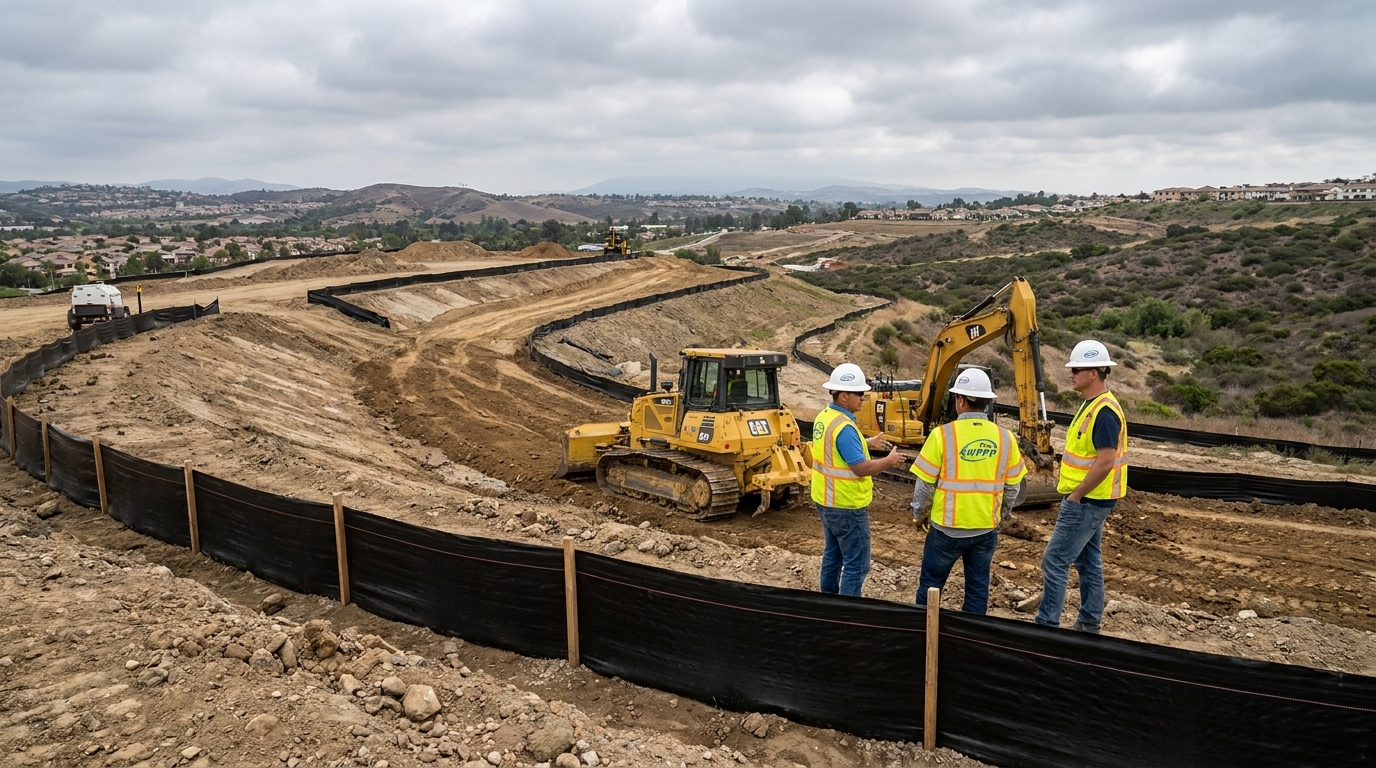
What Is a SWPPP and Why Does Orange County Enforce It So Hard?
A SWPPP is a Stormwater Pollution Prevention Plan: the site-specific written plan showing how sediment, fuels, concrete slurry, paint, and trash will be kept out of storm drains during construction. It is required under the federal Clean Water Act NPDES program, implemented statewide through Order WQ 2022-0057-DWQ, NPDES No. CAS000002.
Orange County drains fast and drains short. Most sites discharge to flood control channels that reach Newport Bay, Anaheim Bay, or the open coast within a few miles, so a sediment release in Anaheim can show up in a receiving water the same day. That short travel distance is why local agencies inspect aggressively.
Jurisdiction is split. North and central Orange County fall under the Santa Ana Regional Water Quality Control Board, Region 8, while south Orange County falls under the San Diego Regional Water Quality Control Board, Region 9. The two regions run separate MS4 permits with different local requirements layered on the same state CGP.
Not sure if you even need one?
Answer a few questions about your site and find out in under two minutes.
Which Orange County Projects Need a SWPPP?
The state threshold is soil disturbance of one or more acres of land surface. Reach one acre and Construction General Permit coverage plus a SWPPP are mandatory before any ground is broken, anywhere in Orange County.
Sites under one acre are still covered when they are part of a larger common plan of development or sale. A 0.4-acre pad inside a 22-acre Irvine masterplan is covered by the CGP, because the state measures total disturbance across the plan rather than the individual parcel. This is the single most common reason a small builder discovers they needed coverage after grading started.
Below both triggers, city and county requirements still apply. Local grading permits typically require an erosion and sediment control plan regardless of acreage, and priority development projects need a WQMP no matter how small the disturbance footprint is. For the statewide framework, see our guide to California SWPPP requirements.
Who Writes and Manages an Orange County SWPPP?
Two certified roles, and the permit distinguishes them clearly. A Qualified SWPPP Developer (QSD) prepares and amends the plan. A Qualified SWPPP Practitioner (QSP) runs field implementation, inspections, sampling, and the corrective action record.
Order WQ 2022-0057-DWQ requires that the discharger verify personnel serving as QSD or QSP have an active and current certificate. QSD eligibility is gated on an underlying credential first: registered civil engineer, professional geologist, engineering geologist, landscape architect, professional hydrologist, CPESC, CPSWQ, or CISEC, followed by the State Water Board QSD course and exam.
Neither role includes field construction. The QSD specifies which control measures the plan requires, where they belong, and in what sequence. Physical installation of BMPs is handled by your site contractor, and the QSP documents whether what was built matches what the plan called for.
When Do You Need a WQMP on Top of Your SWPPP?
A SWPPP covers the construction phase. A Water Quality Management Plan covers the permanent, post-construction condition, and Orange County cities require an approved Project WQMP before they will issue a building permit for a Priority Project. The two documents must agree with each other, because a permanent bioretention basin shown in the WQMP cannot be used as a construction sediment trap in the SWPPP without a plan for restoring its infiltration capacity.
| Priority Project category | Typical threshold that triggers a WQMP |
|---|---|
| Residential development | 10 or more dwelling units |
| Commercial or industrial development | 100,000 square feet or more |
| Restaurant | 5,000 square feet or more |
| Parking lot | 5,000 square feet or more, or 15 or more parking spaces |
| Hillside development | 5,000 square feet or more on natural slopes of 25 percent or steeper |
| Automotive repair shop | Any size, based on the facility SIC code |
| Retail gasoline outlet | 5,000 square feet or more, or 100 or more projected vehicle trips per day |
| Project discharging to an Environmentally Sensitive Area | 2,500 square feet or more of impervious surface |
Confirm the exact thresholds with your city, because they differ between the Region 8 and Region 9 permit areas. The Model WQMP for South Orange County published by the San Diego Regional Water Quality Control Board and the Orange County BMP Design Manual from OC Public Works are the two documents reviewers work from. City programs such as the City of Orange Storm Water Program publish their own screening checklists.
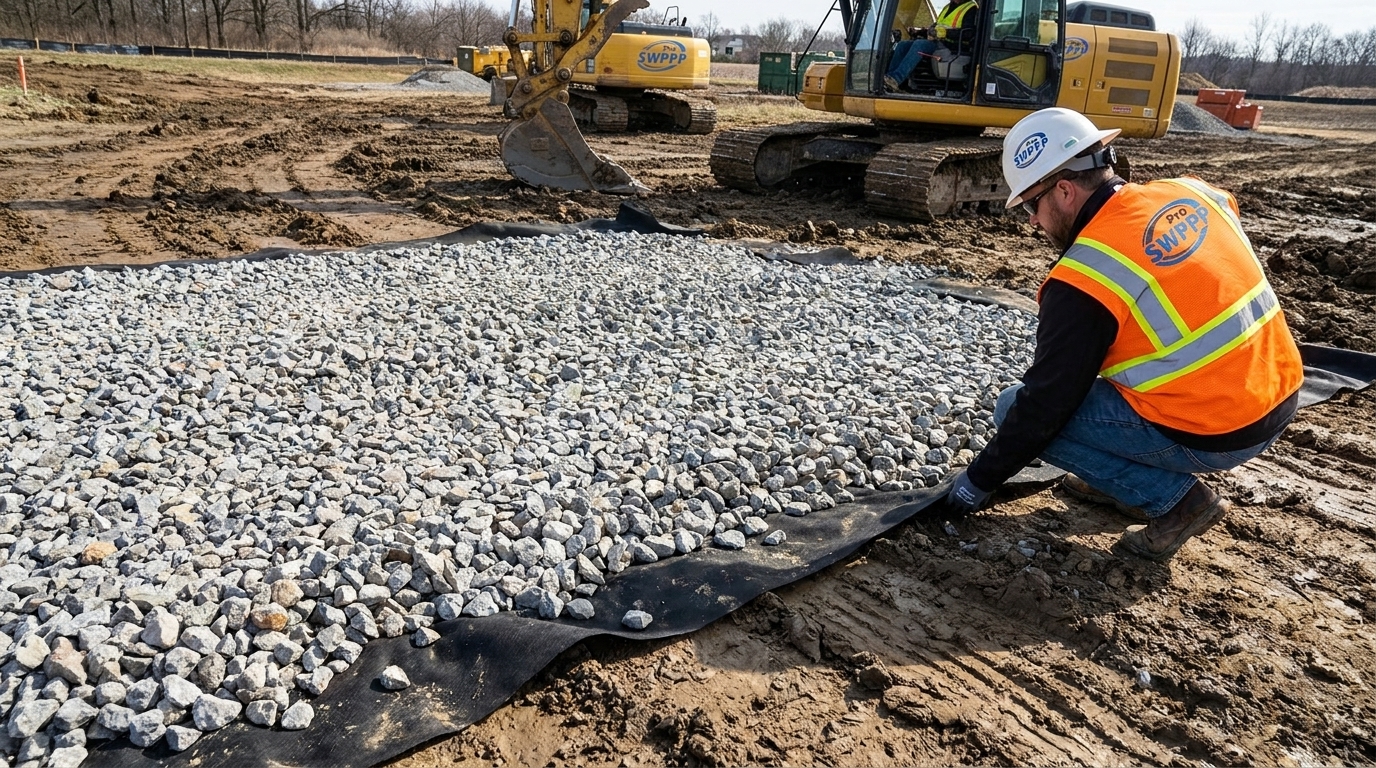
How Do You Get Permit Coverage Through SMARTS?
Coverage comes from filing Permit Registration Documents electronically in SMARTS, the State Water Resources Control Board Stormwater Multiple Application and Report Tracking System. The PRD package includes the Notice of Intent, the Risk Level determination, the site map, the SWPPP, the annual fee, and certification by the Legally Responsible Person.
The state issues a Waste Discharge Identification number, the WDID, once the package is complete and certified. Soil disturbance may not begin until that WDID exists. There is no informal grace period, and an unpermitted start is dated from the first day of grading rather than from the day an inspector notices.
Risk Level is set during this step and drives the rest of the job. Risk Level 1 sites run visual monitoring only. Risk Level 2 and 3 sites add effluent sampling against Numeric Action Levels of pH 6.5 to 8.5 standard units and turbidity of 250 NTU, with Risk Level 3 adding receiving water monitoring. Details on Risk Levels are published by the State Water Resources Control Board Construction Stormwater Program.
How Often Must You Inspect an Orange County Construction Site?
The 2022 CGP put inspections on a weather-forecast schedule, and this is the requirement most Orange County crews are still getting wrong. The permit requires QSP inspections Within 72 hours prior to a forecasted Qualifying Precipitation Event, language taken directly from Order WQ 2022-0057-DWQ adopted by the State Water Resources Control Board on September 8, 2022 and effective September 1, 2023.
A Qualifying Precipitation Event is defined by forecast, not by rain gauge: a 50 percent or greater chance of 0.5 inches or more of rain in a 24-hour period. When that appears in the outlook, the pre-storm inspection obligation begins even if the storm later misses Orange County entirely.
Inspections continue during extended storm events and after the event passes, and routine inspections plus non-stormwater discharge observations run through the long Southern California dry season. Every inspection is logged with date, inspector, findings, photographs, and corrective actions, and the record is uploaded through SMARTS.
The old rule of thumb, inspect within 24 hours after a half-inch of rain, is out of date under the 2022 permit. A file with only post-storm inspections in it shows the gap plainly to any reviewer who compares your inspection dates against the archived forecast.
Just want a number first?
Tell us about your project and we will send a written estimate, no obligation.
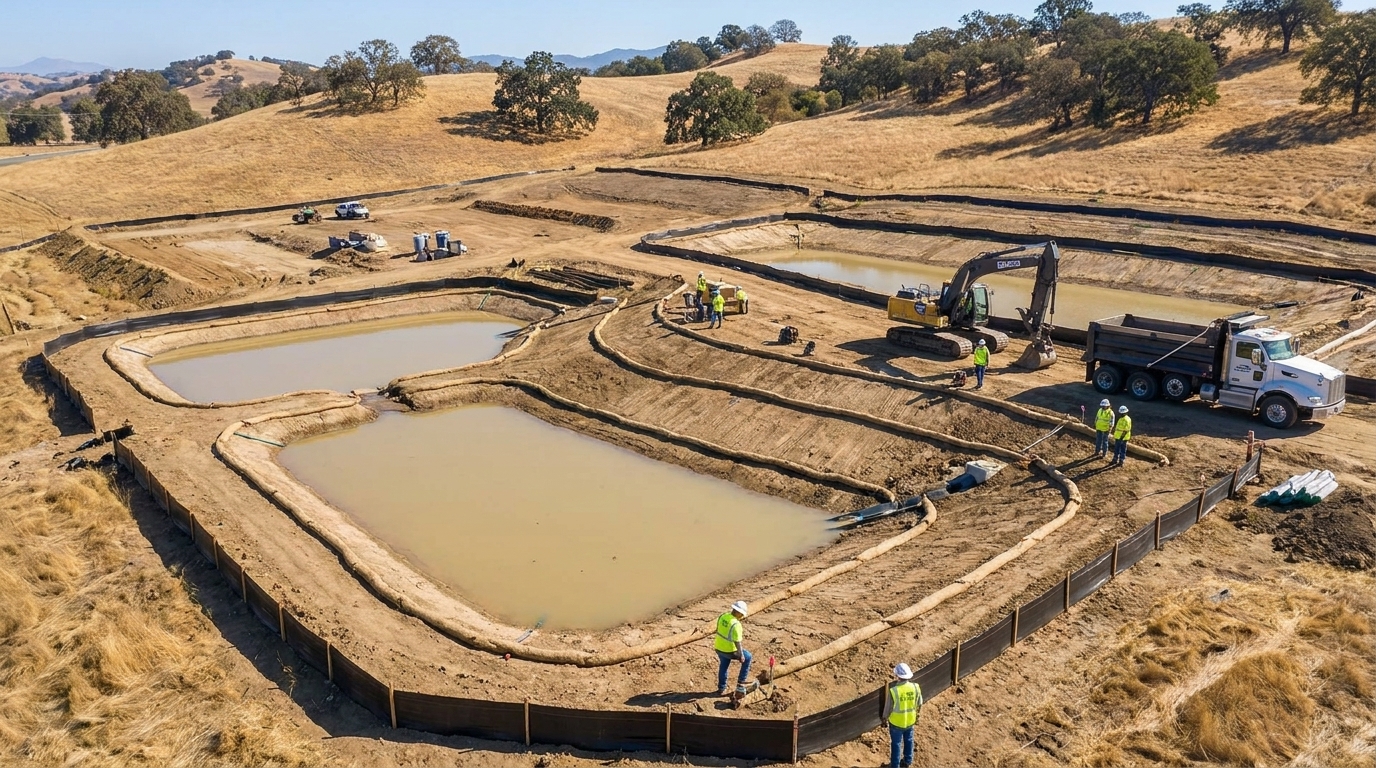
What Are the Most Common Orange County SWPPP Mistakes?
Three failures account for most enforcement in Orange County, and all three are documentation failures rather than engineering failures.
First, treating the SWPPP as a file-and-forget document. The plan is required to reflect current conditions. When the contractor moves a washout area, adds a stockpile, or shifts a grading phase, the site map and BMP schedule have to be amended to match. Physical installation of BMPs is handled by your site contractor, but the amendment that records the change is a permit obligation with its own deadline.
Second, assuming CGP coverage is enough. Cities routinely reject grading and building permit applications because no Project WQMP was submitted. Screening for Priority Project status should happen during entitlement, not after the grading permit is denied.
Third, skipping the pre-storm inspection. Because the trigger is a 50 percent forecast of 0.5 inches, the obligation can arrive three days ahead of any rain. Crews watching the sky instead of the forecast miss it every wet season.
What Happens If You Skip Your SWPPP?
California Water Code section 13385 authorizes administrative civil liability of up to $10,000 per day of violation, with additional per-gallon liability available for discharges. Unpermitted grading is a continuing violation, so the exposure compounds every calendar day until coverage is issued.
The schedule damage usually costs more than the penalty. A stop-work order in October can push a grading window into the wet season, idle subcontractors, and force resequencing of the whole job. Restarting also means producing the missing documentation under deadline while an inspector reviews it.
Closing out has its own standard. A Notice of Termination requires final stabilization, and the permit recognizes a 70 percent final cover method measured against 70 percent of all disturbed and exposed areas of soil that are non-paved or non-built. Projects that never planned for stabilization stay on the permit and keep paying annual fees after the crews are gone.
Why Work With Pro SWPPP in Orange County?
Pro SWPPP, LLC prepares the documentation side of Orange County compliance: site-specific SWPPP documents written to Order WQ 2022-0057-DWQ, Risk Level determinations, PRD and NOI packages filed through SMARTS, BMP maps and inspection logs, SWPPP amendments as the site changes, and Notice of Termination support. Physical installation of BMPs is handled by your site contractor.
Plans are prepared by Derek E. Chinners, CPESC, with more than 20 years in erosion and sediment control, including urban infill, hillside grading, and high-density development where perimeter space is tight and standard details do not fit.
We prepare documentation across California and for projects in Texas and Georgia. Learn more about our team or reach us through our contact page.
Orange County SWPPP FAQ
Do I need a SWPPP for a small lot in Orange County?
If the lot disturbs less than one acre and is not part of a larger common plan of development or sale, state Construction General Permit coverage may not apply. Your city can still require a Water Quality Management Plan and a local erosion and sediment control plan for the grading permit, so check with the planning department first.
How do I get permit coverage before starting work?
File complete Permit Registration Documents in SMARTS, including the Notice of Intent, Risk Level determination, site map, SWPPP, and annual fee, certified by the Legally Responsible Person. The State Water Board then issues a WDID number. Soil disturbance cannot legally begin until that WDID has been issued for the site.
Can I write my own SWPPP in Orange County?
No. Order WQ 2022-0057-DWQ requires a Qualified SWPPP Developer, and the discharger must verify the QSD certificate is active and current. QSD eligibility requires an underlying credential such as a registered civil engineer, professional geologist, landscape architect, CPESC, CPSWQ, or CISEC, plus the State Water Board training and exam.
What is SMARTS and do I need an account?
SMARTS is the State Water Resources Control Board online system for construction stormwater compliance. It is used to file Permit Registration Documents, upload inspection and sampling records, submit SWPPP amendments, file the Annual Report by September 1st each year, and file the Notice of Termination at project closeout.
How often do I need to inspect my Orange County site?
Under the 2022 CGP, QSP inspections are required within 72 hours prior to a forecasted Qualifying Precipitation Event, during extended storms, and after the event, plus routine inspections and non-stormwater discharge observations. A Qualifying Precipitation Event means a 50 percent or greater chance of 0.5 inches or more of rain in 24 hours.
What is the difference between a SWPPP and a WQMP?
The SWPPP controls pollutants during construction and ends when the Notice of Termination is accepted. The WQMP governs permanent post-construction stormwater management using low impact development features and stays with the property indefinitely. Many Orange County Priority Projects need both, and the two documents must be consistent with each other.
Which Regional Water Board covers my Orange County project?
North and central Orange County fall under the Santa Ana Regional Water Quality Control Board, Region 8. South Orange County falls under the San Diego Regional Water Quality Control Board, Region 9. The statewide Construction General Permit applies in both, but the MS4 permits and WQMP requirements layered on top differ.
What happens if a BMP fails during a storm?
Document it immediately with photographs, the time, the location, and a description of the failure, then have the contractor repair or replace it and amend the SWPPP to reflect the change. A documented failure with a documented correction shows good-faith compliance; an undocumented one reads as an unreported discharge.
Complicated site? Talk it through.
Speak directly with a CPESC-certified stormwater expert with 20+ years of experience.