When Does Raleigh Require an E&SC Plan?
Raleigh requires an approved Erosion and Sedimentation Control Plan for any land-disturbing activity that uncovers more than 12,000 square feet — roughly 0.28 acre, and far below North Carolina’s one-acre state threshold. Section 9.4.6 of the Raleigh Unified Development Ordinance requires that plan on file with the City 30 or more days before work starts.
Who Reviews Erosion Control Plans in Raleigh and Wake County?
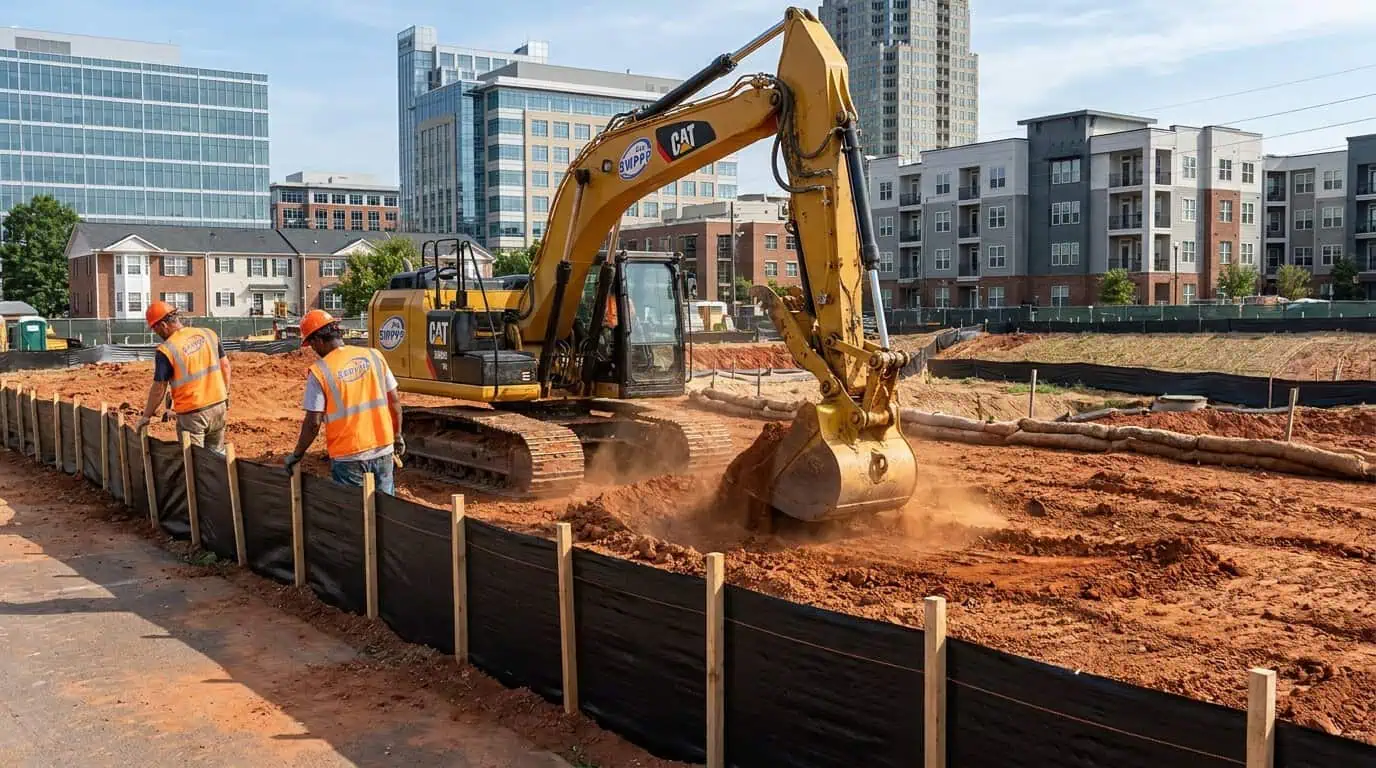
North Carolina’s Sedimentation Pollution Control Act allows cities and counties to run delegated local erosion control programs under oversight from the NCDEQ Division of Energy, Mineral and Land Resources (DEMLR). Raleigh and Wake County both operate their own programs, which is why the rules change at a city line.
Inside city limits and Raleigh’s extraterritorial jurisdiction, City of Raleigh Stormwater Plan Review handles the submittal under UDO Article 9.4. In unincorporated Wake County, the county’s erosion control program reviews the plan. Cary, Apex, Wake Forest, Holly Springs, and Garner each administer separate ordinances with separate thresholds and fee schedules.
Confirm jurisdiction from the parcel record before you draw a sheet. A Raleigh mailing address does not prove Raleigh jurisdiction, and the difference between the two nearest desks is a 12,000-square-foot trigger versus a 43,560-square-foot trigger.
Not sure if you even need one?
Answer a few questions about your site and find out in under two minutes.
What Is Raleigh’s Land-Disturbance Threshold?
Raleigh’s trigger is 12,000 square feet of uncovered land. Section 9.4.6 of the Raleigh Unified Development Ordinance states that no person shall initiate land-disturbing activity “if more than 12,000 square feet is to be uncovered unless, 30 or more days prior to the anticipated date for initiating the activity, an erosion and sedimentation control plan for such activity is filed with and approved by the City.”
That is 28 percent of an acre. A single-family teardown-rebuild on a quarter-acre lot with a driveway, a utility trench, and a laydown area clears 12,000 square feet without much effort. Raleigh’s UDO also treats sites between 12,000 square feet and one acre as plan-required and approval-required before work begins, so there is no informal middle tier.
The 12,000-square-foot trigger applies with equal force inside the Falls Watershed Protection Overlay District (-FWPOD) and the Swift Creek Watershed Protection Overlay District (-SWPOD), and to any activity in a watercourse natural buffer yard or relocating a natural watercourse.
How Do Thresholds Differ Across Wake County?
| Jurisdiction | Plan Trigger | Equivalent Acreage | Published Fee |
|---|---|---|---|
| City of Raleigh | More than 12,000 sq ft | 0.28 acre | $157 review + $317 permit per disturbed acre |
| Town of Wake Forest | 21,780 sq ft | 0.50 acre | Set by town schedule |
| Unincorporated Wake County | 43,560 sq ft | 1.00 acre | $250 review + $250 permit per disturbed acre |
| NC state minimum | 43,560 sq ft | 1.00 acre | $100 per disturbed acre |
Fee and threshold figures are published on the NCDEQ local erosion and sedimentation control program fee list. Three parcels within four miles of each other can sit under three different triggers.
What Is the Common Plan of Development Trap?
A half-acre lot inside a 20-lot subdivision is not evaluated alone. State law and every local program in Wake County add up the disturbance across the entire common plan, and once the total crosses one acre, the whole development is in scope regardless of who owns individual lots.
Custom builders get caught here most often. Owning one lot does not create an exemption when a related entity is disturbing the rest of the tract under the same approved subdivision plan.
What Goes Into a Raleigh Grading Permit Submittal?
Raleigh and Wake County both expect a sealed plan set from a licensed professional, submitted through the City’s development portal. The package is judged on internal consistency as much as on design quality.
A complete Raleigh submittal typically includes:
- Sealed grading and erosion control sheets with the limits of disturbance dimensioned
- Total site area and total disturbed area stated in both square feet and acres
- Existing and proposed drainage area maps
- Sediment basin or trap sizing calculations tied to those drainage areas
- Standard BMP detail sheets referencing the City’s approved detail library
- A phased construction sequence placing perimeter controls ahead of mass grading
- Financially Responsible Party form with signature
- Watercourse buffer, -FWPOD, and -SWPOD overlay mapping where they apply
- Sediment and erosion control surety agreement documentation
The construction sequence is a design instruction to your builder, not a scope of work performed by the plan preparer. Physical installation of BMPs is handled by your site contractor.
How Long Does Raleigh Plan Review Take?
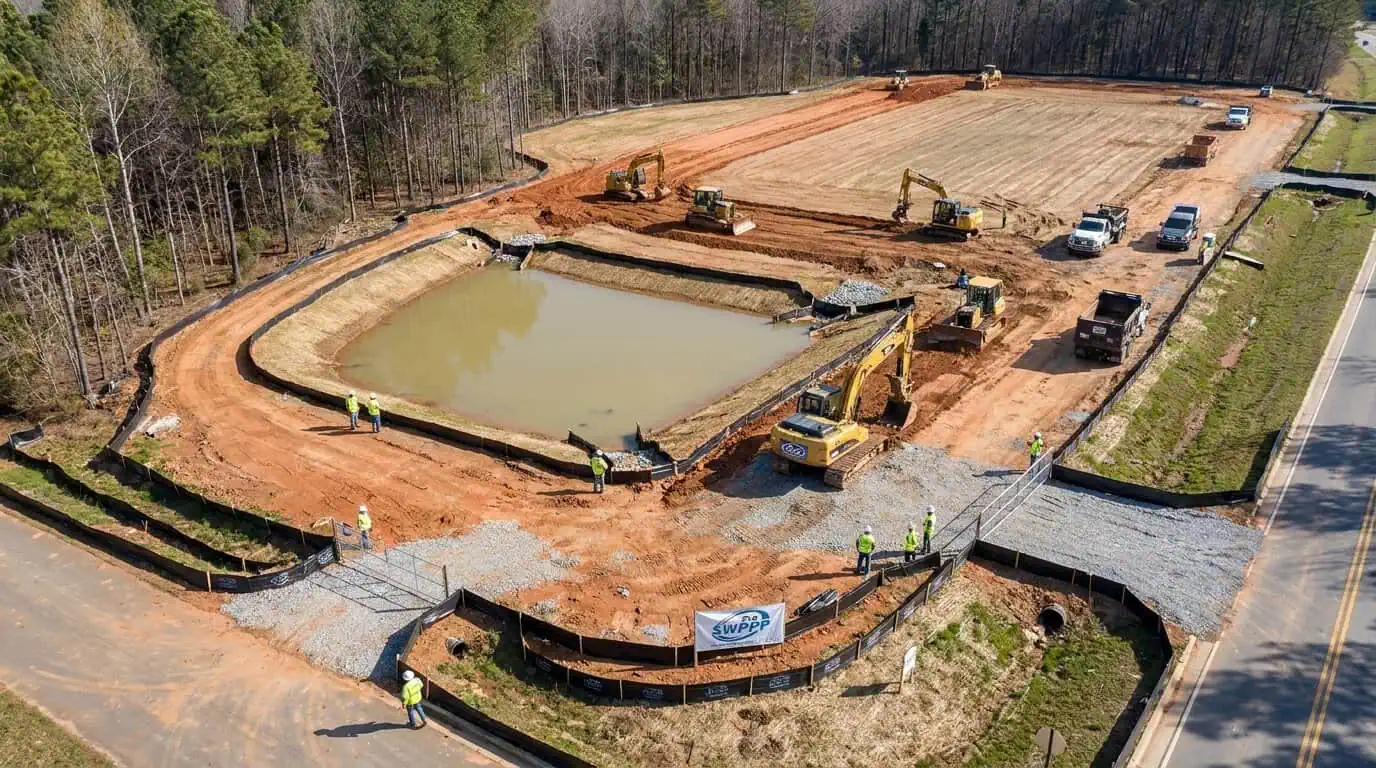
The statutory floor is fixed: UDO 9.4.6 requires the plan on file 30 or more days before the anticipated start of land disturbance. That is a filing deadline, not a promise of approval in 30 days.
In practice, budget a first review cycle plus at least one comment-and-resubmittal round. Complete packages for straightforward sites commonly clear in roughly 7 to 20 business days per cycle; incomplete packages are returned without substantive review, which resets the clock rather than pausing it.
Raleigh also requires a sediment and erosion control surety agreement before the land-disturbing permit is issued, and that paperwork runs on its own track. Start the City of Raleigh stormwater surety agreement process in parallel with plan review rather than after approval.
What Do Raleigh and Wake County Charge?
Raleigh splits the cost into two line items: a land-disturbing plan review fee of $157 per disturbed acre, rounded to the nearest tenth of an acre, and a land-disturbing permit fee of $317 per disturbed acre on the same rounding. Single-family dwellings reviewed lot-by-lot are billed at $100 per lot.
Unincorporated Wake County charges $250 per disturbed acre for plan review and another $250 per disturbed acre for the land-disturbing permit, with lot-by-lot review billed at $100 per lot or $250 per acre. All figures are from the NCDEQ local program fee list.
Run the math before you pick a design. A 3.4-acre Raleigh site carries roughly $534 in review fees and $1,078 in permit fees, about $1,612 total, plus surety. The same 3.4 acres in unincorporated Wake County runs about $1,700. Neither figure includes plan preparation, the NCG01 program, or post-construction stormwater review.
Just want a number first?
Tell us about your project and we will send a written estimate, no obligation.
How Often Must You Self-Inspect Under NCG01?
Any Wake County site disturbing one acre or more also carries NCG01, North Carolina’s construction stormwater general permit, issued by DEMLR for the April 1, 2024 through March 31, 2029 term.
NCG01 requires self-inspection “at least once per 7 calendar days and within 24 hours of a rain event ≥ 1.0 inch in 24 hours” (NCDEQ Division of Energy, Mineral and Land Resources, NCG01 Inspection, Recordkeeping and Reporting). Crews moving in from other states routinely apply a 0.5-inch trigger here; North Carolina’s number is 1.0 inch.
The permit also requires a rain gauge on site with daily rainfall recorded, and days with no rainfall recorded as zero. A gap in the rain log is treated as a missing inspection record, even when the BMPs on the ground are in good condition. Records stay on site and are retained after the Notice of Termination.
City inspectors visit on their own schedule through City of Raleigh stormwater inspections for development. Their visit does not substitute for your self-inspection record.
How Do Falls Lake and Swift Creek Overlays Change the Rules?
Raleigh sits inside two named watershed protection overlays, -FWPOD for Falls Lake and -SWPOD for Swift Creek, and the Neuse River basin nutrient rules apply across the region. Inside those overlays the 12,000-square-foot erosion trigger runs alongside nutrient loading limits, impervious surface caps, and protected riparian buffers.
Watercourse natural buffer yards under UDO 9.2.3 are explicitly named in Section 9.4.6, meaning buffer disturbance is regulated by the same section that sets the erosion threshold. Grading inside a protected buffer generally requires separate authorization and can shrink buildable area enough to change lot yield.
Screen the parcel against Falls Lake, Swift Creek, and Neuse buffer mapping before finalizing grading. Finding an overlay after the grading plan is drawn is the most expensive sequence available. For statewide context, see the guide to North Carolina SWPPP requirements.
Why Work With Pro SWPPP on a Raleigh Project?
Pro SWPPP, LLC prepares compliance documentation. For Wake County work that means the E&SC Plan set, drainage area maps, basin sizing calculations, the phased construction sequence, the Financially Responsible Party form, surety paperwork support, NCG01 inspection forms, and the recordkeeping package that survives an audit.
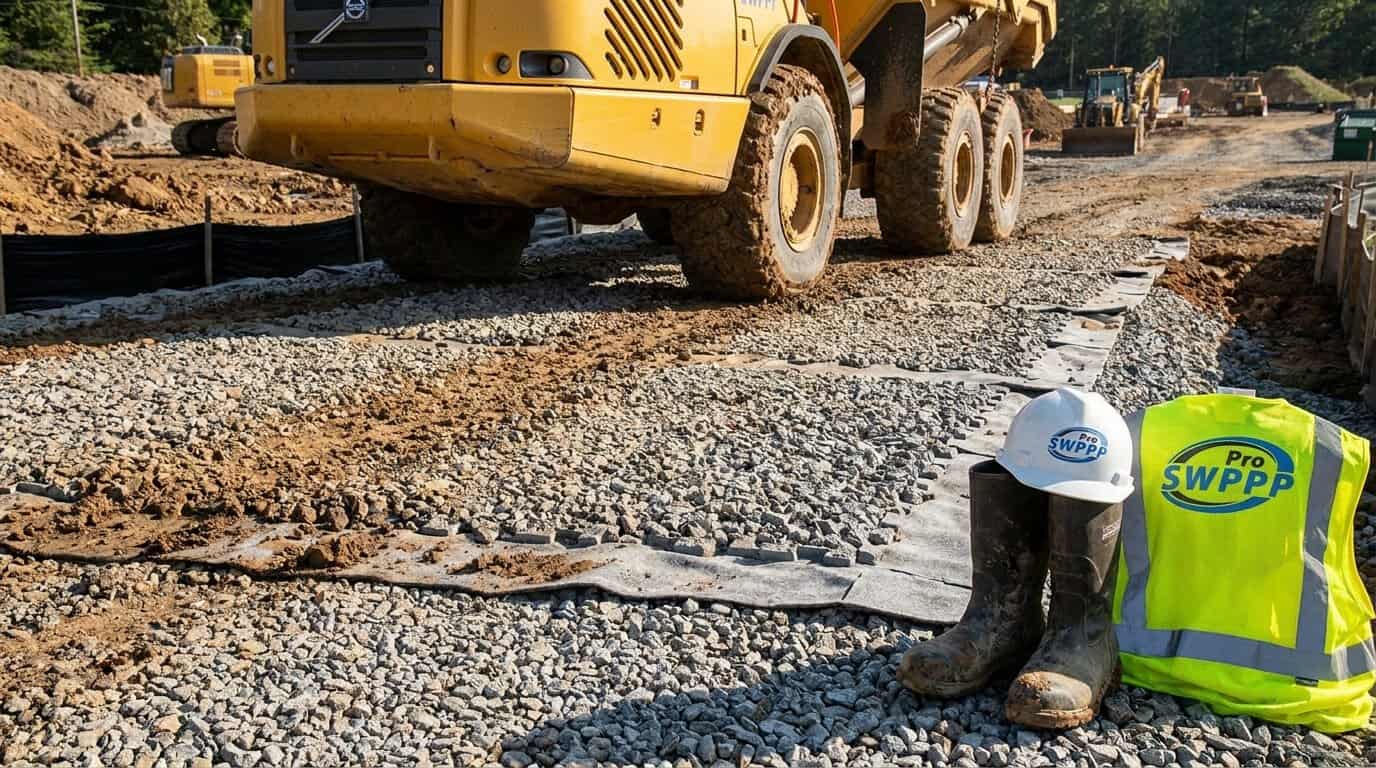
We do not perform field construction. Physical installation of BMPs is handled by your site contractor; our role ends at reviewer-ready paperwork and the documentation your inspector asks to see. Plans are prepared under CPESC-certified review by Derek E. Chinners, CPESC, with more than 20 years in stormwater compliance, and standard delivery is 72 hours.
The same documentation service covers Texas and Georgia. More about the process is on our About page, and questions go through the Contact page.
Raleigh E&SC Plan FAQ
What is Raleigh’s land-disturbance threshold for an E&SC Plan?
More than 12,000 square feet of uncovered land, about 0.28 acre. UDO Section 9.4.6 requires the erosion and sedimentation control plan to be filed with and approved by the City 30 or more days before land-disturbing activity begins. The same trigger applies inside the Falls and Swift Creek watershed protection overlay districts.
Is the threshold different in unincorporated Wake County?
Yes. Unincorporated Wake County applies the state one-acre threshold of 43,560 square feet, more than three and a half times Raleigh’s trigger. Wake Forest sits between the two at 21,780 square feet. Verify jurisdiction from the parcel record, because adjacent lots can fall under different programs.
How much does a Raleigh land-disturbing permit cost?
Raleigh charges $157 per disturbed acre for land-disturbing plan review and $317 per disturbed acre for the permit, both rounded to the nearest tenth of an acre, with single-family lot-by-lot review at $100 per lot. A 3.4-acre site runs about $1,612 in combined city fees before surety.
How many days before construction must the plan be filed in Raleigh?
Thirty or more days before the anticipated start date, per UDO Section 9.4.6. That is a minimum filing window, not an approval guarantee. Plan for at least one comment-and-resubmittal cycle on top of it, since incomplete packages are returned rather than reviewed and the 30-day clock restarts.
What is a sediment and erosion control surety agreement in Raleigh?
It is the financial guarantee Raleigh requires before issuing a land-disturbing permit, ensuring the City can complete or repair erosion controls if the permittee does not. The agreement runs on its own approval track, so start it in parallel with plan review rather than waiting for plan approval.
Do the Falls Lake and Swift Creek overlays change the requirements?
They add requirements rather than change the 12,000-square-foot trigger. Inside the -FWPOD and -SWPOD districts, nutrient loading limits, impervious caps, and protected riparian buffers apply alongside erosion control. UDO 9.4.6 also regulates disturbance in watercourse natural buffer yards established under Section 9.2.3.
How often must I inspect a Wake County site under NCG01?
At least once per 7 calendar days and within 24 hours of a rain event of 1.0 inch or more in 24 hours. NCG01 also requires a site rain gauge with daily rainfall recorded and no-rain days logged as zero. North Carolina uses a 1.0-inch trigger, not the 0.5-inch trigger applied federally.
Do I need both an E&SC Plan and NCG01 coverage?
If you disturb one acre or more, yes. The E&SC Plan is the local approval from Raleigh or Wake County. NCG01 is the state-issued NPDES construction stormwater general permit covering the April 1, 2024 through March 31, 2029 term. Between 12,000 square feet and one acre in Raleigh, the local plan applies on its own.
Complicated site? Talk it through.
Speak directly with a CPESC-certified stormwater expert with 20+ years of experience.