Pro SWPPP helps construction teams across the country tackle one of the most confusing parts of breaking ground: stormwater compliance. If you’re about to move dirt in San Diego, you’re probably asking yourself, “Do I need a SWPPP? What about an NOI? And what on Earth is a WPCP?” Let’s break it down in plain English so you can get to work without risking a $10,000-per-day fine.
Here’s the reality. Most construction projects that disturb one acre or more of soil need stormwater permits. But San Diego adds extra layers because you might be dealing with state rules, city rules, county rules, or even Port of San Diego rules. It sounds like a mess, but once you understand the triggers, you’ll know exactly what paperwork to file and when.
Who Needs a SWPPP in San Diego?
You need a Storm Water Pollution Prevention Plan if your project disturbs one acre or more of soil. That’s the baseline under the California 2022 Construction General Permit. But here’s the catch: even if your lot is smaller than an acre, you still need a SWPPP if it’s part of a larger common plan of development that totals one acre or more.
What does that mean? Imagine you’re building a single home on half an acre inside a 20-lot subdivision. The whole subdivision adds up to more than one acre, so your half-acre lot triggers the requirement. This “common plan” rule trips up a lot of builders who think they’re off the hook because their individual parcel is small.
Once you hit that one-acre threshold, you must file a Notice of Intent through the state’s SMARTS system. The state issues you a Waste Discharge Identification number, and your SWPPP must be prepared by a Qualified SWPPP Developer. That QSD certification isn’t optional. It’s a legal requirement under the Construction General Permit.
City vs. County: The Dual Regulation Twist
If you’re working inside the City of San Diego limits, you face dual regulation. That means you answer to both the state Construction General Permit and the City of San Diego Storm Water Standards. Projects one acre or larger need a full SWPPP. Projects smaller than one acre that don’t meet the state permit still need temporary construction BMPs and a Water Pollution Control Plan.
In the County of San Diego, projects disturbing one acre or more must submit a SWPPP to the County for approval and get a WDID before any dirt moves. The Port of San Diego has its own framework if you’re building on Port tidelands. The Port classifies projects by size and proximity to receiving waters, and that classification drives your inspection intensity.
Don’t want to mess with all the paperwork and requirements? Check out Order your SWPPP now with Pro SWPPP Professional CPESC Certified SWPPP Services.
SWPPP vs. WPCP: What’s the Difference?
A SWPPP is required when you’re covered under the state Construction General Permit. A WPCP is the city’s alternative for smaller projects or projects that qualify for an erosivity waiver. Both documents serve the same goal: prevent polluted stormwater from leaving your site. But the rules and formats differ.
A SWPPP must be prepared by a QSD and include detailed site maps, construction phasing, pollutant inventories, and Best Management Practices for erosion, sediment, and housekeeping. A WPCP follows city standards and can be prepared by a Qualified WPCP Preparer, who may also be a QSD or Qualified SWPPP Practitioner.
If you’re not sure which plan applies to your project, Pro SWPPP can review your site details and tell you exactly what you need. We handle both SWPPPs and WPCPs across California, so you get the right plan the first time.

What Goes Into a San Diego SWPPP?
A solid SWPPP isn’t just a form you fill out and forget. It’s a living document that maps every phase of construction and shows how you’ll keep dirt, chemicals, and trash out of storm drains. Here’s what every San Diego SWPPP must include:
- Site map showing slopes, drainage patterns, storm drains, discharge points, and BMP locations.
- Construction schedule and phasing to minimize exposed soil during wet weather.
- Inventory of pollutant sources like fuel, concrete wash water, paints, and trash.
- Erosion control BMPs such as mulch, hydroseeding, and erosion control blankets.
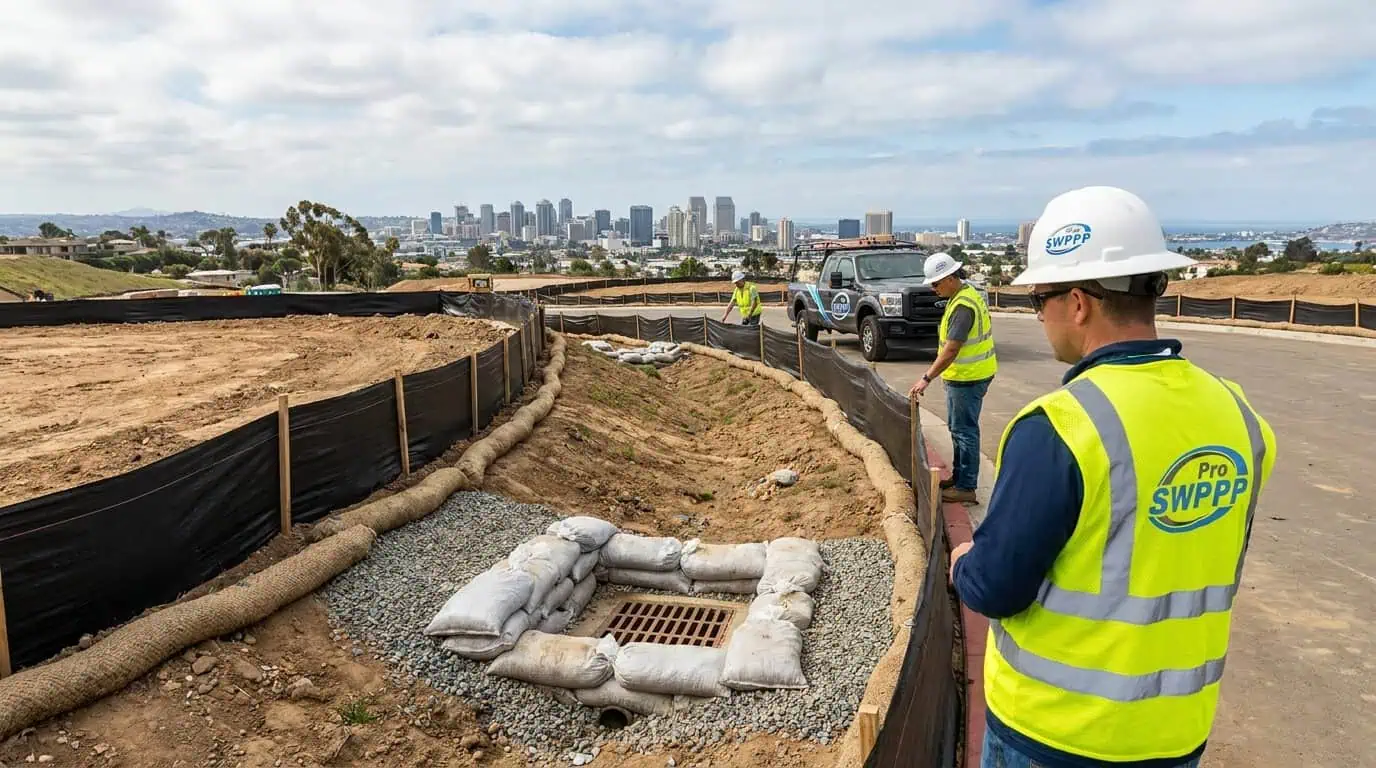
- Sediment control BMPs like silt fence, fiber rolls, and sediment basins.
- Good housekeeping and material management plans, including spill prevention and equipment maintenance.
The City of San Diego Storm Water Standards push for phased grading, advanced treatment when necessary, and permanent BMPs with a maintenance verification statement. That means you document who will maintain those BMPs after construction wraps up.
Real-World Enforcement Example
The EPA published a San Diego County case study showing how grading projects without proper erosion control before wet weather led to sediment discharges and enforcement actions. Fines started around $10,000 per day per violation. Contractors who began grading before getting their NOI and WDID stayed on the hook until they formally terminated their permit. That’s why Pro SWPPP handles your SMARTS registration, SWPPP prep, and annual reporting from start to finish.
Inspection Requirements Under the 2022 Construction General Permit
The 2022 California Construction General Permit changed the game for inspections. It moved from calendar-based schedules to forecast-driven triggers. Now you must conduct inspections before storms, during storms, and after storms, all tied to specific precipitation forecasts.
Weekly, Pre-Event, During-Event, and Post-Event Inspections
All risk levels require weekly inspections during active construction. You must also do pre-event inspections within 72 hours before any forecasted weather with a 50 percent or greater chance of half an inch of rain in 24 hours. If the forecast extends beyond 72 hours, you get up to 120 hours to prepare.
During qualifying rain events, you inspect at least once every 24 hours. If the forecast shows another quarter-inch or more in the next 24-hour period, you keep inspecting daily. After the storm, you have 96 hours to complete a post-event inspection if the site actually received half an inch or more of rain.
City and County standards add their own layers. The County CE 2020 inspection form requires weekly site inspections, deficiency correction within 72 hours, and timestamped photos submitted to the engineer within 24 hours. The city requires self-inspections throughout the project life until final stabilization.
Not sure what your project needs? Take our SWPPP Quiz or Schedule a Free SWPPP Consultation with CPESC Certified SWPPP Expert Derek E. Chinners.
QSD and QSP Roles
The Construction General Permit requires your SWPPP to be prepared by a Qualified SWPPP Developer and implemented by a Qualified SWPPP Practitioner. The QSP runs your inspections, updates the SWPPP when site conditions change, and makes sure BMPs stay functional. If you don’t have a QSP on staff, you’re legally required to hire one. That’s where Pro SWPPP steps in with certified experts ready to inspect and document every phase of your project.

SMARTS, WDID, Annual Reporting, and Permit Termination
Before you break ground, the Legally Responsible Person must submit Permit Registration Documents through the state’s SMARTS system. That includes your Notice of Intent, fees, and SWPPP. Once approved, you get a WDID number. Post that number on site and reference it in all your project signage.
Every year by September 1, you file an Annual Report covering July 1 through June 30. The report lists non-stormwater discharges, implemented BMPs, deficiencies, monitoring data, and any Numeric Action Level responses. If you exceed turbidity or pH limits, you must investigate, adjust BMPs, and report to the Regional Water Board.
Final Stabilization and Notice of Termination
At project completion, you must permanently stabilize all unpaved areas with at least 70 percent plant cover or equivalent stabilization. Remove temporary BMPs. Have your QSP prepare a final NOT inspection report with site map and photos. Then submit a Notice of Termination in SMARTS. Annual fees and permit requirements continue until the state accepts your NOT.
Projects that start grading without an NOI or fail to submit a NOT stay under enforcement risk until termination is formally approved. Pro SWPPP tracks every deadline so you never miss a filing or pay unnecessary fees. Learn more about our process at our about page.
Training, Common Pitfalls, and Emerging Trends
San Diego programs emphasize annual training for employees with SWPPP responsibilities, especially at facilities with ten or more full-time staff. Training covers BMPs, spill response, and illicit discharge detection. Stormwater manuals encourage integrating SWPPP duties into everyday operations, like routine sweeping and spill preparedness.
Common Challenges
- Fragmented responsibility: Confusion between owners, general contractors, and subcontractors about who handles inspections and reporting. The permit makes clear the LRP is ultimately responsible.
- Static SWPPP misconception: Treating the SWPPP as a one-time document. The permit requires updates after major site changes within 30 days and minor changes within 90 days.
- Documentation gaps: Incomplete inspection logs, missing photos, or delayed BMP corrections are frequent non-compliance issues, especially under County guidance that demands 72-hour correction.
Violations of the Construction General Permit and local ordinances can result in administrative civil liabilities starting around $10,000 per day per violation, plus orders to retrofit BMPs or repair environmental damage. That’s real money that shuts down jobs and ruins reputations.
Emerging Trends
The 2022 permit’s forecast-driven inspections are pushing teams to use real-time weather data and planning tools. Electronic SWPPPs and mobile inspection apps with GPS-tagged photos and cloud backups help demonstrate real-time compliance. The Port’s risk-based oversight for waterfront projects is driving more intensive inspections near receiving waters.
County and City manuals now require Low Impact Development practices and permanent BMPs from the design stage, linking construction-phase SWPPPs to long-term stormwater quality goals. Whether you’re in Texas or Georgia, the trend toward integrated LID is spreading nationwide.
Why Choose Pro SWPPP for Your San Diego Project?
Pro SWPPP delivers certified QSD and QSP support, SMARTS registration, weekly inspections, BMP design, and annual reporting. We know San Diego’s dual regulation inside and out. We’ve helped contractors nationwide avoid fines, stay on schedule, and close projects cleanly with accepted NOTs.
You get a dedicated CPESC-certified expert who understands California’s 2022 Construction General Permit, City Storm Water Standards, County BMP handbooks, and Port tidelands requirements. We prepare site-specific SWPPPs and WPCPs, conduct forecast-driven inspections, and handle all your stormwater paperwork from NOI to NOT.
Need help right now? Visit our contact page or call to speak with a compliance specialist. For more information on stormwater regulations, check the EPA NPDES construction stormwater page.
FAQ
Do I need a SWPPP if my project is less than one acre?
It depends. If your small lot is part of a larger common plan of development totaling one acre or more, you need a SWPPP and Construction General Permit coverage. If you’re truly standalone and under one acre, you may only need a WPCP under City of San Diego rules. Pro SWPPP reviews your project details and tells you exactly which plan applies.
What’s the difference between a SWPPP and a WPCP?
A SWPPP is required under the state Construction General Permit for projects one acre or larger. A WPCP is the City of San Diego’s alternative for smaller projects or those with erosivity waivers. Both prevent stormwater pollution, but the SWPPP has stricter state requirements, including QSD preparation and SMARTS filing.
How often do I need to inspect my site under the 2022 Construction General Permit?
You conduct weekly inspections during construction. You also do pre-event inspections within 72 hours before forecasted storms with a 50 percent chance of half an inch of rain. During qualifying rain events, inspect at least once every 24 hours. After storms that deliver half an inch or more, complete a post-event inspection within 96 hours.
What happens if I start construction before getting my WDID?
You’re in violation of the Construction General Permit. Fines can run $10,000 per day per violation. You must stop work, obtain coverage, and possibly pay penalties. That’s why Pro SWPPP handles your NOI and SMARTS submission before you move dirt.
Do I need a QSD and QSP for my San Diego project?
Yes, if you’re covered under the Construction General Permit. A Qualified SWPPP Developer prepares your SWPPP, and a Qualified SWPPP Practitioner implements and inspects it. These certifications are legal requirements, not optional. Pro SWPPP provides certified QSD and QSP professionals for every project phase.
How do I terminate my Construction General Permit when the project is done?
Permanently stabilize all unpaved areas with at least 70 percent plant cover, remove temporary BMPs, have your QSP prepare a final NOT inspection report with photos, and submit a Notice of Termination in SMARTS. Annual fees continue until the state accepts your NOT. We manage the entire closeout process for you.
Ready to get started? Order your SWPPP now or schedule a free consultation with Pro SWPPP.
Visit Pro SWPPP and see why contractors nationwide rely on America’s #1 SWPPP Service.