What Are the Construction Stormwater Requirements in Seattle and King County?
Construction sites in Seattle and King County face three stacked layers of stormwater rules. King County drainage review can begin at 2,000 square feet of new or replaced impervious surface, Seattle requires a custom construction stormwater control plan at 5,000 square feet, and Washington Ecology requires a SWPPP and permit coverage at 1 acre.

Which Agency Regulates Your Site in Seattle and King County?
Three agencies can have jurisdiction over the same project at once. The Washington State Department of Ecology issues the Construction Stormwater General Permit, the statewide NPDES coverage that applies at 1 acre of disturbance.
Inside Seattle city limits, Seattle SDCI reviews drainage control with Seattle Public Utilities (SPU), applying the Seattle Stormwater Code and Manual. In unincorporated King County, King County applies its Surface Water Design Manual through drainage review.
State coverage does not satisfy the local code, and local approval does not satisfy Ecology. A 3-acre Seattle project needs Ecology permit coverage, an SDCI drainage control review, and a construction stormwater control plan, all three.
Not sure if you even need one?
Answer a few questions about your site and find out in under two minutes.
What Size Project Triggers Each Requirement?
Thresholds are measured two ways: new plus replaced hard surface, and total land disturbance. The lower of the two triggers controls, which is why a small footprint with a large staging area still lands in review.
| Trigger | Agency | What Is Required | CESCL Required? |
|---|---|---|---|
| 2,000 sq ft new or replaced impervious surface | King County (unincorporated) | Drainage review under the Surface Water Design Manual | No, unless 1 acre is also disturbed |
| 5,000 sq ft hard surface or 7,000 sq ft land disturbance | Seattle SDCI / SPU | Full drainage control review and a project-specific construction stormwater control plan | No, unless 1 acre is also disturbed |
| 1 acre (43,560 sq ft) of disturbance | Washington Ecology | Construction Stormwater General Permit coverage, NOI, and a 13-element SWPPP | Yes |
| Any size on contaminated or suspect soils | Ecology plus Seattle SDCI | Permit coverage can be required below 1 acre; proof needed before drainage review approval | Follows permit coverage |
Ecology can also require permit coverage on a site under 1 acre when the discharge is determined to be a significant contributor of pollutants to waters of the state. Contaminated ground in older Seattle industrial corridors is the most common way that happens.
Note the 30-day public comment period built into the Ecology NOI process. Coverage is not granted the day you file, so the NOI belongs early in the schedule rather than the week before mobilization.
What Are the 13 Elements a Washington SWPPP Must Cover?
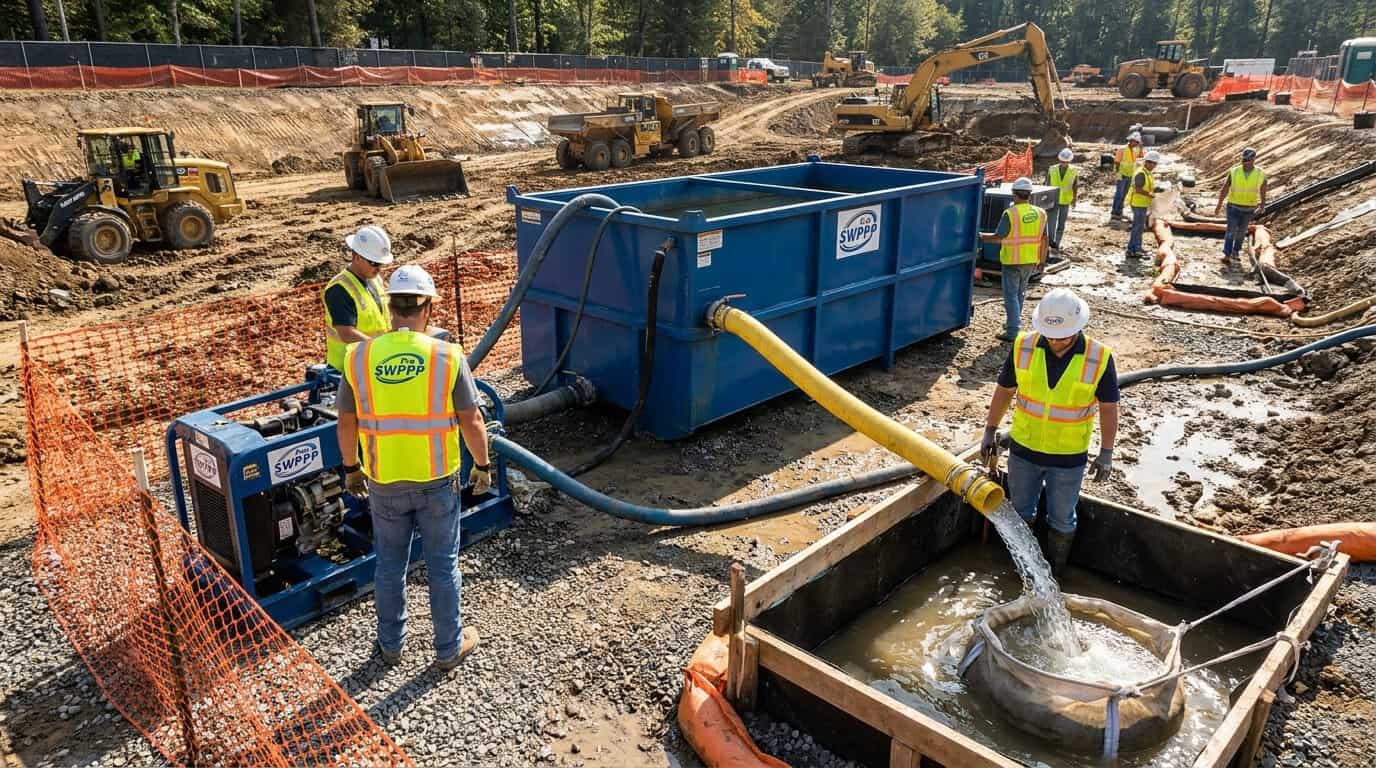
Ecology builds the Construction Stormwater General Permit SWPPP around 13 required elements. Every element must be addressed in the narrative and shown on the drawings, or the plan is incomplete on its face during an inspection.
- Preserve vegetation and mark clearing limits.
- Establish construction access.
- Control flow rates.
- Install sediment controls.
- Stabilize soils.
- Protect slopes.
- Protect drain inlets.
- Stabilize channels and outlets.
- Control pollutants.
- Control dewatering.
- Maintain BMPs.
- Manage the project.
- Protect low impact development BMPs.
Element 13 is the one Seattle projects underestimate. Bioretention cells, permeable pavement, and rain gardens must be protected from sediment during construction, because a bioretention soil mix loaded with construction fines fails its infiltration test at final acceptance.
Ecology is explicit about format. The permit requires that the SWPPP shall include a narrative and drawings, with all BMPs clearly referenced in the narrative and marked on the drawings, per the Washington State Department of Ecology Construction Stormwater General Permit.
Pro SWPPP prepares that narrative and drawing set. Physical installation of BMPs is handled by your site contractor.
Who Has to Inspect the Site, and How Often?
Sites of 1 acre or more must have a Certified Erosion and Sediment Control Lead (CESCL) available. Ecology requires that site inspections be conducted by a person who is knowledgeable in the principles and practices of erosion and sediment control, and on permitted sites of 1 acre or more that person must hold current CESCL certification.
Inspections run at least once every calendar week and within 24 hours of any discharge from the site. Inspection reports stay with the SWPPP and record conditions, BMP status, corrective actions, and the date each correction was completed.
Sampling adds a second clock. Discharges are monitored for turbidity, with a 25 NTU benchmark that triggers review and adaptive management, and a 250 NTU level that requires immediate action and reporting to Ecology. Sites placing concrete also monitor pH against the 6.5 to 8.5 range.
The CESCL requirement is a credential, not a company. Full detail on training hours, the 3-year renewal cycle, and who accredits the course is in our Washington CESCL certification guide.
What Do Seattle SDCI and SPU Add on Top of the State Permit?
Seattle applies its own Stormwater Code through SDCI drainage control review, with the current code and manual effective July 1, 2026 for applications completed on or after that date. A project-specific construction stormwater control plan is required once you cross the city thresholds.
Seattle also requires a soil management plan addressing stockpiles, imported fill, and amended soils, and it requires evidence of Ecology permit coverage before drainage review approval on contaminated or 1-acre-plus sites. The city treats missing state coverage as an incomplete submittal.
One rule catches nearly everyone: projects below the review thresholds are still required to comply with the stormwater code. No drainage review does not mean no erosion control, and a Seattle inspector can issue a correction notice for tracked mud or an unprotected inlet on a site that never needed a drainage report.
What Does King County Require in Unincorporated Areas?
King County applies the 2021 Surface Water Design Manual, amended in 2024, through drainage review that starts at 2,000 square feet of new or replaced impervious surface. The 2024 amendment formalized high-performance bioretention soil mix design, which raises the bar on protecting those facilities during construction.
Dewatering is the separate track people forget. A King County construction dewatering authorization can be required when excavation is deeper than 12 feet, when the site is 1 acre or more, when contamination is present, or when groundwater is expected. Approval can take weeks and gates the drainage review.
Discharge destination changes the paperwork. Water going to a combined sewer requires utility authorization, water going to surface water requires treatment and sampling under the state permit, and infiltration onsite requires soil testing and a design that will actually infiltrate.
What Does Stormwater Compliance Cost, and What Delays Projects?
Four cost centers show up on every Puget Sound job: the SWPPP document, the Ecology permit fee, local drainage review and dewatering authorization fees, and the contractor cost of the BMPs themselves. Ecology assesses an annual permit fee based on site category, and King County and Seattle set their own review fees by schedule.
Schedule risk outweighs fee cost. Building in the 30-day Ecology comment period, plus 2 to 6 weeks of local drainage review, means stormwater is often the critical path item on a Seattle permit rather than a closeout task.
Hitting unexpected contaminated soil is the expensive surprise. Adding Ecology involvement, dewatering authorization, and discharge sampling mid-excavation commonly adds 30 to 60 days, which is why a Phase I environmental site assessment before permitting is cheap insurance on older parcels.
Just want a number first?
Tell us about your project and we will send a written estimate, no obligation.
What Three Checks Should You Run Before Filing Permits?
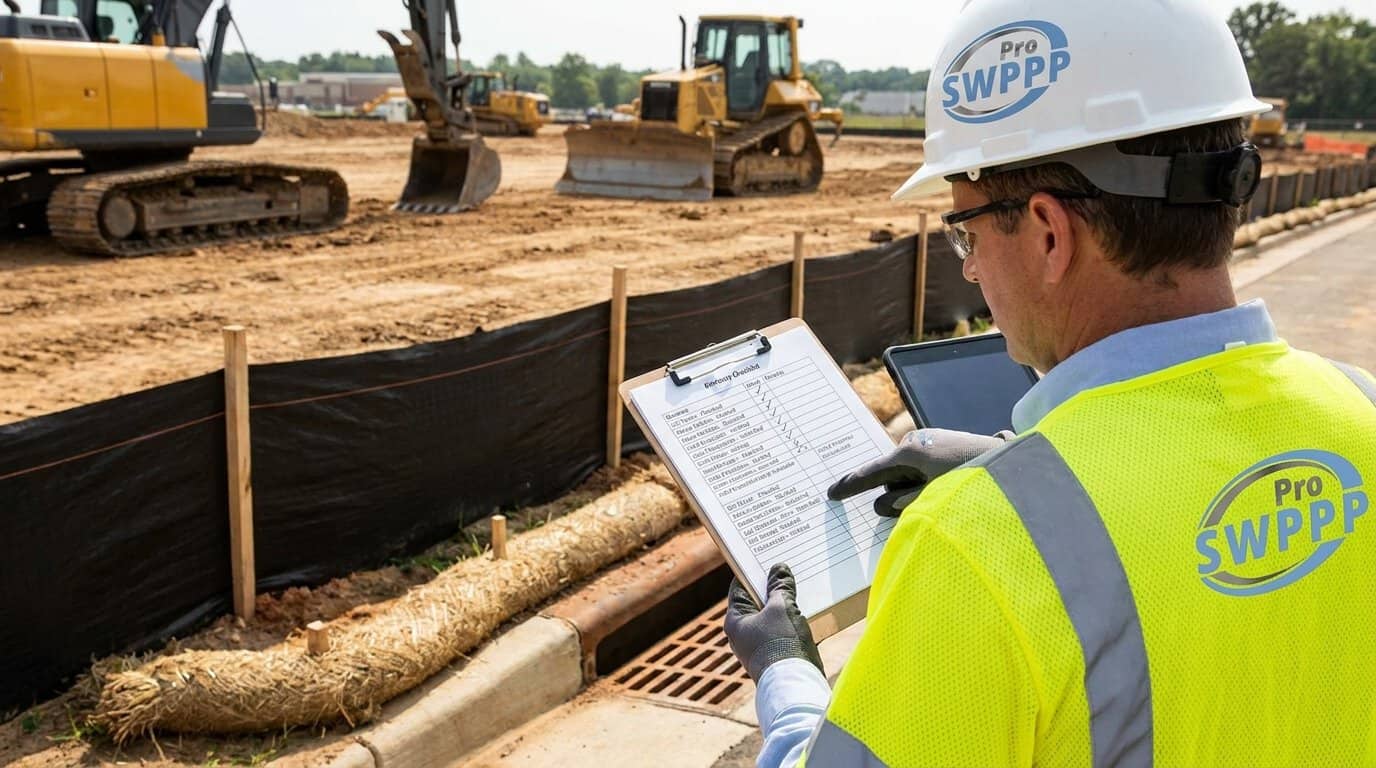
These three checks take a few hours and determine the entire permitting path. Run them before the design is locked, not after.
Check one, disturbance area. Measure new plus replaced hard surface and total land disturbance separately. At 2,000 square feet in unincorporated King County expect drainage review, at 5,000 square feet in Seattle expect a custom plan, and at 1 acre expect Ecology permit coverage and a 13-element SWPPP.
Check two, discharge pathway. Trace where construction water actually goes. Combined sewer, storm drain, surface water, and onsite infiltration each carry different authorization, treatment, and sampling obligations under the Ecology permit and local code.
Check three, contamination risk. Review site history for gas stations, auto shops, dry cleaners, underground storage tanks, and industrial use. Any hit means budgeting for Ecology involvement and a dewatering authorization before the excavator arrives.
Why Work With Pro SWPPP on a Washington Project?
Pro SWPPP prepares the documentation layer: the 13-element SWPPP narrative and drawings, the Ecology NOI, inspection and maintenance log templates, and the records your CESCL uses in the field. Plans are prepared under the direction of Derek E. Chinners, CPESC.
Plans are written against Seattle SDCI and King County review checklists rather than a generic national template, which is what keeps a submittal from bouncing on the first review cycle. Revisions during review are part of the engagement.
Pro SWPPP does not perform field construction. Physical installation of BMPs is handled by your site contractor, and site inspections are performed by your CESCL. Learn more about our team, see our Washington SWPPP requirements guide, or contact us.
Seattle and King County Stormwater FAQ
Do I need a SWPPP in Seattle if my site is under 1 acre?
Possibly. Ecology permit coverage starts at 1 acre, but Seattle requires proof of coverage on any size site with known or suspected contaminated soils or groundwater. Separately, crossing the city threshold of 5,000 square feet of hard surface requires a project-specific construction stormwater control plan even without state coverage.
What is the difference between a SWPPP and the NOI?
The SWPPP is the 13-element plan document with narrative and drawings. The Notice of Intent is the application filed with Washington Ecology to obtain Construction Stormwater General Permit coverage. Write the SWPPP first, then file the NOI, and allow for the 30-day public comment period before coverage begins.
Do I need a CESCL on a Seattle construction site?
Yes on sites of 1 acre or more covered by the Ecology permit, where a Certified Erosion and Sediment Control Lead must be available and must perform the required inspections. Smaller sites still need someone knowledgeable in erosion and sediment control, and some local jurisdictions apply stricter rules.
How often must inspections happen under the Ecology permit?
At least once every calendar week, and within 24 hours of any discharge from the site. Each inspection is documented in writing with conditions found, BMP status, and corrective actions taken. Reports stay with the SWPPP on site and are produced on request during an Ecology or city inspection.
When does King County require a dewatering authorization?
Typically when excavation extends deeper than 12 feet, when the site is 1 acre or larger, when contamination is known or suspected, or when groundwater or surface water is expected in the excavation. Seattle requires proof of that authorization before approving drainage review in those scenarios, so file early.
What turbidity numbers matter during construction?
Ecology uses a 25 NTU benchmark that triggers review of BMPs and adaptive management, and a higher 250 NTU level that requires immediate corrective action and reporting. Sites placing concrete or using recycled concrete also monitor pH and keep discharges within the 6.5 to 8.5 range.
What happens if an inspector finds no SWPPP on site?
A stop-work order is the common outcome, along with a requirement to prepare and implement a compliant SWPPP before construction resumes. Penalties are available under the federal Clean Water Act and Washington state law, and the schedule loss from a shutdown usually exceeds the penalty itself.
Complicated site? Talk it through.
Speak directly with a CPESC-certified stormwater expert with 20+ years of experience.