SWPPP inspections are required every 7 calendar days, or every 14 calendar days plus within 24 hours of any storm that produces 0.25 inches or more of rain. Under EPA’s 2022 Construction General Permit, the person performing the inspection must be a qualified person who has completed the training in CGP Part 6.3. Many state permits require more.
That single schedule decision drives your entire compliance record. Choose weekly and you inspect 52 times a year regardless of weather. Choose biweekly and you inspect 26 times, plus every qualifying storm, on a 24-hour clock that does not pause for weekends or holidays.
For a step-by-step walkthrough of the visit itself — what the inspector looks at, what they photograph, and what they write down — see what happens during a stormwater compliance inspection.
This guide covers the federal baseline, who legally qualifies to sign a report, what an inspector checks, what the reports must contain, what inspections cost, and what happens when they are skipped or done by the wrong person.
Not sure whether your site needs a SWPPP at all? Take the 60-second SWPPP quiz and find out.
How Often Are SWPPP Inspections Required?
EPA’s 2022 Construction General Permit gives you two routine inspection schedules under Part 4.2.2. You inspect once every 7 calendar days, or once every 14 calendar days combined with an inspection within 24 hours of a qualifying storm.
You pick one, and you write that choice into your SWPPP. Once chosen, the schedule is binding. A biweekly site cannot skip the post-storm inspection because the crew was busy, and a weekly site cannot stretch to 10 days.
The qualifying trigger is narrower than most contractors assume. EPA’s CGP Frequent Questions document states inspections must occur “within 24 hours of a 0.25 inch rain storm or a snowmelt discharge from a snow storm that produces 3.25 inches or more of snow.”
That snowmelt threshold catches northern contractors off guard every winter. A 4-inch snowfall followed by a thaw triggers the same 24-hour inspection clock as a quarter-inch of rain.
When the Schedule Gets Stricter
CGP Part 4.3.1 increases inspection frequency for sites discharging to impaired waters or to Tier 2, Tier 2.5, and Tier 3 waters. If your outfall reaches a listed or high-quality water body, the default weekly or biweekly schedule does not apply and you inspect more often.
Check your receiving water before you select a schedule. Discovering the site was discharging to an impaired stream after six months of biweekly inspections converts every one of those inspections into a documented shortfall.
When You Can Inspect Less Often
The CGP allows reduced frequency for stabilized areas under Part 4.4. Once an area is temporarily or finally stabilized and runoff is unlikely, inspections in that area can drop to once per month.
The reduction is not automatic. You must document the stabilization and the reduced schedule in the SWPPP, and keep records proving the area meets the standard — seeding dates, germination, cover percentage. Reducing frequency without that documentation converts a legal reduction into a violation.
When Inspections Start and Stop
The clock starts when you have permit coverage and begin disturbing soil. It stops only after you reach final stabilization, remove temporary controls, and file a Notice of Termination. A two-year project on a weekly schedule generates more than 100 inspection reports, and every gap in that sequence is visible to a regulator reading the file.
Who Can Legally Perform a SWPPP Inspection?
For any project receiving coverage on or after February 17, 2023, EPA requires that personnel “must complete the training requirements in CGP Part 6.3 to be a qualified person for conducting inspections.” That language replaced the older, vaguer “qualified personnel” standard with an enforceable training requirement.
In practice this means you cannot hand the clipboard to whichever superintendent is free that morning. The person who signs the report must hold documented credentials, and a regulator auditing your file will ask for them.
Three credentials commonly satisfy the federal standard:
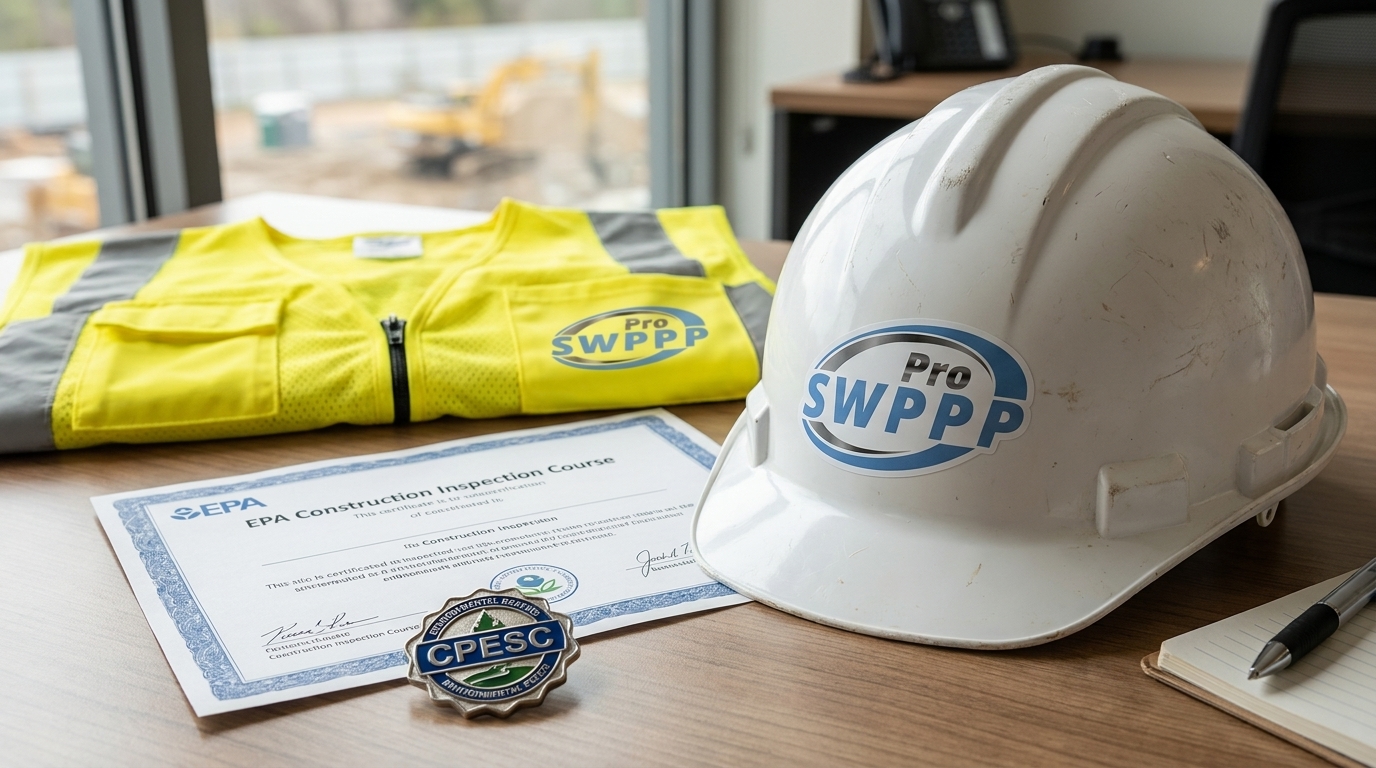
- EPA Construction Inspection Course — a free EPA course and exam built specifically to meet the Part 6.3 requirement.
- CPESC (Certified Professional in Erosion and Sediment Control) — the national professional credential for erosion and sediment control.
- State stormwater inspector certifications — programs such as Washington’s CESCL, Georgia’s Level 1B/2, South Carolina’s CEPSCI, and California’s QSD/QSP.
Holding a national credential does not automatically satisfy a state requirement. Several states require their own certification regardless of what else the inspector holds, and a CPESC alone will not cover you in those jurisdictions.
The Cost of an Unqualified Inspector
If the signer did not meet the standard, every report they signed is deficient. Regulators do not treat that as one violation — they treat it as a failure to inspect on each of those dates. A year of weekly inspections signed by an untrained superintendent is 52 potential violations, not one.
Need the plan itself, not just the inspections? Get My SWPPP — CPESC-prepared, delivered in 72 hours.
How Do State SWPPP Inspection Rules Differ From Federal?
The EPA CGP is the floor, and it applies directly only where EPA is the permitting authority. Most states run their own EPA-authorized NPDES programs, issue their own construction general permits, and use their own terminology for the plan document.
The terminology matters as much as the schedule. A contractor searching for a “SWPPP” in Colorado or Pennsylvania is searching for the wrong document name, and inspectors in those states will ask for something else by name.
| Jurisdiction | Plan document is called | Permit | Inspector credential |
|---|---|---|---|
| Federal (EPA) | SWPPP | 2022 CGP | CGP Part 6.3 training |
| Texas | SWP3 | TXR150000 | No state certification required |
| California | SWPPP | State CGP | QSD / QSP |
| Washington | SWPPP | 2026 CSWGP | CESCL |
| Colorado | Stormwater Management Plan (SWMP) | COR400000 | No state certification required |
| Georgia | ES&PC Plan | NPDES construction GP | GSWCC Level 1B / Level 2 |
| Pennsylvania | E&S Plan + PCSM Plan | PAG-02 | No state certification required |
| South Carolina | C-SWPPP / OS-SWPPP | SCR100000 | CEPSCI |
| Ohio / Indiana / Oklahoma | SWP3 | State CGP | Varies by state |
Always verify the current permit in the state where the work is happening. Where federal and state rules differ, the stricter one governs.
Texas: SWP3, Not SWPPP
Texas operates under TCEQ’s TXR150000, effective March 5, 2023. TCEQ splits sites into large construction — 5 or more acres disturbed, or part of a larger common plan disturbing 5 or more acres — and small construction, at least 1 but less than 5 acres. Both tiers require a SWP3 before construction begins. See our Texas SWPPP requirements guide for the full breakdown.
What Does a SWPPP Inspector Check On Site?
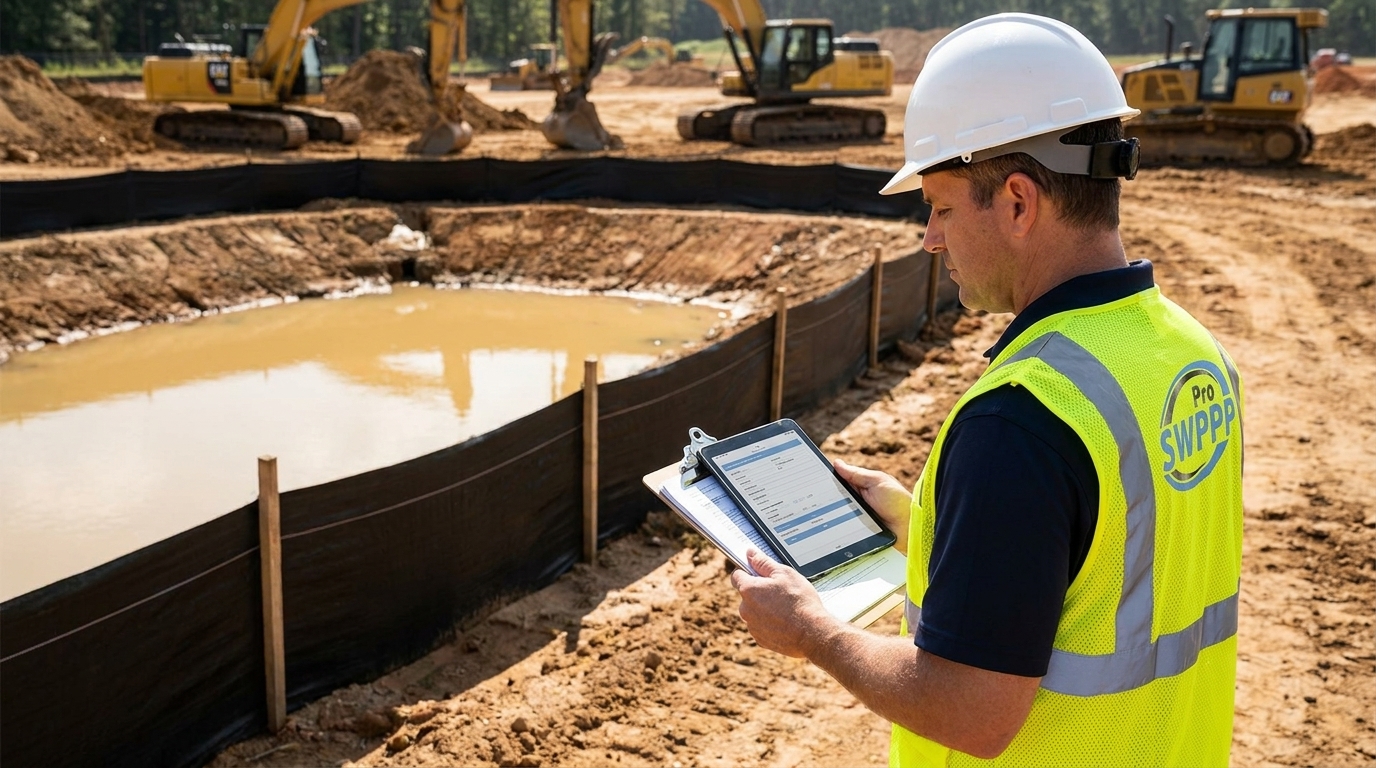
A compliant inspection is a walk of the entire site, not a drive-by. The inspector examines every control, every disturbed area, and every point where water leaves the property, then records what they found.
Every inspection must cover:
- Disturbed areas — anything cleared, graded, or excavated and not yet stabilized.
- Perimeter controls — silt fence, fiber rolls, and sediment barriers along the boundary.
- Sediment traps and basins — capacity, sediment depth, and outlet function.
- Inlet protection — every storm drain inlet, checked for clogging and displacement.
- Vehicle tracking controls — rock pads, wash stations, and the public street beyond the gate.
- Material storage — fuels, chemicals, and stockpiles, covered or contained.
- Discharge points — every outfall, checked for sediment or pollutants leaving the site.
Deficiencies get documented on the spot with a corrective action and a deadline. Under CGP Part 5.2, significant repairs and replacement controls carry their own completion deadlines, and a repeat occurrence of the same problem is treated more seriously than the first.
What Must a SWPPP Inspection Report Include?
Inspection reports are legal records. In an enforcement action they are the primary evidence, for you or against you.
Each report must carry the date and time, the inspector’s name and qualifications, weather conditions and rainfall since the last inspection, the areas inspected, every deficiency found, the corrective actions required with deadlines, and the inspector’s signature.
Retention is explicit. EPA requires records be kept “for a period of at least three years from the date this permit expires or from the date authorization is terminated.” Some states require longer. Electronic records are acceptable provided they can be produced on demand.
How Much Do SWPPP Inspections Cost?
Third-party inspection visits generally run $150 to $500 each, driven by site size, complexity, and travel distance. Training an in-house inspector costs a few hundred dollars in course and exam fees, plus renewals and the crew time each inspection consumes.
Across a multi-month project the inspection line item typically reaches several thousand dollars. Weigh that against a single enforcement action: the penalties below all landed in 2026, and all of them turned on documentation, not on pollution anyone could see from the road.
The larger variable is corrective actions. A torn silt fence or a full sediment basin becomes a repair with a deadline attached, and those repairs — not the inspections — are where inspection-driven costs actually accumulate.
Want a real number for your site? Get a free SWPPP estimate — no obligation.

What Happens If You Skip SWPPP Inspections?
Inspection records are the easiest thing for a regulator to audit, which is exactly why they are the most commonly cited failure. Three 2026 EPA enforcement actions show the pattern:
- Continental Scrap Metal, LLC — docket CWA-01-2026-0029, $17,156. EPA cited failure to conduct and document required inspections, failure to monitor discharges, failure to fully implement control measures, and failure to update the facility’s SWPPP. (EPA Region 1 notice)
- Colaska, Inc. — AggPro Site — docket CWA-10-2026-0183, $12,797. Missing routine site inspection reports, quarterly visual assessments, corrective action documentation, and training records. (EPA Region 10 notice)
- Casella Waste Management and affiliates — dockets CWA-01-2026-0055, -0056, and -0057, $214,816 combined. (EPA Region 1 notice)
Read what those cases have in common. Not one of them is fundamentally about a failed BMP. They are about missing reports, missing training records, and a plan nobody updated — paperwork failures, each one preventable at a fraction of the penalty.
The Violations Regulators Cite Most
- Inspections not conducted at the required frequency.
- Inspections signed by someone who does not meet the Part 6.3 standard.
- Reports missing dates, signatures, or corrective actions.
- Corrective actions identified but never completed.
- Reports back-dated or falsified.
These are difficult violations to contest. The schedule is written in your own permit and your own SWPPP, which makes a gap in the record self-proving.
Why Contractors Use Pro SWPPP for Inspections
Pro SWPPP is America’s #1 SWPPP service — a family-owned firm with 20+ years in stormwater compliance, operating nationwide, founded and led by Derek E. Chinners, CPESC. We handle the compliance side of stormwater — plan development, permit filing, inspections, and the documentation that survives an audit.
Our inspectors meet the 2022 CGP Part 6.3 standard and the state credentials required in every jurisdiction we serve. We inspect on your permit’s schedule, deliver regulator-ready reports, and document and verify corrective actions so a deficiency does not age into a violation.
SWPPPs are delivered in 72 hours because construction schedules do not wait for paperwork. More than 180 five-star Google reviews reflect what that responsiveness is worth on an active site.
To be clear about scope: we are the paperwork and permitting specialists. We write the plans, file the permits, perform the inspections, and keep the records. We do not install BMPs or perform field construction — that stays with your crews and your erosion control contractor.
FAQ
How often are SWPPP inspections required?
Under EPA’s 2022 Construction General Permit, every 7 calendar days, or every 14 calendar days plus within 24 hours of a storm producing 0.25 inches or more of rain. Snowmelt from a storm producing 3.25 inches or more of snow triggers the same 24-hour clock. You select one schedule and document it in your SWPPP. State permits may require more frequent inspections.
Who can perform a SWPPP inspection?
For coverage obtained on or after February 17, 2023, the inspector must complete the training requirements in CGP Part 6.3. The EPA Construction Inspection Course, a CPESC, or a recognized state certification will generally satisfy this. Several states — California, Washington, Georgia, South Carolina — require their own credential regardless of national certifications the inspector already holds.
Can my site superintendent perform SWPPP inspections?
Only if they have completed the EPA course or hold a qualifying certification. An untrained superintendent does not meet the Part 6.3 standard, and every report they sign is deficient. Because regulators count each missing valid inspection separately, a year of reports signed by an unqualified person can generate dozens of violations rather than one.
What happens if I miss a SWPPP inspection?
A missed inspection is a permit violation, and penalties can be assessed per missed inspection. There is no grace period for weather, crew shortages, or holidays. Because your schedule is written into your own permit and SWPPP, a gap in the record is straightforward for a regulator to prove and difficult for a contractor to dispute.
Can I reduce inspection frequency once my site is stabilized?
Yes. Under CGP Part 4.4, areas that are temporarily or finally stabilized and unlikely to generate runoff can drop to monthly inspections. You must document the stabilization and the reduced schedule in your SWPPP and retain proof the area meets the standard — seeding dates, germination, and cover percentage. Reducing frequency without that documentation creates a violation.
How long must SWPPP inspection reports be kept?
EPA requires records be retained for at least three years from the date the permit expires or authorization is terminated. Some states require longer. Electronic records are acceptable as long as they are complete, legible, and can be produced on demand during an audit or enforcement inspection.
Does Pro SWPPP perform SWPPP inspections nationwide?
Pro SWPPP provides CPESC-led inspection and compliance services nationwide. Our inspectors meet the 2022 CGP Part 6.3 standard and applicable state credential requirements. We inspect on your permit schedule, deliver regulator-ready reports, and document corrective actions. We handle compliance documentation and inspections, not BMP installation or field construction.
Still have questions about your inspection schedule? Schedule a call with a stormwater expert — Derek E. Chinners, CPESC.
By Derek E. Chinners, CPESC — Founder & Stormwater Consultant, Pro SWPPP, LLC
Related: What is a SWPPP? · When is a SWPPP required? The 1-acre rule and common plans · What is a SWPPP inspection form, and who fills it out? · How much does a SWPPP inspection cost? · What does a SWPPP inspector do, and when do you hire one?