Pro SWPPP – America’s #1 SWPPP Service – knows that stormwater compliance inspections can make or break your project timeline and budget. These formal checks verify that your construction or industrial site meets federal NPDES stormwater permit requirements, focusing on erosion controls, pollution prevention, documentation, and how you respond to rain and snow events. If deficiencies are found and not corrected fast, you face enforcement actions ranging from expedited settlements to substantial civil penalties under the Clean Water Act. This guide walks you through exactly what happens during a stormwater compliance inspection, who conducts them, what triggers them, how often they occur, what inspectors look for, and how to pass every time without delays or fines.
Who Actually Shows Up to Inspect Your Site?
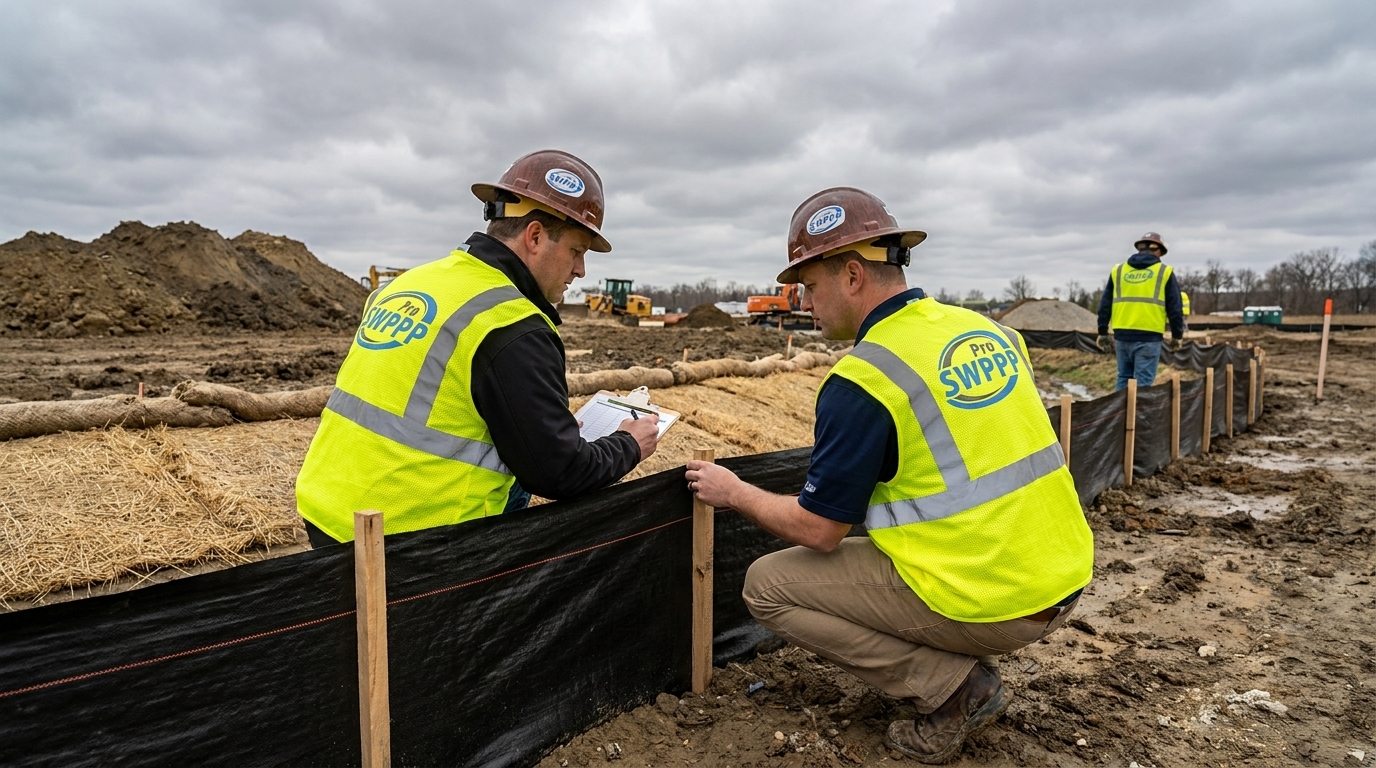
Stormwater inspections come from two directions: your own qualified inspector and outside regulators. Understanding who has authority and what they’re checking keeps you ahead of problems.
Internal Site Inspections by Your Qualified Person
Under the federal EPA 2022 Construction General Permit (CGP), you must conduct routine site inspections using a “qualified person” designated by your company. For EPA-issued CGP coverage, that person must either complete EPA’s Construction Inspection Training Course and pass the exam, or hold a current construction inspection certification or license covering the same material. Many state-issued construction stormwater permits copy or tighten this requirement, sometimes requiring state-approved training or professional credentials.
Your internal inspector walks the site on a set schedule, documents conditions, identifies deficiencies, and triggers corrective actions before regulators ever arrive. This is your first line of defense. Pro SWPPP helps contractors identify qualified personnel and ensures your SWPPP spells out inspection procedures that meet or exceed permit requirements.
Regulatory Inspections by EPA or State and Local Agencies
In EPA-authorized states (most of the country), inspections are performed by the state environmental agency or delegated local programs under the state NPDES stormwater permit. In EPA-direct states such as Massachusetts, New Hampshire, New Mexico, the District of Columbia, certain tribal lands, and Lands of Exclusive Federal Jurisdiction, EPA itself inspects sites covered under its CGP.
Regulatory inspectors focus on whether you’re implementing your SWPPP, maintaining controls, meeting inspection and monitoring requirements, and keeping accurate records. They can show up unannounced. They’ll walk the entire site, review your paperwork, and compare what’s on the ground to what’s in your plan. Any gap between the two becomes a documented violation.
For contractors, this means planning for ongoing internal inspections plus being ready for unannounced compliance inspections by regulators or local stormwater programs at any time.
Not sure your site is even in scope? Take the 60-second quiz — Do I even need a SWPPP?
How Often Do Inspections Have to Happen?
Inspection frequency is driven by permit schedules and by weather events. The federal EPA CGP sets a baseline, and state permits often add stricter requirements or different thresholds. Knowing your specific permit’s rules is critical to staying compliant.
Federal EPA CGP Construction Baseline Frequencies
Under the 2022 EPA CGP, the default inspection frequencies are:
- Routine stormwater inspections: At least once every 7 calendar days, OR once every 14 calendar days AND within 24 hours of a storm event producing 0.25 inch or more of rain in 24 hours, or a discharge from snowmelt caused by 3.25 inches or more of snow in 24 hours.
- Only during normal working hours: Inspections are required during your site’s normal working hours. If the qualifying storm happens on a weekend, the inspection may occur on the next work day.
- Discharges to sensitive waters: For impaired or high-quality waters (Tier 2, 2.5, or 3), the permit has heightened inspection frequencies and specific requirements, including more frequent checks and turbidity monitoring for certain dewatering discharges.
- Dewatering inspections: When dewatering discharges occur, inspections may be required daily while discharging, with documentation of discharge times, rates, signs of pollutants, and photographs of treatment and discharge points.
These frequencies are the national baseline for EPA-issued construction general permits and heavily influence state programs. Pro SWPPP builds inspection schedules into every SWPPP we write, tailored to the exact permit covering your site.
State Programs That Add Stricter or Different Rules
States with their own stormwater permits often adopt the EPA structure but change thresholds or frequencies. For example, the Texas Construction General Permit (2023) requires inspections at least once every 14 days and within 24 hours after a storm producing 0.5 inches or more of rain—double the EPA threshold. It allows an alternative schedule of once every 7 days regardless of rainfall. Temporarily stabilized sites may be reduced to monthly inspections.
Other state programs in California, Washington, and Georgia commonly require weekly inspections plus post-storm inspections, sometimes with more stringent rain thresholds for qualifying storm events. They may layer additional visual monitoring, sampling, or numeric effluent limits for certain sites, especially industrial stormwater, beyond the EPA CGP floor.
The practical takeaway: always check the specific permit—EPA or state—as rain thresholds, schedules, and special conditions can differ substantially from the federal CGP baseline. Pro SWPPP operates nationwide and knows these differences cold.
What Exactly Gets Checked During an Inspection?
Both internal and regulatory inspections cover the same core elements, but regulatory inspectors dig deeper into documentation and enforcement history. Here’s what actually happens when someone walks your site.
Review of Stormwater Controls and BMPs
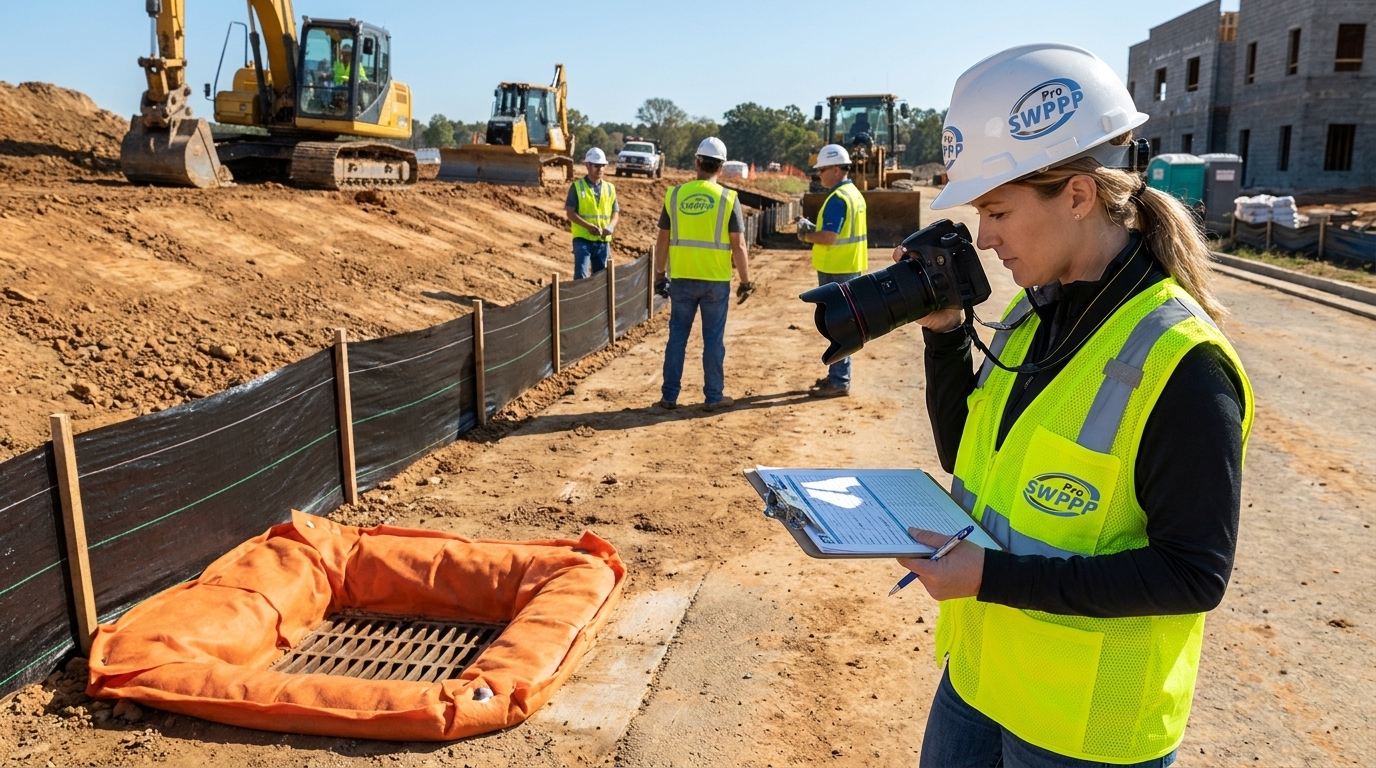
Inspectors check all erosion and sediment controls—silt fence, inlet protection, check dams, stabilized entrances, slope protection, and more—to verify they are properly installed, operational, and effective. They look at pollution prevention controls such as material storage, waste management, concrete washout, and fueling areas. Any control that’s missing, damaged, or ineffective gets documented as a deficiency.
Identifying Conditions That Could Cause Spills or Pollutant Discharge
Inspectors look for leaks from equipment, improperly stored chemicals, uncontained stockpiles, and litter or debris that could enter storm drains. They check for visible erosion and sedimentation attributable to the site, inspecting discharge points and downstream areas for sediment deposits, eroded channels, or sandbars without vegetation. Sediment accumulation on nearby streets, curbs, or drainage features is a red flag.
Confirming Stormwater Flow Paths and Discharge Points
During a discharge, inspectors must identify all discharge points and visually assess water quality: color, odor, floating or settled solids, oil sheen, and other indicators. They determine whether new or modified controls are needed and document any incidents of non-compliance to trigger corrective actions under Part 5 of the CGP.
SWPPP Completeness and Implementation (Regulatory Focus)
Regulators examine whether your SWPPP covers site description, sequence of construction, BMPs, inspection schedule, impaired or high-quality waters, dewatering, and pollution prevention measures. They compare the SWPPP to site conditions: missing controls, different phasing, or an unchanged SWPPP despite site changes can all be violations. Inspectors check whether inspections are being performed on the required schedule, whether deficiencies are documented, and whether corrective actions were completed promptly and recorded in corrective action logs.
Dewatering, Turbidity Monitoring, and Discharge Documentation
For sites with dewatering discharges, inspectors review daily inspection logs during dewatering, turbidity monitoring (if required for discharges to sensitive waters), and whether high turbidity triggered corrective actions. They look at site stabilization and termination documentation, including final stabilization (vegetative cover, pavement, armoring) and documentation supporting the Notice of Termination (NOT), including photos required under the 2022 CGP to show stabilized areas.
In practice, a contractor can expect an external inspection to involve a walkthrough of the entire site (perimeter, stockpile areas, inlets and outfalls, downstream receiving waters), a document review (SWPPP, inspection reports, corrective action logs, training records, rain and snow data, dewatering records, turbidity results), and a discussion with the site superintendent or erosion control lead about problems, timelines, and previous violations.
Don’t want to mess with all the paperwork? Order your SWPPP now with Pro SWPPP Professional CPESC Certified SWPPP Services.
What Triggers an Inspection in the First Place?
Inspections are driven both by permit schedules and by events. Knowing what triggers an inspection helps you anticipate when inspectors will show up and be ready.
Routine Schedule Requirements
Weekly or biweekly (14-day) inspections are established in your SWPPP and required by the permit. Some states require fixed weekly inspections plus additional inspections after “qualifying storm events.” You set the calendar and stick to it, or you’re in violation before anyone even walks the site.
Event-Based Triggers Under EPA CGP Baseline
Rain events producing 0.25 inch or more in 24 hours require an inspection within 24 hours for sites using the 14-day schedule. Snow events producing 3.25 inches or more in 24 hours that later cause snowmelt discharges also trigger inspections. Track rainfall and snowfall using an onsite rain gauge or trusted nearby station, and have a process to recognize when thresholds are met and schedule inspections accordingly.
Dewatering Activities Trigger Daily Inspections
When dewatering is occurring, the 2022 CGP requires daily inspections of dewatering discharge points, with specific documentation. Treat dewatering as a high-inspection-risk activity with intensified documentation. Pro SWPPP includes dewatering procedures and inspection templates in every plan we prepare for sites that anticipate groundwater management.
Regulatory Risk-Based Triggers
Complaints, visible off-site sedimentation, prior violations, high-profile or high-risk projects, nearby impaired waters, and non-submission of required reports or fees can prompt regulatory inspections or focused enforcement initiatives. If your site has a history of problems, expect more frequent unannounced visits.
What Documentation and Forms Are Required?
Proper documentation is as important as the controls themselves. Missing or incomplete records are violations that can trigger penalties even if your BMPs are perfect.
EPA CGP Tools and Templates
For sites under EPA’s CGP, EPA provides standardized templates that inspectors and contractors are expected to use or emulate:
- Site Inspection Report Template: Ensures inspections meet Part 4.7 requirements (date, inspector name, observations, deficiencies, and required corrective actions).
- Dewatering Inspection Report Template: Captures details required by Part 4.6.3, including discharge times, estimated rates, and conditions, with space for photo documentation.
- Corrective Action Log Template: Records deficiencies, dates when problems were identified, corrective actions taken, and dates of completion.
The 2022 CGP also requires photos with your NOT showing stabilized areas when the permit is terminated. Most state programs mirror these requirements with their own online e-NOI and e-NOT portals for permit coverage and termination, inspection report forms, guidance manuals, and electronic reporting systems for industrial stormwater sampling where applicable.
Use standardized templates that match or exceed EPA or state forms. Keep inspection reports, photos, and corrective action logs in a central, organized repository that can be shown to inspectors. Pro SWPPP provides inspection report templates, corrective action logs, and photo documentation checklists with every SWPPP we deliver.
What Happens When Inspections Find Problems?
Finding deficiencies during an inspection is not the end of the world—but how you respond determines whether you face minor paperwork or major penalties.
Corrective Actions Under EPA CGP
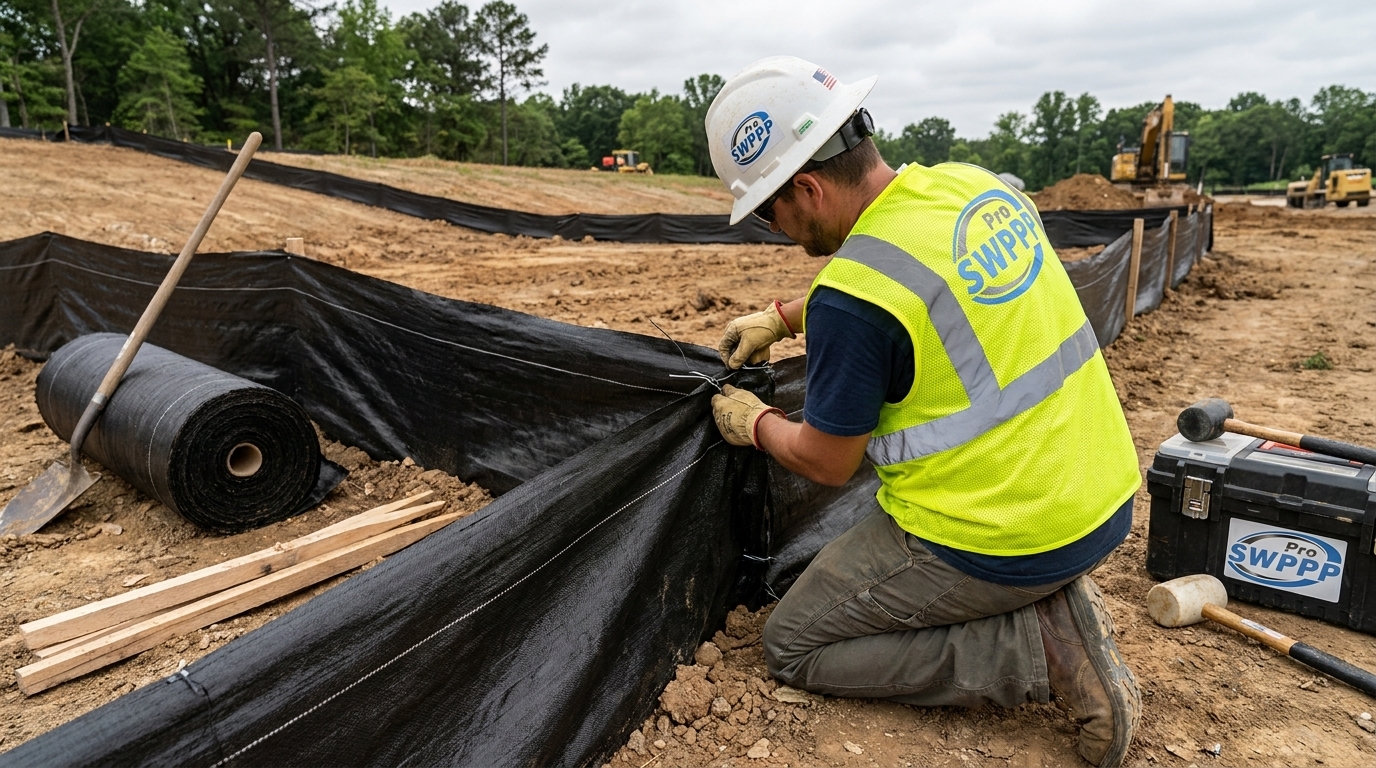
When an inspection identifies non-compliance—failed BMPs, uncontained stockpiles, sediment leaving the site—you must document the incident of non-compliance in the inspection report, initiate corrective action promptly (often within specified time frames in the permit), and record the corrective action in the corrective action log with a description of the problem, date discovered, actions taken (repair, replacement, additional BMPs, changes to SWPPP), and date completed.
Failure to conduct required inspections, document findings, or implement timely corrective actions is itself a violation of the permit and the Clean Water Act. Regulators look at your corrective action log to see if you’re responsive or reactive.
Enforcement Mechanisms and Penalty Ranges
EPA’s stormwater enforcement uses a spectrum of tools. Informal actions include warning letters or notices of violation requesting correction without penalties, often combined with follow-up inspection. In 2023, EPA approved a Construction Stormwater Expedited Settlement Agreement (ESA) program covering violations of NPDES construction stormwater permits, including lack of permit coverage and failure to comply with permit terms.
ESAs are designed for more routine violations with relatively lower penalties and simplified resolution. The penalty cap for the Construction Stormwater ESA is tied to the maximum Class I administrative penalty, which the current 40 CFR 19.4 table sets at $68,445. The $64,618 figure still quoted in older guidance comes from an earlier inflation adjustment and is out of date. “Repeat Violators” are eligible only if their cumulative penalties over the prior 5 years do not exceed the same cap.
For more serious or persistent violations, EPA and states can pursue formal enforcement, including administrative orders with penalties and civil judicial actions under the Clean Water Act. Penalties in such cases can significantly exceed ESA caps and may involve supplemental environmental projects, injunctive relief (mandated structural changes), and long-term compliance plans.
Violations that often drive enforcement include no coverage under a required construction stormwater permit, repeated failure to conduct or document inspections, documented off-site sediment discharges causing or contributing to impairment of receiving waters, and ignoring previous notices of violation or failing to implement promised corrective actions.
The cost of non-compliance includes direct penalties, project delays, remediation costs (cleanups, additional BMPs), and increased scrutiny on future projects. Maintaining robust inspection and documentation practices significantly reduces enforcement risk. Pro SWPPP helps contractors build inspection routines and corrective action processes that keep regulators satisfied and projects on schedule.
What Changed in the Last 2 to 3 Years That Affects Inspections?
Recent regulatory and policy developments directly affect stormwater inspections. Staying current with these changes is essential to avoid violations based on outdated practices.
EPA’s 2022 Construction General Permit (Effective 2022 to 2027)
The 2022 CGP introduced explicit rain and snow thresholds for event-based inspections: 0.25 inch of rain and 3.25 inches of snow. It requires daily inspections during dewatering, with photo documentation requirements. It clarified inspection requirements for discharges to sediment or nutrient-impaired waters and Tier 2, 2.5, and 3 high-quality waters, including turbidity monitoring for some discharges.
The permit also requires that inspectors be qualified and either complete EPA’s inspection course or equivalent. It expanded documentation requirements, including updated templates and photo requirements with the NOT. These changes raise the bar for inspection quality and documentation nationwide.
EPA Construction Inspection Training Course
EPA launched and updated its Construction Inspection Training Course during the CGP term, establishing a standardized curriculum and exam for “qualified persons.” This raises expectations for inspection quality and ensures inspectors understand the permit requirements, erosion and sediment control principles, and proper documentation practices. Contractors should ensure at least one on-site person completes the EPA course or holds an equivalent certification.
EPA Modification Expanding Coverage to Lands of Exclusive Federal Jurisdiction (2026)
This modification slightly expands where the federal CGP applies, meaning the EPA inspection regime is relevant in more locations. Contractors working on federal lands or properties with exclusive federal jurisdiction should verify which permit applies and ensure their inspection practices align with federal CGP requirements.
2023 Construction Stormwater ESA Program
The 2023 ESA program formalizes expedited settlement approaches for construction stormwater violations, with updated penalty caps and “Repeat Violator” rules. It signals continued emphasis on inspection-driven enforcement, where field findings directly translate to ESA resolutions. Contractors should view inspections as the front line of enforcement, not just a compliance exercise.
State Updates (Example: Texas 2023 CGP)
Updated state permits adjust inspection frequencies and thresholds, sometimes diverging from EPA. The Texas 2023 CGP uses a 0.5-inch storm threshold instead of 0.25 inches. Several states have strengthened industrial stormwater sampling and inspection requirements and integrated electronic reporting, intensifying compliance oversight. Contractors should ensure their inspection practices align with the specific version of the CGP or state permit covering their project and any updated state stormwater permits issued in the last 2 to 3 years, especially for industrial sites.
Not sure what your project needs? Schedule a Free SWPPP Consultation with CPESC Certified SWPPP Expert Derek E. Chinners.
How Strict States Differ from the Federal EPA Floor
While the EPA CGP sets a national baseline, many states with their own NPDES stormwater programs add inspection and enforcement rigor. Understanding these differences keeps you compliant wherever you work.
More Frequent Inspections
Some states require weekly inspections regardless of rainfall, not allowing the 14-day option. Others require post-storm inspections for any measurable rain or lower thresholds than EPA’s 0.25 inch. Pro SWPPP operates nationwide, including Texas and Georgia, and knows exactly which states tighten inspection frequencies and how to comply.
Enhanced Monitoring and Documentation
Industrial stormwater permits in states such as California and Washington often require routine sampling during storm events, numeric Action Levels (NALs) or benchmarks that trigger mandatory site reviews and additional inspections, and electronic submittal of inspection and monitoring records. These requirements add complexity and cost but are enforceable violations if ignored.
Tighter Enforcement Policies
State enforcement programs may use mandatory corrective action orders tied to inspection findings, tiered escalation for repeated non-compliance (increased penalties and mandatory third-party oversight), and integration with broader construction permitting systems, making stormwater inspection failures a barrier to occupancy or completion approvals.
For contractors operating across multiple states, treat the EPA CGP as a minimum baseline, then bring site practices up to the strictest applicable state standard. Pro SWPPP writes SWPPPs and inspection procedures that meet state-specific requirements, so you’re covered whether you’re in California, Texas, Georgia, or anywhere else in the country.
What Contractors Need to Do to Be Ready for Any Inspection
Putting it all together, practical inspection-ready steps ensure you pass both internal and regulatory inspections without delays or fines.
Know Your Permit and Receiving Waters
Identify whether your site is under the EPA CGP or a state-issued permit. Determine if you discharge to impaired or high-quality waters, which trigger heightened inspection and monitoring requirements. Check the EPA NPDES construction stormwater page for federal guidance and your state environmental agency website for state-specific permits.
Designate and Train a Qualified Inspector
Ensure at least one on-site person completes the EPA construction inspection course and exam (for EPA CGP sites) or holds an equivalent certification accepted by the permit. Make sure they understand the SWPPP, can identify deficiencies, and know how to document findings and trigger corrective actions.
Set and Follow the Inspection Schedule
Establish a written inspection calendar consistent with permit requirements: weekly or biweekly (with event-based inspections) and daily inspections during dewatering. Track rainfall and snowfall to trigger event inspections. Use a rain gauge on site or a trusted nearby weather station, and document the data in your inspection logs.
Use Detailed, Standardized Inspection Forms
Adopt templates that include all BMPs and areas to be inspected, space for describing deficiencies, corrective actions, and completion dates, and photo documentation (especially for dewatering and final stabilization). Pro SWPPP provides inspection report templates, corrective action logs, and photo documentation checklists with every SWPPP we deliver, so you have everything you need in one package.
Implement and Document Corrective Actions
Treat every deficiency as requiring a written description, planned corrective steps, timelines, and completion verification. Demonstrate a consistent pattern of prompt response to findings. Keep your corrective action log up to date and available for review at all times.
Prepare for Regulatory Inspections
Maintain a current SWPPP on site, matching actual site conditions. Keep complete inspection logs and corrective action records. Have dewatering and turbidity monitoring data (if applicable) organized and ready to show. Ensure site staff can explain the SWPPP, BMPs, and recent inspection outcomes when regulators arrive.
Avoid Permit Coverage Gaps
Confirm NOI or e-NOI submission and coverage before ground disturbance. Submit your NOT only after full stabilization with photographic evidence (for EPA CGP). Never start work without coverage, and never terminate coverage before the site is fully stabilized and documented.
By aligning inspection practices with the EPA CGP baseline and any stricter state requirements, contractors can reduce enforcement risk, control costs, and pass both internal and regulatory stormwater inspections with minimal disruption. Pro SWPPP builds those inspection routines for contractors nationwide — and has 180+ five-star Google reviews from the crews who use them.
Why Pro SWPPP is the SWPPP Service Contractors Trust
Pro SWPPP is the partner contractors rely on when stormwater compliance inspections are on the line. We’re CPESC certified, we’re a family-owned firm with 20+ years in stormwater compliance, and we operate nationwide. We know the federal EPA CGP inside and out, and we know exactly how state programs in Texas, Georgia, California, Washington, and dozens of other states differ from the federal baseline.
When you work with Pro SWPPP, you get a SWPPP written by certified professionals who understand what inspectors look for, a complete set of inspection report templates and corrective action logs, guidance on qualified person requirements and training, and 72-hour turnaround on plans so your project stays on schedule.
We don’t just hand you a generic document and walk away. We build inspection schedules, rain thresholds, dewatering procedures, and corrective action processes into every SWPPP we write. We make sure your plan matches the exact permit covering your site, whether that’s the EPA CGP or a state-issued permit. Our 180+ five-star Google reviews come from contractors who pass inspections because their plans and documentation systems hold up in the real world.
If you want to stop worrying about inspection findings, enforcement actions, and missing documentation, Pro SWPPP is the service that delivers. We’re not the cheapest, but we’re the best. Our clients come back to us project after project because they know we’ll get it right the first time, every time.
Visit our About page to learn more about our team and certifications, or get a free estimate for your site. Pro SWPPP is ready to help you pass every inspection and keep your project moving.
FAQ
How often do I have to inspect my construction site for stormwater compliance?
Under the EPA 2022 CGP, you must inspect at least once every 7 days, or once every 14 days plus within 24 hours of a storm producing 0.25 inch or more of rain or 3.25 inches or more of snow that causes discharge. State permits can set different frequencies and different post-storm triggers — Texas TXR150000, for example, uses a 0.5 inch trigger on the 14-day schedule rather than the federal 0.25 inch. Always check the specific permit covering your site.
Who can perform stormwater inspections on my construction site?
Inspections must be performed by a “qualified person” designated by your company. For EPA CGP sites, that person must complete EPA’s Construction Inspection Training Course and pass the exam, or hold a current construction inspection certification or license covering the same material. State permits may have similar or stricter qualifications. Pro SWPPP helps you identify qualified personnel and meet training requirements.
What happens if inspectors find problems during a stormwater inspection?
You must document the deficiency in your inspection report, initiate corrective action promptly (often within time frames specified in the permit), and record the corrective action in your corrective action log with a description of the problem, date discovered, actions taken, and date completed. Failure to document or correct deficiencies is a permit violation that can lead to enforcement and penalties.
Can EPA or state inspectors show up without warning?
Yes. Regulatory inspections can be unannounced. Inspectors have authority to enter your site during normal business hours to verify compliance with your SWPPP and permit requirements. They will walk the site, review your documentation, and compare site conditions to your plan. Being ready at all times means maintaining up-to-date inspection logs, corrective action records, and a current SWPPP that matches what’s on the ground.
What documentation do I need to keep for stormwater inspections?
You must keep site inspection reports (including date, inspector name, observations, deficiencies, and corrective actions), corrective action logs (recording problems, actions taken, and completion dates), dewatering inspection reports and photos (if applicable), turbidity monitoring data (if required for discharges to sensitive waters), rain and snow data, and photos showing stabilization for your Notice of Termination. Keep these records organized and readily available for regulatory review.
What are the penalties for failing a stormwater inspection?
Penalties vary with the violation and the enforcement route. Under 40 CFR 19.4, Clean Water Act administrative penalties currently run up to $27,378 per violation with a $68,445 cap for Class I actions, and up to $342,218 for Class II. Civil judicial actions can reach $68,445 per day of violation. EPA also resolves many routine construction stormwater cases through expedited settlement agreements at far lower amounts. Beyond the penalty itself, the real costs are usually project delays, remediation expenses, and increased scrutiny on future projects.
Does Pro SWPPP help with inspection procedures and documentation?
Yes. Pro SWPPP includes inspection schedules, inspection report templates, corrective action logs, and photo documentation checklists with every SWPPP we deliver. We build inspection procedures into your plan that meet federal EPA CGP requirements and state-specific rules nationwide. Our goal is to make sure you pass every inspection without delays or fines.
Ready to get started? Order your SWPPP now or schedule a free consultation with Pro SWPPP.
Visit Pro SWPPP and see why contractors nationwide hand us their inspection paperwork — 180+ five-star Google reviews and counting.
Inspection coming and your records are thin? Schedule a call with a stormwater expert before the inspector gets there, not after.
By Derek E. Chinners, CPESC — Founder & Stormwater Consultant, Pro SWPPP, LLC
Related: What is a SWPPP? · When is a SWPPP required? The 1-acre rule and common plans · SWPPP inspections: how often and who can perform them · Texas SWP3 requirements (TXR150000)