You need a SWPPP if your construction project disturbs one acre or more of land, or disturbs less than one acre but forms part of a larger common plan of development or sale that will ultimately reach one acre. The plan must be written and in place before you file your Notice of Intent, not after.
Pro SWPPP has prepared thousands of these plans for contractors nationwide who need a fast, compliant document without the headaches.
When Is a SWPPP Required on a Construction Site?
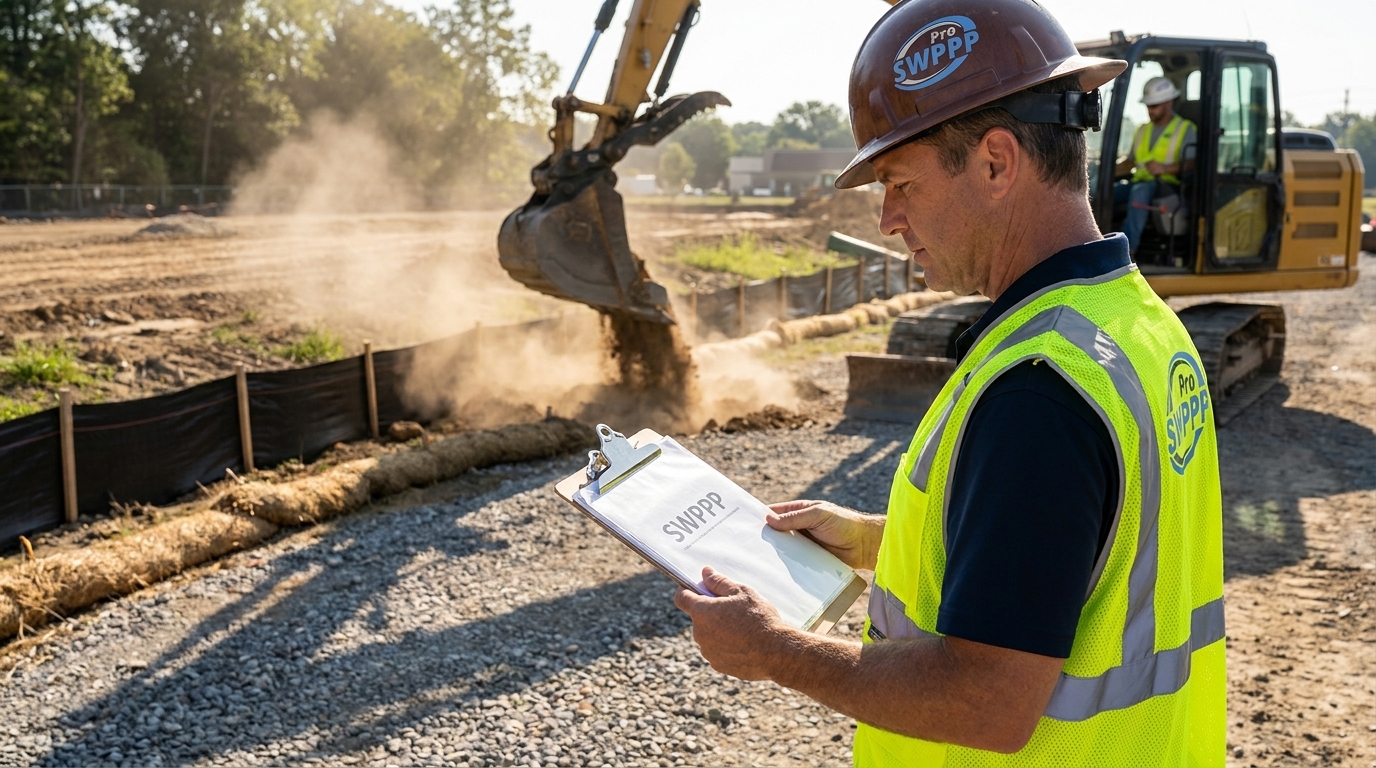
The federal trigger is one acre. Under EPA’s Construction General Permit, any construction activity that disturbs one acre or more of total land area needs permit coverage, and permit coverage requires a Stormwater Pollution Prevention Plan.
“Disturbs” means more than just digging. Clearing, grading, excavating, stockpiling fill, and demolition all count toward your acreage. A site that clears 0.6 acres and stockpiles material across another 0.5 acres has disturbed 1.1 acres and needs a plan.
The acreage is measured across the whole project footprint, not per phase and not per contractor. If the job will eventually touch one acre, you need coverage from the first day of ground disturbance.
Not Sure If You Need One? Take the 60-Second Quiz
What Counts as a Larger Common Plan of Development?
This is the rule that catches most contractors off guard. A project under one acre still needs a SWPPP if it sits inside a larger common plan of development or sale that will ultimately disturb one acre or more.
A common plan exists when separate construction activities are tied together by any shared announcement, plat, permit application, contract, financing arrangement, or marketing. A half-acre lot inside a 20-lot subdivision is part of a common plan, so that lot needs permit coverage even though its own footprint is well under an acre.
The practical test: if a reasonable person looking at the plat, the sign at the entrance, or the sales brochure would see one development, it is one common plan. Builders working a single lot in an active subdivision are almost always covered.
Do Projects Under One Acre Ever Need a SWPPP?
Yes, in three situations beyond the common plan rule.
First, many states set a lower threshold than the federal one acre. Several states and municipalities require permit coverage at smaller disturbances, and a handful of local MS4 programs go lower still.
Second, a permitting authority can designate any site as needing coverage if its discharge contributes to a water quality problem, regardless of size.
Third, sites discharging to an impaired or high-quality receiving water frequently carry added requirements that apply below the normal threshold.
Because the floor moves by state and by city, the acreage question is never answered by the federal rule alone.
Get My SWPPP — 72-Hour Turnaround
Does the SWPPP Have to Be Finished Before I File the Notice of Intent?
Yes. The Construction General Permit requires the SWPPP to be developed before the Notice of Intent is submitted. Filing the NOI first and writing the plan afterward is one of the most common violations regulators cite.
“Developed” means a complete plan: site description, drainage map, identified pollutant sources, selected best management practices, the inspection schedule, and signed operator certifications. A partial draft does not satisfy the requirement.
The sequence matters because the NOI certifies that the plan already exists. Signing that certification when it does not is a false certification, which is a separate and more serious problem than a late plan. Here is how the NOI filing process works.
Who Enforces SWPPP Requirements — EPA or My State?
In most of the country, your state does. EPA has authorized the large majority of states to run their own NPDES stormwater programs, which means the state issues its own Construction General Permit with its own thresholds, inspection frequencies, and forms.
EPA’s own Construction General Permit applies directly only in the handful of non-authorized states, territories, and on most tribal lands. Everywhere else, the state permit governs and the federal permit is only the floor beneath it.
This is why two identical projects in different states can face different rules. The federal 2022 CGP is scheduled to expire on February 16, 2027, and EPA has proposed a 2027 replacement, but state permits run on their own reissuance cycles. The Construction General Permit guide covers how federal and state coverage interact.
Do I Need a SWPPP in My State? Requirements for All 50 States
Every state starts from the same federal trigger of one acre of disturbance, but the permit number, the filing, the plan name, the inspection schedule, and the fine for getting it wrong all change at the state line. Roughly a dozen states do not even use the word SWPPP, which is a common reason contractors wrongly conclude their state has no requirement. The table below compares all 50 states; click a state for its full permit guide.
Penalty figures are each state’s maximum civil penalty under its own water pollution statute. EPA can also enforce the federal Clean Water Act in any state, at up to $68,445 per day per violation under 40 CFR 19.4.
| State | Permit | Trigger | What you file | Plan name | Inspection schedule | Who may inspect | Max state penalty |
|---|---|---|---|---|---|---|---|
| Alabama | ALR100000 (ADEM), eff. Apr 1, 2026 | 1 acre+ or common plan | NOI via AEPACS; Schedule F from Oct 15, 2026: $1,000 base under 5 ac, +$100/ac at 5 ac+, $10,000 cap; no fee to reissue existing coverage | CBMPP (certified by a QCP) | Monthly + after each qualifying rain event† | QCI, QCP, or a person supervised by a QCP | $25,000/violation, each day separate (Ala. Code §22-22A-5) |
| Alaska | AKR100000 (ADEC), eff. Feb 1, 2026 | 1 acre+ or common plan | eNOI via EDMS 5+ business days ahead; $580; SWPPP filed with NOI at 5+ acres | SWPPP | Every 7 days, or 14 days + after a 0.5 in storm that discharges† | Qualified person per permit† | Up to $100,000 + $10,000/day (AS 46.03.760) |
| Arizona | AZG2025-001 (ADEQ), eff. Aug 29, 2025 | 1 acre+ or common plan | NOI in myDEQ; acreage-based annual fee | SWPPP | Every 7 days, or 14 days + within 24 h of 0.5 in | Qualified personnel; no state certification | $25,000/day (A.R.S. §49-262) |
| Arkansas | ARR150000 (DEQ); renewed permit eff. Nov 1, 2026 | 1 acre+ (5+ acres = large site) | 5+ acres: NOI + SWPPP via SEEK, $200/yr. 1–5 acres: automatic, nothing filed. Existing permittees recertify by Oct 1, 2026 | SWPPP | Every 7 days, or 14 days + within 24 h of 0.25 in | Qualified personnel; no state certification | $10,000/violation, each day separate (Ark. Code §8-4-103) |
| California | CGP Order 2022-0057-DWQ (SWRCB) | 1 acre+ or common plan | Permit Registration Documents + annual fee in SMARTS | SWPPP (written by a QSD) | Weekly; before, every 24 h during, and within 96 h after each qualifying 0.5 in storm | QSP or QSP-trained staff | $10,000/day admin; $25,000/day judicial (Water Code §13385) |
| Colorado | COR400000 (CDPHE), exp. Mar 31, 2029 | 1 acre+ or common plan | Permit application via CDPHE online portal | SWMP (Stormwater Management Plan) | Every 7 days, or 14 days + within 24 h of precipitation that causes erosion | Qualified stormwater manager; no state certification | $54,833/day (C.R.S. §25-8-608) |
| Connecticut | DEEP Construction GP, eff. Jan 1, 2026 | 1 acre+ (1–5 acre locally approved sites file nothing with DEEP) | Registration via ezFile; $1,250–$5,000 | SPCP (Stormwater Pollution Control Plan) | Weekly + within 24 h of a storm that discharges† | “Qualified Inspector” per permit† | $25,000/day (C.G.S. §22a-438) |
| Delaware | DE CGP (DNREC), eff. Mar 11, 2026 | 1 acre+ | eNOI; $195/yr | Sediment & Stormwater Management Plan | Weekly; construction reviews every 7 days; no rain trigger | Responsible personnel and/or DNREC Certified Construction Reviewer | $5,000–$40,000/violation, each day separate (7 Del. C. §6005) |
| Florida | FDEP CGP (Rule 62-621.300(4)(a)) | 1 acre+ or common plan | NOI via DEP Business Portal 2+ days ahead; $400 (5+ acres) / $250 | SWPPP | Every 7 days + within 24 h of 0.50 in | Qualified inspector (FSESCI or equivalent training) | $15,000/day (Fla. Stat. §403.141) |
| Georgia | GAR100001/2/3 (EPD), exp. Jul 31, 2028 | 1 acre+ or common plan | NOI via GEOS 14+ days ahead | ES&PC Plan | Every 7 days + within 24 h of 0.5 in | GSWCC-certified personnel | $50,000/day; $100,000/day repeat (O.C.G.A. §12-5-52) |
| Hawaii | HAR 11-55 App. C (DOH), exp. Jan 28, 2029 | 1 acre+ or common plan | NOI via e-Permitting 30+ days ahead; $500 | SWPPP | Every 7 days, or 14 days + within 24 h of 0.25 in | Qualified person; no state certification | $60,000/day (HRS §342D-30) |
| Idaho | IDR100000 (DEQ), exp. Feb 9, 2027 | 1 acre+ or common plan | NOI via IPDES E-Permitting 14+ days ahead | SWPPP | Every 7 days, or 14 days + each day a 0.25 in storm discharges | Trained personnel; no state certification | $10,000/violation or $5,000/day continuing (Idaho Code §39-108) |
| Illinois | ILR10 (IEPA), exp. Aug 31, 2028 | 1 acre+ or common plan | NOI via EPA NeT; $250 (under 5 acres) / $750 | SWPPP | Every 7 days + within 24 h (or next work day) of 0.50 in | Qualified personnel (e.g., PE, CPESC, CESSWI) | $25,000/day (415 ILCS 5/42) |
| Indiana | INRA00000 (IDEM), exp. Dec 17, 2026 | 1 acre+ or common plan | NOI via Regulatory ePortal 48+ h ahead; $175 | SWP3 | Weekly + by next business day after 0.5 in | Trained individual; no state certification | $25,000/day (IC 13-30-4-1) |
| Iowa | General Permit No. 2 (DNR), exp. Feb 29, 2028 | 1 acre+ incl. common plan | NOI + newspaper notice; $175–$700 | SWPPP | Every 7 days; no rain trigger | Qualified personnel; no state certification | $5,000/day (Iowa Code §455B.191) |
| Kansas | KSR100000 (KDHE), exp. Jul 31, 2027 | 1 acre+ or common plan | NOI via KEIMS; $60/yr | SWP2 | Every 7 days, or 8–14 days + by next weekday after 0.5 in | Qualified personnel; no state certification | $10,000/violation, each day separate (K.S.A. 65-170d) |
| Kentucky | KYR100000 (DOW), exp. Dec 31, 2029 | 1 acre+ incl. common plan | NOI via eForms 7+ days ahead | SWPPP | Every 7 days, or 14 days + within 24 h of 0.5 in | Trained (KEPSC, CPSWQ, TNEPSC, CESSWI or similar) | $25,000/day (KRS 224.99-010) |
| Louisiana | LAR100000 (5+ ac) / LAR200000 (1–5 ac) (LDEQ) | 1 acre+ | 5+ acres: NOI, $291/yr. 1–5 acres: site notice + completion report, no NOI | SWPPP | Every 7 days, or 14 days + within 24 h of 0.5 in | Qualified personnel; no state certification | $32,500/day (La. R.S. 30:2025) |
| Maine | Maine CGP (DEP), exp. Jan 13, 2030 | 1 acre+ or common plan | NOI to DEP; approved after 14 days | SWPPP (by a DEP-certified ESC professional) | Weekly + before and within 24 h after storms | Knowledgeable person; 5+ acres need a DEP-certified inspector | $10,000/day; $25,000/day repeat (38 M.R.S. §349) |
| Maryland | 20-CP (MDE), exp. Mar 31, 2028 | 1 acre+ or common plan | NOI via ePermits 14+ days ahead; 14-day public notice | Approved ESC + SWM Plans | Weekly + after storms, or every 4 business days† | Knowledgeable person; Responsible Personnel Certification for foremen | $10,000/violation, each day separate (Env. §9-342) |
| Massachusetts | EPA 2022 CGP (EPA), exp. Feb 16, 2027 | 1 acre+ or common plan | NOI via EPA NeT-CGP; no fee | SWPPP | Every 7 days, or 14 days + within 24 h of 0.25 in | EPA inspector course/exam or equivalent certification | $68,445/day (federal, 40 CFR 19.4) |
| Michigan | Permit-by-rule R 323.2190 (EGLE) | 1 acre+ with a discharge; Part 91 SESC permit first | 1–5 acres: automatic. 5+ acres: Notice of Coverage via MiEnviro, $400 | Part 91 SESC Plan | Weekly + within 24 h of every rain that causes a discharge | EGLE Certified Storm Water Operator | $25,000/day (MCL 324.3115) |
| Minnesota | MNR100001 (MPCA), exp. Jul 31, 2028 | 1 acre+ or common plan | Application via e-Services; $400 | SWPPP | Every 7 days + within 24 h of more than 0.5 in | Trained person (refresher every 3 years) | $15,000/day (Minn. Stat. §115.071) |
| Mississippi | MSR10 (5+ ac) / MSR15 (1–5 ac) (MDEQ) | 1 acre+ | 5+ acres: LCNOI + SWPPP to MDEQ. 1–5 acres: SCNOI kept on site | SWPPP | Weekly (min. 4/month) + after rain that causes a discharge | Qualified personnel; no state certification | $25,000/violation, each day separate (Miss. Code §49-17-43) |
| Missouri | MORA00000 (MoDNR), exp. Feb 7, 2027 | 1 acre+ or common plan | Application via ePermitting; $500–$5,000 + $200/yr | SWPPP | Every 7 days + within 48 h of a 2-yr storm, or 14 days + within 24 h of 0.25 in | Qualified person; no state certification | $10,000/day (RSMo §644.076) |
| Montana | MTR100000 (DEQ), exp. Dec 31, 2027 | 1 acre+ or common plan | NOI-SWC via FACTS; $900–$3,500 + annual fee | SWPPP | Every 7 days, or 14 days + within 24 h of 0.25 in | DEQ-certified SWPPP Administrator | $25,000/violation (MCA §75-5-631) |
| Nebraska | NER210000 (DWEE), exp. Nov 30, 2026 | 1 acre+ or common plan | CSW-NOI + SWPPP online | SWPPP | Every 7 days, or 14 days + within 24 h of 0.25 in or snowmelt (business hours) | Qualified personnel; no state certification | $10,000/day (Neb. Rev. Stat. §81-1508.02) |
| Nevada | NVR100000 (NDEP), administratively continued | 1 acre+ or common plan | NOI 14+ days ahead; $300–$1,250 + annual fee | SWPPP | Every 7 days + within 24 h of 0.5 in | Qualified personnel; no state certification | $25,000/day (NRS 445A.700) |
| New Hampshire | EPA 2022 CGP (EPA), exp. Feb 16, 2027 | 1 acre+ or common plan | NOI via EPA NeT-CGP; no fee | SWPPP | Every 7 days, or 14 days + within 24 h of 0.25 in | EPA inspector course/exam or equivalent certification | $68,445/day (federal, 40 CFR 19.4) |
| New Jersey | NJPDES 5G3 (NJDEP) | 1 acre+ | Request for Authorization via NJDEP Online after Soil Conservation District plan certification | SPPP (SCD-certified SESC plan + waste control plan) | Weekly† | Per permit† | $50,000/day (N.J.S.A. 58:10A-10) |
| New Mexico | EPA 2022 CGP (EPA), exp. Feb 16, 2027 | 1 acre+ or common plan | NOI via EPA NeT-CGP; no fee | SWPPP | Every 7 days, or 14 days + within 24 h of 0.25 in | EPA inspector course/exam or equivalent certification | $68,445/day (federal, 40 CFR 19.4) |
| New York | GP-0-25-001 (NYSDEC), exp. Jan 28, 2030 | 1 acre (NYC: 20,000 sq ft; NYC East of Hudson watershed: 5,000 sq ft) | eNOI via nForm; MS4 acceptance where required | SWPPP | Every 7 days; twice weekly if 5+ acres or impaired waters; no rain trigger | Qualified inspector + trained contractor on site daily | $37,500/day (ECL §71-1929) |
| North Carolina | NCG010000 (DEMLR), exp. Mar 31, 2029 | 1 acre+ or common plan | E&SC Plan approval, then e-NOI | E&SC Plan | Every 7 days + within 24 h of 1.0 in; daily rain gauge | No certification required (per DEQ) | $25,000/day (G.S. §143-215.6A) |
| North Dakota | NDR11-0000 (NDDEQ), exp. Mar 31, 2030 | 1 acre+ incl. common plan | NOI via eReporting | SWPPP | Every 14 days + within 24 h of more than 0.25 in | Knowledgeable person named in the SWPPP; no state certification | $12,500/day (NDCC §61-28-08) |
| Ohio | OHC000006 (Ohio EPA), exp. Apr 22, 2028 | 1 acre+ or common plan | NOI via eBiz; $200 + $20/acre over 5 (max $500) | SWP3 | Every 7 days + by end of next day after more than 0.5 in | Qualified inspection personnel | $10,000/day (ORC §6111.09) |
| Oklahoma | OKR10 (ODEQ), exp. Oct 17, 2027 | 1 acre+ or common plan | NOI Form 606-002A; $447.71 first year | SWP3 | Every 14 days + within 24 h of 0.5 in; high-priority sites every 7 days† | Qualified personnel; no state certification | $10,000/day (27A O.S. §2-6-206) |
| Oregon | 1200-C (DEQ), exp. Dec 14, 2030 | 1 acre+ or common plan | Application + ESCP via Your DEQ Online; 5+ acres 14-day public review | ESCP | Every 7 days, or 14 days + within 24 h of 0.25 in (locked at coverage) | CESSWI, CPESC, CPSWQ, CISEC, WA CESCL, or Oregon PE/RLA/CEG | $25,000/day (ORS 468.130) |
| Pennsylvania | PAG-02 (DEP / conservation districts), exp. Dec 7, 2029 | 1 acre+ (E&S Plan needed below 1 acre too) | NOI to conservation district; $500 + $100/acre | E&S Plan + PCSM Plan | Weekly + within 24 h of 0.25 in | DEP Clean Water Academy training, CPESC, CESSWI, or approved equivalent | $10,000/day (35 P.S. §691.605) |
| Rhode Island | 2026 RIPDES CGP (RIDEM), eff. Sep 27, 2026 | 1 acre+ | Application via RIDEM OWR portal | SESC Plan / SWPPP | Every 7 days + within 24 h of 0.25 in† | Qualified personnel† | $25,000/day (R.I.G.L. §46-12-13) |
| South Carolina | SCR100000 (SCDES), exp. Mar 29, 2031 | 1 acre+ or common plan; smaller sites near the coast | NOI + C-SWPPP via ePermitting; $125 (+$100/acre plan review, max $2,000) | C-SWPPP (submitted) / OS-SWPPP (on site) | At least weekly, no more than 9 days apart† | Per permit §4.2† | $10,000/day (S.C. Code §48-1-330) |
| South Dakota | SDR100000 (DANR), exp. Oct 31, 2028 | 1 acre+ or common plan | NOI via EPA NeT 15+ days ahead; $100–$750 | SWPPP | Every 7 days, or 14 days + within 24 h of 0.25 in or snowmelt | Qualified personnel; no state certification | $10,000/day (SDCL §34A-2-75) |
| Tennessee | TNR100000 2026 CGP (TDEC), eff. Oct 1, 2026 | 1 acre+ or common plan | NOI + SWPPP via MyTDEC Forms; $250–$10,000 | SWPPP | Twice weekly, 48+ h apart; + after 0.5 in if 50+ acres disturbed | TNEPSC Level I or another permit-listed credential; TN supplement training from Oct 1, 2027 | $10,000/day (T.C.A. §69-3-115) |
| Texas | TXR150000 (TCEQ), exp. Mar 5, 2028 | 1 acre+ (5+ acres = large site) | 5+ acres: NOI via STEERS, $225. 1–5 acres: post site notice, no NOI | SWP3 | Every 14 days + within 24 h of 0.5 in, or every 7 days | Knowledgeable personnel; no state certification | $25,000/day per violation (Tex. Water Code §7.102) |
| Utah | UTRC00000 (DWQ), exp. Jun 30, 2029 | 1 acre+ or common plan | NOI via EPA NeT + annual fee | SWPPP | Every 7 days, or 14 days + within 24 h of 0.50 in | Utah RSI, CPESC, CPSWQ, CESSWI, CISEC, or listed equivalent | $10,000/day (Utah Code §19-5-115) |
| Vermont | 3-9020 (DEC), eff. Jun 20, 2025 | 1 acre+ or common plan | eNOI via ANR Online with risk evaluation | EPSC Plan (low-risk sites: Low Risk Handbook) | Every 7 days + before runoff events; daily Oct 15–Apr 15 on unstabilized areas | On-Site Plan Coordinator; no state certification | $85,000/violation + $42,500/day (10 V.S.A. §8221) |
| Virginia | VAR10 (DEQ), exp. Jun 30, 2029 | 1 acre+ or common plan | Registration statement to local VESMP authority or DEQ | SWPPP | Every 5 business days, or 10 business days + within 24 h of 0.25 in | DEQ-certified inspector (required since Jul 1, 2025) | $32,500/day (Va. Code §62.1-44.32) |
| Washington | CSWGP (Ecology), eff. Jan 1, 2026 | 1 acre+ or common plan | NOI via WQWebPortal 60+ days ahead; 30-day public notice | SWPPP | Weekly + within 24 h of a discharge†; weekly turbidity sampling | CESCL | $10,000/day (RCW 90.48.144) |
| West Virginia | WV0115924 (WVDEP), 2024 reissuance | 1 acre+ or common plan | Site Registration Application via ESS | SWPPP + Groundwater Protection Plan | Every 7 days + within 24 h of 0.25 in† | Qualified person† | $25,000/day (W. Va. Code §22-11-22) |
| Wisconsin | WI-S067831-6 (DNR), exp. Sep 30, 2026, continued until reissued | 1 acre+ | NOI via ePermitting 14+ working days ahead; $250–$800 | Erosion Control Plan + Storm Water Management Plan | Weekly + within 24 h of 0.5 in | Permittee or designee; no state certification | $10,000/day (Wis. Stat. §283.91) |
| Wyoming | WYR100000 (DEQ), renewal pending | 1 acre+ (5+ acres = large site) | 5+ acres: NOI + SWPPP via WYIMS, $200/yr. 1–5 acres: no NOI | SWPPP | Every 14 days + within 24 h of 0.5 in, or every 7 days | Per permit† | $10,000/day (Wyo. Stat. §35-11-901) |
Scroll sideways on mobile to see every column. Values are summarized from each state’s current construction general permit and statute as of September 26, 2026. Cells marked † are taken from the agency’s own guidance or the previous permit because the current permit text could not be confirmed line by line; check the permit covering your project before relying on them. Permits are reissued on their own cycles (Tennessee on October 1, 2026; Arkansas on November 1, 2026; Nebraska expires November 30, 2026), so always confirm the version that applies on your start date.
Don’t Want to Decode Your State’s Permit? Get My SWPPP
The document does the same job under every name. The forms, the submitting agency, and the inspector credential are what change.
What Happens If You Don’t Have a SWPPP When You Need One?
Discharging stormwater from a regulated construction site without permit coverage is a Clean Water Act violation, and the Act authorizes civil penalties assessed per day of violation. Because the clock runs daily, a plan that is missing for a full season becomes expensive quickly.
The enforcement pattern worth understanding is that most penalties are not for visible pollution. EPA’s recent stormwater settlements turn overwhelmingly on paperwork: no plan developed, a plan developed but never implemented, or inspections that happened but were never documented.
The practical consequences usually arrive before the penalty does. Inspectors issue stop-work orders, lenders and general contractors withhold draws over open violations, and a documented violation follows the company into future permit applications.
What Do I Do Next?
Confirm your total disturbed acreage across the full project footprint, including stockpiles and staging. Then check whether the site sits inside a larger common plan.
If either test puts you at one acre or more, you need a plan before you file the NOI and before ground disturbance begins. If you are close to the line, check your state and city thresholds rather than relying on the federal acre.
Related guides: what a SWPPP costs · SWPPP inspection requirements · who is qualified to prepare and inspect one · industrial facilities and the MSGP · DIY versus professional preparation
By project type: residential subdivisions · warehouses and distribution centers · gas stations and convenience stores · self-storage · apartments and multifamily · schools and municipal buildings · cell tower sites · waterlines and pipelines
If your site is under five acres, there is one narrow way out of the plan entirely: the Low Erosivity Waiver.
Frequently Asked Questions
When is a SWPPP required?
A SWPPP is required once construction disturbs one acre or more of land. It is also required below one acre when the work is part of a larger common plan of development or sale that will ultimately disturb one acre or more. The plan must exist before you file the Notice of Intent.
What is a larger common plan of development?
Any announcement, plat, contract, financing, or marketing that ties separate construction activities together. A half-acre lot inside a 20-lot subdivision is part of a common plan, so that lot needs permit coverage even though its own footprint is under one acre.
Do I need a SWPPP before or after filing the Notice of Intent?
Before. The permit requires the SWPPP to be developed prior to submitting the NOI. Filing the NOI first is one of the most common violations regulators cite, and it puts you out of compliance before any dirt moves.
Is it still called a SWPPP in every state?
No. Texas, Ohio, Indiana and Oklahoma call it an SWP3. Colorado calls it a Stormwater Management Plan. Pennsylvania requires an E&S Plan plus a PCSM Plan. Georgia uses an ES&PC Plan, New Jersey an SPPP, North Carolina an E&SC Plan, and Kansas an SWP2.
Do I need a SWPPP if I’m only grading half an acre?
Possibly. Half an acre standing alone in a state that follows the federal threshold does not trigger coverage. Half an acre inside a subdivision, business park, or phased development does, because the common plan rule measures the whole development rather than your piece of it.
Who is responsible for the SWPPP when several contractors share a site?
Every operator with control over construction plans or day-to-day operations carries responsibility. General contractors and developers are typically both named, and subcontractors can be held liable for their own activities. Shared responsibility does not divide the liability, it multiplies who can be cited.
Does a SWPPP expire?
The plan itself does not expire, but permit coverage does, and the plan must be kept current. Any change in site conditions, operators, or selected controls requires an update, and coverage ends only when you file and receive an accepted Notice of Termination.
Schedule a Call with a Stormwater Expert
Derek E. Chinners, CPESC — Founder & Stormwater Consultant, Pro SWPPP, LLC