
Do You Need a SWPPP in Tampa or Hillsborough County?
Construction in Tampa or unincorporated Hillsborough County that disturbs one acre or more, including smaller parcels inside a common plan of development, needs a SWPPP and a Notice of Intent filed with the Florida Department of Environmental Protection under its Generic Permit for Stormwater Discharge from Large and Small Construction Activities.
What is a SWPPP, and which agency permits it in Florida?
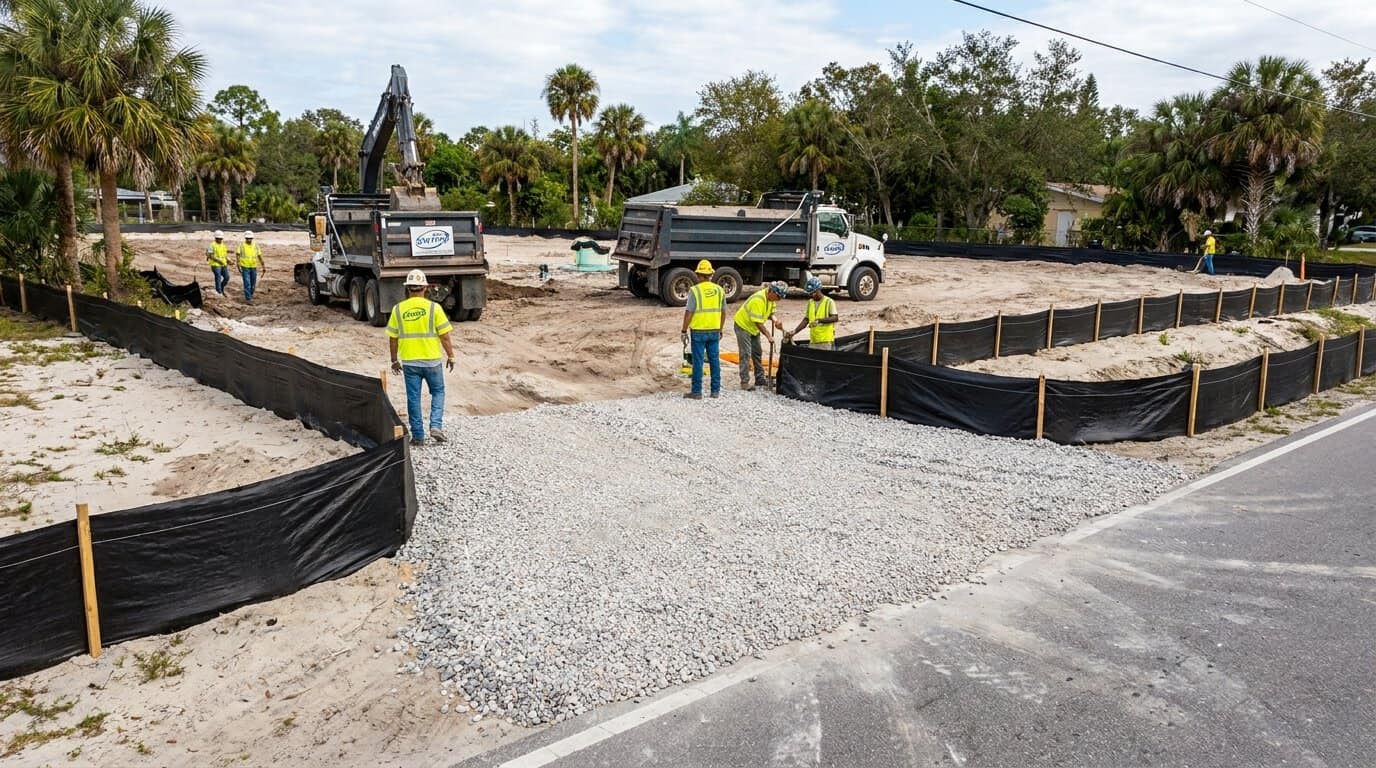
A SWPPP is a Stormwater Pollution Prevention Plan: the written document showing how sediment, concrete washout, fuel, and other pollutants will be kept out of storm drains, ditches, and Tampa Bay tributaries during construction. It carries a site map, a pollutant inventory, the Best Management Practices selected for each phase, an inspection schedule, and a corrective action record.
Florida runs its own delegated NPDES program. The Florida Department of Environmental Protection issues the Generic Permit for Stormwater Discharge from Large and Small Construction Activities, referred to on most job sites as the CGP. FDEP is the permitting authority; the City of Tampa and Hillsborough County add local plan review, land alteration permitting, and their own inspections.
The plan is a living document. It is written before the NOI is filed, revised whenever the grading sequence, contractor, or control layout changes, and kept on site in current form for the entire life of the project.
Not sure if you even need one?
Answer a few questions about your site and find out in under two minutes.
When does a Tampa project need a SWPPP and an NOI?
The trigger is one acre of land disturbance. It applies again, separately, when a smaller parcel is part of a larger common plan of development or sale that totals one acre or more, which is how most residential infill builders end up regulated.
Three half-acre lots sold as one platted project total 1.5 acres. That project needs a SWPPP and NOI coverage even though no single lot reaches the threshold, and the coverage has to be in place before the first pass with a dozer.
The sequence matters. FDEP expects the SWPPP to be complete before the Notice of Intent is submitted, and the NOI must reach FDEP at least two days before construction begins. Filing a Notice of Termination at the end of the job closes the authorization. City of Tampa construction guidance repeats the same three steps: develop and implement the plan, submit the NOI, file the NOT when the site is stable.
What is the difference between a SWPPP and an ERP?
These two permits get confused constantly, and mixing them up is what produces the mid-project surprise where a retention pond has to be redesigned. One governs the construction period; the other governs the finished site forever.
| Item | SWPPP under the FDEP CGP | Environmental Resource Permit (ERP) |
|---|---|---|
| What it controls | Pollutant discharge during construction | Permanent stormwater management and wetland impacts |
| Trigger | 1 acre disturbed, or a common plan totaling 1 acre or more | Site-specific, based on impervious area, wetlands, and dredge or fill |
| Authority | FDEP under the delegated NPDES program | FDEP or the applicable water management district |
| Filing | NOI at least 2 days before construction; NOT at closeout | Application with engineered design, reviewed before construction |
| Lifespan | Ends at final stabilization | Continues through operation and maintenance of the system |
Florida also updated its statewide stormwater design rules following Senate Bill 7040, signed in June 2024. Those changes shifted post-construction design toward performance criteria, including modeled reductions in total nitrogen and total phosphorus, and they apply to the ERP rather than to the construction SWPPP. Confirm current design criteria with Florida DEP before finalizing pond design. A statewide breakdown is in our Orange County Florida FDEP SWPPP guide.
What has to be inside a Tampa SWPPP?
The CGP sets the required contents, and Tampa and Hillsborough County reviewers work from the same list. Five elements carry most of the review risk on a Tampa job.
Site map and site description
Property boundaries, total and disturbed acreage, soils, existing and proposed drainage, discharge points, receiving waters, and the construction sequence. Tampa sites frequently discharge to a city inlet within a few hundred feet, so the map has to show that path explicitly.
Erosion and sediment controls
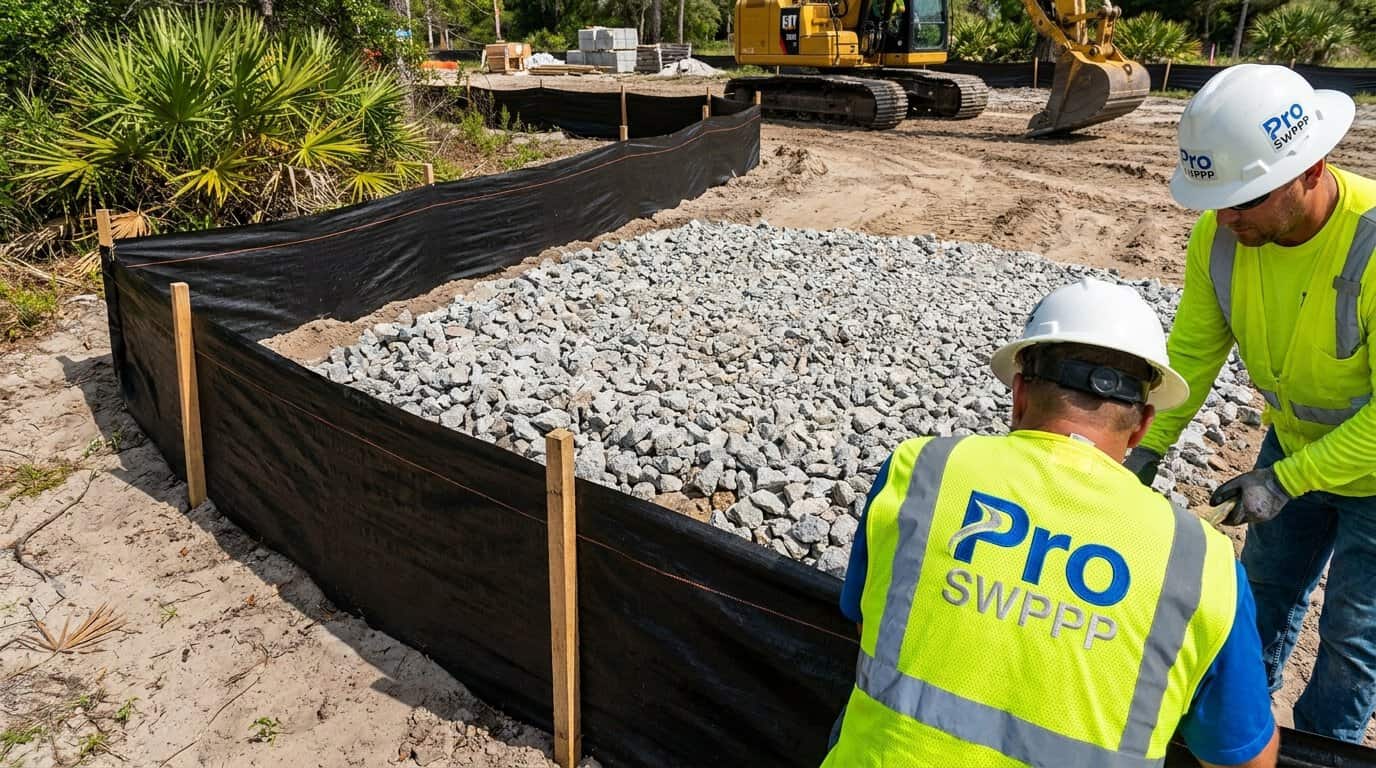
Perimeter silt fence or turbidity barrier, stabilized construction entrance, inlet protection on every affected storm drain, sediment traps or basins on larger sites, and temporary seeding or mulch on exposed slopes. The plan specifies what gets built and where; physical installation of BMPs is handled by your site contractor.
Non-stormwater and waste controls
Concrete washout with containment, fuel and chemical storage with secondary containment, spill kits, covered material storage, and portable sanitary facility placement away from inlets. Florida rainfall turns an uncontained washout into a discharge in a single afternoon.
Inspection and recordkeeping procedures
The named inspector, the 7-day interval, the 0.5-inch rainfall trigger, the log form, and the corrective action process. Records stay on site during construction and are retained for at least 3 years after the Notice of Termination is filed.
Stabilization plan
Temporary and final stabilization methods, seed or sod specifications, and the schedule for stabilizing areas where work has paused. Florida vegetation establishes quickly, which makes phased stabilization one of the cheapest compliance wins available.
What does stormwater compliance cost in Hillsborough County?
Hillsborough County funds its stormwater program through an assessment based on impervious area, measured in Equivalent Residential Units. One ERU equals 4,267 square feet of impervious surface, so a commercial building with 20,000 square feet of roof and pavement is assessed at roughly 4.7 ERUs.
The county assessment was $86.49 per ERU in the FY2025 rate schedule, which put that same 20,000-square-foot site near $406 per year. Rates are set annually, so confirm the current figure with Hillsborough County before using it in a pro forma.
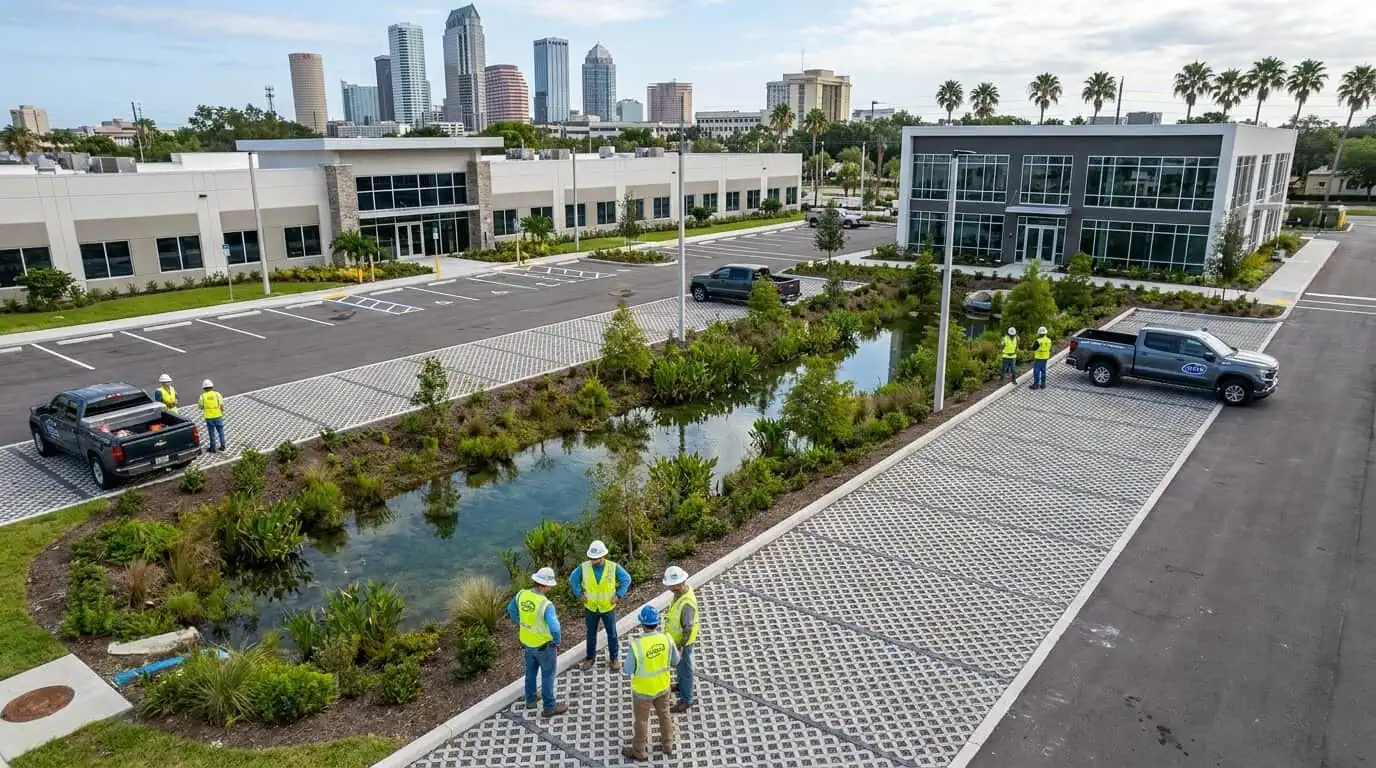
The construction SWPPP does not change that assessment. The permanent design does: reducing impervious cover, using permeable pavement, preserving natural drainage, and distributing infiltration across the site all lower the long-term ERU count while helping meet the state nutrient performance criteria. FDEP charges a separate application fee for NOI coverage under the CGP; verify the current amount with FDEP at the time of filing.
Just want a number first?
Tell us about your project and we will send a written estimate, no obligation.
How often must a Tampa site be inspected?
The FDEP generic permit sets the schedule: at least once every seven (7) calendar days and within twenty-four (24) hours of the end of a storm event of 0.50 inches or greater. That requirement comes from the Florida DEP Generic Permit for Stormwater Discharge from Large and Small Construction Activities, and in a Tampa summer the rain trigger fires far more often than the calendar one.
Each inspection records the date, the inspector, rainfall since the previous visit, the condition of every control, any evidence of discharge, the corrective action required, and the date it was completed. Failed or damaged controls are repaired as soon as practicable, and the plan is amended when the failure reflects a design problem rather than a maintenance lapse.
Keep the written reports on site and retain them for at least 3 years after the NOT. FDEP and EPA can inspect at any time, and a compliant site with missing logs is still a violation. Federal background is on the EPA NPDES construction stormwater page.
Which mistakes cost Tampa contractors the most?
- Filing the NOI before the SWPPP exists, which reverses the order FDEP requires
- Starting grading before perimeter controls and the stabilized entrance are in place
- Missing the 24-hour inspection after a 0.5-inch storm during the summer rainy season
- Letting the plan drift out of date after a grading revision or a change of contractor
- Treating one big detention pond as the whole stormwater strategy instead of distributing treatment
- Never filing the Notice of Termination, leaving the authorization and its obligations open
Each of these can produce a notice of violation, and enforcement can come from FDEP, EPA, or the local government at the same time. The most expensive outcome is rarely the penalty itself; it is the stop-work order that idles a mobilized crew.
Who prepares the SWPPP, and who builds the controls?
Pro SWPPP, LLC is a documentation firm. The deliverables are the site-specific SWPPP, the site map, BMP specifications and details, the FDEP NOI package, inspection forms and log templates, plan amendments, and the Notice of Termination package with final stabilization documentation. Every plan is prepared under Derek E. Chinners, CPESC, a Certified Professional in Erosion and Sediment Control with more than 20 years in construction stormwater.
Physical installation of BMPs is handled by your site contractor. Pro SWPPP does not place silt fence, build basins, or perform field construction of any kind, and the service does not replace the crew already on site. The plan tells that crew what to build, where, and to what standard.
Typical turnaround from a complete site plan and grading plan to a delivered SWPPP is a few business days, with time built in for one review cycle before the NOI is filed. The same documentation approach applies to projects in Texas, where TCEQ administers the program, and Georgia, where EPD applies tiered requirements based on receiving-stream sensitivity. Scope questions go through contact us, and team background is on the about page.
How do you close out the permit with a Notice of Termination?
A Notice of Termination is filed with FDEP once the site reaches final stabilization. That means all disturbed areas are seeded, sodded, or paved with vegetation established well enough to resist erosion, temporary controls have been removed and their disposal documented, and no ongoing pollutant discharge remains.
Until the NOT is filed the authorization stays active, and with it the 7-day inspection obligation and the recordkeeping duty. Document the closeout with dated photographs, final inspection reports, and seeding or sodding records, then retain the file for at least 3 years.
What else do Tampa contractors ask about SWPPP requirements?
Do I need a SWPPP if I am only disturbing half an acre?
Not on acreage alone. The CGP threshold is one acre. A half-acre site is still regulated when it belongs to a larger common plan of development or sale that totals one acre or more. City of Tampa or Hillsborough County land alteration permits may also apply below one acre, so confirm locally before assuming the project is exempt.
Can I file the NOI before the SWPPP is written?
No. FDEP expects the plan to be complete first, because the NOI certifies that it exists and the permit conditions attach to it. The NOI also has to reach FDEP at least two days before construction begins, and an inspector arriving on day one will ask to see the plan on site.
Who is qualified to prepare a SWPPP in Tampa?
Florida does not license SWPPP preparers by title, but the plan has to satisfy an engineer-level standard of care and survive FDEP and local review. A Certified Professional in Erosion and Sediment Control or a licensed engineer is the practical answer. Plans from Pro SWPPP are prepared under Derek E. Chinners, CPESC.
How often do I have to inspect the BMPs?
At least once every 7 calendar days, and within 24 hours of the end of any storm event of 0.5 inches or greater. Every inspection needs a written report kept on site, and those reports are retained for at least 3 years after the Notice of Termination. Gaps in the log are treated as inspections that never happened.
Do the 2024 Florida stormwater rule changes affect my SWPPP?
Not directly. The changes that followed Senate Bill 7040 apply to post-construction design under the Environmental Resource Permit, including nutrient reduction performance. The construction SWPPP still follows the FDEP generic permit. Aligning both early avoids the situation where temporary controls have to be torn out and rebuilt around a redesigned pond.
What happens if I get caught without a SWPPP?
Expect a notice of violation and, on an active site, a stop-work order. Penalties are assessed per day of violation and both FDEP and EPA have enforcement authority, with local governments able to act on top. The direct cost of the delay to a mobilized crew usually exceeds the penalty itself.
Does Pro SWPPP install erosion controls?
No. Pro SWPPP prepares documentation: the SWPPP, the site map, BMP specifications, the FDEP NOI package, inspection forms, and closeout paperwork. Physical installation of BMPs is handled by your site contractor. That separation keeps the plan a neutral, reviewable record for FDEP, the City of Tampa, and Hillsborough County.
Complicated site? Talk it through.
Speak directly with a CPESC-certified stormwater expert with 20+ years of experience.