
What Are the TDEC SWPPP Inspection Requirements in Tennessee?
The Tennessee Construction General Permit (TNR100000) requires SWPPP inspections at least twice every calendar week, spaced a minimum of 72 hours apart, on every construction site disturbing one acre or more. Each inspection must be performed by someone holding an active Fundamentals of Erosion Prevention and Sediment Control Level I certification recognized by the Tennessee Department of Environment and Conservation.
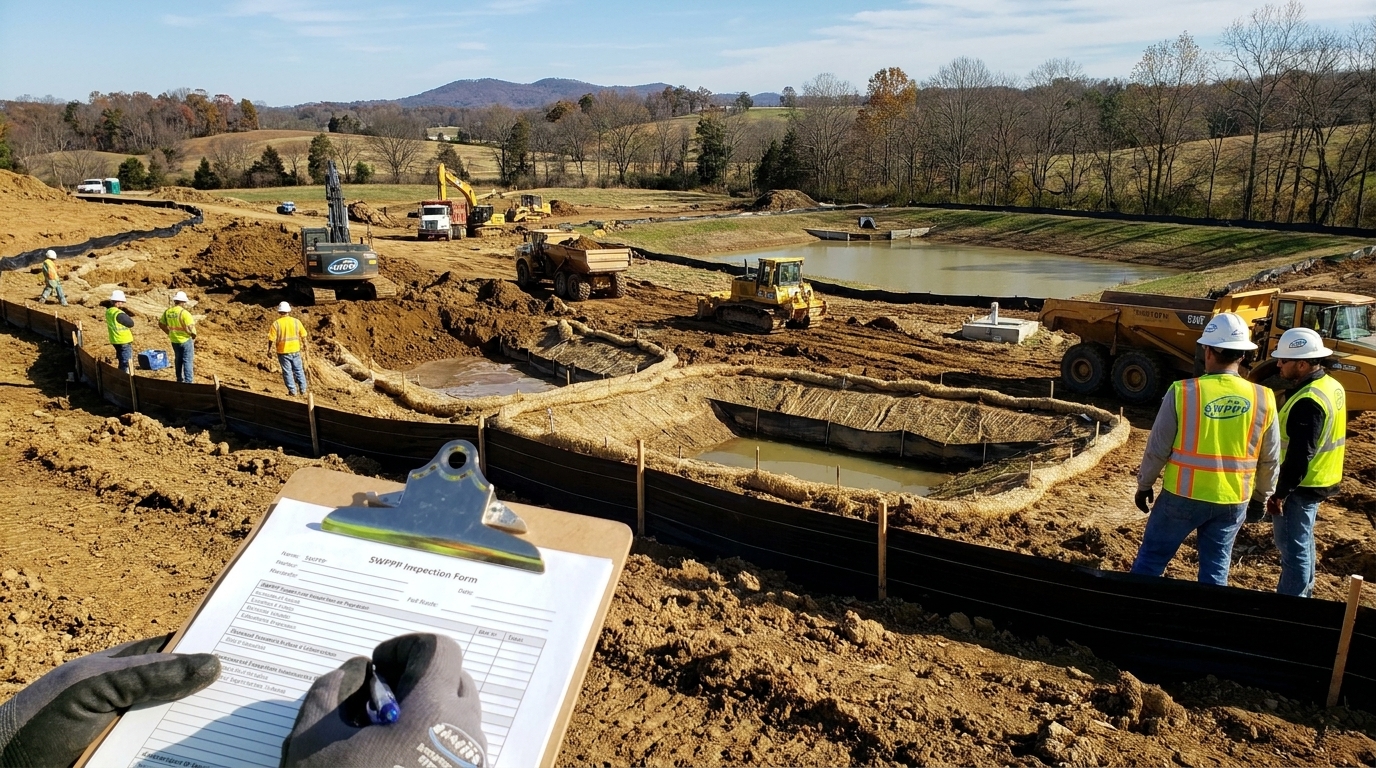
How Often Does TDEC Require SWPPP Inspections in Tennessee?
Twice every calendar week, with at least 72 hours between the two inspections. That is the single most misunderstood number in Tennessee stormwater compliance. Contractors coming from states that allow a 7-day cycle routinely underinspect and generate a documented violation on every week of the job.
The requirement is stated plainly in Section 3.5.8.2 of the Tennessee Construction General Permit: Inspections described in paragraphs b, c and d below, shall be performed at least twice every calendar week. Inspections shall be performed at least 72 hours apart. That language comes directly from permit TNR100000, issued by the Tennessee Department of Environment and Conservation NPDES Stormwater Construction Permit program.
The 72-hour spacing rule is what trips up crews who try to bank two inspections on a Thursday and Friday. Two inspections 24 hours apart do not satisfy the permit. A Monday and Thursday pattern, or Tuesday and Friday, keeps you clean every week of the project.
Not sure if you even need one?
Answer a few questions about your site and find out in under two minutes.
Which Tennessee Projects Need a SWPPP and a TDEC Permit?
Permit TNR100000 authorizes stormwater discharges from construction activities that result in soil disturbance of one or more acres. Sites under one acre are still pulled in when the parcel is part of a larger common plan of development or sale, which is how a half-acre pad inside a 12-acre subdivision ends up needing full coverage.
Coverage starts with a Notice of Intent. TDEC directs that the complete application should be submitted at least 30 days prior to commencement of construction activities, and land disturbance may not begin until TDEC issues the Notice of Coverage. Budgeting 30 days for that step is the difference between breaking ground on schedule and sitting idle.
Once coverage is issued, the SWPPP itself must be site-specific: actual drainage patterns, actual soil types, actual phasing, actual control-measure locations. A generic template does not satisfy TNR100000, and a TDEC inspector comparing the plan against the ground will spot the mismatch in minutes. For the broader state picture, see our guide to Tennessee SWPPP Requirements.
Who Is Qualified to Perform TDEC SWPPP Inspections?
Tennessee ties inspection authority to a specific credential, not to job title or years of experience. Section 3.5.8.1 of the permit states: Inspectors performing the required twice weekly inspections must have an active certification by completing the Fundamentals of Erosion Prevention and Sediment Control Level I course. That course is administered under the Tennessee Erosion Prevention and Sediment Control program recognized by TDEC.
TDEC also accepts several equivalent credentials in place of the Level I card. Any one of the following qualifies a person to sign the twice-weekly inspection form:
- Active Fundamentals of Erosion Prevention and Sediment Control Level I certification
- Licensed professional engineer or licensed landscape architect
- Certified Professional in Erosion and Sediment Control (CPESC)
- Completion of the Level II Design Principles course
An uncertified foreman walking the site and filling out the form is a permit violation even if every control measure on the ground is perfect. The credential is a permit condition in its own right, and the inspector name and certification number go on the TDEC form where an auditor will read them.
What Are the TDEC Inspection Deadlines at a Glance?
| Requirement under TNR100000 | Deadline | Who performs it |
|---|---|---|
| Routine site inspection | Twice every calendar week, at least 72 hours apart | Level I certified inspector |
| Reduced-frequency inspection (temporarily stabilized areas, snow or ice cover, extreme drought) | Once per month until thawing, precipitation causes runoff, or work resumes | Level I certified inspector |
| Repair or replace an inadequate control measure | Before the next rain event if possible, and in no case more than 7 days after the need is identified | Site contractor |
| Revise the SWPPP after an inspection finding | No later than 7 days following the inspection | SWPPP preparer |
| Implement the SWPPP revision in the field | No later than 14 days following the inspection | Site contractor |
| Temporary or permanent soil stabilization | Within 2 weeks after activity ceases; within 1 week on steep slopes | Site contractor |
| Notice of Intent submittal | At least 30 days before construction begins | Owner or operator |
| Natural riparian buffer | 30-foot buffer preserved, and never less than 15 feet at any measured location | Designer and site contractor |
What Does a TDEC Inspector Actually Check on Site?
The TDEC inspection form walks the inspector through disturbed areas, material and fuel storage zones, drainage devices, outfalls, riparian buffer zones, and every erosion and sediment control measure on the plan. Each item is recorded as functioning, deficient, or absent, along with the corrective action and the date it was completed.
In practice, the inspector is answering a short list of physical questions on every visit:
- Are silt fences upright, keyed in, and not overtopped with accumulated sediment?
- Is inlet protection in place and free of clogging on every catch basin?
- Are rock check dams intact and correctly spaced along the channel?
- Is vegetation establishing on areas that hit the 2-week stabilization deadline?
- Is the construction exit stopping track-out onto public roads?
- Are stockpiles covered or bermed, and is the 30-foot buffer undisturbed?
The form also captures the rainfall total since the last inspection and asks whether rainfall has been checked and documented daily, so a rain gauge and a daily rainfall log are part of the compliance package. Physical installation of BMPs is handled by your site contractor; the inspector documents condition and the SWPPP records the correction.

Do Rain Events Change the Tennessee Inspection Schedule?
Tennessee does not swap in a rain-triggered inspection the way many states do. The twice-weekly, 72-hours-apart schedule runs regardless of weather, which means a heavy storm does not buy you an extra week and a dry stretch does not let you skip a visit. The schedule is fixed; the rainfall record is what changes.
Rainfall must be checked and documented daily, and the total since the last inspection is entered on the TDEC form. That log matters during enforcement because it lets TDEC line up a discharge complaint against the rainfall that produced it and against your inspection dates.
Rain does affect your repair clock. An inadequate control measure must be replaced, modified, or repaired before the next rain event if possible, and in no case more than 7 days after the need is identified. A storm in the forecast compresses that window from 7 days to whatever time is left before the rain arrives.
Weather also unlocks the only relief in the schedule. Where a site or a portion of a site has been temporarily stabilized, or runoff is unlikely because of snow, ice, or extreme drought, inspections drop to once per month until thawing or precipitation results in runoff, or construction activity resumes.
Just want a number first?
Tell us about your project and we will send a written estimate, no obligation.
How Fast Must Inspection Findings Be Corrected?
Three separate clocks start the moment an inspector writes up a deficiency. Miss any one of them and the paperwork itself becomes the violation, even after the physical problem is fixed.
First, the field fix: repair, replace, or modify the inadequate control measure before the next rain event if possible, and in no case more than 7 days after the need is identified. Second, the SWPPP revision: the plan must be updated in no case later than 7 days following the inspection. Third, implementation of that revision in the field, in no case later than 14 days following the inspection.
The 7-day and 14-day deadlines are why a stale SWPPP is so dangerous. A site that shifts phases every few weeks generates plan amendments constantly, and TDEC compares the current plan against current conditions. Physical installation of BMPs is handled by your site contractor; keeping the written plan synchronized with those changes is the documentation work.
What Buffer and Stabilization Rules Apply in Tennessee?
TNR100000 requires that a 30-foot natural water quality riparian buffer be preserved between the receiving waterbody and disturbed areas, and the permit sets a hard floor: the buffer may never measure less than 15 feet at any measured location. Buffer encroachment is one of the fastest routes to an enforcement letter because it is visible from the property line.
Stabilization runs on its own timer. Temporary or permanent soil stabilization must be completed within 2 weeks after construction activity in that portion of the site has temporarily or permanently ceased, tightening to one week on steep slopes. Those are calendar deadlines, not weather-dependent goals.
Both requirements interact with your inspection record. Once an area hits the 2-week mark, the inspector is checking for established cover, and an unstabilized pad with no documented reason is a written finding that starts the 7-day repair clock.
What Happens During a TDEC Enforcement Visit?
TDEC and EPA field staff arrive unannounced. They ask for the Notice of Coverage, the current SWPPP, and the complete set of twice-weekly inspection forms, then walk the site and compare the plan against the ground. Missing forms are treated as missed inspections, which is a separate violation from whatever they find in the dirt.
The federal backstop is blunt. Clean Water Act Section 301(a), enforced through the NPDES program described by the U.S. Environmental Protection Agency stormwater discharges from construction activities program, makes the discharge of any pollutant by any person unlawful except in compliance with a permit. Your permit is the only thing standing between routine sediment runoff and an unlawful discharge.
Findings escalate from a notice of violation with a correction deadline, to civil penalties, to a stop-work order. The most common driver of the worst outcomes is not a failed silt fence. It is a file with 6 inspection forms in it when the calendar called for 24.

Why Work With Pro SWPPP on Tennessee Documentation?
Pro SWPPP, LLC prepares the paperwork side of TNR100000 compliance: site-specific SWPPP documents, Notice of Intent packages, inspection forms and logs, rainfall documentation templates, and the 7-day plan amendments that keep the written record synchronized with a moving site. Physical installation of BMPs is handled by your site contractor.
Plans are prepared by Derek E. Chinners, CPESC, one of the credentials TDEC accepts in place of the Level I card. That means the document you file and the inspection record you keep are built by someone who is permit-qualified to sign a Tennessee inspection form.
We prepare documentation for contractors in Tennessee and for projects in Georgia and Texas, where permit structures differ but the documentation burden is the same. Learn more on our About page or through Contact Us.
Tennessee TDEC SWPPP Inspection FAQ
How often does TDEC require SWPPP inspections in Tennessee?
At least twice every calendar week, with a minimum of 72 hours between the two inspections. This applies to every site covered under permit TNR100000. A once-per-week schedule, or two inspections on consecutive days, both fail the requirement and are documented as permit violations during a TDEC audit.
Who is qualified to perform TDEC SWPPP inspections?
Someone holding an active Fundamentals of Erosion Prevention and Sediment Control Level I certification. TDEC also accepts a licensed professional engineer, a licensed landscape architect, a Certified Professional in Erosion and Sediment Control (CPESC), or completion of the Level II Design Principles course. An experienced but uncertified foreman does not qualify under the permit.
Do I need a SWPPP if my Tennessee site is under one acre?
Permit TNR100000 covers soil disturbance of one or more acres, but a smaller site still needs coverage when it is part of a larger common plan of development or sale. A 0.4-acre lot inside a 15-acre subdivision is covered. Local municipal stormwater ordinances may also apply below one acre.
How soon must I fix a problem found during an inspection?
Repair, replace, or modify the inadequate control measure before the next rain event if possible, and in no case more than 7 days after the need is identified. The SWPPP must be revised no later than 7 days following the inspection, and that revision implemented in the field no later than 14 days following the inspection.
Does rain trigger an extra SWPPP inspection in Tennessee?
The twice-weekly, 72-hours-apart schedule runs regardless of rainfall, so Tennessee does not add a separate rain-triggered inspection the way several neighboring states do. Rainfall must be checked and documented daily, and the total since the last inspection is recorded on the TDEC form. Rain does shorten the 7-day repair window.
Can I reduce inspection frequency in winter or during a drought?
Yes, in narrow circumstances. Where a site or a portion of a site is temporarily stabilized, or runoff is unlikely because of snow or ice cover or extreme drought, inspections drop to once per month. That reduced frequency ends as soon as thawing or precipitation results in runoff, or construction activity resumes on that portion of the site.
How wide does the stream buffer have to be in Tennessee?
A 30-foot natural water quality riparian buffer must be preserved between the waterbody and disturbed areas, and the permit sets an absolute floor of more than 15 feet at any measured location. Buffer width is checked on every inspection and encroachment is one of the most visible and most commonly cited violations.
When do I have to submit my NOI to TDEC?
The complete Notice of Intent application should be submitted at least 30 days prior to commencement of construction activities. Land disturbance cannot legally begin until TDEC issues coverage. Building that 30-day window into the project schedule is the simplest way to avoid an unpermitted start, which is enforced separately from any site condition.
Complicated site? Talk it through.
Speak directly with a CPESC-certified stormwater expert with 20+ years of experience.