Pro SWPPP – America’s #1 SWPPP Service hears it all the time: contractors break ground on Army Corps projects, then get hit with surprise compliance issues that shut everything down. You thought your SWPPP was enough. Then USACE shows up asking for Pre-Construction Notifications, wetland mitigation plans, and stream-crossing docs you’ve never heard of. Your project stops. Money burns. Stress mounts. Let’s fix that right now.
Here’s the truth: the United States Army Corps of Engineers doesn’t write your SWPPP. The EPA does that under the Clean Water Act and the NPDES Construction General Permit. But USACE absolutely controls whether you can work near streams, wetlands, or any waters of the U.S. If you disturb more than a tenth of an acre of wetlands or cross a stream the wrong way, you need their green light before one shovel hits dirt.
This complete 2026 guide walks you through exactly how to stay compliant with both your SWPPP requirements and USACE rules so your project moves forward without delays, fines, or surprise stop-work orders.
What USACE Actually Controls on Construction Sites
USACE enforces Section 404 of the Clean Water Act. That means any time you place fill material, dredge, or otherwise impact waters of the United States, you need their authorization. Most construction projects qualify under Nationwide Permits, which are faster than individual permits but still come with strict conditions.
The 2026 Nationwide Permit program tightened the rules. Now, if your work touches 0.1 acres of wetlands or more, you must file a Pre-Construction Notification with your district office. Same goes for temporary fills over one-tenth acre in non-tidal wetlands, stream crossings that don’t meet best management practices, or work near ecologically sensitive areas like Wild and Scenic Rivers.
Your SWPPP describes erosion control, sediment control, and stormwater management. USACE wants to see that SWPPP when you submit your PCN because they need proof you won’t trash the water. They check that your silt fences, sediment basins, and stabilization plans actually protect streams and wetlands. If your SWPPP is weak or missing key details, your PCN gets denied and your timeline explodes.

How the EPA Construction General Permit Fits In
Most states require coverage under the NPDES Construction General Permit if you disturb one acre or more. Some states, like Texas, run their own programs through agencies like TCEQ. In Georgia, the state EPD handles it. Either way, you need a Notice of Intent and a site-specific SWPPP that lists every Best Management Practice you’ll use to keep dirt out of the water.
The EPA updated its CGP template in 2022 to clarify minimum requirements. Your SWPPP must describe site conditions, identify potential pollutants, list structural and non-structural controls, assign responsibility for inspections, and outline maintenance schedules. That’s baseline. When USACE is involved, you layer on extra requirements like mitigation plans for wetland loss and stream-crossing designs that meet their width and slope standards.
Pro SWPPP builds SWPPPs that satisfy both EPA and USACE from day one. Our CPESC-certified pros know exactly which BMPs pass Corps scrutiny and which ones trigger red flags.
2026 USACE Requirements You Can’t Ignore
Let’s get specific. The 2026 draft Nationwide Permits introduced new Pre-Construction Notification triggers that catch a lot of contractors off guard:
- Any wetland or stream impact of 0.1 acres or greater requires PCN and often compensatory mitigation at a 1:1 ratio.
- Stream crossings must be at least 1.2 times bankfull width plus shoulders. If your crossing is narrower, you need written authorization.
- Temporary fills in non-tidal wetlands over one-tenth acre need PCN even if you plan to remove them later.
- Work within a quarter mile of Wild and Scenic Rivers triggers extra review.
- Tidal submerged aquatic vegetation impacts over 25 square feet or mudflats over 1,000 square feet require PCN in certain districts like New England.
Each district office can add Regional Conditions on top of these national rules. For example, Fort Worth and Galveston districts now require PCN for all wetland losses of 0.1 acres or more, with full mitigation plans included. Corpus Christi mandates a SWPPP for every covered project, no exceptions.
Don’t want to mess with all the paperwork and requirements? Check out Order your SWPPP now with Pro SWPPP Professional CPESC Certified SWPPP Services.
Step-by-Step: Complying with USACE Construction SWPPP Requirements
Step 1: Determine Jurisdiction
Walk your site with a wetland delineator or review existing jurisdictional determination reports. Identify all streams, wetlands, and other waters of the U.S. Even a roadside ditch can count if it flows to a navigable water.
Step 2: Choose the Right Nationwide Permit
Most road, utility, and commercial construction falls under NWP 12, 14, or 39. Check the 2026 permit texts for your activity and calculate your impact acreage.
Step 3: Build Your SWPPP with USACE Details
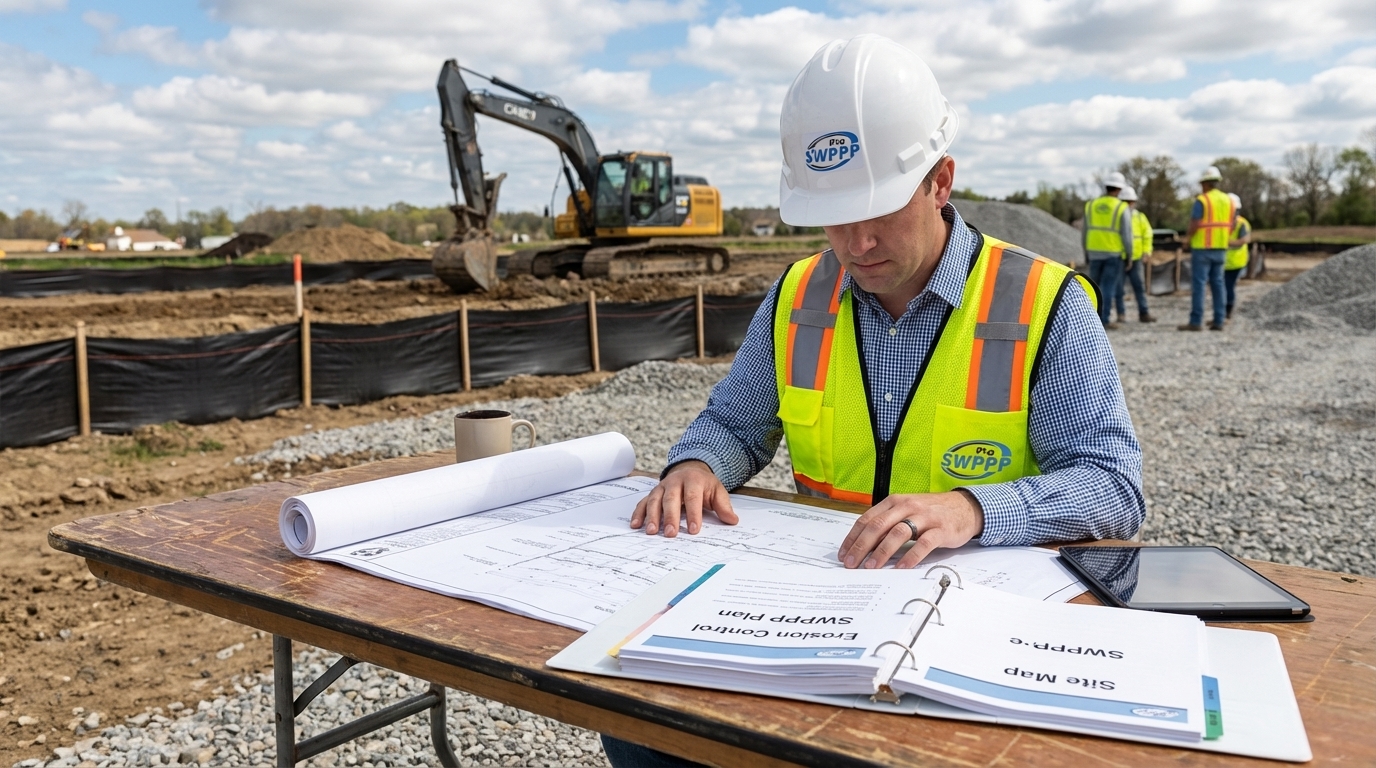
Start with the EPA CGP template. Add site maps showing jurisdictional waters. List erosion control BMPs like silt fence, stabilized construction entrances, and temporary seeding. Describe sediment controls like sediment basins sized for the two-year, 24-hour storm event. Include inspection schedules and maintenance procedures.
For USACE, add stream-crossing designs, show how you’ll avoid broken concrete fill unless justified, and attach mitigation plans if you’re losing wetlands. If your project is phased, demonstrate it’s a single and complete project under USACE rules.
Step 4: Submit Your Pre-Construction Notification
If your impacts trigger PCN, bundle your SWPPP, site plans, Endangered Species Act coordination docs, and National Historic Preservation Act compliance letters. Send everything to your district engineer at least 45 days before you start. Some districts offer joint application processes with state agencies to save time.
Step 5: Get Written Verification
Wait for your district engineer to issue written authorization or confirm you’re covered under the Nationwide Permit. Never assume you’re good to go without written proof.
Step 6: Maintain and Inspect
NWP General Condition 14 requires you to keep your BMPs working. Inspect after every rain event and weekly. Fix any failures immediately. Update your SWPPP whenever site conditions change.
Common Mistakes That Trigger USACE Enforcement
Mistake 1: Skipping PCN
Contractors assume small wetland fills don’t need notification. Wrong. The 2026 rules lowered the threshold to 0.1 acres. Miss that and you’re working without authorization, which means fines and restoration orders.
Mistake 2: Using Broken Concrete as Fill
USACE allows clean concrete fill in limited cases, but broken concrete without proper justification and PCN violates most Nationwide Permits. Document your material sources and get advance approval.
Mistake 3: Ignoring Stream-Crossing BMPs
Your crew builds a culvert that’s too narrow or at the wrong slope. USACE sees it during inspection and issues a cease-and-desist. Suddenly you’re ripping out the crossing and starting over. Follow the 1.2x bankfull width rule from the start.
Mistake 4: Treating SWPPP and USACE Permits Separately
Your SWPPP and PCN should tell the same story. If your SWPPP says you’ll avoid wetlands but your site plan shows fill in a wetland, USACE will catch it and delay your permit.
Not sure what your project needs? Take our SWPPP Quiz or Schedule a Free SWPPP Consultation with CPESC Certified SWPPP Expert Derek E. Chinners.
Why Pro SWPPP Makes USACE Compliance Easy
Pro SWPPP handles USACE projects across the country. We know every district’s quirks, from Galveston’s wetland mitigation ratios to New England’s tidal vegetation thresholds. Our team writes SWPPPs that pass EPA and Corps review on the first submission, so you don’t waste weeks in back-and-forth revisions.
We also coordinate your PCN package. That means your SWPPP, site maps, ESA letters, and NHPA compliance docs all match and tell a clear story. District engineers love clear documentation because it speeds up their review. Faster review means you start work sooner.
Our CPESC-certified experts stay current on every regulatory change. When the 2026 Nationwide Permits dropped new PCN triggers, we updated our templates the same day. When a district adds a Regional Condition, we know before most contractors even hear about it. You get that expertise baked into every SWPPP we write.
Learn about our team and process to see why contractors trust us with their most complex projects.
Real-World Example: Texas Commercial Development
A developer in Fort Worth planned a retail center on a 10-acre site. The site had a quarter-acre wetland and a small tributary stream. Under the 2026 rules, that wetland triggered PCN and required compensatory mitigation.
The developer’s first consultant wrote a basic SWPPP that covered erosion control but didn’t address USACE requirements. The district office rejected the PCN because the SWPPP didn’t show how stream-crossing BMPs met the width standard and didn’t include a mitigation plan.
Pro SWPPP rewrote the SWPPP in 48 hours. We sized the stream crossing to 1.2x bankfull width with proper shoulders, detailed sediment basin capacity, and attached a mitigation plan showing purchase of wetland credits from an approved mitigation bank. The district approved the PCN in three weeks, and the project broke ground on schedule.
How to Prepare for 2026 and Beyond
The trend is clear: USACE and EPA are tightening coordination. Digital tools like the EPA’s 2022 CGP SWPPP template in docx format make it easier to build compliant plans, but they don’t replace site-specific expertise. Climate-resilient designs are becoming standard, with sediment basins and stabilization practices designed for bigger storms.
If you’re planning work near water in 2026, start early. Get your jurisdictional determination done before you finalize site plans. Hire a CPESC-certified professional to write your SWPPP and coordinate your PCN. Budget time for district review, especially if your project involves sensitive resources like endangered species habitat or historic sites.
The payoff is huge. Projects with solid SWPPPs and clean PCNs move fast. Projects with missing or sloppy docs sit in review for months, burn cash, and sometimes get denied outright. The choice is yours.
If you have questions or need help right now, reach out to our team. We answer fast and give you a clear path forward.
Common Questions
Does every construction project need USACE approval?
No. USACE jurisdiction only applies if your work impacts waters of the United States, like wetlands, streams, or other jurisdictional waters. If your site has no jurisdictional waters, you only need your EPA or state SWPPP and CGP coverage. A jurisdictional determination from USACE or a qualified consultant tells you for sure.
What happens if I start work before getting USACE authorization?
USACE can issue a cease-and-desist order, require you to restore the site at your expense, and fine you up to tens of thousands of dollars per day. Criminal penalties are possible for willful violations. Always get written authorization before you disturb any jurisdictional water.
Can I use the same SWPPP for EPA and USACE requirements?
Yes, but you must add USACE-specific details like stream-crossing designs, wetland mitigation plans, and proof that your BMPs meet Corps standards. A basic EPA SWPPP won’t pass USACE review on its own.
How long does USACE PCN review take?
USACE has 45 days to review your PCN, but many districts finish faster if your package is complete and clear. Incomplete submittals restart the clock. Hiring a pro to prepare your PCN package can cut weeks off your timeline.
Do I need a SWPPP if my project is under one acre?
It depends on your state. Some states require SWPPPs for projects under one acre if they’re part of a larger common plan of development or if they discharge to impaired waters. USACE requirements are separate and based on impact acreage to jurisdictional waters, not total site size.
What is compensatory mitigation and when do I need it?
Compensatory mitigation offsets unavoidable wetland or stream losses. Under 2026 NWPs, you typically need mitigation if you permanently impact more than one-tenth acre of wetlands. Mitigation can be purchasing credits from a mitigation bank, permittee-responsible mitigation, or in-lieu fee programs.
Ready to keep your project on track and compliant with both EPA and USACE requirements? Trust Pro SWPPP – America’s #1 SWPPP Service to deliver fast, accurate SWPPPs and PCN packages that pass review the first time. Get started today.