Pro SWPPP – America’s #1 SWPPP Service – helps contractors stay compliant with Vermont’s strict stormwater rules every year. If you’re building or operating an industrial site in the Green Mountain State, you need to understand the Stormwater Pollution Prevention Plan (SWPPP) requirements. Vermont has some of the tightest stormwater controls in the country. This guide walks you through everything you need to know about construction and industrial SWPPP requirements in Vermont, from permit triggers to inspections to filing deadlines. We’ll show you how to stay on the right side of the law and avoid costly fines.

SWPPP Requirements in Vermont: What You Need to Know
Vermont requires a SWPPP for two main types of projects: construction sites that disturb one or more acres of land, and industrial facilities that have outdoor activities or materials exposed to rain and runoff. These plans are legally binding documents. They spell out how you will keep sediment, chemicals, and other pollutants from washing into rivers, streams, and lakes.
Vermont’s rules are stricter than the federal baseline in several ways. The state lowered the threshold for post-construction stormwater permits from one acre to half an acre of new impervious surface in July 2022. Vermont also requires that your SWPPP be prepared by a licensed professional engineer or a state-certified Site Technician. Many states do not have that credential requirement.
Construction inspections must happen weekly and after every storm that drops half an inch of rain or more. Industrial facilities must conduct monthly site inspections, quarterly visual monitoring of stormwater discharge, and a comprehensive annual review. All of this gets documented and reported to the Vermont Department of Environmental Conservation (DEC). If you skip inspections or fail to update your SWPPP, you can face stop-work orders, fines, and even criminal charges in severe cases.
Pro SWPPP takes the paperwork burden off your plate. We handle SWPPP preparation, inspector certifications, and annual reports so you can focus on the work. Our team is CPESC certified and has 20+ years of experience nationwide. We know Vermont’s rules inside and out.
Vermont Stormwater Regulatory Framework
Who Regulates Stormwater in Vermont?
The Vermont Department of Environmental Conservation (DEC), under the Agency of Natural Resources, runs the stormwater program. DEC’s Watershed Management Division issues all construction and industrial stormwater permits. Vermont has delegated authority from the U.S. Environmental Protection Agency (EPA) to administer the National Pollutant Discharge Elimination System (NPDES) program. That means Vermont writes and enforces its own permits instead of using EPA’s federal forms.
Vermont’s stormwater authority comes from 10 V.S.A. § 1264, which directs the Agency of Natural Resources to develop stormwater permit programs that meet the federal Clean Water Act and state water quality standards. DEC issues general permits for construction and industrial activities, plus individual permits for higher-risk projects.
Vermont’s General Permits
Vermont uses three main stormwater permit types:
- Construction General Permit (CGP 3-9020): Covers construction sites disturbing one or more acres of land or smaller sites that are part of a larger common plan.
- Multi-Sector General Permit (MSGP): Covers industrial facilities with outdoor activities or materials exposed to stormwater, based on Standard Industrial Classification (SIC) codes.
- Operational Stormwater Discharge Permits: Cover post-construction stormwater systems for developments with half an acre or more of impervious surface.
The state also issues permits for municipal separate storm sewer systems (MS4s) and municipal roads, but those are outside the scope of most construction and industrial projects.
Relationship to Federal EPA Rules
Vermont’s permits meet or exceed federal EPA requirements. The state has added extra layers of protection, especially around impaired waters and inspector qualifications. When federal and state rules conflict, the stricter state rule applies. EPA’s guidance documents (available at www.epa.gov/npdes/stormwater) provide background, but you must follow Vermont’s specific permit language and DEC manuals.
Construction General Permit (CGP) in Vermont
Who Needs a CGP?
You need Vermont’s Construction General Permit if your project will disturb one or more acres of land. You also need coverage if your project is smaller than one acre but is part of a common plan of development or sale that will collectively disturb one or more acres. A common plan includes phased subdivisions, multi-parcel developments, and linear projects like roads or pipelines.
Vermont categorizes projects by risk level:
- Low Risk: Standard coverage under the CGP with basic erosion and sediment controls.
- Moderate Risk: CGP coverage with enhanced controls and more frequent inspections.
- High Risk: Individual permit required. This applies to projects that disturb more than five acres at once, cannot meet the 14-day stabilization deadline, or discharge to impaired waters without adequate treatment.
Risk level depends on factors like soil type, slope, proximity to streams, and whether you’re discharging to waters on Vermont’s 303(d) impaired list.
How to Apply: Notice of Intent (NOI) Process
You must submit a Notice of Intent (NOI) to DEC and receive written approval before you begin any land disturbance. Vermont recommends submitting your NOI at least 14 days before your planned start date to allow time for review. No dirt moves until DEC sends you permit authorization.
The NOI must include:
- Project location, total disturbance area, and maximum area disturbed at one time.
- Receiving water body and whether it is listed as impaired for stormwater or sediment.
- Name and contact for the operator responsible for permit compliance.
- Confirmation that an Erosion Prevention and Sediment Control (EPSC) plan meeting Vermont standards has been prepared by a licensed professional.
- Applicable permit fees.
DEC prefers NOI submissions through its eDEC online permitting system. You can also submit paper forms for certain permit types, but electronic filing is faster and easier to track.
EPSC Plan Requirements
Your EPSC plan is your SWPPP for construction. Vermont’s 2019 Standards and Specifications for Erosion Prevention and Sediment Control spell out exactly what must be in the plan. The plan must be prepared by or under the direction of a licensed professional engineer, Certified Professional in Erosion and Sediment Control (CPESC), or Vermont Licensed Site Technician (LST).
The EPSC plan must include:
- Detailed project description, construction sequence, and timing.
- Map of existing conditions, including topography, soils, vegetation, and drainage patterns.
- Location of all sediment control devices, erosion control measures, and stormwater discharge points.
- Pollution prevention measures for materials, waste, and equipment storage.
- Stabilization schedule showing when each area will be seeded, mulched, or paved.
All erosion and sediment control devices must be installed and stabilized before you start primary earth disturbance. Vermont inspectors will check this before you break ground.

Industrial Stormwater Permits in Vermont
Who Needs an Industrial MSGP?
If you operate a facility with outdoor industrial activities or materials exposed to rain and runoff, you probably need Vermont’s Multi-Sector General Permit. Coverage is based on your facility’s SIC code. DEC maintains a list of covered industries, including manufacturing plants, quarries, scrap yards, chemical storage, lumber yards, and certain truck terminals.
Private and municipal facilities can both require MSGP coverage. If all your materials and activities are under roof or under cover and never contact stormwater, you may qualify for a “no exposure” exclusion. You must certify the no-exposure condition and submit a form to DEC.
How to Apply for Industrial MSGP
You must submit a Notice of Intent (NOI) to DEC for new facilities or unpermitted existing facilities. The NOI form asks for:
- Facility location, SIC code, and contact information.
- Identification of all stormwater discharge points (outfalls).
- Receiving water body and impaired-waters determination.
- Confirmation that a SWPPP will be implemented at the facility.
- Permit application fee (often around $680 for industrial facilities).
DEC provides a SWPPP template and instruction booklet to guide you through preparing your plan. Once your NOI is approved, you must keep your SWPPP on-site and send a copy to DEC.
Industrial SWPPP Content
Your industrial SWPPP must identify all potential pollutant sources and describe the best management practices (BMPs) you will use to control them. Key sections include:
- Good Housekeeping: Procedures for material storage, spill response, waste management, and equipment maintenance.
- Erosion and Sediment Control: Measures for any exposed soils, stockpiles, or disturbed areas on-site.
- Runoff Management: Diversion ditches, infiltration areas, detention ponds, or treatment devices to capture and treat stormwater before discharge.
- Inspection and Monitoring: Schedule for monthly site inspections, quarterly visual assessments, and annual comprehensive reviews.
- Training: Employee training plan covering spill prevention, BMP operation, and permit requirements.
DEC requires quarterly visual inspections of stormwater discharge from each outfall. You collect a sample in a clear jar within the first 30 to 60 minutes of discharge and record observations on a standard form. If you see oil sheen, discoloration, foam, or other signs of pollution, you must investigate and take corrective action.
Pro SWPPP prepares industrial SWPPPs for facilities across Vermont. We handle the templates, inspection schedules, and annual reporting so you stay compliant without the headache. Order your SWPPP now with Pro SWPPP Professional CPESC Certified SWPPP Services.
Required BMPs for Vermont Construction Sites
Erosion Control BMPs
Erosion control keeps soil from moving in the first place. Vermont requires erosion control measures to be installed before you disturb the ground. Common erosion control BMPs include:
- Stabilization: Temporary seeding, mulch, erosion control blankets, or hydroseed applied to exposed soil within the time limits set by your permit (often 7 to 14 days).
- Diversion: Dikes, berms, and swales that redirect runoff away from unstable slopes and erodible areas.
- Velocity Reduction: Check dams, rock riprap, or turf reinforcement mats that slow water and prevent gully formation.
- Minimizing Disturbance: Phasing construction so only small areas are open at any one time.
Vermont’s 2019 EPSC Standards specify stabilization deadlines based on the time of year and weather conditions. During the growing season, you generally must stabilize exposed soil within 7 days if no work is planned. In winter or dormant periods, deadlines may be extended, but you must still protect the site from erosion and track off.
Sediment Control BMPs
Sediment control traps soil that does erode before it leaves the site. Vermont requires perimeter sediment controls at all down-slope edges and around storm drains. Common sediment control BMPs include:
- Silt Fence: Fabric barrier staked into the ground to filter runoff and trap sediment. Must be properly entrenched and supported.
- Sediment Traps and Basins: Excavated ponds that allow sediment to settle out before water discharges off-site. Required for larger drainage areas.
- Check Dams: Stone or log barriers placed in ditches to slow flow and capture sediment.
- Inlet Protection: Devices around storm drain inlets to prevent sediment from entering the drainage system.
- Construction Entrance: Rock pad or wash rack that prevents mud from being tracked onto public roads.
All sediment controls must be inspected regularly and maintained. If a silt fence is torn or buried, if a basin fills with sediment, or if a check dam washes out, you must repair or replace it immediately.
Pollution Prevention BMPs
Vermont also requires measures to prevent non-sediment pollutants from reaching stormwater. These include:
- Material Storage: Keep construction materials, chemicals, and fuels under cover or in secondary containment.
- Waste Management: Properly dispose of concrete wash water, saw-cut slurry, and other construction waste. Never dump into storm drains or streams.
- Vehicle and Equipment Maintenance: Conduct fueling and maintenance in designated areas with spill kits available. Clean up leaks immediately.
- Concrete and Masonry: Designate washout areas away from storm drains. Line washout pits or use portable containers.
Pro SWPPP’s plans include detailed BMP selection and placement maps tailored to Vermont’s standards. We make sure your site is compliant from day one.
SWPPP Inspection Requirements in Vermont
Construction Site Inspections
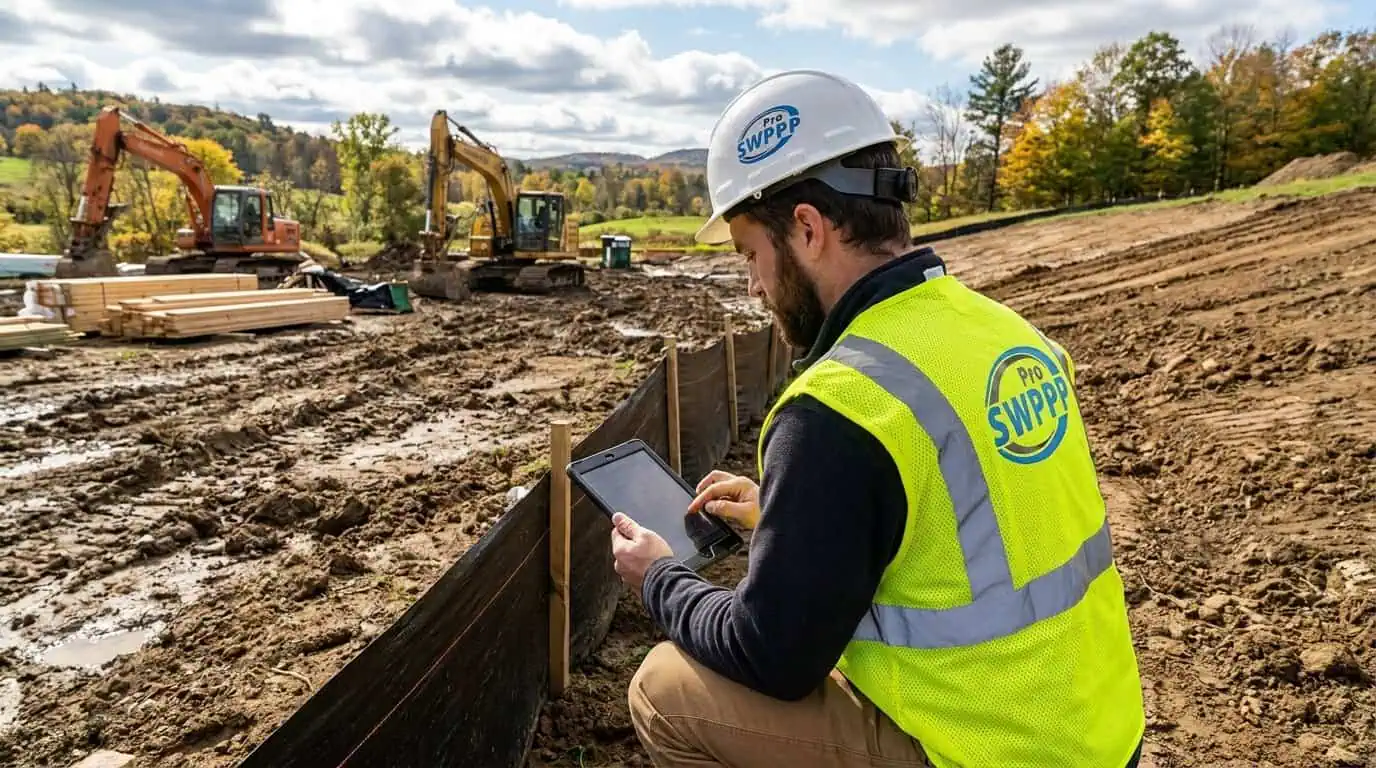
Vermont requires construction site inspections more often than most states. Your inspector must walk the entire site at least once every seven calendar days during active construction. You must also inspect within 24 hours after any storm event that produces half an inch or more of rain in 24 hours.
Inspections must be conducted by or under the supervision of a Vermont Licensed Site Technician (LST) or a professional engineer (PE). This credential requirement is unique to Vermont and a few other states. The LST program ensures that inspectors understand state-specific erosion control standards and can spot problems before they turn into violations.
During winter or frozen conditions, DEC may allow reduced inspection frequency. If your site is temporarily stabilized with no active work, inspections can drop to monthly. You must document the reason for any reduced schedule in your SWPPP.
What Inspectors Look For
Each inspection must cover:
- Condition of all erosion and sediment control devices.
- Evidence of sediment leaving the site or entering storm drains.
- Compliance with stabilization deadlines.
- Proper storage and handling of materials and waste.
- Any necessary maintenance or repairs.
Inspection reports must be signed, dated, and kept on-site with your SWPPP. If an inspector finds a problem, you must take corrective action immediately and document what you did.
Industrial Facility Inspections
Industrial facilities under the MSGP must conduct three types of inspections:
- Monthly Site Inspections: Walk all areas where industrial materials or activities are exposed to stormwater. Check that BMPs are in place and working. Document deficiencies and corrective actions.
- Quarterly Visual Monitoring: Collect a stormwater sample in a clear jar from each outfall during the first 30 to 60 minutes of discharge. Record color, odor, clarity, foam, oil sheen, and any other observations on DEC’s standard form.
- Annual Comprehensive Inspection: A thorough review of the entire facility for SWPPP compliance, preferably conducted during or immediately after a rain event.
All inspection records must be kept on-site and included in your annual report to DEC. Pro SWPPP offers inspection services and report preparation so you never miss a deadline. Contact us to learn more.
Enforcement and Penalties in Vermont
What Happens When You Violate a Permit?
Vermont DEC takes stormwater violations seriously. If an inspector finds that you’re operating without permit coverage, have failed to install required controls, or are discharging sediment-laden water off-site, DEC can issue a notice of violation (NOV). The NOV will list the violations and require corrective action within a specified deadline, often 24 to 48 hours for active discharges.
If you don’t fix the problem, DEC can escalate to an administrative order, which may include civil penalties and a requirement to hire a third-party consultant. In severe cases, DEC can issue a stop-work order that shuts down your entire project until you come into compliance.
Fine Ranges and Penalty Structure
Vermont’s enforcement authority comes from Title 10 of the Vermont Statutes. Civil penalties for stormwater violations can reach thousands of dollars per day per violation. The exact amount depends on the severity of the discharge, whether the violation was willful or negligent, the environmental harm caused, and your history of compliance.
Criminal penalties can apply if DEC determines that you knowingly discharged pollutants without a permit or falsified inspection records. Criminal fines and even jail time are possible for the most serious cases.
DEC does not publish a consolidated list of recent enforcement actions in the search results, but the agency’s annual reports and press releases occasionally highlight major cases. The best way to avoid penalties is to stay compliant from the start. Pro SWPPP’s services ensure your SWPPP is accurate, your inspections are timely, and your documentation is complete.
Stop-Work Orders and Project Delays
A stop-work order can cost you far more than any fine. Every day your crew sits idle, you’re burning money on equipment rentals, labor, and missed deadlines. Getting back to work requires proving to DEC that you’ve corrected all violations and implemented additional measures to prevent future problems. That can take days or weeks.
Pro SWPPP helps you avoid stop-work orders by ensuring your SWPPP is complete and your BMPs are properly designed before you break ground. We also provide rapid response if DEC issues a notice of violation, so you can get back on track fast.
How to File Your NOI in Vermont
Step-by-Step NOI Filing Process
Filing your Notice of Intent is the first official step to getting permit coverage. Here’s how to do it for construction projects:
- Step 1: Prepare your EPSC plan according to Vermont’s 2019 Standards and Specifications. Have a licensed PE, CPESC, or LST review and sign the plan.
- Step 2: Determine your project’s risk category (low, moderate, or high). Check whether your receiving water is on Vermont’s 303(d) impaired list or Part D Priority Surface Waters list.
- Step 3: Gather all required information: site location, total disturbance area, maximum concurrent disturbance, receiving water, operator contact, and EPSC plan certification.
- Step 4: Log in to DEC’s eDEC online permitting system. Create an account if you don’t already have one.
- Step 5: Complete the NOI form online. Upload your EPSC plan and any supporting documents. Pay the permit fee by credit card or electronic check.
- Step 6: Submit the NOI. DEC recommends doing this at least 14 days before your planned start date.
- Step 7: Wait for DEC to review your NOI and issue written permit authorization. Do not begin construction until you receive this authorization.
For industrial facilities, the process is similar. You complete an MSGP NOI form, attach your SWPPP or a summary, and pay the applicable fee. DEC will review and issue coverage if everything is complete.
Using eDEC and ANRonline
Vermont’s eDEC system is the preferred portal for submitting NOIs and permit applications. It allows you to upload documents, track your application status, and receive permit authorization electronically. Once your permit is active, you’ll use ANRonline to submit annual reports and inspection forms.
ANRonline is DEC’s electronic reporting system. All industrial MSGP annual reports and operational stormwater permit inspection reports must be submitted through ANRonline. The system generates a compliance record and provides automated reminders for upcoming deadlines. If you’re not comfortable with online portals, Pro SWPPP can handle the filing for you.
Timelines and Deadlines
Construction permit coverage: Submit your NOI at least 14 days before construction. DEC’s review typically takes 7 to 14 business days, but complex or high-risk projects may take longer. Plan ahead to avoid delays.
Industrial permit coverage: New facilities should submit an NOI as soon as operations begin or as soon as you know industrial materials will be exposed to stormwater. DEC will review and issue coverage, usually within a few weeks.
Annual reports: Industrial MSGP annual reports are due by February 15 each year, covering the previous calendar year. Operational stormwater permit annual inspections must be conducted between snowmelt and June 15, with reports submitted via ANRonline by July 15 (or July 30 for municipal utilities).
Not sure what your project needs? Schedule a Free SWPPP Consultation with CPESC Certified SWPPP Expert Derek E. Chinners.

Why Pro SWPPP is Vermont’s Best SWPPP Service
CPESC Certified and 20+ Years of Experience
Pro SWPPP is led by CPESC-certified professionals with 20+ years of stormwater compliance experience. We’ve prepared SWPPPs for construction and industrial sites nationwide, including Vermont. We know the state’s 2019 EPSC Standards inside and out. We know what DEC inspectors look for and how to design BMPs that work in Vermont’s climate and terrain.
Our team includes licensed engineers and trained site technicians who can stamp and certify your plans. We stay current on every rule change, guidance update, and enforcement trend so you don’t have to.
72-Hour Turnaround
Speed matters when you’re trying to start a project. Pro SWPPP delivers complete, permit-ready SWPPPs in 72 hours or less. We don’t cut corners. We just know how to work efficiently. Our streamlined process and deep experience mean we can produce high-quality plans fast.
If you need a rush plan for an urgent project, we can often deliver even faster. Just ask.
Full-Service Support
Pro SWPPP doesn’t just hand you a binder and walk away. We provide:
- Custom SWPPP preparation tailored to your site and Vermont’s standards.
- NOI filing assistance and eDEC portal support.
- Inspector training and on-site inspection services by Licensed Site Technicians.
- SWPPP updates and amendments when your project changes.
- Annual reporting and ANRonline submissions for industrial facilities.
- Rapid response if DEC issues a notice of violation or requests additional information.
We’re your stormwater compliance partner from permit application to final stabilization. Visit our about page to learn more about our team and services.
Trusted Across America
Pro SWPPP has helped contractors, developers, and industrial operators in states from Texas to Georgia to Vermont. Our clients range from small site contractors to Fortune 500 companies. We’ve handled projects as small as one-acre residential subdivisions and as large as multi-hundred-acre industrial complexes.
Thousands of projects trust Pro SWPPP because we deliver quality, speed, and peace of mind. We take the stress out of stormwater compliance so you can focus on building.
FAQ
Do I need a SWPPP for a project smaller than one acre in Vermont?
You need a SWPPP and Construction General Permit if your project disturbs one or more acres, or if it’s part of a common plan of development that will disturb one or more acres total. If your small project is standalone and under one acre, you generally do not need a CGP. However, if you’re adding impervious surface (pavement, roofs, etc.), you may need an operational stormwater discharge permit if the total new impervious area is half an acre or more. Always check with DEC if you’re unsure.
Who can prepare a SWPPP in Vermont?
Vermont requires that your EPSC plan (construction SWPPP) be prepared by or under the direction of a licensed professional engineer (PE), a Certified Professional in Erosion and Sediment Control (CPESC), a Certified Inspector of Erosion and Sediment Control (CIESC), or a Vermont Licensed Site Technician (LST). Industrial SWPPPs do not have the same licensing requirement, but it’s still smart to have a qualified professional prepare your plan to ensure it meets DEC standards.
How often do I need to inspect my construction site in Vermont?
You must inspect your construction site at least once every seven calendar days during active construction, and within 24 hours after any storm event that produces half an inch or more of rain in 24 hours. Inspections must be conducted by or under the supervision of a Licensed Site Technician or PE. If your site is temporarily stabilized with no active work, inspections can be reduced to monthly, but you must document the justification in your SWPPP.
What happens if I start construction before my NOI is approved?
Starting construction before you receive written permit authorization from DEC is a violation. You can face a notice of violation, civil penalties, and a stop-work order. DEC takes unpermitted construction seriously. Always wait for your permit authorization letter before you move any dirt.
Do industrial facilities need annual stormwater reports in Vermont?
Yes. Facilities covered under Vermont’s Multi-Sector General Permit must submit an annual report by February 15 each year. The report summarizes your monthly inspections, quarterly visual monitoring results, any benchmark exceedances, and corrective actions taken. You submit the report through DEC’s ANRonline system. If you had no inspections, monitoring, or corrective actions, you can submit a certification of full compliance instead.
Can Pro SWPPP handle my Vermont industrial SWPPP and annual reporting?
Absolutely. Pro SWPPP prepares industrial SWPPPs, conducts site inspections, performs quarterly visual monitoring, and files annual reports via ANRonline. We take the entire compliance burden off your plate so you can focus on running your facility. Our CPESC-certified team knows Vermont’s MSGP inside and out. Order your SWPPP now or schedule a free consultation to get started.
What are Vermont’s stabilization deadlines for construction sites?
During the growing season, exposed soil must be stabilized within seven days if no further work is planned in that area. Final stabilization must be achieved within 14 days of reaching final grade, or immediately if the site will be idle for more than 14 days. In winter or dormant periods, deadlines may be extended, but you must still protect the site from erosion and track-off. Your EPSC plan and permit will specify exact stabilization timelines based on your project’s risk level and time of year.
Ready to get started? Order your SWPPP now or schedule a free consultation with Pro SWPPP.
Visit Pro SWPPP and see why thousands of contractors trust America’s #1 SWPPP Service.