If you’re planning a self-storage build, you need to know whether a SWPPP (Stormwater Pollution Prevention Plan) is required before you break ground. The short answer: yes, almost always. Pro SWPPP – America’s #1 SWPPP Service has prepared SWPPPs for self-storage contractors nationwide, and we’ve seen every scenario. Here’s what you need to know to stay compliant, avoid fines, and keep your project on track.
This guide walks you through the federal rules, state differences, real costs, and the exact steps to get permit coverage. By the end, you’ll know exactly when you need a SWPPP, how to get one fast, and why cutting corners isn’t worth the risk.
Not sure whether your build crosses the threshold? Take the 60-second SWPPP quiz and find out before you break ground.
Does My Self-Storage Build Need a SWPPP?
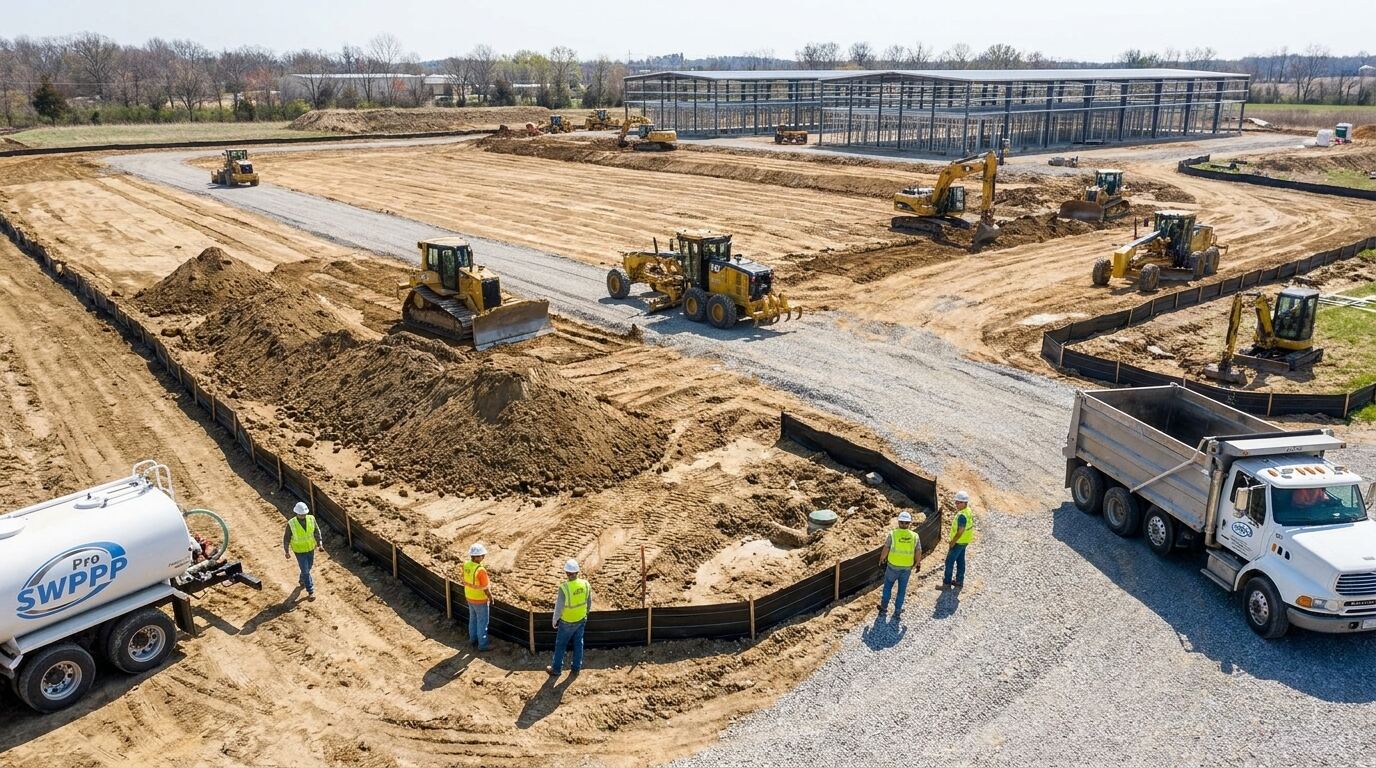
Here’s the rule that applies everywhere in the United States. If your construction project disturbs 1 acre or more of land, you need a SWPPP and a stormwater construction permit. Period.
That 1-acre threshold isn’t just the building footprint. It’s the total disturbed area, including grading, paving, utility trenches, stormwater basins, parking lots, and any off-site work required by the project. For most self-storage builds, you’re going to hit that 1-acre mark easily.
But there’s a second trigger that catches a lot of contractors off guard: the “common plan of development” rule. Even if your self-storage lot disturbs less than 1 acre, if it’s part of a larger commercial park or subdivision that will disturb 1 acre or more total, you still need a SWPPP. This is the Clean Water Act rule enforced by the EPA and every state environmental agency. Miss it, and you’re operating illegally from day one.
What Counts as “Disturbed Area”?
Disturbed area means any place where you clear, grade, excavate, or stockpile. For a typical self-storage project, that includes:
- Building pads and foundations
- Drive aisles and parking areas
- Stormwater detention basins
- Utility trenching (water, sewer, electric, storm drains)
- Staging areas for equipment and materials
- Any off-site improvements (road widening, sidewalks, etc.)
Add it all up, and most self-storage sites land well above 1 acre. Even a modest 30,000-square-foot facility on 2 acres of land will often disturb 1.5 to 2 acres once you account for grading and drainage work.
The Common Plan Trap
Let’s say you’re building on a 0.8-acre pad in a new commercial park. The park has five other pads, and together they’ll disturb 4 acres. Your project alone is under 1 acre, but because it’s part of a “common plan of development,” you need a SWPPP. This rule trips up a lot of contractors who buy shovel-ready pads and assume the developer handled everything. They didn’t. You’re responsible for your own permit coverage.
Pro SWPPP helps contractors identify these situations during the pre-construction phase. We review site plans, subdivision plats, and master drainage plans to catch common-plan issues before they become violations.
Don’t want to mess with all the paperwork? Order your SWPPP now with Pro SWPPP Professional CPESC Certified SWPPP Services.
Who Enforces Stormwater Rules for Construction?
Stormwater construction permits are issued under the federal Clean Water Act’s National Pollutant Discharge Elimination System (NPDES) program. But here’s where it gets tricky: most of the time, your state runs the program, not the EPA.
The EPA directly issues construction stormwater permits in only a handful of places: Massachusetts, New Hampshire, New Mexico, the District of Columbia, most U.S. territories, and on tribal lands nationwide. In these areas, you apply for coverage under the EPA’s Construction General Permit (CGP) and file your Notice of Intent (NOI) through the EPA’s online system.
In all other states, the state environmental agency runs its own EPA-authorized NPDES program. That means each state has its own construction stormwater general permit, its own NOI process, its own fees, and often its own stricter rules.
Examples of State Programs
Here’s how it breaks down in a few major states where self-storage is booming:
- Texas: The Texas Commission on Environmental Quality (TCEQ) issues the Construction General Permit (TXR150000). You file the NOI online through TCEQ’s system and pay a permit fee.
- Georgia: The Georgia Environmental Protection Division (EPD) runs the program. They require both a state NOI and often a local erosion and sedimentation control permit from the county.
- California: The State Water Resources Control Board issues a statewide Construction General Permit. It has some of the strictest BMP requirements and inspection frequencies in the country.
The federal baseline is the same everywhere (1 acre trigger, SWPPP requirement, basic BMPs), but the details vary state to state. That’s why you need a SWPPP service that knows your state’s rules inside and out.
Pro SWPPP prepares SWPPPs in Texas, Georgia, and nationwide. We know which agency to file with, which forms to use, and how to meet state-specific requirements the first time.
What Exactly Is a SWPPP and What Goes in It?
A SWPPP is a written plan that describes how you will control stormwater pollution during construction. It’s required by both federal and state construction stormwater permits. Think of it as your blueprint for keeping mud, sediment, concrete slurry, and other pollutants out of storm drains, streams, and lakes.
For a self-storage project, the SWPPP must include:
- Site description: Location, size, soil types, existing drainage patterns, and receiving waters.
- Construction sequence: What gets disturbed when, and how long areas will stay exposed.
- Potential pollutant sources: Sediment, fuels, oils, concrete washout, trash, and chemicals.
- Best Management Practices (BMPs): Specific controls you’ll install to prevent erosion and capture sediment.
- Site maps: Showing disturbed areas, drainage flow paths, BMP locations, and stormwater outfalls.
- Inspection and maintenance plan: Who inspects, how often, and what records you keep.
- Qualified personnel: The name and contact info of the person responsible for SWPPP implementation and inspections.
The SWPPP has to be on-site and available for inspection by regulators at all times. Many states also require electronic submittal or public posting online.
Self-Storage-Specific Concerns
Self-storage sites have a few characteristics that make SWPPP planning critical. You’re creating large impervious surfaces (buildings, pavement) that generate a lot of runoff. You’re often working on flat or gently sloped sites where water can pond and carry sediment off-site. And you’re doing a lot of concrete and asphalt work, which means washout containment and spill prevention are front and center.
A good SWPPP for a self-storage build will emphasize perimeter sediment controls, inlet protection on every storm drain, stabilized construction entrances to keep mud off public roads, and proper concrete washout facilities. Pro SWPPP tailors every SWPPP to the site’s drainage, soil, and construction phasing, so you’re not paying for boilerplate that doesn’t match your actual work.
How Much Does a SWPPP Cost for a Self-Storage Project?
SWPPP costs depend on site size, complexity, and state requirements. There’s no fixed price because every project is different. But here’s the real-world range based on the self-storage projects Pro SWPPP has completed.
Want a number for your own site? Get a free SWPPP estimate.
SWPPP Preparation Fees
For a small to mid-sized self-storage build (1 to 5 acres of disturbance), SWPPP preparation typically costs $2,000 to $7,000. That includes site plan review, SWPPP document preparation, site maps, and BMP specifications.
Larger or more complex sites (5+ acres, multiple phases, sensitive receiving waters, or tough state/local review) can run $7,000 to $15,000 or more. If you’re in a high-enforcement state like California or building near a protected stream, expect the higher end of the range.
Some consultants charge hourly, others charge a flat rate. Pro SWPPP uses transparent flat-rate pricing, so you know the cost up front with no surprise invoices.
Permit Fees
The EPA’s Construction General Permit has no federal filing fee. But state programs often charge permit fees that range from a few hundred dollars to several thousand, depending on disturbed acreage and project type. For example:
- Some states charge a flat $100 to $500 NOI fee.
- Others use a sliding scale based on disturbed acres, running $1,000 to $3,000 or more for larger sites.
- A few states charge annual renewal fees if construction runs longer than one year.
These fees go to the state environmental agency, not to your SWPPP preparer. Budget for them separately.
BMP Installation and Maintenance Costs
The SWPPP tells you what BMPs to install, but you still have to buy the materials and do the work. Common BMP costs for self-storage construction include:
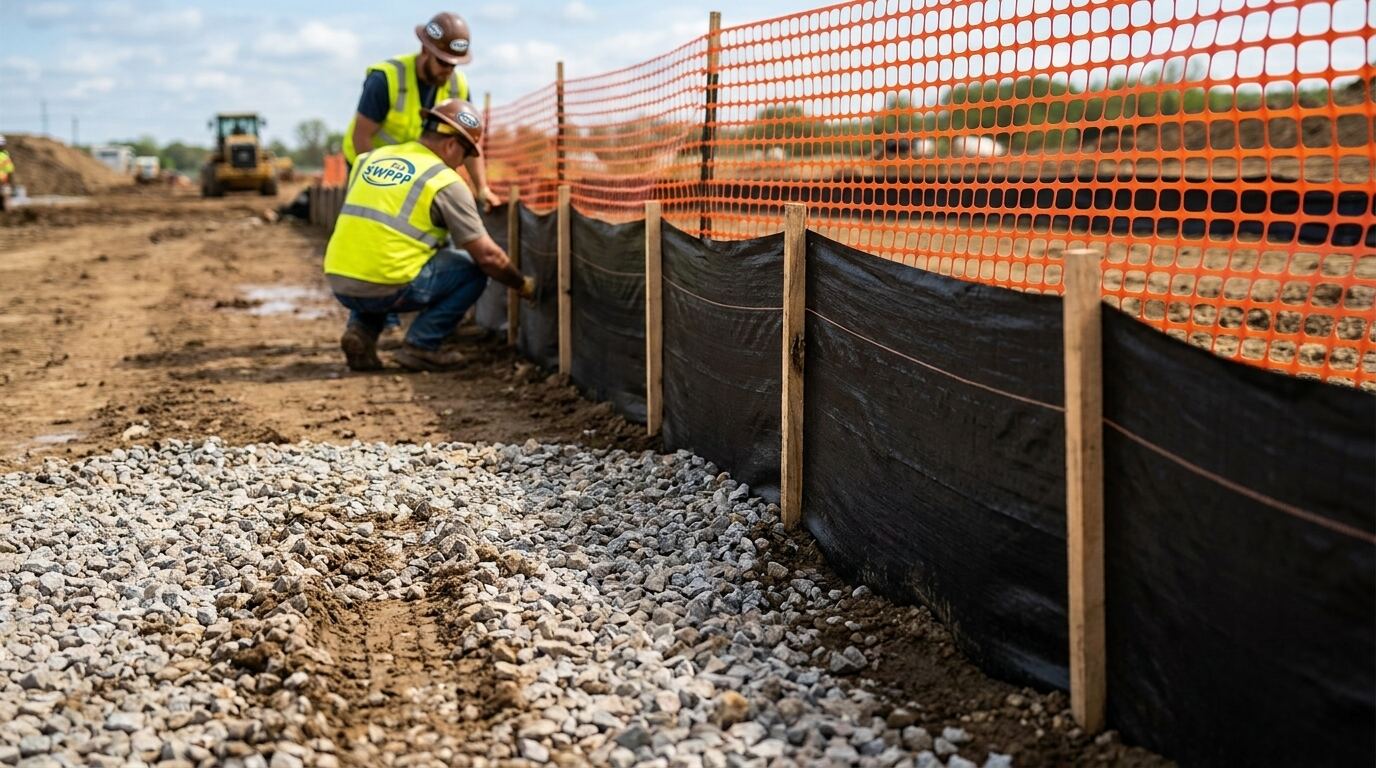
- Silt fence: $3 to $8 per linear foot installed
- Inlet protection devices: $50 to $200 each
- Stabilized construction entrance (gravel pad): $2,000 to $5,000
- Temporary seeding and mulch: $500 to $2,000 per acre
- Sediment basin or trap: $3,000 to $15,000 depending on size
Over the life of a 6- to 12-month construction project, total BMP installation and maintenance can easily add $10,000 to $50,000 to your budget, especially on larger or high-rainfall sites. But compare that to the cost of a single enforcement action (often $10,000 to $100,000+ in fines), and it’s a bargain.
Inspections
Under the 2022 EPA Construction General Permit, inspections are required at least once every seven calendar days and within 24 hours of the end of any storm event of 0.25 inches or more (or 3.25 inches of snowmelt); the 0.5-inch figure many contractors still quote came from the older 2017 permit. You can do these yourself if you have a qualified person on staff, or hire an outside inspector. Inspection costs range from $150 to $500 per visit, depending on site size and travel distance.
Pro SWPPP offers inspection services in many states, or we can train your site superintendent to handle it. Either way, you’ll have documented proof of compliance when the regulator shows up.
Not sure what your project needs? Schedule a Free SWPPP Consultation with CPESC Certified SWPPP Expert Derek E. Chinners.
The Step-by-Step Process to Get Permit Coverage
Here’s exactly what you need to do, start to finish, to legally disturb land on a self-storage construction site.
Step 1: Confirm You Need Coverage
Calculate your total disturbed area. If it’s 1 acre or more, or if you’re part of a larger common plan that totals 1+ acres, you need a stormwater construction permit and SWPPP. No exceptions.
Step 2: Determine Which Permit Applies
Find out whether you’re in an EPA-run area (Massachusetts, New Hampshire, New Mexico, DC, tribal lands, or certain territories) or a state-run program. Check the EPA’s NPDES state program list if you’re not sure.
In state-run areas, go to your state environmental agency’s website and look for the construction stormwater general permit. That’s your rulebook.
Step 3: Prepare the SWPPP
You must have a complete, site-specific SWPPP before you file your Notice of Intent (NOI). The permit does not allow you to submit a placeholder or draft. The SWPPP must meet all federal or state requirements, including site maps, BMP selection, and inspection procedures.
This is where most contractors bring in a professional. A CPESC-certified consultant like Pro SWPPP will review your grading plan, drainage study, and construction schedule, then prepare a compliant SWPPP in days, not weeks.
Step 4: File the Notice of Intent (NOI)
Once the SWPPP is complete, submit your NOI through the appropriate system:
- EPA CGP areas: File electronically via the EPA’s NPDES eReporting Tool (NeT).
- State programs: Use the state’s online portal or paper form, depending on the state.
Pay any required permit fees at the time of filing. Some states issue a permit number immediately; others take a few days to process the NOI.
Step 5: Wait for Coverage (If Required)
The EPA CGP and some state permits require a waiting period between NOI submission and the start of construction. This can range from zero days (immediate coverage upon submission) to 14 days. Check your permit for the exact rule. Do not start land disturbance until coverage is in effect.
Step 6: Install BMPs and Start Construction
Before you clear or grade, install perimeter controls (silt fence, berms), inlet protection, and your stabilized construction entrance. Keep the SWPPP on-site and make sure your crew knows where it is and what the key BMPs are.
Step 7: Inspect, Maintain, and Document
Conduct inspections at the frequency required by your permit (typically weekly and after rain events). Document every inspection in writing, note any problems, and fix them within the timeframe specified in the permit (often 24 hours to 7 days). Keep all inspection logs and corrective action records with the SWPPP.
Step 8: Update the SWPPP as Needed
If you change the construction sequence, add a new discharge point, or discover that a BMP isn’t working, update the SWPPP in writing. Most permits require SWPPP amendments within 7 to 14 days of the change.
Step 9: Achieve Final Stabilization and File the Notice of Termination (NOT)
When the site is fully stabilized (usually defined as uniform perennial vegetative cover or equivalent permanent stabilization, and all temporary BMPs removed), you file a Notice of Termination to close out the permit. Do not skip this step. An open permit can create liability even after you’ve turned the project over to the owner.
Pro SWPPP handles every step, from SWPPP prep to NOT filing, so you never have to guess what comes next.
What BMPs Do You Actually Need on a Self-Storage Site?
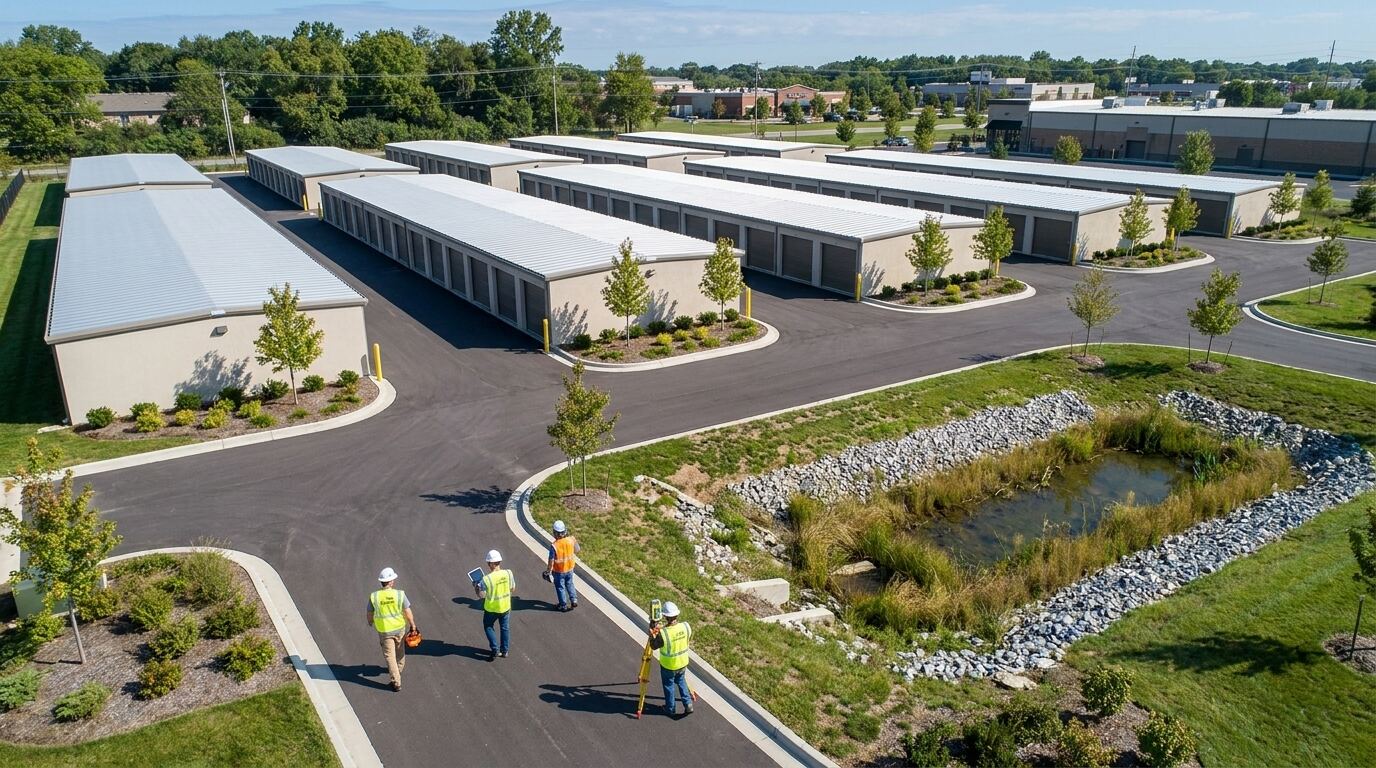
Every SWPPP is site-specific, but there are a handful of BMPs that show up on almost every self-storage construction project. Here’s what Pro SWPPP typically specifies, and why.
Perimeter Sediment Controls
Silt fence, filter berms, or sediment logs around the downslope perimeter of the site. These catch sediment-laden runoff before it leaves your property. On flat sites, you may need sediment traps or basins instead of just fence.
Stabilized Construction Entrance
A gravel pad at every point where vehicles enter or exit the site. This knocks mud off tires and prevents tracking onto public roads. Many municipalities will shut you down if you’re tracking mud into the street, even if your SWPPP is otherwise perfect.
Inlet Protection
Devices (fabric, gravel rings, or manufactured inserts) around every storm drain inlet on or near the site. Self-storage projects often have multiple inlets because of the large paved areas. Protect every single one.
Concrete Washout Facility
A designated area, usually a portable containment bin or lined pit, for cleaning concrete trucks and tools. Concrete slurry has a very high pH and is toxic to aquatic life. Never wash it into a storm drain or onto the ground. Most permits explicitly require a washout facility for any project using concrete.
Dust Control
Watering or chemical stabilizers to prevent dust from leaving the site. Dust isn’t just a nuisance; sediment-laden dust that washes off nearby roads or properties during a rainstorm counts as a stormwater violation.
Temporary and Permanent Seeding
Any area that will be inactive for more than 14 days (the exact threshold varies by state) must be temporarily seeded, mulched, or covered. At final stabilization, permanent seeding or sod is required unless the area is paved or covered by buildings.
Good Housekeeping
Proper storage and disposal of trash, scrap metal, paint, solvents, fuels, and other materials that could contaminate stormwater. Keep a spill kit on-site and train your crew to clean up small spills immediately.
These BMPs aren’t optional. They’re required by the permit, and inspectors will check for them. Installing them correctly the first time saves you from expensive corrective actions and fines later.
What Happens If You Don’t Get a SWPPP?
Skipping the SWPPP and permit process is a Clean Water Act violation from the moment you disturb the first shovel of dirt. Here’s what you’re risking.
Fines and Penalties
Federal and state environmental agencies can issue fines of up to tens of thousands of dollars per day of violation. A single rainstorm that causes a discharge without permit coverage can trigger penalties that dwarf the cost of a SWPPP. We’ve seen contractors face six-figure settlements for projects that started without an NOI.
Stop-Work Orders
If a regulator or local stormwater inspector catches you operating without a permit, they can issue a stop-work order. Your project is dead in the water until you get coverage, install BMPs, and possibly remediate any damage. That can mean weeks or months of delay, which translates directly into lost revenue on your self-storage facility.
Corrective Action Costs
If your discharge causes sedimentation in a stream, wetland, or municipal storm system, you may be required to clean it up at your expense. Sediment removal from a waterway is expensive and specialized work. You’ll also have to install the BMPs you should have had in the first place.
Reputation and Future Projects
Environmental violations are often public record. Large enforcement actions are published in agency newsletters and press releases. Lenders, bonding companies, and future clients will see that record. It can hurt your ability to bid on other projects or secure financing.
The cost of a SWPPP is a rounding error compared to the risk of an enforcement action. Don’t roll the dice.
How State Rules Differ from the Federal Baseline
The EPA sets the minimum national standard: 1-acre trigger, SWPPP requirement, basic BMP categories, and inspection protocols. But states with authorized NPDES programs can (and do) impose stricter rules.
More Frequent Inspections
Some states require inspections every 7 days and within 24 hours of a qualifying rain event, instead of the federal standard of every 14 days. California, for example, has some of the most aggressive inspection requirements in the country.
Qualified Inspector Credentials
Many states require that inspections be conducted by a “Qualified SWPPP Practitioner” (QSP) or similar credentialed professional. In California, the QSP must complete state-approved training and pass an exam. Other states accept CPESC certification or equivalent experience.
Numeric Effluent Limits
A few states impose numeric turbidity or pH limits on stormwater discharges in sensitive watersheds. If you exceed the limit, you have to take immediate corrective action and may face penalties even if your BMPs are installed correctly.
Electronic Submittal and Public Posting
Some states require that the SWPPP be uploaded to a public database or posted on the project website. This increases transparency and makes it easier for neighbors, environmental groups, and regulators to review your plan.
Stricter Stabilization Timelines
A few states require stabilization (seeding and mulching) within 7 days of final grade, instead of the federal 14-day standard. Miss that deadline, and you’re out of compliance.
Because state rules vary so much, you need a SWPPP service that knows your state’s permit inside and out. Pro SWPPP has CPESC-certified professionals working nationwide every day. We know which states are strict, which inspectors are picky, and how to write a SWPPP that passes review the first time.
Visit our About page to learn more about our team’s certifications and experience.
Why Pro SWPPP is the SWPPP Service Contractors Trust
When you need a SWPPP for a self-storage build, you have three options: try to do it yourself, hire a local engineer who does one or two SWPPPs a year, or work with a national specialist who does nothing but stormwater compliance. Pro SWPPP – America’s #1 SWPPP Service is that specialist.
CPESC Certified, 20+ Years in Stormwater Compliance
Our lead consultant, Derek E. Chinners, is a Certified Professional in Erosion and Sediment Control (CPESC), the gold standard credential in stormwater management. We are a family-owned firm with 20+ years in stormwater compliance, working nationwide and backed by 180+ five-star Google reviews.
We’re not a general engineering firm that does SWPPPs on the side. Stormwater compliance is all we do, every day. That focus means we’re faster, more accurate, and more up-to-date on regulatory changes than anyone else.
72-Hour Turnaround
Self-storage developers work on tight schedules. You can’t afford to wait three weeks for a SWPPP. Pro SWPPP delivers compliant, site-specific SWPPPs in 72 hours or less for most projects. Rush service is available when you need it even faster.
We’ve never missed a deadline. Ever.
Flat-Rate Pricing with No Surprises
We quote a flat rate up front based on your site size and complexity. No hourly billing, no change orders, no surprise invoices. You’ll know exactly what the SWPPP costs before we start.
We Handle NOI Filing and Inspections
Don’t want to figure out which state portal to use or how to fill out the NOI? We’ll do it for you. Need weekly inspections and reports? We offer that too, in most states. One phone call, and your entire stormwater compliance program is handled.
Proven Track Record with Self-Storage Builders
Pro SWPPP has prepared SWPPPs for hundreds of self-storage projects, from single-building facilities to large multi-phase developments. We understand the unique challenges: large impervious surfaces, phased construction, tight urban sites, and the need to open on time. We’ve worked with national self-storage brands, regional developers, and individual owner-operators.
Check out our work in Texas and Georgia, two of the hottest self-storage markets in the country.
Support from Start to NOT
We don’t just hand you a document and disappear. We’re available by phone and email throughout construction to answer questions, help with SWPPP amendments, and guide you through inspections. When it’s time to file the Notice of Termination, we handle that too.
Get a free SWPPP estimate anytime during your project. We respond fast.
FAQ
Do I need a SWPPP in every state?
Yes, if you disturb 1 acre or more. Every state and territory in the U.S. has a stormwater construction permit requirement, either run by the EPA or by the state environmental agency. The 1-acre threshold and SWPPP mandate apply nationwide under the Clean Water Act.
Can I write my own SWPPP?
Legally, yes. But it’s risky. SWPPPs must meet detailed technical requirements, and mistakes can lead to permit denials, fines, or failed inspections. Most contractors hire a CPESC-certified professional to prepare the SWPPP, because the cost is small compared to the risk of doing it wrong. Pro SWPPP offers affordable flat-rate pricing and 72-hour turnaround, so there’s no reason to DIY.
How long does it take to get permit coverage?
It depends on the state. In EPA CGP areas and many state programs, coverage can be effective immediately upon NOI submission, or within a few days. A few states require 7 to 14 days for review. Plan ahead and file your NOI at least two weeks before you want to start grading, just to be safe.
What happens if it rains before I install all my BMPs?
You’re in violation. The permit requires that BMPs be in place before land disturbance begins. If you disturb soil and then get caught by a rainstorm before you’ve installed silt fence and inlet protection, any discharge is unpermitted and can trigger enforcement. Always install perimeter controls, inlet protection, and stabilized entrance before clearing or grading.
Do I need a new SWPPP for each phase of a multi-phase project?
Not necessarily. If all phases are part of a single common plan of development, you can often cover them under one SWPPP and one NOI, as long as you update the SWPPP to reflect each phase’s schedule and BMPs. Check with your state agency or consultant. Pro SWPPP routinely handles multi-phase self-storage projects with a single master SWPPP and phased BMP plans.
Can I terminate the permit before final landscaping is done?
No. Most permits define final stabilization as uniform perennial vegetative cover (or equivalent permanent stabilization) over all disturbed areas not covered by pavement or buildings. If you haven’t seeded, sodded, or otherwise permanently stabilized the site, you can’t file the Notice of Termination. Attempting to close out the permit early can result in a violation if stormwater discharges continue.
What if my project is less than 1 acre but very close to a stream?
You may still have local requirements. Many cities and counties have erosion and sediment control ordinances that apply to smaller projects, especially near sensitive waters. Check with the local building or stormwater department. Even if you don’t need a state or federal permit, you might need a local permit or BMP plan.
Ready to get started? Order your SWPPP now or schedule a free consultation with Pro SWPPP.
Visit Pro SWPPP and see why contractors nationwide rate us 180+ five-star Google reviews.
By Derek E. Chinners, CPESC — Founder & Stormwater Consultant, Pro SWPPP, LLC
Related: What Is a SWPPP? · When Is a SWPPP Required? The 1-Acre Rule and Common Plans · Texas SWPPP Requirements (SWP3) · Georgia SWPPP Requirements