Pro SWPPP – America’s #1 SWPPP Service – gets one question more than almost any other: does a school or municipal building need a SWPPP? The short answer is yes, if the project disturbs one acre or more of land, or if it’s part of a larger common plan that will disturb one acre or more. This is federal law under the Clean Water Act’s NPDES program, and it applies to public projects just like it does to private construction. There is no magic exemption for schools, fire stations, libraries, or city halls. If you clear, grade, excavate, or move soil above that threshold, you need a construction stormwater permit and a written Stormwater Pollution Prevention Plan before the first shovel hits dirt.
What confuses contractors is that public owners often assume their projects are somehow different or exempt. They’re not. In fact, because schools and municipal buildings often discharge into MS4 systems, they may face even stricter local oversight and penalties. This guide walks you through exactly when a school or municipal building needs a SWPPP, who issues the permit, what the plan must contain, and how to avoid the enforcement nightmare that happens when public projects skip these steps.
Not sure whether your project crosses the threshold? Take the 60-second SWPPP quiz and find out before you bid.
When Does a School or Municipal Building Need a SWPPP?
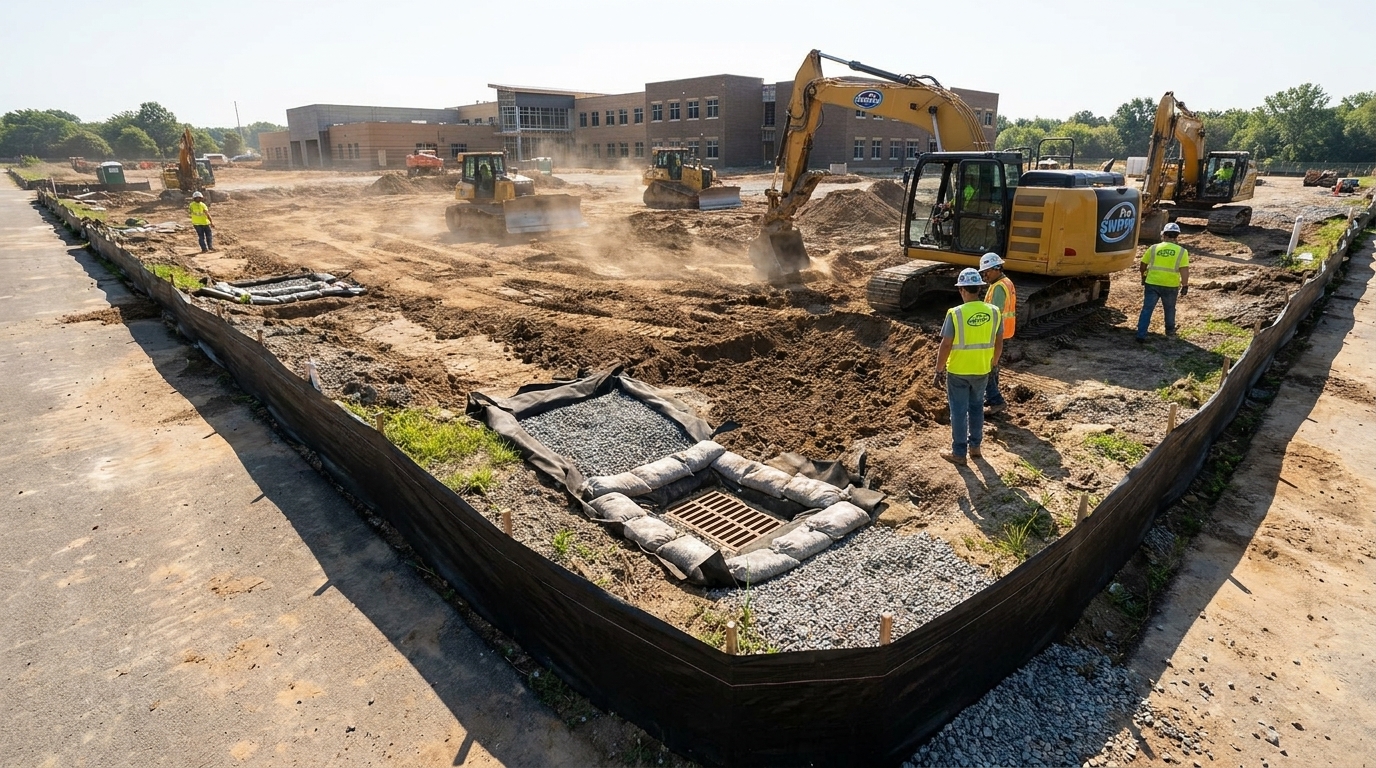
The federal trigger is simple. If your project disturbs one acre or more of land, you need NPDES construction stormwater permit coverage and a SWPPP. If it disturbs less than one acre but is part of a common plan of development that will ultimately disturb one acre or more, you still need coverage. The EPA defines construction activity as clearing, grading, excavating, and stockpiling soil. That includes everything from site prep to utility trenching to building pads to parking lot grading.
For a school or municipal building, “common plan” is the critical phrase. If you’re building a new elementary school with parking, a playground, and stormwater infrastructure as one project, you count the total disturbed area across all of it. If the city is building a fire station as phase one of a larger public works campus, the total planned disturbance across all phases determines whether you need coverage, even if phase one alone is under an acre.
There is no federal exemption for public facilities. The only broad exemptions in some state programs are for certain single-family homes, not for schools or government buildings. If anything, public projects get more scrutiny because they discharge into municipal storm sewer systems and because taxpayer-funded construction is highly visible.
The One-Acre Threshold Is a Hard Line
One acre is 43,560 square feet. That’s a square roughly 209 feet on a side. A typical elementary school building footprint plus parking and access roads easily exceeds one acre of disturbance. Even a small fire station with apparatus bay, parking, and a detention pond often crosses the line. Contractors must calculate total disturbance early in estimating, not wait until mobilization.
If you’re unsure whether your project will hit the threshold, assume it will and plan for SWPPP compliance. The cost of preparing a SWPPP and filing an NOI is far less than the cost of a stop-work order, penalties, and emergency BMP installation after the fact.
What Counts as Land Disturbance
Land disturbance includes any activity that exposes soil to stormwater runoff. This includes:
- Clearing trees and vegetation
- Grubbing stumps and roots
- Grading and excavation for building pads
- Trenching for utilities, water, sewer, and electric
- Stockpiling topsoil or fill material
- Creating staging and laydown areas
- Building access roads and parking lots
- Installing stormwater management features
Even if the building itself is small, the supporting infrastructure often pushes the project over one acre. Pro SWPPP helps contractors and public owners calculate disturbance accurately and determine permit needs before bidding or breaking ground.
Who Issues the Permit: EPA or the State?
The EPA sets the national baseline, but most states run their own EPA-authorized NPDES stormwater programs. That means the permit you need, the forms you file, and the agency you deal with depend on where your project is located. In most of the country, you’ll be working with a state environmental agency like the Texas Commission on Environmental Quality (TCEQ), the Georgia Environmental Protection Division (EPD), or the California State Water Resources Control Board.
The EPA directly issues construction stormwater permits in only a few places: Massachusetts, New Hampshire, New Mexico, the District of Columbia, most U.S. territories, certain tribal lands, and some federal facilities. If your school or municipal building is in one of those areas, you’ll file your Notice of Intent with the EPA and comply with the EPA’s 2022 Construction General Permit.
For everyone else, you’ll file with your state agency under a state-specific Construction General Permit. The state permit will incorporate the federal baseline but often adds stricter requirements for BMP installation, inspection frequency, monitoring, and documentation.
How to Find Out Which Agency Has Jurisdiction
The EPA publishes a list of authorized NPDES stormwater programs by state. You can find it on the EPA’s stormwater website. If your state is on the list, you’ll file with the state. If it’s not, or if your project is on tribal land or a federal installation, you’ll file with the EPA. Don’t guess. The wrong filing can delay your project by weeks and trigger enforcement.
Pro SWPPP tracks permit requirements nationwide and can tell you immediately which agency has jurisdiction and what portal you need to use. We prepare SWPPPs and file NOIs in EPA and state systems every day, so we know the exact process for your location.
Local Governments Layer on More Requirements
Even if your project is below the one-acre federal threshold, many cities and counties require erosion and sediment control plans or local SWPPP equivalents through their grading or building permit process. If your school or municipal building discharges into a local MS4, the municipality may impose its own inspection schedule, BMP standards, and penalties.
For example, some counties require a local stormwater management plan and erosion control approval before issuing a grading permit, regardless of whether you need state or federal NPDES coverage. Violating local rules can result in stop-work orders and fines that stack on top of state or federal penalties. Always check with the local public works or planning department early in design.
What Must Be in the SWPPP for a School or Municipal Building
A SWPPP is not a one-page form. It’s a detailed written plan that identifies who is responsible for stormwater compliance, what BMPs will be used, where they will be installed, when they will be maintained, and how the site will be stabilized at the end of construction. The EPA’s 2022 Construction General Permit and equivalent state permits lay out exactly what must be in the plan.
At a minimum, the SWPPP must include site maps showing existing and proposed topography, drainage patterns, locations of all BMPs, locations of stormwater discharge points, and areas of soil disturbance. It must identify the operators (usually the contractor and the public owner), describe the nature of construction activities, and list the sequence of major activities.
For a school or municipal building, pay special attention to large impervious areas like parking lots, roofs, and paved playgrounds or plazas. These surfaces generate high volumes of runoff that can overwhelm erosion controls if not managed properly. The SWPPP must address how runoff from these areas will be controlled during and after construction.
Erosion and Sediment Controls
The backbone of any SWPPP is erosion and sediment control. Erosion controls prevent soil from moving in the first place. Sediment controls capture soil that does move before it leaves the site. Both are required, and they must be installed before major disturbance begins.
Typical erosion controls for a school or municipal building include:
- Temporary and permanent seeding and mulching
- Erosion control blankets or mats on slopes
- Dust control measures like watering or tackifiers
- Phased grading to minimize exposed soil at any one time
Typical sediment controls include:
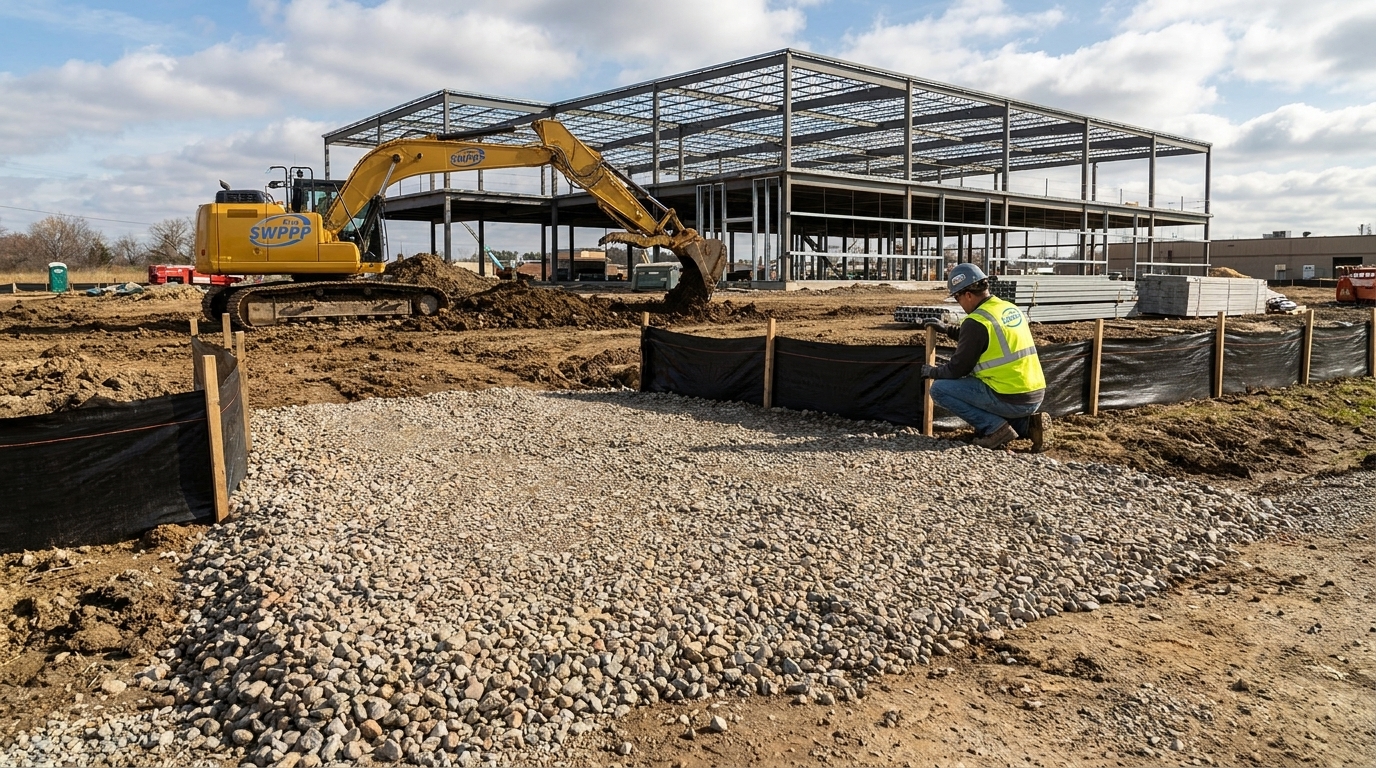
- Perimeter silt fence along downslope boundaries
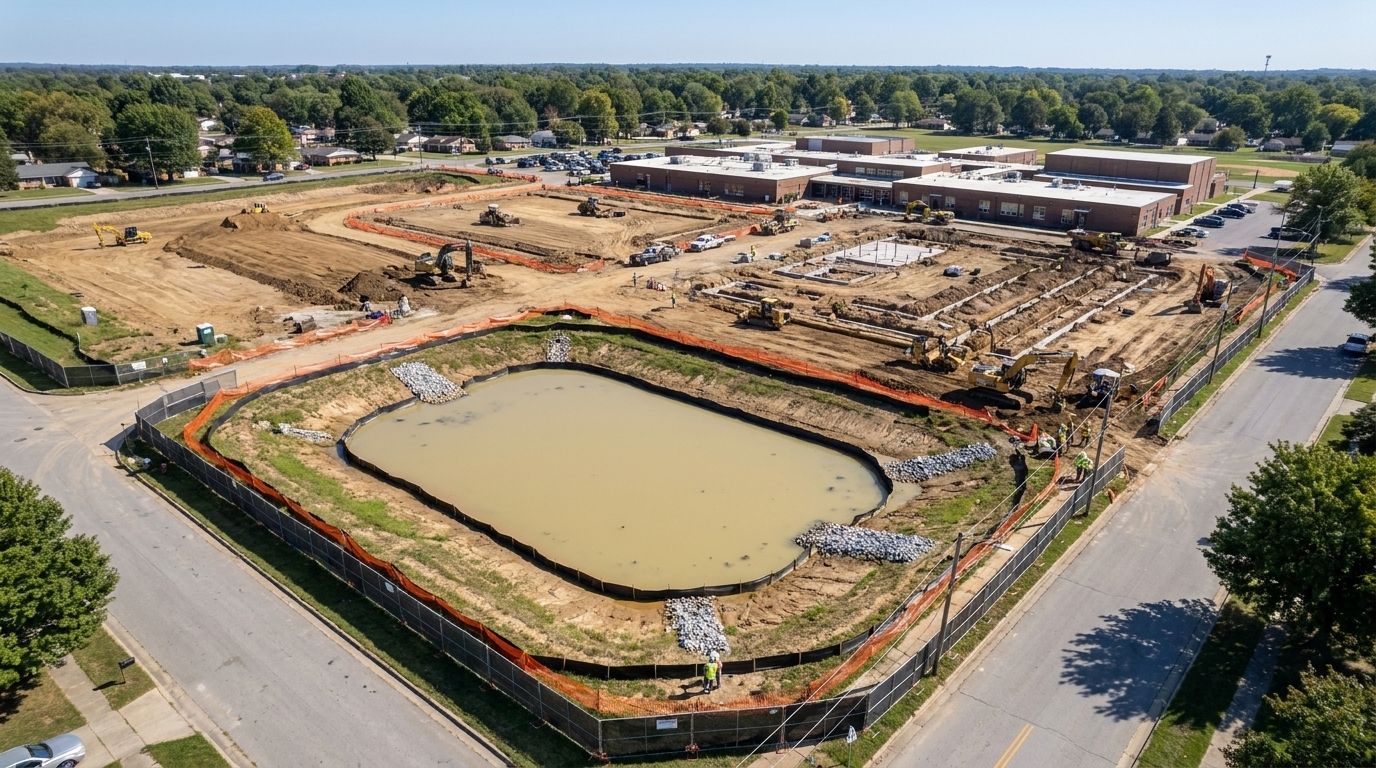
- Sediment basins or traps in low areas
- Inlet protection devices on storm drains
- Check dams in ditches and swales
- Stabilized construction entrances to prevent tracking mud onto public roads
The SWPPP must specify the type, location, and installation standards for each control. Generic statements like “install silt fence as needed” do not meet permit requirements and will fail inspection.
Stormwater Management and Pollution Prevention
Beyond erosion and sediment, the SWPPP must address stormwater management during construction. This includes routing clean water around disturbed areas where possible, managing dewatering from trenches or foundations, and controlling the volume and velocity of runoff leaving the site.
Pollution prevention is equally important. The SWPPP must prohibit and control discharges of:
- Concrete washout water (must be contained in designated washout areas)
- Equipment wash water and vehicle fluids
- Paints, solvents, and chemical spills
- Sanitary waste and trash
- Fuels and oils from storage or fueling areas
For a school or municipal building, contractors often underestimate the pollution prevention side. A single concrete truck washing out into a storm drain can trigger enforcement and thousands of dollars in penalties, even if erosion controls are perfect. The SWPPP must designate concrete washout locations, chemical storage areas, and fueling procedures, and those procedures must be followed every day.
Don’t want to mess with all the paperwork? Order your SWPPP now with Pro SWPPP Professional CPESC Certified SWPPP Services.
Filing the Notice of Intent and Getting Permit Coverage
Once the SWPPP is prepared, the next step is filing a Notice of Intent with the appropriate permitting authority. The NOI is the formal request for permit coverage. You cannot legally disturb soil until you have received permit coverage, except in very narrow emergency situations defined by the permit.
The sequence is critical: SWPPP first, NOI second, permit coverage third, then construction. Reversing this order is one of the most common violations for school and municipal projects, especially when public owners are in a hurry to start work or meet bond funding deadlines.
EPA Projects: Electronic Filing Through NeT
If your project falls under the EPA’s 2022 Construction General Permit, you must file the NOI electronically through the NPDES eReporting Tool, or NeT. This is a web-based system that requires you to register, enter project details, upload certain SWPPP elements, and submit the NOI online. Permit coverage is typically granted within a few days of a complete submission.
The EPA permit requires that the SWPPP be developed consistent with the permit requirements before the NOI is submitted. That means you can’t file the NOI and then write the SWPPP. Inspectors will ask to see the SWPPP and its preparation date, and if it’s dated after your NOI, you’re in violation from day one.
State Projects: State-Specific Portals and Forms
Most states use their own online portals for NOI filing. For example, California uses the SMARTS system, Texas uses an online NOI form on the TCEQ website, and Georgia uses the Georgia Environmental Protection Division’s eForms portal. Each state has its own terminology, required attachments, and processing times.
Some states require you to submit the full SWPPP with the NOI. Others require only a site map and a certification that the SWPPP has been prepared. Some states issue a permit number immediately upon submission; others review the NOI and issue a Waste Discharge Identification number or permit coverage letter within a few days.
Contractors working across state lines must learn the specific process for each state. Pro SWPPP handles NOI filing nationwide and knows the quirks of each system, saving contractors the frustration of navigating unfamiliar portals and avoiding filing errors that delay projects.
The Emergency Construction Exception
The EPA permit and most state permits include a narrow exception for emergency construction activities necessary to protect public health and safety. For example, if a school’s roof collapses and emergency repairs require immediate site disturbance, you may be allowed to begin work and file the NOI within 30 days, with documentation in the SWPPP explaining the emergency.
This exception is not a blank check. It applies only to genuine emergencies, not schedule pressures or funding deadlines. Inspectors will scrutinize emergency claims closely, and misuse of the exception can result in penalties higher than if you had simply waited for normal permit coverage.
BMP Installation, Inspection, and Maintenance Requirements
Getting permit coverage is just the beginning. The real work is installing, inspecting, and maintaining BMPs throughout the project. The EPA and state permits set minimum inspection frequencies, require trained inspectors, and demand corrective action within specific timeframes when deficiencies are found.
For school and municipal buildings, the inspection and maintenance burden is often underestimated. These projects can last a year or more, through multiple wet seasons, with frequent changes in grading and drainage patterns as different construction phases occur. A SWPPP that looks good on paper in month one can fail in month six if inspections and updates don’t happen.
Inspection Frequency: 7-Day vs. 14-Day Schedules
The EPA’s 2022 Construction General Permit offers two inspection schedules. Under the 7-day schedule, you inspect the site at least once every seven calendar days. Under the 14-day schedule, you inspect at least once every 14 days, but you must also inspect within 24 hours after any storm event that produces 0.25 inches or more of rain in a 24-hour period.
Most contractors choose the 14-day schedule because it results in fewer routine inspections during dry periods. But in wet climates or during rainy seasons, the storm-event trigger can result in more frequent inspections than the 7-day schedule. Plan for this in your staffing and budget.
State permits may impose stricter schedules. Some states require weekly inspections regardless of storm activity. Some require inspections within 24 hours of any measurable rain. Some require more frequent inspections in high-risk watersheds or during certain seasons. Always check your specific permit.
Who Can Inspect and What Training Is Required
The EPA’s 2022 permit requires that inspections be conducted by trained personnel. As of February 2023, inspectors must have training in erosion and sediment control principles, BMP installation and maintenance, and inspection techniques. Many states have similar or more detailed training requirements.
For a school or municipal building project, this often means the superintendent or foreman cannot simply walk the site and check boxes. The inspector must understand how silt fence works, what sediment accumulation levels require cleanout, how to evaluate stabilization, and how to document findings. Pro SWPPP provides training resources and can conduct inspections on behalf of contractors who lack trained staff.
Corrective Action Timelines
When an inspection identifies a deficiency, the permit requires corrective action within a specific timeframe. Under the EPA permit, corrective action must be completed by the next scheduled inspection or within seven calendar days, whichever is sooner, unless infeasible due to weather or ground conditions.
For example, if you inspect on Monday and find that a silt fence has collapsed, you must repair it by the next scheduled inspection or within seven days. If heavy rain makes repair unsafe, you must document why corrective action was delayed and complete it as soon as conditions allow.
Failure to take corrective action is one of the most common enforcement triggers. Inspectors from the state or local MS4 program often visit sites and review inspection logs. If they see repeated findings with no corrective action, they will issue violations and may shut down the project until conditions are corrected.
Enforcement, Penalties, and What Happens When Public Projects Skip the SWPPP
Public owners sometimes believe they are immune from enforcement or that regulators will go easy on government projects. This is a dangerous misconception. Federal, state, and local agencies enforce stormwater requirements against public projects just as aggressively as against private developers, and in some cases more so because of the visibility and public accountability of taxpayer-funded construction.
Penalties for SWPPP violations can be severe. Under the Clean Water Act, federal penalties can reach tens of thousands of dollars per day per violation. States often have parallel penalty structures. Local MS4 programs can impose additional fines and stop-work orders. When a school district or city fails to obtain permit coverage or implement a SWPPP, penalties can quickly reach six figures, especially if sediment discharges reach sensitive waters or cause downstream damage.
Common Violations on School and Municipal Projects
The most common violations seen on public projects include:
- Starting construction before obtaining permit coverage (no NOI filed)
- No SWPPP prepared or SWPPP not available on site
- SWPPP that is incomplete or does not meet permit requirements
- BMPs not installed as shown in the SWPPP
- Failed or poorly maintained BMPs (collapsed silt fence, sediment-filled basins, unstabilized slopes)
- No inspection logs or inspections not conducted at required frequency
- Corrective actions not taken after deficiencies are identified
- Concrete washout, equipment wash water, or fuel spills discharged to storm drains
- Failure to stabilize disturbed areas that have been inactive for 14 days or more
Any one of these can trigger enforcement. Multiple violations compound the penalties and can result in consent orders requiring enhanced oversight and third-party audits for all future projects by that public owner.
Stop-Work Orders and Project Delays
When state or local inspectors find serious SWPPP violations, they have the authority to issue stop-work orders. This means all land-disturbing activity must cease until the violations are corrected, a compliant SWPPP is in place, and BMPs are installed and functioning.
For a school or municipal building project, a stop-work order can be devastating. It delays the project schedule, increases costs due to idle equipment and extended general conditions, and can jeopardize bond funding or grant deadlines. Contractors may face liquidated damages if the delay pushes completion past a contractual milestone. Public owners face embarrassment and scrutiny from elected officials and the public.
The best defense is to treat SWPPP compliance as a non-negotiable project requirement from day one, just like safety or quality control. Pro SWPPP works with contractors and public owners to ensure SWPPPs are prepared correctly, filed on time, and implemented without the enforcement risk that derails projects.
Recent Regulatory Changes That Impact School and Municipal Projects
Stormwater regulations have become more detailed and more stringent in the last few years. Contractors and public owners working on schools and municipal buildings need to be aware of recent changes to the EPA Construction General Permit and to state permits, because these changes impose new documentation, monitoring, and BMP requirements that affect project budgets and schedules.
The EPA’s 2022 Construction General Permit
The EPA issued a new Construction General Permit in February 2022. It took effect immediately for new projects and replaced the 2017 permit. The 2022 CGP includes several important changes:
- Expanded coverage to include Lands of Exclusive Federal Jurisdiction, meaning more federal facilities must use the EPA permit
- More detailed perimeter control requirements, specifying installation and maintenance standards
- Enhanced dewatering controls, including turbidity monitoring for dewatering discharges in some cases
- Mandatory training for inspection personnel, effective February 2023
- New documentation requirements, including photographs of stabilized areas submitted with the Notice of Termination
- Clarifications on stabilization timelines in arid and semi-arid regions
- Explicit authorization for electronic SWPPP and inspection log storage
For school and municipal buildings, the training and documentation changes mean contractors must budget for inspector training and ensure that inspection records, corrective action logs, and SWPPP updates are maintained electronically or on-site and available for review at all times.
State Permit Updates: California, Texas, and Georgia Examples
Many states have updated their Construction General Permits in the last two to three years. California adopted a new CGP in September 2022 that took effect in September 2023. The California permit adds numeric action levels for turbidity and other pollutants, requires monitoring and sampling during certain rain events, and imposes additional requirements for passive treatment systems when action levels are exceeded. For a large school or municipal building in California, this can mean significant additional monitoring and BMP costs.
Texas and Georgia have also updated permit requirements, with enhanced inspection and reporting obligations and more detailed BMP specifications. Contractors working in multiple states must track each state’s current permit version and ensure their SWPPPs and procedures are updated accordingly. Pro SWPPP stays current with all state permit changes and ensures that every SWPPP we prepare meets the latest requirements.
Budgeting and Planning for SWPPP Compliance on Public Projects
SWPPP compliance is not free, and it’s not a line item that should be treated as an afterthought. Contractors bidding on school or municipal building projects must budget for SWPPP preparation, BMP materials and installation, inspection labor, monitoring, and the risk of corrective actions. Public owners must include these costs in project budgets and ensure contractors are held accountable for compliance.
What SWPPP Compliance Costs
The direct permit fee is usually nominal, often a few hundred dollars. The real costs are in SWPPP preparation, BMPs, and ongoing compliance. Typical cost elements include:
- SWPPP preparation by a qualified professional (often $2,000 to $5,000 or more depending on project size and complexity)
- BMP materials: silt fence, inlet protection, stabilized entrance rock, erosion control blankets, sediment basin excavation, seeding and mulching
- BMP installation labor
- Weekly or biweekly inspections throughout the project
- Maintenance and repair of BMPs (silt fence replacement, sediment cleanout, reseeding)
- Monitoring and sampling in states with numeric action levels or TMDL requirements
- Training for inspection personnel
- SWPPP updates as site conditions change
For a typical school or municipal building, SWPPP and BMP costs often range from one to three percent of total construction cost, but can be higher on steep, erodible, or environmentally sensitive sites. Under-budgeting for these items leads to change orders, disputes, and the risk of cutting corners that trigger enforcement.
Integrating SWPPP into the Project Schedule
SWPPP compliance is not a one-time task at the start of the project. It continues from site mobilization through final stabilization and closeout. Contractors must integrate SWPPP milestones into the overall project schedule:
- SWPPP preparation and review during the design or preconstruction phase
- NOI filing and receipt of permit coverage before any land disturbance
- BMP installation before grading or clearing begins
- Inspection schedule aligned with permit requirements and construction phases
- SWPPP updates when site conditions, drainage patterns, or BMPs change
- Final stabilization activities and Notice of Termination filing at project closeout
Public owners should require contractors to submit SWPPP compliance schedules and hold regular progress meetings to review inspection findings and corrective actions. Pro SWPPP can assist both contractors and owners with compliance planning and oversight, reducing the risk of surprises and delays.
Not sure what your project needs? Schedule a Free SWPPP Consultation with CPESC Certified SWPPP Expert Derek E. Chinners.
Why Pro SWPPP is the SWPPP Service Contractors Trust
Pro SWPPP is a family-owned firm with 20+ years in stormwater compliance, preparing SWPPPs for school and municipal building projects nationwide and backed by 180+ five-star Google reviews. We are CPESC certified, meaning our team holds the gold-standard Certified Professional in Erosion and Sediment Control credential recognized by regulators and engineers nationwide. We operate nationwide and understand the federal EPA baseline and the specific requirements of each state’s Construction General Permit.
Our 72-hour turnaround guarantee means you get a compliant, site-specific SWPPP in three days or less, so permit delays don’t hold up your project. We prepare the SWPPP, file the Notice of Intent, and provide ongoing support for inspections, updates, and corrective actions throughout construction. Public owners and contractors choose Pro SWPPP because we eliminate the guesswork and the enforcement risk, delivering professional SWPPP services at a price that fits project budgets.
CPESC Certified Expertise You Can Trust
The CPESC credential is the industry standard for erosion and sediment control professionals. It requires years of experience, rigorous examination, and continuing education. When you work with Pro SWPPP, you work with CPESC-certified experts who know the regulations inside and out and who have prepared SWPPPs for schools, fire stations, libraries, municipal buildings, and other public facilities.
Our team stays current with every EPA and state permit update, so your SWPPP always reflects the latest requirements. We know what inspectors look for and how to design BMPs that work in real-world conditions. We don’t use cookie-cutter templates. Every SWPPP is customized to your site’s soils, slopes, drainage, and construction sequence.
Nationwide Coverage, Local Knowledge
Pro SWPPP operates nationwide, from Texas to Georgia and everywhere in between. We know the differences between the EPA’s 2022 CGP, California’s SMARTS system, Texas TCEQ requirements, and Georgia EPD rules. We know which states require full SWPPP submission with the NOI and which require only a site map. We know which states have numeric action levels and turbidity monitoring, and which states allow less frequent inspections in dry seasons.
No matter where your school or municipal building project is located, Pro SWPPP has the experience and the local knowledge to deliver a compliant SWPPP and NOI filing without delay. Visit our About page to learn more about our team and our nationwide capabilities.
72-Hour Turnaround and Responsive Support
Construction schedules are tight, and public projects often face political or funding deadlines. When you need a SWPPP fast, Pro SWPPP delivers. Our 72-hour turnaround guarantee means you get a complete, site-specific SWPPP and NOI filing within three business days of providing site plans and project details. We don’t make you wait weeks while your project sits idle.
After the SWPPP is in place, we provide ongoing support. If site conditions change, we update the SWPPP. If an inspector identifies a deficiency, we help you develop corrective actions. If you need training or have questions about inspection frequency or BMP maintenance, we’re a phone call or email away. Our goal is to make SWPPP compliance as simple and painless as possible, so you can focus on building the school or municipal facility, not wrestling with regulatory paperwork.
Transparent Pricing and Easy Ordering
Pro SWPPP offers clear, upfront pricing with no hidden fees. You know what the SWPPP will cost before you commit, and there are no surprises. Ordering is simple: visit our website, provide your project details, and we take it from there. You can order your SWPPP online in minutes, or schedule a free consultation with our team to discuss your project’s specific needs.
For public owners managing multiple school or municipal building projects, we offer volume pricing and portfolio services. Get a free SWPPP estimate to discuss how Pro SWPPP can support your entire capital program with consistent, high-quality SWPPP services across all projects.
FAQ
Do I need a SWPPP for a school expansion that’s under one acre?
It depends. If the expansion is under one acre and completely standalone, you may not need NPDES permit coverage. But if it’s part of a larger common plan that will ultimately disturb one acre or more, you do need coverage and a SWPPP. For example, if the district is planning a campus-wide improvement project in phases and total disturbance across all phases will exceed one acre, every phase needs coverage. Additionally, many local governments require erosion and sediment control plans for any land-disturbing activity, even if it’s below the federal threshold. Always check federal, state, and local requirements before starting work.
Who is responsible for the SWPPP on a public project: the owner or the contractor?
Under NPDES rules, both the owner and the contractor can be considered operators and both can be held liable for SWPPP compliance. Typically, the contractor is responsible for day-to-day implementation, inspection, and maintenance of BMPs, while the public owner retains overall legal responsibility. The contract documents should clearly spell out who prepares the SWPPP, who files the NOI, and who conducts inspections. Pro SWPPP works with both contractors and public owners to ensure responsibilities are clear and compliance is achieved.
What happens if we start construction before getting permit coverage?
Starting land-disturbing activity before obtaining permit coverage is a violation of the Clean Water Act and state law. It can result in stop-work orders, civil penalties of thousands of dollars per day, and mandatory corrective actions including emergency BMP installation and site stabilization. Inspectors take this violation very seriously, especially on high-visibility public projects. Always file the NOI and receive permit coverage before the first shovel hits dirt.
How long does it take to get a construction stormwater permit?
Under the EPA’s 2022 CGP, permit coverage is typically granted within a few days of submitting a complete NOI through the NPDES eReporting Tool. Most state programs have similar turnaround times, often issuing permit numbers or coverage letters within 3 to 7 business days. However, if your NOI is incomplete or if the state requires additional documentation, it can take longer. Plan for at least one to two weeks of lead time before you need to start construction, and have your SWPPP prepared before you file the NOI so there are no delays.
Can Pro SWPPP help with inspection and corrective action during construction?
Yes. Pro SWPPP provides ongoing support throughout the life of your project. We can conduct inspections on your behalf if you lack trained staff, help you interpret inspection findings, develop corrective action plans, and update the SWPPP as site conditions change. Our goal is to keep your project in compliance from start to finish, so you avoid enforcement and stay on schedule. Contact us to discuss inspection services and ongoing compliance support for your school or municipal building project.
Does a SWPPP cover post-construction stormwater management?
The construction SWPPP required by the NPDES program focuses on controlling stormwater and pollutants during construction. However, many permits and local ordinances also require post-construction stormwater management plans that address permanent stormwater controls like detention ponds, bioretention areas, and infiltration systems. These post-construction requirements are often part of the site plan approval or grading permit process. Pro SWPPP can coordinate with your engineer to ensure both construction and post-construction stormwater requirements are addressed in a comprehensive way.
What if our project is on tribal land or a federal installation?
Construction projects on tribal land or federal installations typically fall under the EPA’s jurisdiction, not state jurisdiction. That means you’ll file your NOI with the EPA and comply with the 2022 EPA Construction General Permit, even if the surrounding state has its own delegated program. Pro SWPPP has extensive experience with EPA CGP projects and can handle SWPPP preparation and NOI filing for schools, government facilities, and infrastructure on federal and tribal lands nationwide.
Ready to get started? Order your SWPPP now or schedule a free consultation with Pro SWPPP.
Visit Pro SWPPP and see why contractors nationwide rate us 180+ five-star Google reviews, or get a free estimate for your capital project.
By Derek E. Chinners, CPESC — Founder & Stormwater Consultant, Pro SWPPP, LLC
Related: What Is a SWPPP? · When Is a SWPPP Required? The 1-Acre Rule and Common Plans · Texas SWPPP Requirements (SWP3) · Georgia SWPPP Requirements