Pro SWPPP helps contractors and facility operators across Rhode Island meet all state and federal stormwater compliance requirements. If you are planning to disturb soil on a construction site or operate an industrial facility in Rhode Island, you need to understand the Rhode Island Department of Environmental Management’s rules for stormwater pollution prevention. This guide breaks down everything you need to know about SWPPP requirements in Rhode Island, from permit thresholds to inspection schedules to enforcement penalties. Pro SWPPP has served contractors and facility operators nationwide for 20+ years, with 180+ five-star Google reviews, and our CPESC-certified team delivers compliant, professional SWPPPs with a guaranteed 72-hour turnaround.

SWPPP Requirements in Rhode Island: What You Need to Know
Rhode Island requires a Stormwater Pollution Prevention Plan for any construction project that disturbs one acre or more of land. The plan must describe how you will prevent sediment, debris, and pollutants from leaving your site and entering storm drains, streams, or wetlands. Even if your project is smaller than one acre, you still need a SWPPP if you are part of a larger common plan of development or sale that totals one acre or more.
Industrial facilities also need permit coverage and pollution prevention plans. Manufacturers, warehouses, terminals, recycling operations, and many other businesses must comply with the Rhode Island Pollutant Discharge Elimination System Multi-Sector General Permit. The state reissued this permit in September 2024 with updated monitoring and inspection requirements.
Rhode Island merged several application processes into one unified portal. You no longer submit separate forms for Water Quality Certification, Groundwater Discharge, Underground Injection Control, and RIPDES permits. One application covers everything. This saves time and reduces confusion.
Pro SWPPP prepares complete, compliant SWPPPs for Rhode Island construction and industrial sites every week. Our team knows the state-specific rules, understands the RIDEM application portal, and delivers plans that pass inspection the first time.
Rhode Island Stormwater Regulatory Framework
The Rhode Island Department of Environmental Management administers the state’s stormwater program through the Rhode Island Pollutant Discharge Elimination System. The EPA delegated authority to RIDEM to issue permits and enforce Clean Water Act requirements in Rhode Island. This means RIDEM writes the permits, reviews applications, conducts inspections, and issues fines for violations.
Rhode Island operates under both federal NPDES rules and state-specific regulations. The state follows EPA baseline standards but adds extra requirements in certain areas. For example, Rhode Island integrates freshwater wetlands rules, water quality certification, and underground injection control into one stormwater permit. Many other states handle these separately.
Two Primary Permit Types
Rhode Island issues two main stormwater permits:
- Construction General Permit (CGP): Covers stormwater discharges from construction sites disturbing one or more acres.
- Multi-Sector General Permit (MSGP): Covers stormwater discharges from industrial facilities in ten major activity categories.
Both permits require a Notice of Intent, a site-specific pollution prevention plan, regular inspections, and recordkeeping. RIDEM may issue individual permits for larger or more complex projects, but most sites qualify for general permit coverage.
State Regulations and the Rhode Island Stormwater Manual
Rhode Island codified its stormwater rules in 250-RICR-150-10-8, known as the Stormwater Management, Design, and Installation Rules. The state incorporated the Rhode Island Stormwater Manual into these regulations in 2018. The manual provides detailed design standards for Best Management Practices, runoff calculations, and low-impact development techniques.
Municipalities with regulated small MS4s must also implement six minimum control measures in their stormwater management programs. If your project discharges to a local storm sewer system, you may need to coordinate with the city or town to meet local requirements on top of state permit conditions.
Construction General Permit (CGP) in Rhode Island
Any construction project that disturbs one or more acres of land must obtain coverage under the Rhode Island RIPDES Construction General Permit. This includes excavation, grading, clearing, demolition, and any other activity that exposes soil. The one-acre threshold applies to the total disturbed area, not the total property size.
If your project is part of a larger common plan of development, the acreage for the entire plan counts toward the one-acre threshold. For example, a residential subdivision with ten half-acre lots needs permit coverage because the total plan exceeds one acre.
Notice of Intent and Authorization Process
You must submit a Notice of Intent to RIDEM before you start any land disturbance. The NOI includes project details, site maps, drainage calculations, and a complete SWPPP. Rhode Island consolidated the NOI process with Water Quality Certification and other authorizations into one online application.
Eligible projects receive automatic authorization within 30 days unless RIDEM determines that a full technical review is required. Common triggers for full review include discharges to impaired waters, high-pollutant land uses, remediation sites, or unusual site characteristics. If your project requires full review, the approval process takes longer.
Required Submission Materials
Your CGP application package must include:
- Stormwater Construction and Water Quality Certification Application
- Appendix A Checklist
- Project Narrative
- Stormwater Management Plan (including Sediment and Erosion Control Plan, Operations and Maintenance Plan, and Stormwater Drainage and Analysis Report)
- Site plans showing existing and proposed conditions, flow paths, discharge points, and receiving waters
Pro SWPPP prepares all required documents and submits complete application packages through the RIDEM online portal. We know exactly what RIDEM reviewers look for and format plans to meet state standards.
Don’t want to mess with all the paperwork? Order your SWPPP now with Pro SWPPP Professional CPESC Certified SWPPP Services.
Industrial Stormwater Permits in Rhode Island
Industrial facilities with outdoor material storage, equipment maintenance areas, loading docks, or manufacturing operations need coverage under the RIPDES Multi-Sector General Permit. RIDEM reissued the MSGP on September 1, 2024, replacing the 2019 version. All existing permittees had to renew coverage under the new permit.
The MSGP covers ten major categories of industrial activity, including manufacturing, mineral extraction, waste handling, transportation facilities, treatment plants, and recycling operations. If your facility has a Standard Industrial Classification code that falls into one of these categories, you likely need permit coverage.
Industrial SWPPP Requirements
An industrial SWPPP identifies all potential sources of stormwater pollution at the facility and describes control measures to prevent pollutants from reaching storm drains or surface waters. The plan must include:
- Site map showing buildings, impervious surfaces, drainage patterns, outfalls, and material storage areas
- Description of industrial activities and materials exposed to stormwater
- List of all Best Management Practices installed to control pollutants
- Inspection and monitoring schedule
- Spill response and cleanup procedures
- Employee training program
Industrial SWPPPs require quarterly inspections and annual updates. Many facilities also need to collect stormwater samples and submit monitoring reports to RIDEM. Pro SWPPP prepares industrial SWPPPs and provides inspection support for facilities across Rhode Island.
Sector-Specific Requirements
The MSGP includes additional requirements for certain sectors. For example, concrete plants must implement specific controls for washout areas. Auto salvage yards need protocols for fluid management and vehicle storage. Asphalt plants must address aggregate pile runoff. RIDEM assigns sector codes based on the primary industrial activity at the facility.
Pro SWPPP has prepared industrial SWPPPs for manufacturers, terminals, recycling facilities, construction equipment yards, and wastewater treatment plants. We know the sector-specific rules and design control measures that meet RIDEM expectations.
Required BMPs for Rhode Island Construction Sites
Rhode Island requires all construction sites to install and maintain effective erosion and sediment controls at all times. The state does not consider a site compliant simply because you installed the practices shown on your approved plan. You must achieve actual control of sediment and erosion across the entire site.
Your SWPPP must describe the specific BMPs you will use during each phase of construction. Rhode Island follows the standards in the Rhode Island Stormwater Manual and the state erosion and sediment control handbook. Common required practices include:
- Perimeter controls: Silt fence, sediment barriers, or erosion control blankets around site boundaries and drainage areas
- Inlet protection: Filters or barriers around all storm drain inlets to prevent sediment entry
- Stabilized construction entrance: Stone pad or wash rack to remove mud from vehicle tires before entering public roads
- Sediment basins or traps: Temporary ponds or settling areas for runoff from large disturbed areas
- Slope protection: Erosion control matting, mulch, or temporary seeding on steep slopes or long slopes
- Dust control: Water truck or tackifier application to prevent wind erosion
- Final stabilization: Permanent seeding, landscaping, or paving of all disturbed areas
State-Specific BMP Rules
Rhode Island has specific rules for certain site conditions. Sites with high-pollutant land uses (like fueling stations or chemical storage areas) need additional controls beyond standard erosion practices. Projects discharging to impaired waters may require enhanced treatment or additional monitoring.
The Construction Manager must maintain the SWPPP and all inspection records at the project field office. RIDEM inspectors can request to see the SWPPP, inspection logs, and amendment records at any time. If you make changes to erosion controls during construction, you must document those changes in an amendment log and mark them on site plans as red-lined drawings.
Weekend Storm Preparedness
Rhode Island explicitly requires contractors to have resources available to restore or replace damaged erosion controls after weekend storms. If a heavy rain event hits your site on Saturday, you cannot wait until Monday to fix washouts or replace damaged silt fence. This rule catches many contractors off guard, especially on small projects with limited crews.
Pro SWPPP designs practical, maintainable BMPs that hold up during storm events and provides clear installation and maintenance instructions. Our plans help contractors avoid the most common installation mistakes that lead to BMP failures.
For more information on federal stormwater rules, visit the EPA NPDES Construction Stormwater page.
SWPPP Inspection Requirements in Rhode Island
Rhode Island construction sites must conduct inspections on a regular schedule throughout the project. The specific frequency depends on your permit conditions and site characteristics, but most sites follow a standard schedule:
- Weekly inspections: Check every section of the site at least once every seven days
- Rain event inspections: Inspect within 24 hours after any storm event that generates at least 0.25 inches of rainfall in a 24-hour period
- Snowmelt and runoff inspections: The 2026 permit adds a trigger for a significant amount of runoff, including runoff caused by snowmelt following a snow event of 3.25 inches or greater (Part III.J.3.b.i)
- Frozen-condition reduction: If earth-disturbing activity is suspended because the ground is frozen, inspections drop to once per month, but you must document the beginning and ending dates of that period in your SESC plan (Part III.J.3.b.iv)
Some sites need more frequent inspections based on proximity to sensitive waters, steep slopes, or other risk factors. Your permit will specify the required inspection frequency for your project.
Permit update (September 26, 2026): Rhode Island has a new Construction General Permit. RIDEM signed the 2026 RIPDES Construction General Permit on September 23, 2026. It takes effect September 27, 2026 and runs to midnight on September 27, 2031, picking up the day after the 2025 CGP expires. There is no gap and no administrative continuation.
If you already have coverage, sites authorized under the 2025 or 2020 RIPDES CGP do not have to reapply. There is one exception worth checking today: if your authorization was issued as part of a RIDEM Freshwater Wetlands Permit, Water Quality Certification, UIC or Groundwater Discharge Permit, CRMC Assent, or QLP Approval that has since expired, your CGP coverage is not reinstated until that underlying approval is reissued.
Two new obligations that change day-to-day site work:
- Dewatering turbidity monitoring (Part III.J.2.g). Collect at least one turbidity sample every day you discharge dewatering water, at every discharge point, after treatment and before the water leaves the site. Use a meter reporting in NTUs under a Part 136-approved method and verify calibration before each day’s use. Benchmarks are background plus 5 NTU in Class A, AA and SA waters and background plus 10 NTU in all other waters, measured against your weekly average. A benchmark exceedance is not itself a violation, but failing to take corrective action after one is. Monitoring logs go to RIDEM on its online form within 30 days of your last dewatering discharge monitoring.
- Site photos with your Notice of Termination (Part I.F.6). The NOT now requires site photos documenting stabilized conditions. The permit sets no photo count and no required vantage points, so document enough of the site to show stabilization everywhere you disturbed ground.
Applications are tiered. Projects disturbing five acres or more apply through the OWR Permit Application Portal with the RISDISM Appendix A Checklist and a Stormwater Management Plan, and coverage begins only after the Director reviews the application and grants it. Projects disturbing at least one acre but less than five file the application, the Appendix A Checklist, a project narrative and a site plan set showing flow paths, discharges and receiving waters, and are authorized on receipt unless RIDEM notifies you otherwise. Either way the application is due at least 30 days before land disturbance begins, and before construction starts you must post a weather-resistant sign at least 12 inches by 18 inches carrying the initials DEM and your assigned permit number.
Qualified SWPPP Inspector
Inspections must be conducted by a qualified person, and the 2026 permit names the credentials RIDEM recognizes as meeting that bar: Certified Inspector of Sediment and Erosion Control (CISEC) or Certified Professional in Erosion and Sediment Control (CPESC), per Part III.J.3.b.ii. Whoever inspects has to know erosion and sediment control well enough to recognize a failing control and say what to do about it.
Inspection records must carry the date and time of the inspection and the inspector’s name, signature and contact information. Maintenance and corrective action logs must be signed by the maintenance contractor or the site operator. Electronic records are acceptable as long as RIDEM can obtain them on request (Part III.J.3.b.iii). Failing to make and document these inspections is itself a permit violation.
The inspector must check all erosion controls, sediment barriers, inlet protection, stabilized areas, and discharge points. If the inspector finds damaged or ineffective controls, the Construction Manager must notify the contractor immediately. Repairs must happen as soon as possible, usually within 24 hours for critical issues.

Inspection Documentation
Every inspection must be documented in writing. Inspection reports should include:
- Date and time of inspection
- Inspector name and signature
- Weather conditions and recent rainfall amounts
- Description of areas inspected
- Condition of all BMPs
- Any problems identified
- Corrective actions needed and completion dates
Keep all inspection reports with the SWPPP at the project field office. RIDEM inspectors will review your inspection logs during site visits. Missing inspections or incomplete documentation can result in fines, even if your BMPs are working correctly.
Industrial Facility Inspections
Industrial facilities under the MSGP must conduct routine inspections at least once per quarter. Inspectors must check material storage areas, BMP condition, evidence of leaks or spills, and housekeeping practices. Facilities with certain types of operations may need monthly inspections or more frequent monitoring.
Pro SWPPP provides inspection training and support for both construction and industrial clients. We help you set up inspection schedules, develop checklists, and document results in a format that meets RIDEM requirements.
Enforcement and Penalties in Rhode Island
RIDEM has full enforcement authority over stormwater violations in Rhode Island. The agency can issue warnings, notices of violation, administrative orders, and civil penalties. Serious or repeat violations can result in stop-work orders, permit revocation, or referral for criminal prosecution.
Civil penalties for stormwater violations can reach thousands of dollars per day. Each day of non-compliance counts as a separate violation. Missing required inspections, failing to install required BMPs, or allowing sediment discharges to continue without corrective action can trigger escalating fines.
Common Violations
RIDEM inspectors cite construction sites most often for these violations:
- Operating without permit coverage or Notice of Intent approval
- Missing or incomplete SWPPP
- Failure to conduct required inspections
- Inadequate or poorly maintained erosion controls
- Sediment tracked onto public roads
- Discharges of sediment-laden water to streams or wetlands
- Failure to stabilize disturbed areas within required timeframes
Industrial facilities get cited for inadequate material storage covers, lack of secondary containment, poor housekeeping, missing inspection reports, and failure to implement SWPPP provisions.
Avoiding Enforcement Actions
The best way to avoid fines is to maintain a complete, accurate SWPPP, conduct all required inspections on schedule, and fix problems immediately. RIDEM inspectors appreciate contractors who take compliance seriously and respond quickly when issues arise. If you get a notice of violation, respond promptly and document all corrective actions.
Pro SWPPP helps contractors avoid violations by preparing thorough, site-specific SWPPPs and providing ongoing support during construction. Our plans clearly explain what needs to be done and when, reducing the risk of missed requirements.
How to File Your NOI in Rhode Island
Filing your Notice of Intent in Rhode Island requires several steps and coordination between your design team, contractor, and permit consultant. Here is the process from start to finish:
Step 1: Prepare Your SWPPP and Site Plans
Before you can submit an NOI, you need a complete SWPPP that meets all Rhode Island requirements. The plan must include erosion and sediment control details, drainage calculations, BMP specifications, inspection schedules, and maintenance procedures. You also need site plans showing existing conditions, proposed grading, stormwater flow paths, and discharge locations.
Step 2: Access the RIDEM Online Portal
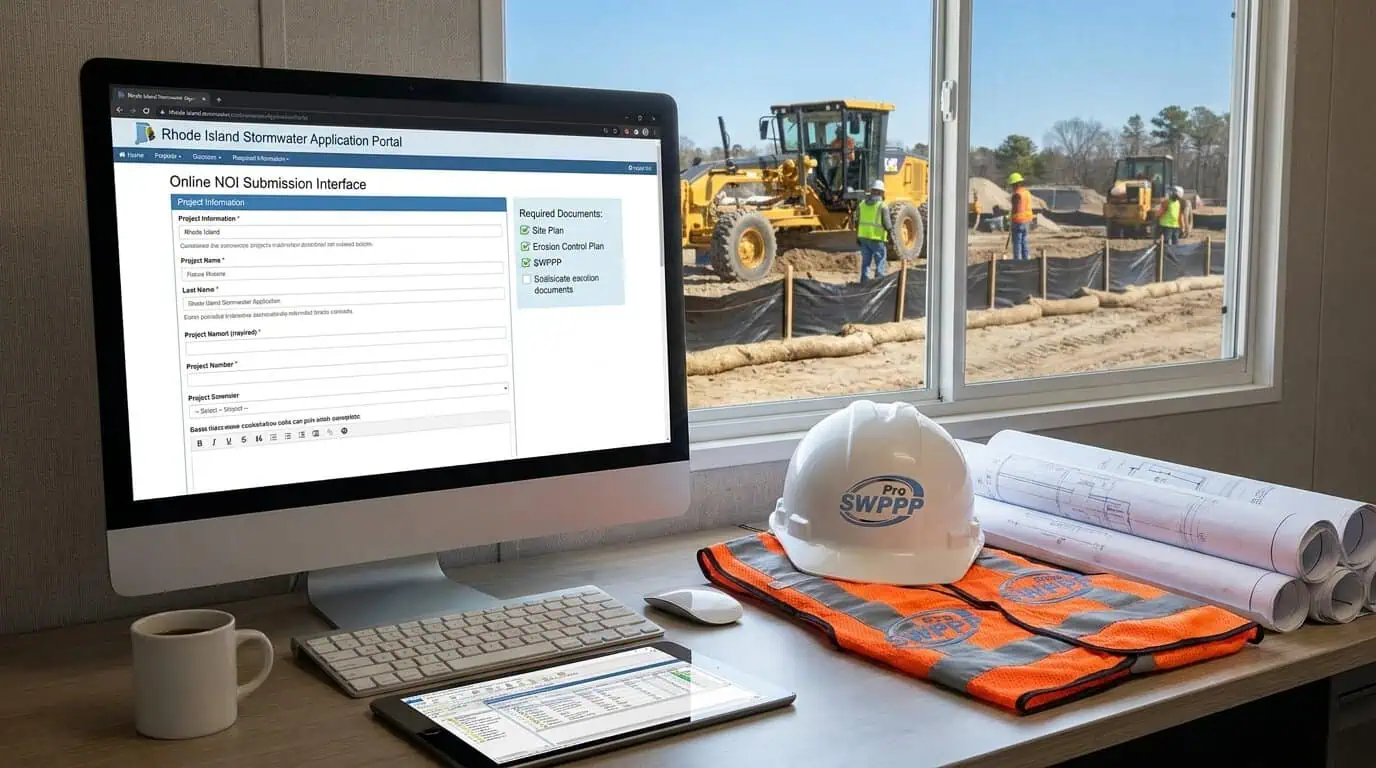
Rhode Island uses the RIDEM Office of Water Resources Application Portal for all stormwater permit applications. You create an account, start a new application, and upload all required documents through the online system. The portal guides you through each section and flags missing information before you submit.
Step 3: Complete the Unified Application
Fill out the Stormwater Construction and Water Quality Certification Application form. This single form covers RIPDES CGP coverage, Water Quality Certification, Groundwater Discharge authorization, and Underground Injection Control approval. You no longer need separate applications for each program.
Step 4: Submit Required Attachments
Upload the following documents to your application:
- Appendix A Checklist (completed and signed)
- Project Narrative describing the project scope, schedule, and stormwater controls
- Stormwater Management Plan (including SWPPP, erosion control plan, and drainage report)
- Site plans in PDF format
Step 5: Pay the Application Fee
Rhode Island charges an application fee for Construction General Permit coverage. The fee amount depends on project size and complexity. The portal will calculate your fee and provide payment instructions.
Step 6: Wait for Authorization
Eligible projects receive automatic authorization within 30 days unless RIDEM selects your application for full technical review. If your project triggers full review, RIDEM will notify you and provide an estimated review timeline. You cannot start land disturbance until you receive your permit authorization letter.
Step 7: Implement Your SWPPP
Once you receive authorization, you can begin construction. Install all erosion controls before you start clearing or grading. Keep your SWPPP and permit letter on site at all times. Conduct inspections on the required schedule and document all maintenance activities.
Pro SWPPP handles the entire NOI filing process for Rhode Island construction projects. We prepare the application, upload all documents, coordinate with RIDEM staff, and track your approval status. You get a complete, ready-to-submit package without spending hours navigating the online portal.
Not sure what your project needs? Schedule a Free SWPPP Consultation with CPESC Certified SWPPP Expert Derek E. Chinners.
Why Pro SWPPP is Rhode Island’s Best SWPPP Service
Pro SWPPP has prepared SWPPPs for construction and industrial clients in Rhode Island and nationwide. Our team includes CPESC-certified professionals with 20+ years of experience in stormwater compliance. We know Rhode Island’s regulations, understand RIDEM’s review process, and deliver plans that pass inspection the first time.
CPESC Certified Professionals
Every Pro SWPPP plan is prepared or reviewed by a Certified Professional in Erosion and Sediment Control. CPESC certification is the gold standard in stormwater management. Our team stays current on changing regulations, new BMP technologies, and enforcement trends. You get expert advice and compliant plans backed by real credentials.
72-Hour Turnaround Guarantee
We deliver complete SWPPPs within 72 hours of receiving your project information. Most firms take weeks or even months to prepare plans. Pro SWPPP has streamlined processes and dedicated staff to meet tight deadlines without cutting corners. You get a professional, compliant plan fast.
Proven Track Record
Pro SWPPP has served clients across Rhode Island, from small residential developments to large commercial projects and industrial facilities. We have prepared SWPPPs for sites in Providence, Warwick, Cranston, Pawtucket, East Providence, Woonsocket, and every corner of the state. Our plans have been approved by RIDEM reviewers and have stood up to field inspections.
Check out our work in Texas and Georgia to see how we help contractors nationwide.
Ongoing Support
Pro SWPPP does not just hand you a plan and disappear. We provide ongoing support during construction, answer questions about BMP installation and maintenance, and help you respond to RIDEM inspection findings. If your project changes or you encounter unexpected site conditions, we update your SWPPP quickly to reflect current conditions.
Transparent Pricing
We provide upfront, all-inclusive pricing with no hidden fees. You know exactly what your SWPPP will cost before you commit. No surprise charges. No hourly billing. Just straightforward pricing for professional service.
Learn more about our team and process on our About page or reach out through our Contact page.

FAQ
Do I need a SWPPP in Rhode Island if my project is less than one acre?
You need a SWPPP if your project disturbs one or more acres, or if it is part of a larger common plan of development or sale that totals one or more acres. Even a small lot can trigger the permit requirement if it is part of a larger subdivision or commercial development. Check with RIDEM or consult with Pro SWPPP if you are unsure whether your project meets the threshold.
How long does it take to get RIPDES permit approval in Rhode Island?
Eligible projects receive automatic authorization within 30 days of submitting a complete application. If RIDEM selects your project for full technical review, the approval process can take 60 to 90 days or longer. Incomplete applications or missing documents will delay approval. Pro SWPPP ensures your application package is complete and formatted correctly to avoid delays.
What happens if I start construction before getting permit authorization?
Starting land disturbance without permit coverage is a violation of the Clean Water Act and Rhode Island regulations. RIDEM can issue a stop-work order, require you to stabilize all disturbed areas immediately, and assess civil penalties. Always wait for your authorization letter before clearing or grading.
Can I use the same SWPPP for multiple construction projects?
No. Each project needs a site-specific SWPPP that addresses the unique conditions, drainage patterns, soils, slopes, and receiving waters at that location. You cannot copy a SWPPP from another project and change the address. RIDEM reviewers will reject generic or template plans that do not reflect actual site conditions.
How often do I need to update my industrial SWPPP?
Industrial SWPPPs must be reviewed and updated at least once per year. You also need to update the plan whenever you make changes to site operations, add new material storage areas, install new equipment, or modify drainage patterns. Keep the SWPPP current to reflect actual facility conditions.
What is the difference between RIDEM and EPA enforcement in Rhode Island?
RIDEM has primary enforcement authority for stormwater violations in Rhode Island because the EPA delegated NPDES permitting authority to the state. The EPA can still conduct inspections and take enforcement action if RIDEM fails to address serious violations, but most enforcement actions come from RIDEM staff.
Does Pro SWPPP provide inspection services in Rhode Island?
Pro SWPPP focuses on SWPPP preparation and permit application support. We provide inspection training and guidance, but we do not conduct routine field inspections. We can recommend qualified local inspectors if you need inspection services for your project. Contact us to discuss your specific needs.
Ready to get started? Order your SWPPP now or schedule a free consultation with Pro SWPPP.
Visit Pro SWPPP and see why contractors nationwide rely on America’s #1 SWPPP Service.
Stop Babysitting Rhode Island’s Stormwater Paperwork
Here’s the open secret of construction stormwater compliance: every state and county runs its own version of the same headache — a clunky permit portal, a Notice of Intent that has to be filed just so, fees, inspection logs, and a review team that loves bouncing things back “with revisions.” Rhode Island is no exception. You didn’t get into construction to moonlight as a stormwater clerk at 9 PM.
That’s the entire point of Pro SWPPP. We handle all of it — your Rhode Island SWPPP, the permit filing, and the CPESC certification it requires — done in 72 hours, with 24-hour expedited turnaround when the clock’s against you. You break ground; we wrestle the bureaucracy.
Skip the Paperwork. Get Back to Your Build.
Your Rhode Island SWPPP, permit filing, and CPESC certification — done for you in 72 hours, 24-hour rush available, or it’s FREE.
✅ Order Your Rhode Island SWPPP — The Easy Way →
📞 Talk to THE SWPPP Authority →
Schedule a call with Derek E. Chinners — Founder & Stormwater Consultant, CPESC · 833-GET-SWPPP