Pro SWPPP – America’s #1 SWPPP Service – fields this question almost every day from tower contractors, wireless crews, and site developers: does a cell tower site actually need a SWPPP? Cell towers are the one project type where the honest answer usually starts with no — and then turns into yes anyway. A typical macro site compound disturbs well under an acre on its own, so the federal threshold does not catch it. What catches it is everything attached to it: the access road, the utility trench corridor, the crane pad, and above all the other towers being built under the same contract, because a phased rollout is a single larger common plan and the acreage is added together across every site in it. This guide walks you through every decision point, the federal baseline, how state rules can tighten the screws, what happens if you get it wrong, and how to hand the whole paperwork mess to a certified expert so you can get back to building.
Cell towers are not exempt just because they are small or single-purpose. EPA treats tower construction like any other land disturbance. When your project crosses the threshold, you need permit coverage and a site-specific stormwater pollution prevention plan before you start moving dirt. Skip it, and you risk fines, stop-work orders, and project delays that cost more than the permit ever would have.
Let’s break down exactly when you need a SWPPP, what it must include, who writes it, and how Pro SWPPP makes the entire process faster, cheaper, and simpler than handling compliance in-house.
When Does a Cell Tower Site Need a SWPPP?
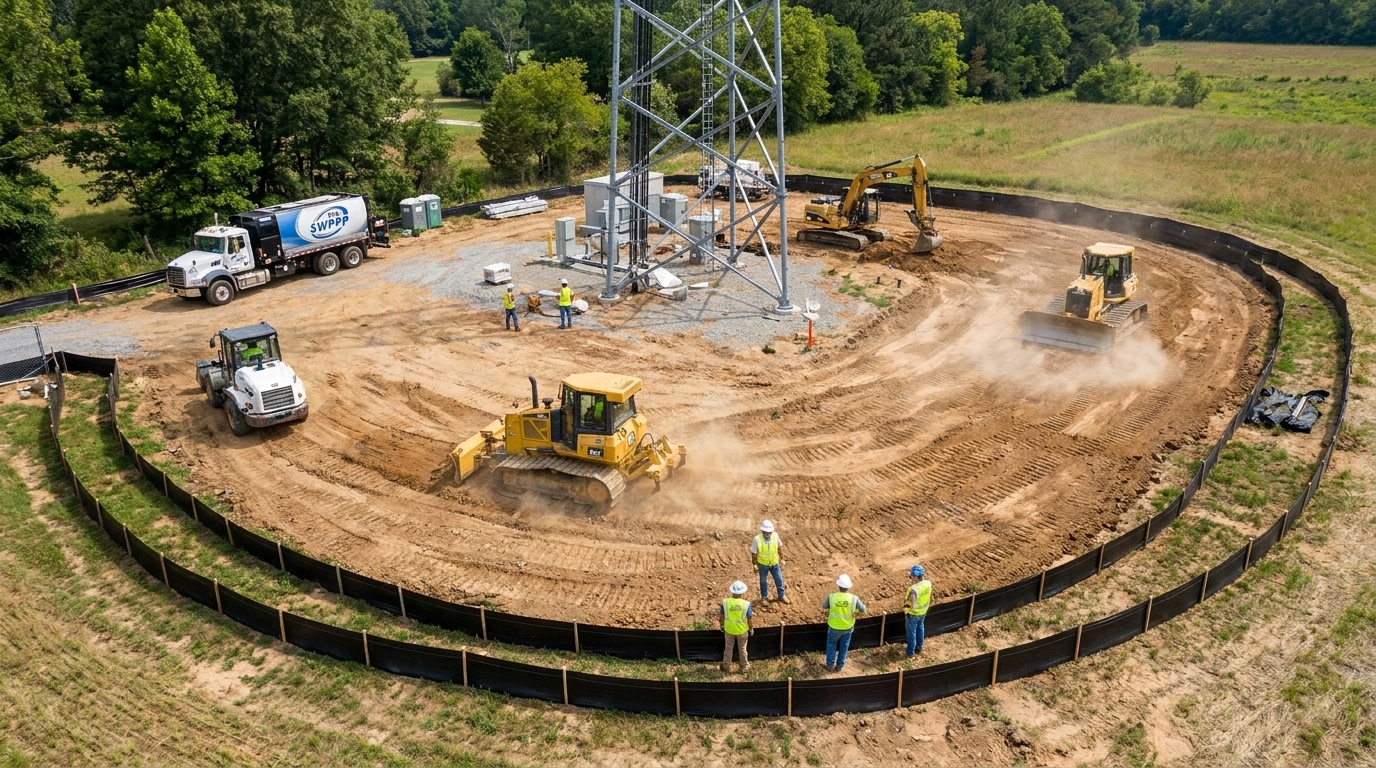
A cell tower site needs a SWPPP when construction activity disturbs one acre or more of land. That federal baseline comes from the EPA’s National Pollutant Discharge Elimination System. If your project sits below one acre, you are usually off the hook federally. But if that smaller site is part of a larger common plan of development or sale that will eventually disturb one acre or more, you still need coverage even if your piece is tiny.
Contractors often miss the “common plan” trigger. If you are building one tower this month and another next quarter under the same master agreement or phased rollout, EPA can count both disturbances together. When the total hits one acre, permit coverage kicks in. The same rule applies to access roads, utility trenching, laydown areas, crane pads, and staging zones. All disturbed soil counts toward the threshold.
State programs can drop the bar lower than one acre. Some jurisdictions require coverage at half an acre. Others require a plan for any project near sensitive waters, regardless of size. Always check the state permit before you assume federal rules are the end of the story.
The One-Acre Rule and How It Adds Up Fast
The federal trigger is one acre of disturbance, or any smaller site that is part of a larger common plan of development — the full rule, including the state programs that set a lower bar, is covered in our guide to when a SWPPP is required. What matters on a tower site is how quietly a small-looking compound gets there: a 200-foot by 200-foot cleared area is already nearly an acre, and access road grading, a trench run, staging, and stockpiles routinely push a build everyone called a quarter-acre job across the line before the first footer is poured.
Here is what typically counts toward disturbed acreage on a cell tower project:
- Tower pad excavation and grading
- Access road clearing, grading, and base installation
- Utility trench corridors for power, fiber, or telco lines
- Equipment shelter foundation and surrounding grading
- Crane pad and rigging zones
- Laydown and material storage areas
- Topsoil stockpiles and spoil piles from excavation
- Temporary construction entrances and perimeter controls
Pro SWPPP calculates disturbance area as part of every plan. We measure site maps, review grading plans, and confirm whether your project crosses the threshold. If it does, we prepare the SWPPP and file the permit paperwork before you mobilize.
Common Plan Aggregation: The Rule That Catches Tower Rollouts
The “larger common plan” rule is where wireless contractors get burned. If you are installing towers under a single contract, master service agreement, or phased deployment, EPA treats all sites under that plan as one project. Even if each individual tower site disturbs only half an acre, the cumulative disturbance determines permit coverage.
For example, a carrier awards a contract to build six towers over twelve months. Each site disturbs 0.6 acres. That is 3.6 total acres under one common plan. Every single tower site in that rollout needs permit coverage and a SWPPP, even the ones you start before the total reaches one acre. The key is the plan, not the individual footprint.
State agencies and EPA regional inspectors actively look for common-plan aggregation during audits. If your NOI does not reference the larger plan, or if you omit sites that should have been counted, the agency can issue violations retroactively. Pro SWPPP helps clients structure NOI submissions to capture the full plan correctly from day one.
What the Federal EPA Baseline Requires for Construction SWPPPs
The federal NPDES Construction General Permit sets the floor for stormwater compliance nationwide. EPA’s 2022 CGP covers discharges from construction activities that disturb one acre or more in areas where EPA is the permitting authority. That includes federal-permit states, tribal lands, and certain territories across all ten EPA regions.
The permit requires operators to prepare a site-specific SWPPP before submitting the Notice of Intent. The SWPPP must identify all potential pollutant sources, describe best management practices to control erosion and sediment, include site maps and inspection schedules, and outline procedures for stabilization and permit termination. The plan stays on site or at an accessible location for the duration of construction and must be updated whenever conditions change.
EPA’s framework also mandates regular self-inspections tied to rainfall and site activity. Inspection records become part of the SWPPP documentation. When final stabilization is complete, the operator submits a Notice of Termination to close out permit coverage. The entire cycle runs from SWPPP prep through NOI filing, construction compliance, and closeout.
Core Elements Every SWPPP Must Include
A compliant SWPPP is not a generic template. It must be tailored to the actual site conditions, soil types, slopes, receiving waters, and construction sequence. EPA enforcement targets cookie-cutter plans that do not match the dirt. Here are the mandatory sections:
- Site description: location, topography, soils, existing vegetation, and receiving waters or MS4 discharge points
- Construction phasing: sequence of land disturbance, stabilization, and final grading
- Pollutant sources: soil erosion, sediment transport, concrete washout, vehicle tracking, fueling areas, material storage
- Best management practices: perimeter controls, slope stabilization, inlet protection, construction entrances, stockpile covers, concrete washout containment
- Site maps: showing existing and proposed topography, drainage patterns, BMP locations, and discharge points
- Inspection schedule: frequency, responsible party, and documentation procedures
- Stabilization practices: temporary and permanent seeding, mulching, erosion control blankets, and timing requirements
- Recordkeeping: NOI copy, permit authorization, inspection logs, rainfall records, and BMP maintenance notes
Pro SWPPP writes every plan from scratch using CPESC-certified professionals drawing on 20+ years of field experience. We do not sell templates. Every SWPPP matches your grading plan, your soil report, and your actual construction schedule.
Don’t want to mess with all the paperwork? Order your SWPPP now with Pro SWPPP Professional CPESC Certified SWPPP Services.

How State Permits Differ from the Federal Floor
Most states run their own EPA-authorized NPDES programs. When a state has authorization, the state permit replaces the federal CGP within that state. The state program must be at least as strict as the federal baseline, but it can add tighter rules, lower thresholds, faster stabilization deadlines, mandatory training, and stricter BMP standards.
For example, Texas TCEQ enforces the Texas Pollutant Discharge Elimination System and requires coverage for projects disturbing five acres or more, with local review for smaller sites near impaired waters. Georgia EPD runs its own permit with detailed erosion control standards and requires certified installers for certain BMPs. California SWRCB divides the state into regional boards, each with layered permit requirements and training mandates for all site supervisors.
State-to-state variation matters for tower contractors working across regions. You cannot assume the same NOI form, inspection frequency, or stabilization deadline applies everywhere. Pro SWPPP tracks permit rules nationwide and updates every plan to match the local program.
NOI Portals, Waiting Periods, and State-Specific Forms
Each state with an authorized program operates its own electronic NOI portal. You cannot file a Texas NOI through EPA’s system, and you cannot use Georgia’s form in Florida. The wrong portal means your NOI is invalid, and construction without valid coverage is an unpermitted discharge.
Waiting periods also vary. Some states authorize coverage immediately upon NOI receipt. Others impose a seven-day or fourteen-day waiting period before discharges are legal. A few require agency acknowledgment before you can break ground. Missing the waiting period can trigger violations even if your SWPPP is perfect.
Pro SWPPP handles NOI preparation and submission in every state we serve. We know which portal to use, which fee applies, and how long you have to wait. We file correctly the first time so your schedule does not slip because of a paperwork mistake. Learn more about our coverage in Texas and Georgia, or get a free estimate for a tower site in any other state.
Not sure your rollout crosses the line? Take the 60-second quiz — Do I even need a SWPPP?
Best Management Practices That Actually Matter on Tower Sites
Cell tower SWPPPs do not need fifty BMPs. They need the right six or seven controls installed correctly and maintained every week. EPA does not prescribe a BMP checklist. The permit requires practices that will effectively minimize pollutant discharge based on site conditions. For most tower builds, that boils down to perimeter sediment barriers, stabilized access, material containment, and rapid final stabilization.
Here are the BMPs that show up on nearly every compliant tower SWPPP:
- Perimeter sediment controls: silt fence, compost filter socks, or fiber rolls around the limit of disturbance to trap sediment before it leaves the site
- Stabilized construction entrance: aggregate pad at the site exit to knock mud and sediment off tires before vehicles hit public roads
- Slope and channel stabilization: erosion control blankets, hydroseed, or tackified mulch on graded slopes steeper than 3:1 or longer than 50 feet
- Inlet protection: filter fabric, gravel rings, or block-and-gravel systems around storm drain inlets within or downstream of the site
- Stockpile covers: tarps or seeded berms around topsoil and aggregate piles to prevent wind and rain transport
- Concrete washout containment: designated washout pit or portable bin for truck chute rinsing, lined and posted with signage
- Spill prevention: secondary containment or absorbent pads under fuel tanks, oil drums, and hazardous material storage
- Dust control: water truck, tackifier, or gravel on haul roads to minimize airborne sediment that later becomes stormwater pollution
Pro SWPPP specifies BMP requirements, maintenance frequency, and trigger conditions for each control inside the written plan. We do not leave it to guesswork. Every plan includes marked-up site maps showing exactly where each BMP should go and what type suits the slope, soil, and drainage — your crews or your earthwork contractor install them, and we document, inspect, and keep the records that prove it.
Installation Timing and the 14-Day Stabilization Rule
BMPs must be in place before land disturbance starts. Perimeter controls go in first. Access points get stabilized before the first truck rolls. Inlet protection gets installed before the first rainstorm. Waiting until after erosion happens is a permit violation and a guaranteed inspection failure.
Federal and most state permits also require stabilization of disturbed areas within fourteen calendar days of reaching final grade. That means seeding, mulching, or installing permanent ground cover within two weeks of finishing grading. If you leave bare dirt exposed longer than fourteen days, you need interim stabilization like tackified straw or erosion blankets.
Tower projects often stretch over months with long gaps between phases. Your SWPPP must account for those pauses. If you clear the site in April but do not pour the pad until June, the cleared area needs temporary stabilization. Pro SWPPP writes phasing plans that keep you compliant during every stage, not just at final closeout.
Who Is Responsible for the SWPPP and Permit Coverage?
The “operator” of the construction site is responsible for obtaining permit coverage and implementing the SWPPP. An operator is any party with operational control over construction plans, specifications, or day-to-day activities. That can include the owner, the general contractor, the tower crew, or multiple parties at once.
On most tower projects, the wireless carrier or site developer holds operational control over the construction plan. The tower erection contractor holds operational control over day-to-day dirt work and BMP installation. Both can be co-permittees. Both can be liable if the SWPPP is not followed. Contract language often tries to shift all compliance downstream to the contractor, but EPA and state agencies do not care what your contract says. They pursue whoever is actually in control.
Smart contractors require the owner or developer to obtain permit coverage before mobilization, or they secure their own coverage and add the cost to the bid. Either way, the SWPPP must be written and the NOI filed before the first shovel hits dirt. Pro SWPPP works with owners, contractors, and developers to clarify operator roles and ensure coverage is in place before the clock starts.
What Happens When You Build Without Coverage
Starting construction without a valid SWPPP and permit authorization is an unpermitted discharge. It is a Clean Water Act violation from day one. State and federal agencies can issue notices of violation, administrative orders, civil penalties, and injunctive relief to stop work until coverage is obtained.
Fines vary by state and by the severity of the violation. Some states start at a few thousand dollars per day. Others can issue penalties of ten thousand dollars or more per violation per day. When an unpermitted site discharges sediment into a stream or MS4 during a rain event, each discharge can count as a separate violation. Costs add up fast.
Beyond fines, the project stops. The agency will not let you continue until you file a complete NOI, prepare a compliant SWPPP, install all required BMPs, and sometimes conduct corrective cleanup of any off-site sediment deposits. That can mean weeks of delay, demobilization costs, remobilization, and lost revenue. Pro SWPPP prevents that scenario by delivering compliant plans and NOI filings in seventy-two hours or less.
Inspection Requirements and How to Keep Records Straight
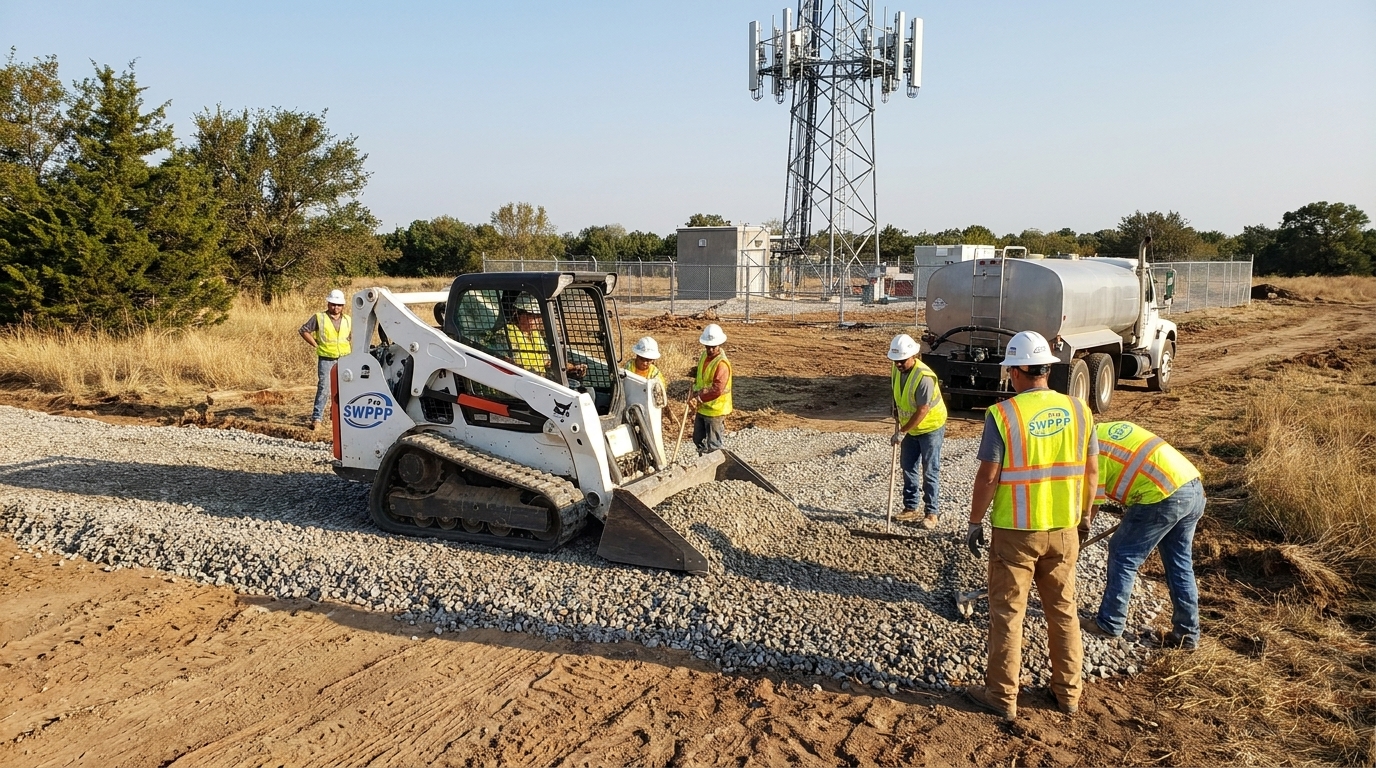
Every construction SWPPP must include an inspection schedule. The federal CGP and most state permits require inspections at least once every seven calendar days and within 24 hours of any storm event that produces 0.25 inches or more of rain (or 3.25 inches or more of snowmelt). Note: the 0.5-inch trigger still circulating in older checklists comes from the 2017 Construction General Permit and is obsolete — the 2022 CGP lowered the threshold to 0.25 inches. Some state permits tighten the frequency further to weekly inspections regardless of rainfall, or require inspection after any measurable precipitation.
The qualified inspector must walk the entire site, check every BMP for damage or sediment buildup, verify that stabilization is progressing on schedule, and document findings in an inspection report. The report goes into the SWPPP records and must be available for agency review at any time. If an inspector finds a problem, the SWPPP requires corrective action within a specific timeframe, usually seven calendar days or before the next storm, whichever comes first.
Inspection lapses are one of the top enforcement findings during agency audits. Missing reports, unsigned logs, or inspections conducted weeks apart trigger automatic violations. Pro SWPPP clients often ask us to provide inspection services or train their crews on compliant documentation. We also offer remote inspection coordination and report templates that match state permit requirements.
What a Compliant Inspection Report Must Include
A compliant inspection report is not a one-sentence email. It must contain specific information that demonstrates the site was actually walked and evaluated. Here is what every report needs:
- Date and time of the inspection
- Name and title of the qualified inspector
- Weather conditions and approximate rainfall since the last inspection
- List of BMPs inspected and their condition
- Any signs of erosion, sediment tracking, or off-site discharge
- Corrective actions needed and completion deadlines
- Photos documenting site conditions and BMP status
- Inspector signature
Pro SWPPP provides inspection report templates customized to each state’s permit language. We train your crew to complete reports in ten minutes per site and store them in a format that survives agency requests and audits.
Not sure what your project needs? Schedule a Free SWPPP Consultation with CPESC Certified SWPPP Expert Derek E. Chinners.
How Recent Regulatory Changes Affect Cell Tower Projects
EPA’s 2022 Construction General Permit is the current federal baseline, but it expires in February 2027. On August 3, 2026, EPA proposed the 2027 CGP to replace it. The proposed permit continues the one-acre threshold and the basic SWPPP framework, but it signals possible changes to NOI content, electronic submission requirements, and SWPPP access information.
One notable proposed change is requiring permittees to submit more detailed electronic SWPPP access information with the NOI. That could mean uploading portions of the SWPPP or providing web links to cloud-hosted plans. The goal is to make SWPPPs more accessible to inspectors and the public without requiring physical site visits to obtain a copy.
State programs will follow similar trends. Several states already require electronic SWPPP submission or cloud storage with agency access. Contractors who still rely on paper binders and on-site storage may face compliance gaps under the next permit cycle. Pro SWPPP uses cloud-based SWPPP hosting and electronic delivery as standard practice. Our clients get PDF plans, editable files, and secure links that meet current and future submission rules.
Training and Certification Requirements Spreading Across States
More states are adopting mandatory erosion and sediment control training for site supervisors, inspectors, and BMP installers. California requires a Qualified SWPPP Developer and a Qualified SWPPP Practitioner on every project. Georgia requires erosion control certification for contractors working on certain permit types. Other states are considering similar rules.
These training mandates add cost and scheduling hurdles for contractors who do not have certified staff in-house. Pro SWPPP employs CPESC-certified professionals who meet or exceed every state’s training requirements. When you hire Pro SWPPP, you get a qualified plan preparer and access to qualified inspection support without sending your crew to week-long certification courses.
What Makes Cell Tower Sites Different from Other Construction Projects
Cell tower sites look small compared to shopping centers or subdivisions, but they punch above their weight when it comes to stormwater risk. Towers often sit on ridgelines, hilltops, or other high-visibility locations with steep slopes and fast runoff. Access roads get cut through wooded areas with minimal shoulder. Trenching for utilities crosses natural drainages. Crane rigging requires large cleared pads that concentrate heavy equipment traffic on loose soil.
All of that adds up to high sediment generation in a short construction window. Tower builds are also remote. Inspectors cannot drive by every day. If erosion starts, it can go unnoticed until a neighbor complains or a rainstorm dumps sediment into a creek. That is when agencies get involved, and by then the damage is done.
Tower contractors also juggle multiple sites under the same rollout contract. Common-plan aggregation means every site needs a SWPPP, even the ones that would fall below one acre if considered alone. Tracking NOI filings, inspection schedules, and termination deadlines across six or ten simultaneous sites is a full-time job. Pro SWPPP manages multi-site rollouts with a single point of contact, centralized document tracking, and coordinated NOI filings that keep every site compliant without drowning your PM in paperwork.
Access Roads and Utility Trenches: The Hidden Acreage
Most tower SWPPPs underestimate disturbance because they focus only on the tower pad and ignore access improvements. A new gravel road from the county highway to the tower can easily disturb half an acre or more. Add a fiber optic trench running a quarter mile to the nearest junction box, and you have crossed the one-acre line before the tower foundation is even staked.
Utility trenching is especially tricky because it creates a linear disturbance corridor with spoil piles and exposed subsoil. If that trench crosses a stream or drainage swale, sediment control becomes critical. Pro SWPPP includes access roads, utility corridors, and temporary construction features in every disturbance calculation and specifies trench-specific BMPs like spoil barriers, trench plugs, and rapid backfill schedules.
Why Pro SWPPP is the SWPPP Service Contractors Trust
Pro SWPPP has been the go-to SWPPP provider for cell tower contractors, site developers, and wireless carriers. We are a family-owned firm with 20+ years in stormwater compliance, we operate nationwide, deliver plans in seventy-two hours or less, and back every document with CPESC-certified expertise. Our clients do not gamble on compliance. They hand us the site data, and we deliver a compliant SWPPP ready for NOI filing and agency review.
Here is what sets Pro SWPPP apart from in-house plans, generic templates, and cut-rate competitors:
CPESC Certification and Real Field Experience
Every Pro SWPPP plan is prepared or reviewed by a Certified Professional in Erosion and Sediment Control. CPESC certification is the gold standard in stormwater compliance. It proves the plan writer understands soil science, hydrology, BMP selection, and regulatory frameworks at a level that no online template or generalist consultant can match.
Our team also includes former agency inspectors, civil engineers, and construction managers who have walked hundreds of sites. We know what works in red Georgia clay, Texas caliche, and California serpentine. We know which BMPs survive a gully washer and which ones blow out after the first quarter-inch. That experience goes into every plan. Learn more about our team and credentials.
Seventy-Two Hour Turnaround Without Cutting Corners
Speed matters when your tower crew is scheduled to mobilize Monday and the NOI is not filed. Pro SWPPP delivers compliant plans in seventy-two hours or less from the time we receive complete site data. That includes site-specific maps, BMP specifications, inspection schedules, and NOI-ready documentation.
We do not sacrifice quality for speed. Every plan is written from scratch, reviewed by a second CPESC, and checked against the applicable state permit. Faster than in-house, better than a template, and reliable enough to bet your schedule on.
Nationwide Coverage with Local Permit Knowledge
Pro SWPPP serves clients nationwide, from Texas to Georgia, California to the Carolinas, and everywhere in between. We track state permit updates, NOI portal changes, and fee schedules so you do not have to. Whether your project falls under EPA’s federal CGP or a state-authorized program, we know the rules and file correctly the first time.
Our nationwide reach also means consistent quality across multi-state rollouts. You get the same SWPPP format, the same level of detail, and the same support whether you are building in Houston or Atlanta. That consistency saves time during audits and simplifies recordkeeping for corporate compliance teams.
Inspection Support and Ongoing Compliance Assistance
Pro SWPPP does not disappear after we hand you the plan. We offer ongoing inspection coordination, corrective action guidance, and permit amendment support if your site conditions change. Need help training your crew on BMP installation? We provide site-specific walkthroughs and photo-documented checklists. Facing an agency inspection? We prepare your records and coach your team through the process.
Many clients also use our inspection services to fill gaps when their crew is stretched thin or working in a state where they do not have certified staff. We conduct remote inspections using drone footage and site photos, or we dispatch a local inspector to walk the site and complete reports that meet state permit standards.
Pricing That Makes Sense for Small and Large Projects
Pro SWPPP pricing is transparent and project-based. You know the cost before we start. No hourly billing, no change orders for routine updates, and no surprise fees when the NOI takes longer than expected. Small single-tower sites get the same professional treatment as multi-site rollouts, just scaled to match the scope.
We also work with clients on volume pricing for tower programs and master service agreements. If you are deploying dozens of sites over the next year, we can structure a flat-rate package that covers SWPPP prep, NOI filing, and inspection support across the entire program.
You can explore EPA’s official stormwater construction resources at EPA’s NPDES Construction Activities page for additional background on federal permit requirements.
FAQ
Do I need a SWPPP if my tower site is less than one acre?
Usually no, unless your project is part of a larger common plan of development or sale that will disturb one acre or more when all phases are added together. If you are building multiple towers under the same contract or phased rollout, EPA and state agencies count the total disturbance across all sites. When the total crosses one acre, every site needs permit coverage and a SWPPP. Some states also require coverage for smaller sites near sensitive waters or impaired streams. Check the state permit or ask Pro SWPPP to confirm whether your specific project triggers coverage.
Who is responsible for preparing the SWPPP: the owner or the contractor?
The operator with control over construction plans or day-to-day operations is responsible. On tower projects, that can include the property owner, the wireless carrier, the site developer, the general contractor, or the tower erection crew. Often, multiple parties share operator status and can be co-permittees. Contract language sometimes assigns SWPPP responsibility to one party, but agencies hold all operators accountable regardless of contract terms. The safest approach is to clarify operator roles before mobilization and ensure coverage is in place before dirt moves.
Can I use the same SWPPP for multiple tower sites?
No. Every construction site requires a site-specific SWPPP tailored to that location’s topography, soils, drainage, and construction sequence. Generic templates and copy-paste plans do not meet permit requirements and will fail an agency inspection. Even if two towers are identical structures, the surrounding conditions differ. Pro SWPPP prepares a unique plan for each site, ensuring compliance and protecting you from violations.
How long does it take to get a SWPPP and file the NOI?
Pro SWPPP delivers compliant SWPPPs in seventy-two hours or less from the time we receive complete site information. NOI filing adds another day or two depending on the state portal and any required waiting periods. Most projects can go from initial contact to filed NOI in less than one week. If you are under a deadline, let us know. We have expedited plans in 24 hours when schedules demand it.
What happens if I start construction before the SWPPP is ready?
You are in violation of the Clean Water Act and state water quality laws. Discharging stormwater from a construction site without a valid permit and SWPPP is an unpermitted discharge. Agencies can issue stop-work orders, assess civil penalties, and require corrective cleanup before you are allowed to continue. Fines can range from thousands to tens of thousands of dollars per day depending on the state and the severity of the discharge. The only way to avoid that risk is to have the SWPPP prepared and the NOI filed before the first equipment arrives on site.
Do I need a new SWPPP if the project scope changes during construction?
If the scope change increases disturbance area, alters drainage patterns, adds new pollutant sources, or requires different BMPs, you must update the SWPPP and amend the NOI if necessary. Significant changes that affect permit coverage, such as expanding beyond the original limit of disturbance, may require a permit modification or a new NOI. Pro SWPPP provides amendment services to keep your plan and permit current when field conditions change.
Can Pro SWPPP help with inspections and agency audits?
Yes. Pro SWPPP offers inspection coordination, report preparation, corrective action planning, and agency audit support. We can train your crew on inspection procedures, provide report templates, or dispatch a qualified inspector to walk the site and complete documentation. If you receive an agency notice or inspection request, we help you prepare records, review findings, and respond to corrective action deadlines. Our goal is to keep you compliant from start to finish, not just hand you a binder and walk away.
Ready to get started? Order your SWPPP now or schedule a free consultation with Pro SWPPP.
Visit Pro SWPPP and see why contractors nationwide hand us their stormwater paperwork — 180+ five-star Google reviews and counting.
Building a tower rollout this quarter? Schedule a call with a stormwater expert and we will map the whole plan — every site — before you mobilize.
By Derek E. Chinners, CPESC — Founder & Stormwater Consultant, Pro SWPPP, LLC
Related: What is a SWPPP? · When is a SWPPP required? The 1-acre rule and common plans · California SWPPP requirements