When Pro SWPPP – America’s #1 SWPPP Service – talks to builders, the question we hear most often is, “My lot is only half an acre. Do I really need a SWPPP?” The answer shocks most contractors: yes, you probably do. Even if your individual parcel is small, if it’s part of a residential subdivision that disturbs one acre or more total, you’re caught in what we call the “common plan trap.” This guide will walk you through exactly when a residential subdivision needs a SWPPP, how the common plan rule works, what happens if you ignore it, and how to stay compliant without wasting time or money.
For the full nationwide rule, including the 1-acre threshold, the exceptions, and what your state calls the plan, see Do I need a SWPPP? Your complete nationwide guide.
Pro SWPPP is a family-owned firm with 20+ years in stormwater compliance, writing construction SWPPPs nationwide and backed by 180+ five-star Google reviews. We’ve seen contractors get blindsided by enforcement letters because they thought their small lot exempted them. It doesn’t. Here’s everything you need to know to avoid that trap.
Not sure whether your lot is caught in a common plan? Take the 60-second SWPPP quiz and find out before you break ground.

Does Your Residential Subdivision Really Need a SWPPP?
Short answer: if the entire subdivision will disturb one acre or more of land, yes. Every builder working in that subdivision needs stormwater permit coverage and a SWPPP, even if their individual lot is tiny.
The federal Clean Water Act created the NPDES construction stormwater program. Under this program, you need a construction stormwater permit if you disturb one acre or more. But here’s the part most people miss: you also need a permit if you disturb less than one acre but you’re part of a larger common plan of development or sale that will disturb one acre or more total.
Residential subdivisions are the textbook example of a “larger common plan.” When a developer buys 20 acres, subdivides it into 40 half-acre lots, builds roads and utilities, and sells those lots to builders, that entire 20-acre project is one common plan. Every builder who buys a lot and builds a house is part of that plan. It doesn’t matter that each builder only disturbs half an acre. The total disturbance is 20 acres, so everyone needs coverage.
What Triggers the SWPPP Requirement Nationwide
The EPA Construction General Permit sets the baseline for the entire country. You need permit coverage and a SWPPP if:
- Your site will disturb one acre or more of land, OR
- Your site will disturb less than one acre but is part of a larger common plan that will disturb one acre or more total
Most states run their own EPA-authorized stormwater programs. States like Texas (TCEQ), Georgia (EPD), and California (SWRCB) issue their own construction general permits. But every state must meet or exceed the federal baseline. No state lets you escape the one-acre or common plan trigger.
In fact, some states are stricter. Older Phase I rules required permits for disturbance of five acres or more. Phase II lowered the bar to one acre. Some states still layer both thresholds into their permits, meaning larger subdivisions face even more scrutiny.
Why Lot Size Doesn’t Matter
Contractors assume if their lot is small, they’re off the hook. That assumption costs them thousands in fines and weeks of project delays. Lot size is irrelevant when you’re part of a common plan.
Example: a developer plats a 10-acre subdivision with 20 lots. Each lot is half an acre. Six different builders buy lots and start building houses. Each builder thinks, “I’m only disturbing half an acre, so I don’t need a permit.” Wrong. The subdivision is a 10-acre common plan. All six builders need coverage.
EPA guidance makes this crystal clear. The Construction General Permit FAQ states that the permit “authorizes the discharge of stormwater from construction sites that disturb one acre or more of land, and from smaller sites that are part of a larger common plan.” Pro SWPPP has helped hundreds of builders understand this trap before they learned it the hard way.
What Exactly Is a “Common Plan of Development or Sale”?
This is where the trap snaps shut. Understanding the definition of a common plan is the difference between compliance and a Notice of Violation.
A “larger common plan of development or sale” is a contiguous area where multiple separate construction activities may happen at different times, but all occur under one plan. The key word is “plan.” If a subdivision plat, master plan, marketing brochure, or recorded covenant shows the full scope of development, that documentation creates the common plan.
Examples That Always Count as Common Plans
- Developer buys land, builds roads and utilities, then sells individual lots to builders
- Master-planned community with phases built over several years
- Subdivision where infrastructure is completed first, then homes are built on a rolling schedule
- Retail or industrial park where a developer prepares pads and sells them to different tenants
Even if different companies do the work at different times, if it’s all shown on one plan, it’s one common plan. EPA Region 6 guidance says a common plan comes into being once there is documentation showing plans to disturb earth, regardless of phase or timing. That means the moment the subdivision plat is recorded, the common plan exists.
When a Common Plan Starts
A common plan starts when you have documentation showing the full development scope. This can be:
- Recorded subdivision plat
- Engineering plans for roads and utilities submitted to the city or county
- Master site plan presented for approval
- Marketing or sales materials showing phased build-out
Once that documentation exists, every construction activity within the boundaries of that plan is part of the common plan. It doesn’t matter if the developer sells lots to ten different builders over five years. They’re all operating under the original plan.
When a Common Plan Ends
This is critical for contractors working on older subdivisions or finishing the last few lots. EPA Region 6 provides a two-part test:
- Was the original plan substantially completed with less than one acre of disturbance remaining?
- Is there a clearly identifiable period (often two years or more) with no ongoing construction and the site meeting final stabilization criteria?
If both are true, a new builder on a leftover lot might be able to argue they’re not part of the old common plan. But if either fails, regulators will treat the new work as part of the original subdivision and expect permit coverage.
Pro SWPPP has seen enforcement cases where a builder started work on “the last two lots” five years after the subdivision was finished, thinking the common plan was dead. The state disagreed because the lots were still on the original plat and the site had never been formally closed out. The builder paid $15,000 in penalties and had to halt work for two months.
Who Actually Needs to Get Permit Coverage in a Subdivision?
This question trips up contractors constantly. The answer depends on who is considered an “operator” under the stormwater rules.
An operator is anyone who has operational control over construction plans and specifications or day-to-day operations. In a subdivision, that can be multiple parties at different times.
The Developer’s Role
The subdivision developer is almost always the first operator. They design the subdivision, file the plat, and build the infrastructure (roads, utilities, drainage). The developer must obtain permit coverage and prepare a SWPPP before starting any earth disturbance.
In many cases, the developer’s permit and SWPPP cover the entire subdivision, including future home construction on individual lots. When builders buy lots, they may become co-permittees under the developer’s permit. Some states allow this umbrella approach. Others require each builder to file their own Notice of Intent.
The Individual Builder’s Role
If you’re a builder buying a lot in a subdivision, you need to know if you’re covered under the developer’s permit or if you need your own. This varies by state and by how the developer structured the original permit.
- If the developer’s SWPPP lists you as a co-operator or sub-permittee, you may be covered (but you still must follow the SWPPP and may have inspection and reporting duties)
- If the developer’s permit coverage has ended or was lot-specific, you need your own NOI and SWPPP
- If you’re doing your own site work (grading, utilities to the house, driveways), you are an operator and need coverage unless the developer’s permit explicitly covers your work
Pro SWPPP always recommends confirming coverage in writing before you break ground. Don’t assume. We’ve seen cases where the developer told builders “you’re covered,” but the state had no record of the builders as co-permittees. When inspectors showed up, the builders got cited.
Subcontractors and Excavators
Subcontractors doing earthwork (grading, excavation, utility trenching) can also be operators if they control day-to-day operations. If you’re a grading contractor hired by a builder, you may need to be listed on the permit as a co-operator. Some states require this explicitly.
The safe rule: if you’re moving dirt or disturbing vegetation, make sure you or your client has permit coverage and a SWPPP in place before you start.
What Your Subdivision SWPPP Must Include
A SWPPP is not a generic template you download and forget. It’s a site-specific plan that describes your erosion and sediment controls, pollution prevention measures, and inspection schedule. If you get audited and your SWPPP is incomplete or doesn’t match what’s on the ground, you will be fined.
EPA and state permits spell out required SWPPP elements. Here’s what must be in every subdivision SWPPP, whether it’s a master plan for the whole development or a lot-specific plan for one home.
Site Description and Condition
Your SWPPP must describe:
- Topography, slopes, and drainage patterns
- Soil types and erosion potential
- Existing vegetation and areas to be preserved
- Receiving waters (creeks, lakes, storm drains) and any sensitive areas (wetlands, endangered species habitat)
For a subdivision, this section often covers the entire development, then adds lot-specific details as builders take over individual parcels.
Construction Phasing and Sequencing
You must describe the order of work. Subdivisions are almost always phased. Phase 1 might be roads and utilities. Phase 2 might be grading and home construction on the first 10 lots. Phase 3 might be the next 10 lots six months later.
The SWPPP must show this phasing because it determines when and where you install erosion controls. If you’re only disturbing Phase 1 this year, you shouldn’t be clearing Phase 3 yet. Regulators will cite you for disturbing more area than you can stabilize or protect.
Erosion and Sediment Control BMPs
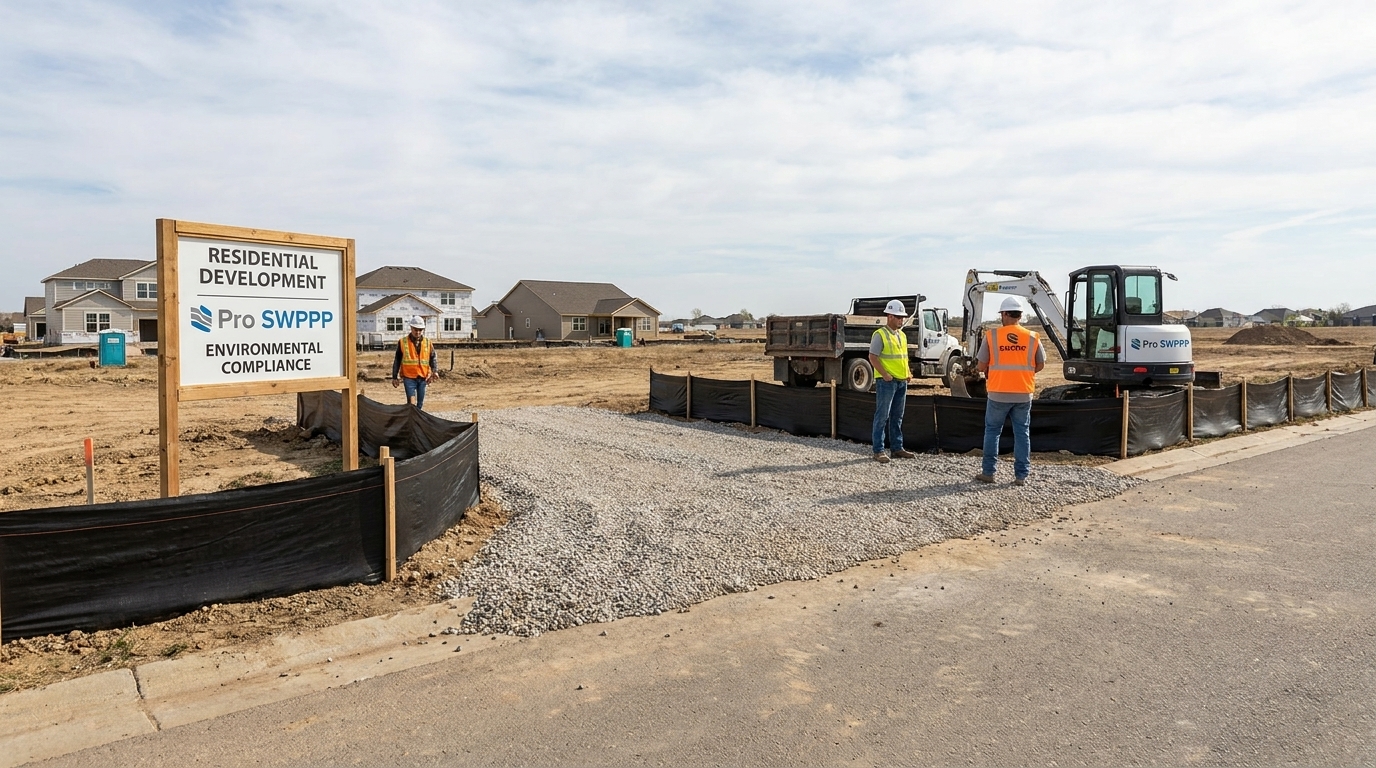
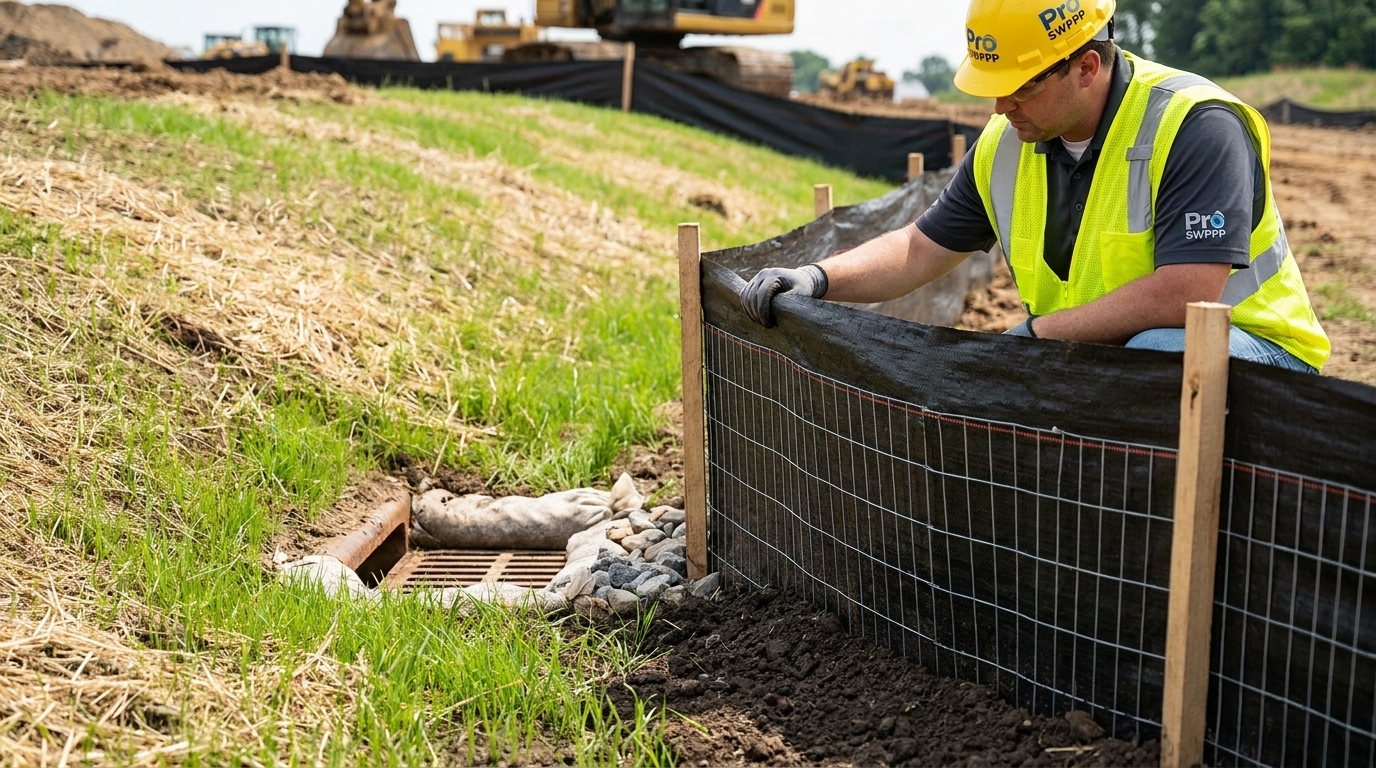
Best Management Practices (BMPs) are the physical controls you install to prevent sediment from leaving the site. Your SWPPP must list every BMP you’ll use and show where it goes on a site map. Common subdivision BMPs include:
- Silt fence around disturbed areas and along property lines
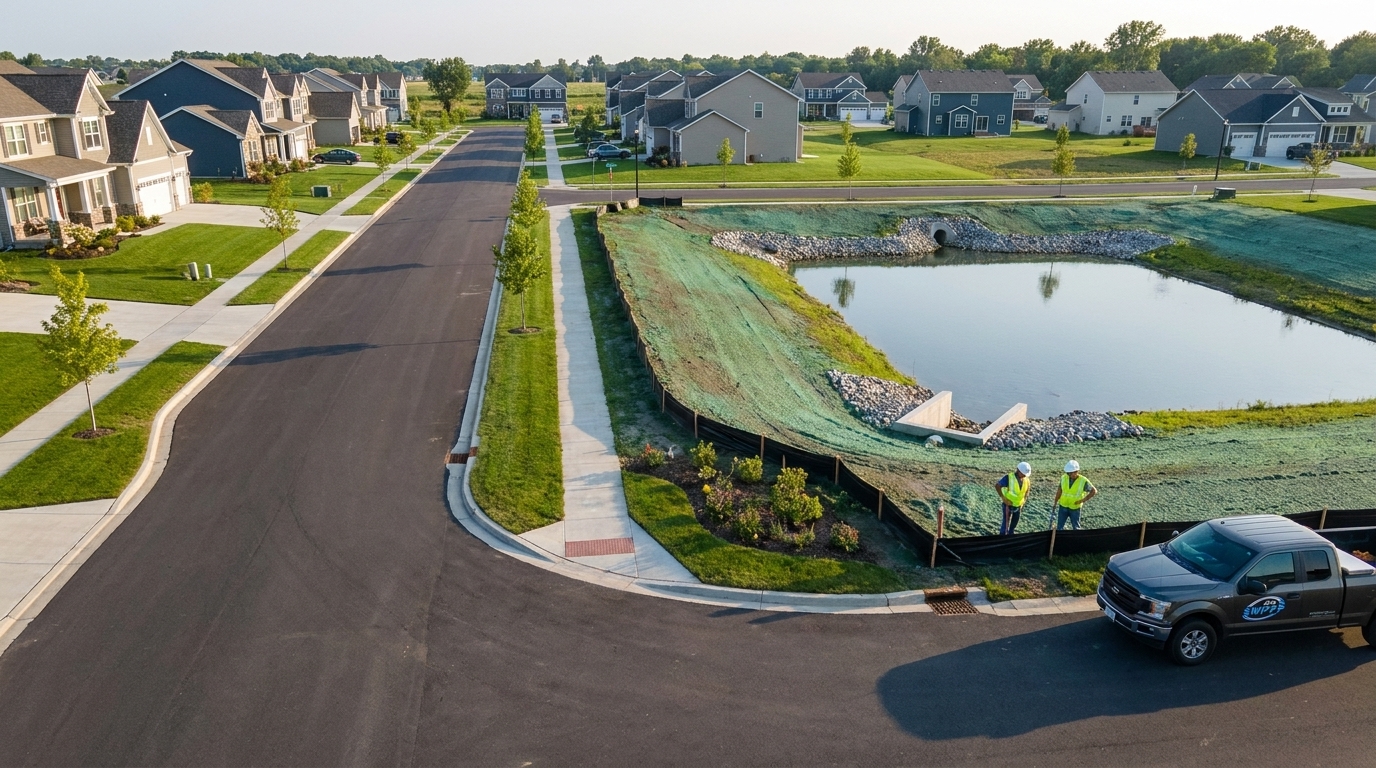
- Sediment basins or traps to capture runoff before it enters storm drains or streams
- Stabilized construction entrance (gravel pad) to prevent mud from tracking onto public roads
- Inlet protection on all storm drains
- Temporary seeding or mulch on graded areas that won’t be worked for more than 14 days
- Permanent seeding and landscaping as final stabilization
For home construction, you also need controls for concrete washout, paint and chemical storage, and waste disposal. Every one of these must be in the SWPPP and on the site map.
Site Map
The site map is one of the most important parts of the SWPPP. It must show:
- Property boundaries and total disturbance area
- Topographic contours and drainage flow directions
- Locations of all BMPs (silt fence, basins, inlets, construction entrance)
- Areas of disturbance and areas that will remain undisturbed
- Stormwater discharge points (where runoff leaves your site)
- Locations of material storage, concrete washout, and other potential pollutant sources
Inspectors will compare your site map to what they see on the ground. If your map shows a silt fence on the south property line but there’s no fence there, you’re in violation.
Inspection and Maintenance Schedule
Your SWPPP must include an inspection schedule. Under the 2022 EPA Construction General Permit, the standard schedule is an inspection at least once every seven calendar days and within 24 hours of the end of any storm event of 0.25 inches or more (or 3.25 inches of snowmelt). The 0.5-inch figure many contractors still quote came from the older 2017 permit and no longer applies. Some states require more frequent inspections or certified inspectors.
Each inspection must be documented in an inspection report. You must note any problems (damaged silt fence, sediment escaping the site, inlet protection missing) and fix them immediately. The SWPPP must describe who will do inspections and how you’ll track corrective actions.
Final Stabilization Criteria
The SWPPP must define when the site is “finally stabilized.” Typically, this means all land-disturbing activities are complete and permanent vegetation or other permanent stabilization measures are in place. For a subdivision, final stabilization happens in phases: roads and common areas might stabilize first, then individual lots as homes are finished and landscaped.
Until final stabilization, your permit coverage continues and you must maintain BMPs and conduct inspections. Pro SWPPP helps clients define realistic stabilization criteria so they can close out permit coverage as soon as compliance allows.
Don’t want to mess with all the paperwork? Order your SWPPP now with Pro SWPPP Professional CPESC Certified SWPPP Services.
How to Get Construction Stormwater Permit Coverage
Having a SWPPP isn’t enough. You must also obtain permit coverage by filing a Notice of Intent (NOI) with the appropriate regulatory agency. Operating without coverage is an unpermitted discharge under the Clean Water Act, and penalties can be severe.
Who Issues the Permit?
It depends on where you’re building. The EPA administers the Construction General Permit in a few states and territories (Massachusetts, New Hampshire, New Mexico, District of Columbia, and others). In these places, you file your NOI with EPA.
Most states run their own EPA-authorized NPDES programs. In Texas, you file with TCEQ. In Georgia, you file with EPD. In California, you file with the State Water Resources Control Board. Each state has its own permit number, forms, and online portal.
Before you file, confirm which agency has jurisdiction. If you’re working near Texas or Georgia, Pro SWPPP knows exactly where to file and what the current requirements are.
What’s in a Notice of Intent?
The NOI is a form that tells the regulatory agency who you are, where your site is, how much land you’ll disturb, and where stormwater will discharge. Typical NOI information includes:
- Operator name, address, and contact information
- Site location (address, GPS coordinates, receiving water body)
- Total acreage of disturbance
- Whether the site is part of a larger common plan (and if so, the total common plan acreage)
- Certification that a SWPPP has been prepared and will be implemented
Some states charge a permit fee with the NOI. Fees vary widely, from a few hundred dollars to several thousand for large projects.
Timing: When to File the NOI
You must have permit coverage before you start any land disturbance. Under the EPA CGP, coverage typically begins a certain number of days after the NOI is submitted (often 7 to 14 days), provided the NOI is complete and you meet eligibility requirements.
State permits may have different timelines. Some grant coverage immediately upon electronic submission. Others require a waiting period or agency approval. Always check the specific permit and file early. Starting work without coverage is an automatic violation.
Co-Permittees and Operator Changes
In a subdivision, you may need to amend the NOI or file a new one when operators change. For example:
- Developer files the original NOI and lists themselves as operator
- Builder buys a lot and starts construction; builder files an amended NOI or a separate NOI to become a co-permittee
- Grading contractor doing substantial earthwork may also need to be listed as an operator
Some states allow a master NOI for the whole subdivision with co-operators added as needed. Others require separate NOIs for each phase or lot. Pro SWPPP handles this coordination so no one falls through the cracks.
What It Costs to Comply (And What It Costs If You Don’t)
Contractors worry about the cost of SWPPPs and permits. The truth is, compliance is cheap compared to the cost of getting caught without it.
Actual Compliance Costs
For a typical small to mid-sized subdivision, expect these costs:
- NOI permit fee: Ranges from $100 to $2,000 depending on state and project size. Most states charge a few hundred dollars.
- SWPPP preparation: For a single-lot home, a simple SWPPP might cost $500 to $1,500. For a full subdivision master SWPPP, expect $2,000 to $10,000 depending on complexity, acreage, and number of phases.
- BMP installation: Silt fence, construction entrance gravel, inlet protection, and seeding materials typically cost a few thousand dollars for a small subdivision. Larger projects with sediment basins or complex drainage may run higher.
- Inspection and maintenance: Weekly inspections and BMP repairs are ongoing labor costs. If you hire a third-party inspector, budget a few hundred dollars per month.
Total compliance cost for a 20-lot subdivision might be $10,000 to $25,000 over the life of the project. That’s a tiny fraction of overall construction cost.
Noncompliance Costs
Now compare that to the cost of noncompliance. Under the Clean Water Act, penalties can be staggering:
- Civil administrative penalties: Up to $11,000 per violation. If you have multiple violations (no SWPPP, no NOI, sediment discharge, failed inspections), those stack up fast.
- Civil judicial penalties: Up to tens of thousands of dollars per day for ongoing violations. EPA and states regularly seek penalties in the hundreds of thousands for serious cases.
- Criminal penalties: For knowing or negligent violations, fines and imprisonment are possible. Knowing endangerment (e.g., discharging pollutants that harm people) can lead to years in prison.
EPA enforcement documents show real cases where contractors paid $50,000+ in penalties for operating without a SWPPP or failing to implement BMPs. States like Texas and Georgia have parallel enforcement authority and often pursue even higher penalties.
Beyond fines, you face:
- Work stoppages: Regulators can order you to halt construction until violations are corrected. Lost time costs far more than permit fees.
- Remediation costs: If sediment escapes your site and damages wetlands, streams, or neighboring property, you’ll pay for cleanup, restoration, and third-party damages.
- Reputational damage: Public enforcement actions get published. Clients and municipalities see that you violated stormwater rules. Future bids get harder.
Real Examples of SWPPP Penalties
EPA Region 10 enforcement worksheets document how penalties are calculated. Missing a SWPPP entirely can trigger penalties of $6,000 or more just for the SWPPP violation, plus additional amounts for each deficiency (no site map, no BMP plan, no inspection schedule). Operating without an NOI compounds the problem because every day of discharge is a separate violation.
Pro SWPPP has worked with clients who received Notices of Violation. In one case, a builder in a 15-lot subdivision assumed the developer’s permit covered him. It didn’t. The state fined him $18,000 and required third-party monitoring for six months, costing another $8,000. A $1,200 SWPPP and $300 NOI fee would have prevented the whole mess.
Recent Changes and What’s Coming Next
Stormwater rules are not static. EPA and states update permits, guidance, and enforcement priorities regularly. Here’s what has changed in the last few years and what’s on the horizon.
Updated Federal Guidance on Common Plans
EPA has released new factsheets and guidance emphasizing that sites under one acre must obtain permits if they’re part of a larger common plan. This guidance directly targets the “my lot is small” loophole. EPA is making it harder for builders to claim ignorance.
Regional EPA offices (especially Region 6, which covers several south-central states) have published detailed guidance on when a common plan starts and ends. This guidance clarifies that a common plan begins the moment documentation (plat, master plan) exists, and it doesn’t end just because a few years pass. Contractors relying on old assumptions are getting caught.
State Permit Renewals and Stricter Requirements
Many states renew their construction general permits every five years. Recent renewals in states like Texas, Georgia, and California have added:
- More specific BMP performance standards
- Mandatory electronic NOI filing through state portals
- Stricter inspection and reporting requirements (e.g., photo documentation, GPS coordinates of BMPs)
- Higher penalties for late NOIs or incomplete SWPPPs
No state is loosening the rules. The trend is toward more scrutiny, especially for subdivisions and other common plan projects.
Increased Enforcement and Technology
States are using satellite imagery, drone surveys, and citizen complaints to identify unpermitted construction. If you’re clearing land without a visible silt fence or construction entrance, inspectors can spot it from aerial photos and show up with a citation.
Enforcement is also becoming more automated. Some states cross-reference building permits with stormwater NOIs. If you pull a building permit but haven’t filed an NOI, you get flagged.
Pro SWPPP tracks these changes nationwide. When a state updates its permit or portal, we update our processes the same day so our clients stay compliant.
Practical Rules of Thumb for Subdivision Builders
Here’s what every contractor building in a residential subdivision should remember. Print this list and tape it to your truck dashboard.
Assume You Need a SWPPP Unless You Can Prove Otherwise
If the subdivision plan shows one acre or more of total disturbance, you need coverage. Don’t guess. Don’t trust verbal assurances from the developer. Confirm in writing that either you’re covered under an existing permit or you need to file your own NOI.
Lot Size Is Irrelevant
Stop looking at your individual lot size. Look at the total subdivision. A 0.3-acre lot in a 20-acre subdivision is part of a common plan. You need coverage.
Get the SWPPP Before You Move Dirt
EPA has fined contractors for preparing a SWPPP after construction started. The SWPPP must be ready before the first shovel hits the ground. If you’re doing pre-construction clearing or grubbing, that counts as land disturbance. You need the SWPPP first.
Document Everything
Keep copies of your NOI, permit coverage letter, SWPPP, and all inspection reports. If an inspector shows up, you need to produce these documents on the spot. Pro SWPPP provides clients with a complete compliance binder and digital copies so you’re always ready.
Inspect Weekly and After Every Storm
Most violations happen because BMPs fail and no one notices. Silt fence tears. Inlet protection washes away. Sediment escapes. Weekly inspections catch these problems before regulators do. After every storm of 0.25 inches or more, walk the site and check every control.
Want a number before you commit? Get a free SWPPP estimate for your subdivision.
Plan for Final Stabilization
Your permit coverage doesn’t end when you finish the house. It ends when the site is finally stabilized. That means permanent grass, landscaping, driveways, and no bare soil. Don’t stop maintaining BMPs until you’ve documented final stabilization and filed a Notice of Termination (NOT) with the regulatory agency.
Not sure what your project needs? Schedule a Free SWPPP Consultation with CPESC Certified SWPPP Expert Derek E. Chinners.
Why Pro SWPPP is the SWPPP Service Contractors Trust
Pro SWPPP is a family-owned firm with 20+ years in stormwater compliance, and we’ve been protecting contractors from the common plan trap that whole time. We write SWPPPs nationwide, from single-lot homes to 500-acre master-planned communities, and hold 180+ five-star Google reviews. Our team is led by CPESC (Certified Professional in Erosion and Sediment Control) certified experts who know the federal baseline and every state variation.
CPESC Certified Expertise
Our lead professional, Derek E. Chinners, holds the CPESC certification. This is the gold standard credential in stormwater and erosion control. When you work with Pro SWPPP, you’re not getting a generic template from a non-expert. You’re getting a plan reviewed and certified by someone who has passed rigorous national exams and maintains continuing education.
This matters when inspectors audit your site. A CPESC-certified SWPPP carries weight. Inspectors know it was done right.
72-Hour Turnaround
Contractors need speed. You don’t have weeks to wait for a SWPPP. Pro SWPPP delivers complete, site-specific SWPPPs in 72 hours or less. We’ve built systems and templates that let us move fast without cutting corners. You get a compliant plan before your project timeline slips.
Nationwide Coverage
We operate nationwide, fromTexas to Georgia and beyond. We know the EPA CGP baseline and we know every state’s quirks. Texas TCEQ has different NOI forms than Georgia EPD. California requires Risk Level determination. New York has additional erosion control requirements. Pro SWPPP handles all of it so you don’t have to research 50 different state rules.
We Handle NOI Filing and Agency Coordination
Pro SWPPP doesn’t just write your plan and disappear. We help you file your NOI, track permit coverage, and communicate with regulators if questions arise. If you’re a builder in a subdivision and need to be added as a co-permittee, we coordinate with the developer and the state to make it happen.
Compliance Support Throughout Your Project
Once your SWPPP is in place, Pro SWPPP remains available for questions. BMP not working? Call us. Inspector asked for plan revisions? We’ll update it. Need help documenting final stabilization? We’ll walk you through it. Our goal is zero violations and zero delays for every client.
Learn more about our team and process at Pro SWPPP About, or get a free SWPPP estimate for your project.
FAQ
Do I need a SWPPP if my lot is only half an acre?
Yes, if your lot is part of a larger subdivision that will disturb one acre or more total. The half-acre threshold only matters if your project is completely independent and not part of any larger common plan. In a subdivision, you’re part of the common plan, so you need coverage regardless of individual lot size.
Who is responsible for getting the SWPPP in a subdivision – the developer or the builder?
It depends on who is the “operator” under the stormwater rules. The developer is usually the operator during infrastructure work and may obtain a master permit covering the whole subdivision. Individual builders become operators when they take control of lots and start construction. Some states require builders to file their own NOIs and SWPPPs. Always confirm in writing who holds permit coverage before starting work.
Can I use the same SWPPP for every lot in a subdivision?
A master SWPPP can cover the entire subdivision if it includes site-specific details for each phase or lot. However, as individual builders take over lots, they often need to update the SWPPP with lot-specific BMPs, grading plans, and final stabilization measures. Pro SWPPP can create a master plan and then provide lot-specific addendums as needed.
What happens if I start building without a SWPPP or permit coverage?
You are in violation of the Clean Water Act. Penalties can include fines of up to $11,000 per violation per day, mandatory work stoppages, required remediation, and potential criminal charges for knowing violations. Inspectors can also require third-party monitoring at your expense. The cost of noncompliance almost always exceeds the cost of doing it right from the start.
How long does it take to get permit coverage for a subdivision?
It varies by state. Under the EPA Construction General Permit, coverage typically begins 7 to 14 days after submitting a complete NOI. Some states grant coverage immediately upon electronic submission. Others may take several weeks if review or approval is required. Always file your NOI well before you plan to start construction. Pro SWPPP can expedite the process and ensure your NOI is complete the first time.
Does the common plan rule apply to commercial or industrial subdivisions too?
Yes. The common plan rule applies to any type of development: residential, commercial, industrial, or mixed-use. If a developer plats an industrial park, builds roads and utilities, and sells pads to different companies, that’s a common plan. Every company disturbing land in that park needs stormwater permit coverage, just like in a residential subdivision.
When can I terminate my construction stormwater permit?
You can file a Notice of Termination (NOT) once the site reaches final stabilization. Final stabilization means all land-disturbing activities are complete and permanent vegetation or other permanent stabilization measures are in place. For a home, that typically means the yard is seeded or sodded, driveways and walkways are paved, and no bare soil remains. Some states also require that temporary BMPs be removed and the site be cleaned up. Until you file the NOT and it’s accepted, your permit coverage and inspection obligations continue.
Ready to get started? Order your SWPPP now or schedule a free consultation with Pro SWPPP.
Visit Pro SWPPP and see why contractors nationwide rate us 180+ five-star Google reviews.
Still have questions about your subdivision? Schedule a free call with a stormwater expert.
By Derek E. Chinners, CPESC — Founder & Stormwater Consultant, Pro SWPPP, LLC
Related: What Is a SWPPP? · When Is a SWPPP Required? The 1-Acre Rule and Common Plans · Utah SWPPP Requirements · Texas SWPPP Requirements (SWP3)
For more information on federal stormwater regulations, see the EPA NPDES Construction Stormwater page.