Pro SWPPP – America’s #1 SWPPP Service – helps contractors across the country answer one of the most common questions on any warehouse or distribution center build: does your project need a SWPPP? The short answer is almost always yes. If you’re disturbing one acre or more of land – or you’re part of a larger development that adds up to one acre – you need a Stormwater Pollution Prevention Plan and a construction stormwater permit before the first dozer blade touches dirt. Miss this step and you’re looking at stop-work orders, daily fines, and a very unhappy owner.
Warehouse and distribution center construction has exploded over the last decade. E-commerce has driven demand for millions of square feet of new logistics space. That means more grading, more paving, more exposed soil, and more stormwater runoff carrying sediment straight into storm drains and streams. The EPA and every state environmental agency know this. They enforce construction stormwater rules aggressively on industrial sites, and warehouses fall squarely into the regulated categories.
This guide walks you through exactly when a warehouse or DC build needs a SWPPP, what triggers federal and state permit requirements, who enforces them, what happens if you skip coverage, and how Pro SWPPP takes the entire burden off your plate so you can focus on building instead of paperwork.
Not sure whether your build crosses the threshold? Take the 60-second SWPPP quiz and find out before you mobilize.
Does Every Warehouse or Distribution Center Construction Project Need a SWPPP?
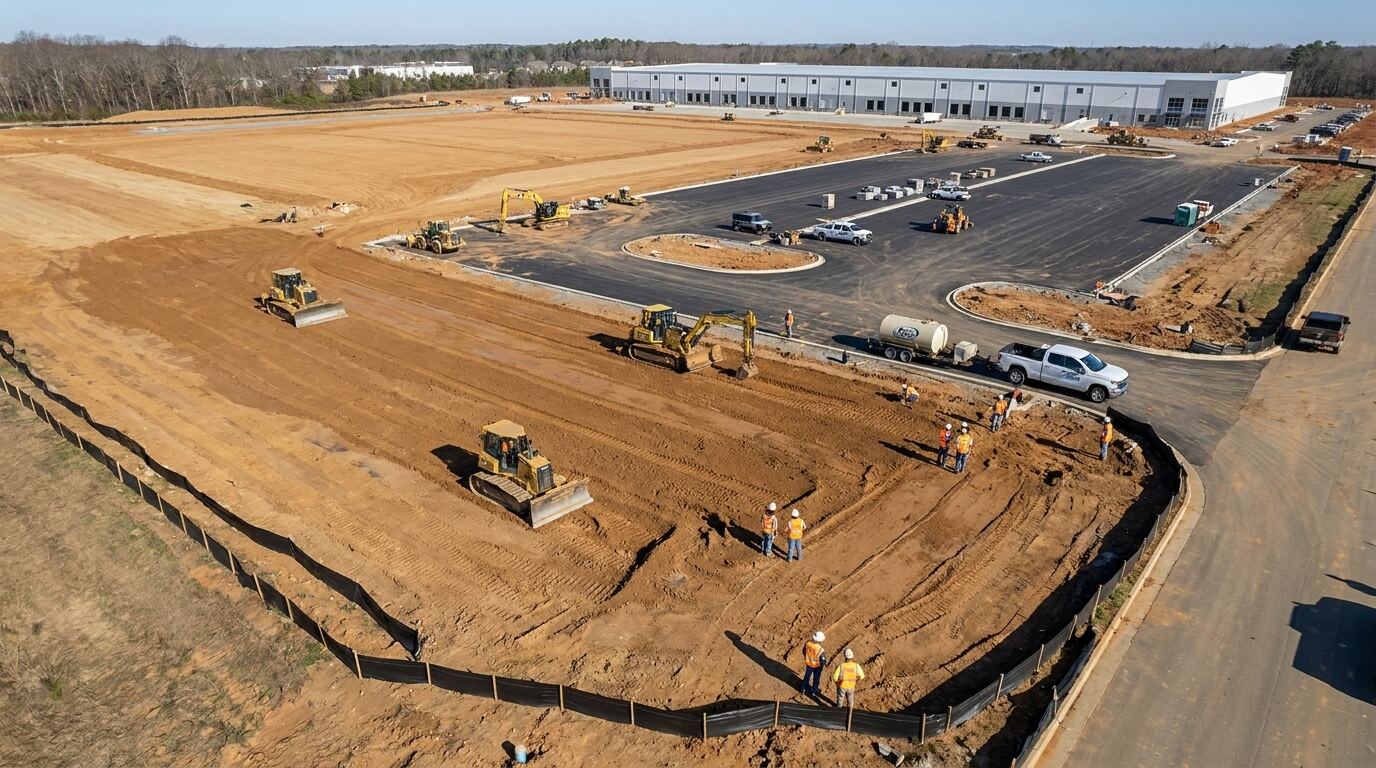
Not every project, but almost every project. Under the federal Clean Water Act and the National Pollutant Discharge Elimination System, any construction activity that disturbs one acre or more of land and discharges stormwater to waters of the United States or a regulated storm sewer system must have an NPDES construction stormwater permit. That permit requires you to write and implement a SWPPP before you start work.
The one-acre threshold is surprisingly easy to hit. A typical warehouse pad, parking lot, access roads, utility corridors, and staging areas routinely exceed one acre of disturbance. Even a modest 100,000 square foot distribution center with truck courts and employee parking will push you over that line. Pro SWPPP has prepared plans for hundreds of warehouse projects, and nearly all of them met or exceeded the one-acre trigger.
The second rule is the common plan of development or sale. If your warehouse pad is only 0.7 acres but it sits inside a 20-acre industrial park, you still need coverage. EPA defines a common plan broadly. Any sign, plat, advertisement, zoning request, or permit application that ties multiple parcels together makes them one development. Contractors sometimes try to break a large park into separate sub-one-acre phases to dodge the permit. Regulators see right through that, and you’ll get hit with an enforcement action for unpermitted discharge.
The One-Acre Rule in Practice
One acre is 43,560 square feet. A single warehouse building footprint can easily be 200,000 to 500,000 square feet or more. Add in grading for drainage, perimeter roads, trailer parking, and loading docks, and you’re looking at many acres of disturbed soil. Even smaller flex-industrial warehouse buildings often disturb more than one acre once you account for site improvements.
If your project truly disturbs less than one acre, is not part of a larger common plan, and all stormwater infiltrates on-site with no discharge to any water body or storm drain, you might not need an NPDES construction permit. But that scenario is rare. Most warehouse sites connect to municipal storm sewer systems, and any discharge into an MS4 is regulated. Pro SWPPP recommends that if you’re anywhere close to the one-acre threshold, assume you need coverage and prepare your SWPPP early.
Common Plan of Development: The Hidden Trigger
The common plan trap catches contractors all the time. You might be building one 80,000 square foot warehouse on a three-quarter-acre lot. But if that lot is part of a 15-acre business park master plan, the entire park is the common plan. Every individual building pad within that park needs its own permit coverage, even if each pad alone is under one acre.
Regulators look for clues: recorded plats, shared infrastructure, joint marketing materials, combined zoning applications, and common ownership or financing. If any of those links exist, you’re part of a common plan. Pro SWPPP reviews project documents during our intake process to identify common plan issues before they become problems. We’ve saved clients from starting work on what they thought was a small exempt site, only to discover it was part of a larger development requiring full permit coverage.
Who Issues the Permit and Sets the SWPPP Rules?
The federal EPA sets the baseline rules under the Clean Water Act, but most states run their own authorized NPDES programs. That means the specific permit you apply for, the forms you fill out, the fees you pay, and the exact SWPPP requirements depend on which state your warehouse project is in. Pro SWPPP operates nationwide and knows the local rules inside and out.
In a handful of states and territories – Massachusetts, New Hampshire, New Mexico, the District of Columbia, and certain tribal lands – EPA is the permitting authority. In those areas, your project is covered by EPA’s Construction General Permit, also called the CGP. You file a Notice of Intent electronically through EPA’s NPDES eReporting Tool, and your SWPPP must meet the requirements spelled out in Part 7 of the federal CGP.
In the other 46 states, the state environmental agency issues construction stormwater permits under its own Construction General Permit. For example, in Texas you work with TCEQ and file through their online portal. In Georgia, it’s Georgia EPD and the Land Disturbance Permit. In California, the State Water Resources Control Board issues the Construction General Permit and requires electronic NOI filing through SMARTS. Every state has a slightly different name, process, and set of forms, but they all require a SWPPP that meets or exceeds the federal baseline.
Federal EPA Baseline: The Construction General Permit
EPA’s Construction General Permit establishes the minimum national standard. The current 2022 CGP is in effect until February 2027 and covers construction sites that disturb one acre or more. Before you submit your Notice of Intent, you must develop a complete SWPPP. The SWPPP must describe your site, identify all potential pollutant sources, list the best management practices you’ll use to control erosion and sediment, lay out your construction sequence, and establish inspection and maintenance procedures.
EPA provides a SWPPP template and detailed guidance for construction sites. The template is a good starting point, but every SWPPP must be site-specific. Copy-paste templates that don’t reflect actual site conditions are a red flag during inspections. Pro SWPPP writes every plan from scratch, tailored to your warehouse project’s grading, drainage, BMP locations, and construction phasing.
State Programs: Same Floor, Stricter Walls
State programs must meet or exceed the federal CGP requirements, and most states add stricter rules. Common state-level differences include shorter stabilization deadlines, mandatory sediment basin sizing formulas, more frequent inspection schedules, and numeric limits tied to impaired waters or TMDLs. Some states require you to upload your SWPPP or key sections when you submit your NOI, while others just want a certification that you have one on-site.
For warehouse and distribution center projects, the practical impact is more prescriptive BMP standards and less flexibility. States like California and Washington have detailed stormwater manuals that specify exactly what types of perimeter controls, stabilization methods, and post-construction treatment you need. States like Texas and Georgia enforce aggressively and conduct frequent unannounced inspections. Pro SWPPP stays current on every state’s latest permit version and ensures your plan checks every box.
Local MS4 Oversight
Don’t forget the local layer. Many cities and counties operate Municipal Separate Storm Sewer Systems and have their own erosion and sediment control ordinances. Even if you have your state or EPA construction permit, the local MS4 may require you to submit a copy of your SWPPP, obtain a local grading permit, and pass city inspections. Some MS4s charge separate fees and issue their own stop-work orders if BMPs aren’t maintained.
Pro SWPPP coordinates with local MS4 requirements as part of our service. We know which cities require plan submittals, which require pre-construction meetings, and which send inspectors weekly. We include local contact information and ordinance references in your SWPPP so your site manager has everything in one place.
What Has to Be in a Warehouse or DC SWPPP?
A SWPPP for a warehouse or distribution center construction project is not a generic document. It’s a detailed, site-specific plan that describes your project, your site conditions, your construction sequence, and exactly how you will prevent stormwater pollution from leaving the site. Pro SWPPP prepares hundreds of these plans every year, and we know what regulators expect to see.
Every SWPPP must include a site map showing limits of disturbance, existing and proposed contours, drainage patterns, locations of BMPs, stormwater outfalls, sensitive areas, and staging or stockpile areas. For a warehouse project, that map will show the building pad, paved truck courts, loading docks, parking lots, access roads, utility corridors, sediment basins, perimeter silt fencing, stabilized construction entrances, and any post-construction stormwater controls like detention ponds or bioretention areas.
The SWPPP must describe your construction sequence. When will you clear and grub? When will mass grading occur? When will you install storm drains and utilities? When will the building slab be poured? When will paving happen? When will final stabilization be complete? Regulators want to see that you’ve thought through the phasing so you’re not leaving large areas of exposed soil sitting idle for months.
Erosion and Sediment Controls (Construction BMPs)
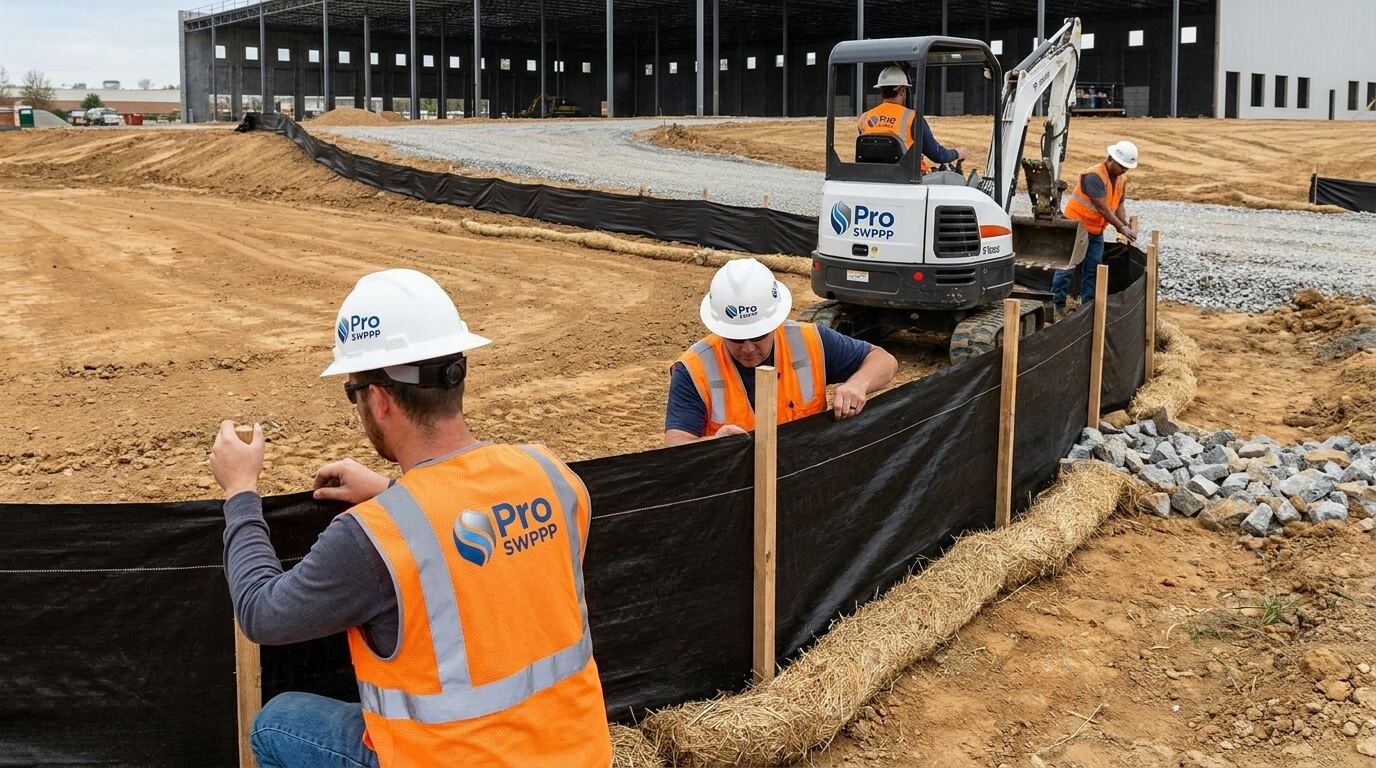
The heart of the SWPPP is the list of best management practices you’ll implement to control erosion and trap sediment on-site. For warehouse construction, typical BMPs include:
- Perimeter controls: Silt fence, fiber rolls, or berms around the limits of disturbance to keep sediment from leaving the site.
- Stabilized construction entrance: A rock pad at every site access point to knock mud off truck tires and prevent track-out onto public roads.
- Sediment basins or traps: Temporary ponds or sumps that capture runoff from large drainage areas and allow sediment to settle before water leaves the site.
- Inlet protection: Gravel bags, filter fabric, or silt sacks around storm drain inlets to catch sediment before it enters the storm sewer.
- Slope stabilization: Temporary seeding, erosion control blankets, hydromulch, or tackifier applied to slopes and disturbed areas that won’t be worked for more than a few days.
- Dust control: Water trucks or soil stabilizers to prevent wind erosion on large warehouse pads during dry weather.
- Stockpile management: Perimeter controls and covers for soil, sand, or aggregate stockpiles to prevent washout during storms.
Pro SWPPP doesn’t just list generic BMPs. We specify installation details, maintenance frequencies, and trigger thresholds so your field crew knows exactly what to do and when. For example, we’ll note that perimeter silt fence must be inspected weekly and after every storm event of 0.25 inches or more, and any tears or undermining must be repaired within 24 hours.
Pollution Prevention Measures
Warehouse construction involves more than just dirt. You’ll have fuel and equipment on-site, concrete washout, material deliveries, and waste management. The SWPPP must address all potential pollutant sources. Typical pollution prevention measures include:
- Concrete washout area: A lined pit or containment where ready-mix trucks can rinse chutes, preventing alkaline water from running into storm drains.
- Equipment maintenance: Performing oil changes, refueling, and repairs in a designated area with spill containment, never in the middle of the site.
- Material storage: Keeping chemicals, paints, solvents, and other hazardous materials under cover or in secondary containment.
- Spill response: A spill kit on-site and a written procedure for cleanup and reporting.
- Waste management: Proper disposal of trash, construction debris, and hazardous waste to prevent litter and contamination.
These measures are often overlooked on fast-moving warehouse projects, but they’re required by the permit and they’re common inspection findings. Pro SWPPP includes clear instructions and site-specific locations for pollution prevention BMPs so your crew knows where to set up washout pits and spill kits on day one.
Inspection and Maintenance Procedures
Your SWPPP must spell out how often you’ll inspect the site, who will conduct inspections, what you’ll look for, and how you’ll document findings and corrective actions. Under the 2022 EPA Construction General Permit the standard schedule is an inspection at least once every seven calendar days and within 24 hours of the end of any storm event producing 0.25 inches of rain or more (or 3.25 inches of snowmelt). The 0.5-inch trigger many contractors still quote came from the older 2017 permit. Some states require more.
Want a number before you commit? Get a free SWPPP estimate for your warehouse or distribution center build.
For a large warehouse project with multiple contractors on-site, inspection responsibility usually falls to the general contractor’s site superintendent or a dedicated environmental inspector. Pro SWPPP provides inspection checklists and log templates as part of every plan. We train your team on what to look for: broken silt fence, clogged inlet protection, unstabilized slopes, tracked sediment on roads, and any signs of discharge leaving the site.
When an inspection finds a problem, the permit requires you to fix it as soon as possible, typically within 24 to 72 hours depending on the severity. Documentation is critical. Regulators will ask to see your inspection logs during site visits. Missing or incomplete logs are an automatic violation. Pro SWPPP’s plans include clear corrective action procedures and record-keeping requirements so you stay compliant from start to finish.
When Do You Need the SWPPP and Permit in Place?
You must have your SWPPP written and your permit coverage in place before you begin any land-disturbing activity. That means before clearing, grubbing, grading, excavation, demolition, or stockpiling. If an inspector shows up on day one of earthwork and you don’t have a permit or a SWPPP on-site, you’re in violation and you’ll get a stop-work order on the spot.
The sequence is simple: develop the SWPPP first, then submit your Notice of Intent, then wait for permit authorization or coverage to go into effect, then and only then can you start moving dirt. Some states issue permit coverage immediately upon NOI approval, while others require a waiting period or issue a written authorization letter. Pro SWPPP knows the timing for every state and builds it into your project schedule.
Don’t wait until the week before mobilization to think about your SWPPP. Permitting timelines vary. In some states, electronic NOI approval is instant. In others, it can take one to two weeks or more, especially if your site is in a sensitive watershed or the agency requests additional information. Pro SWPPP offers 72-hour turnaround on SWPPP preparation so you’re never the reason your project is delayed.
Who Is the Operator?
The permit requires every “operator” to obtain coverage. An operator is anyone who has operational control over construction plans and specifications or over day-to-day activities necessary to ensure compliance with the SWPPP. On most warehouse projects, that means both the owner-developer and the general contractor are operators and both must be named on the NOI.
Some owners try to push all permit responsibility onto the GC. Some GCs try to push it onto the owner. That doesn’t work. EPA and state agencies hold both parties responsible. If stormwater violations occur, both the owner and the GC can be named in an enforcement action. Pro SWPPP coordinates with all parties to ensure everyone is listed correctly on the permit and everyone understands their compliance obligations.
Don’t want to mess with all the paperwork? Order your SWPPP now with Pro SWPPP Professional CPESC Certified SWPPP Services.
What Happens If You Build Without a SWPPP or Violate Permit Conditions?
Violations of the Clean Water Act and NPDES permit conditions are serious. Penalties can include administrative orders, civil fines, and in extreme cases, criminal prosecution. Pro SWPPP has seen enforcement actions shut down warehouse projects for weeks and cost developers and contractors hundreds of thousands of dollars in fines, legal fees, and remediation.
The most common violation is starting construction without permit coverage. If you disturb one acre or more and discharge stormwater without a permit, you’re violating the Clean Water Act. EPA and state agencies can assess civil penalties up to tens of thousands of dollars per day per violation. The clock starts the day you begin grading and runs until you obtain coverage and come into compliance.
Other common violations on warehouse projects include failure to install or maintain BMPs, allowing sediment to discharge off-site, missing inspection logs, and not updating the SWPPP when site conditions change. Any of these can trigger enforcement. Inspectors often show up unannounced. If your silt fence is torn down, your stabilized entrance is buried in mud, or you have no SWPPP on-site, expect a violation notice.
Stop-Work Orders and Project Delays
A stop-work order is the fastest way to blow a construction schedule. If an inspector finds you working without a permit or with inadequate BMPs, they can issue an immediate order to cease all land-disturbing activities. Your crews sit idle while you scramble to obtain coverage, install BMPs, and convince the agency you’re back in compliance. That can take days or weeks, and every day costs money.
For a large warehouse or distribution center build, a stop-work order can cascade through the entire project. Grading delays push back foundation work, which pushes back steel erection, which pushes back the occupancy date. Owners get angry. Banks get nervous. Pro SWPPP helps you avoid that nightmare by getting your SWPPP and permit handled correctly the first time, before the first shovel hits the ground.
Fines, Consent Decrees, and Supplemental Environmental Projects
Civil penalties for Clean Water Act violations are assessed per day and per outfall. A large warehouse site with multiple discharge points can rack up fines quickly. Settlements often include not just cash penalties but also supplemental environmental projects: stream restoration, watershed monitoring, or other mitigation work that costs additional money and time.
Repeat violators or companies with a history of non-compliance face higher penalties and more intrusive oversight. EPA and state agencies publish enforcement actions publicly, which can damage your reputation with owners and lenders. Pro SWPPP’s clients avoid enforcement because we build compliance into the plan from day one and provide ongoing support throughout construction.
Post-Construction Industrial Stormwater: What Happens After the Warehouse Is Built?
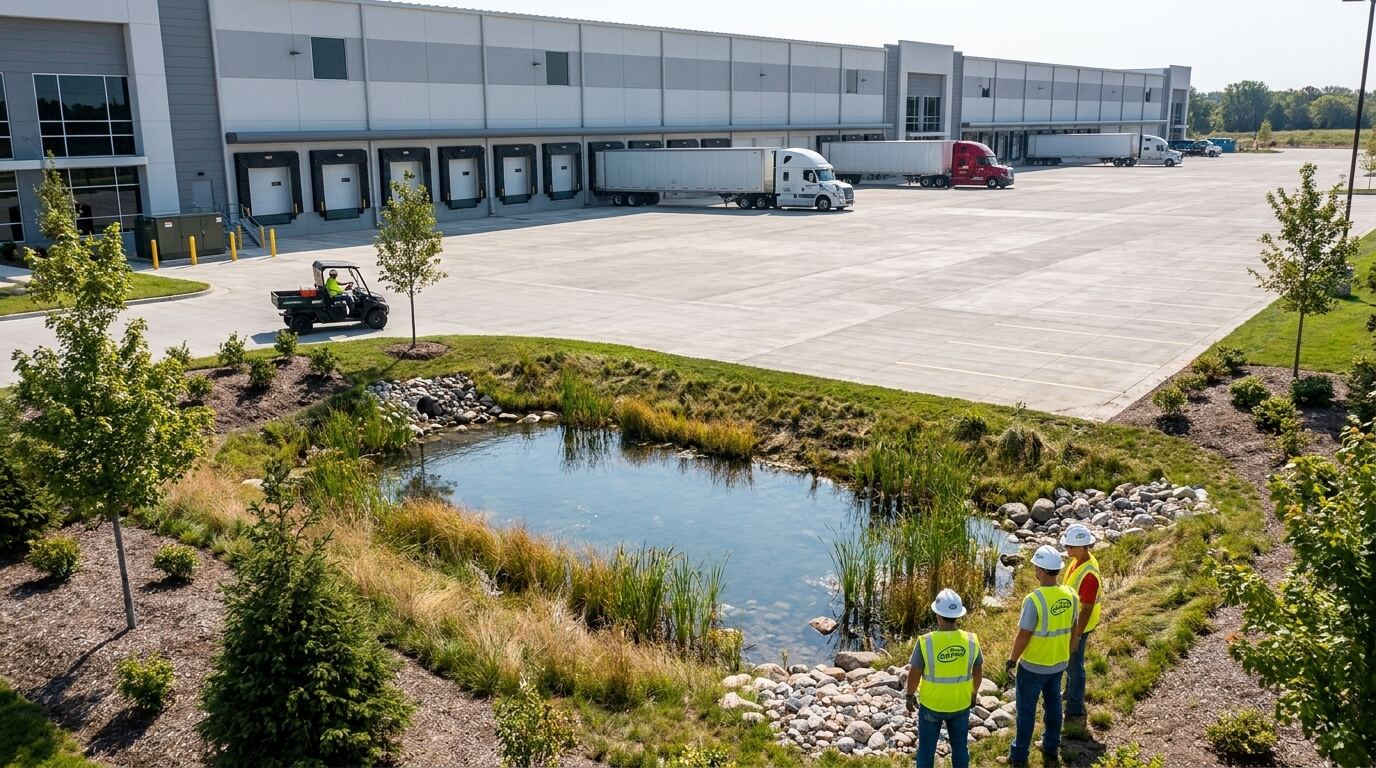
Once your warehouse or distribution center is operating, construction stormwater permitting ends, but industrial stormwater permitting may begin. Public warehousing and storage is listed as a regulated industrial category under federal NPDES rules. If your facility has stormwater discharge associated with industrial activity, the owner must obtain an industrial stormwater permit and maintain an industrial SWPPP.
However, many warehouses and DCs qualify for a “no exposure” exclusion. If all industrial materials and activities are under storm-resistant shelter – meaning no outdoor storage of product, no outdoor loading, no uncovered waste, and no exposed machinery or materials that could contact stormwater – the facility can file a No Exposure Certification instead of obtaining an industrial stormwater permit.
This is a critical decision for the building owner and operator. If you design your warehouse with fully enclosed loading docks, indoor truck bays, covered dumpsters, and no outdoor storage, you can avoid the ongoing cost and compliance burden of an industrial stormwater permit. If you have outdoor pallet storage, open-air loading, or equipment parking, you’ll need industrial permit coverage and an ongoing industrial SWPPP.
Construction vs. Industrial SWPPPs
Don’t confuse the two. The construction SWPPP covers the dirt work, grading, and building activities. It expires when you complete final stabilization and file a Notice of Termination. The industrial SWPPP covers the operating facility and its ongoing stormwater discharges. It stays in effect as long as the building is in use.
Pro SWPPP prepares both construction and industrial SWPPPs. If your warehouse will need industrial permit coverage after construction, we can bundle both services and coordinate the transition so there’s no gap in compliance. We also help owners evaluate whether they can achieve no exposure status through facility design changes, which can save thousands of dollars in annual permit fees and inspection costs.
Recent Changes to Federal and State SWPPP Rules
Stormwater regulations are not static. EPA and state agencies update permits and guidance regularly, and contractors need to stay current. Pro SWPPP tracks every change so your project is always compliant with the latest rules.
EPA’s current Construction General Permit took effect in 2022 and runs through February 2027. It kept the one-acre threshold, reinforced the requirement to develop a complete SWPPP before submitting your NOI, and added more detail on BMP selection and water quality protection. EPA has also proposed a new 2027 CGP that will introduce even stricter requirements.
Proposed 2027 Federal CGP: What’s Coming
EPA published a draft 2027 Construction General Permit in August 2024. Key proposed changes include:
- SWPPP submission with NOI: EPA is proposing to require applicants to submit an electronic copy of the SWPPP, a website link to the SWPPP, or at minimum the SWPPP site map and a signed certification when filing the NOI. This makes the SWPPP much more visible to regulators and pushes operators to finish the plan earlier.
- Stabilization before sediment basins: The draft CGP requires sites that install a sediment basin to implement stabilization measures before directing stormwater flows into the basin. That means you can’t just route raw runoff from bare soil directly into a pond; you need vegetative cover or other stabilization upstream.
- Clearer water quality standards: The proposed permit replaces the broad requirement to “meet applicable water quality standards” with more specific indicator-based limits applied to all permittees, not just those in impaired watersheds.
These changes will make SWPPP preparation and compliance more demanding. Pro SWPPP is already preparing for the new permit and incorporating best practices from the draft into current plans so our clients are ahead of the curve when the final rule takes effect.
State-Level Updates
States are also tightening rules. In the last two to three years, many states have moved to electronic NOI portals, increased permit fees, added numeric effluent limits for sites discharging to impaired waters, and required more frequent inspections. States like Texas and Georgia have updated their CGPs to include stricter stabilization deadlines and mandatory training for site operators.
Pro SWPPP monitors state regulatory calendars and participates in stakeholder comment periods. When a state updates its CGP or issues new guidance, we update our templates, checklists, and training materials immediately. Our clients never get caught off guard by a new rule they didn’t know about.
Practical Checklist: How to Get SWPPP and Permit Coverage for Your Warehouse or DC Build
Here’s a step-by-step roadmap for contractors and owners preparing to build a warehouse or distribution center:
- Measure total disturbance: Add up the building pad, parking, access roads, utilities, staging areas, and any grading. If it’s one acre or more, you need coverage.
- Check for a common plan: Is your project part of a larger industrial park or phased development? If yes, even a small pad may require a permit.
- Identify the permitting authority: Find out if your state runs its own NPDES program or if EPA is the authority. Pro SWPPP handles this research for you.
- Develop the SWPPP: Write a complete, site-specific plan that includes a site map, construction sequence, BMPs, pollution prevention measures, and inspection procedures. Use Pro SWPPP to get a CPESC-certified plan in 72 hours.
- File the Notice of Intent: Submit your NOI through the state or EPA online portal, naming all operators and attaching any required fees or documents.
- Wait for coverage: Confirm your permit is active before starting dirt work. Some states issue instant coverage, others take a week or more.
- Implement BMPs before disturbance: Install perimeter controls, stabilized entrances, and inlet protection before the first load of dirt is moved.
- Conduct weekly inspections: Keep detailed logs and fix any problems within 24 to 72 hours.
- Update the SWPPP as conditions change: If your site layout changes, add new BMPs or update the map.
- File a Notice of Termination: Once final stabilization is complete and all temporary BMPs are removed, file your NOT to close out the permit.
Pro SWPPP guides clients through every step. We prepare the SWPPP, assist with NOI filing, provide inspection training, and offer ongoing support until your NOT is accepted. You get a single point of contact and no surprises.
Not sure what your project needs? Schedule a Free SWPPP Consultation with CPESC Certified SWPPP Expert Derek E. Chinners.
Why Pro SWPPP is the SWPPP Service Contractors Trust
Pro SWPPP is a family-owned firm with 20+ years in stormwater compliance, helping contractors and developers nationwide navigate construction stormwater rules. We’ve prepared SWPPPs for warehouse and distribution center projects from small flex buildings to multi-million-square-foot logistics hubs, and we hold 180+ five-star Google reviews.
Our team is led by CPESC-certified professionals who understand both the regulatory requirements and the realities of construction schedules. We know that warehouse projects move fast, budgets are tight, and delays cost money. That’s why we offer 72-hour turnaround on SWPPP preparation and same-day support when questions come up in the field.
CPESC Certified and Regulatory Expertise
Every SWPPP we prepare is reviewed and stamped by a Certified Professional in Erosion and Sediment Control. That certification means our staff have passed rigorous exams on stormwater regulations, BMP design, and compliance strategies. When a state inspector reviews your plan, they see a professional credential they respect.
We stay current on every state’s latest permit version, guidance documents, and enforcement priorities. We’ve worked with TCEQ, Georgia EPD, California SWRCB, and dozens of other state agencies. We know what they look for during inspections and what triggers enforcement. Pro SWPPP builds that knowledge into every plan so you pass inspections the first time.
Speed Without Sacrificing Quality
Most consultants take two weeks or more to deliver a SWPPP. Pro SWPPP delivers in 72 hours or less without cutting corners. We use a streamlined intake process, advanced mapping tools, and a library of state-specific templates that we customize for your project. You get a complete, site-specific, permit-ready plan in three days or less.
Speed matters on warehouse projects. Owners expect fast-track schedules and just-in-time permitting. When you order your SWPPP from Pro SWPPP, you won’t be the bottleneck holding up mobilization.
Ongoing Support and Training
A SWPPP is only as good as the crew implementing it. Pro SWPPP doesn’t just hand you a binder and wish you luck. We provide site-specific inspection checklists, corrective action logs, and training materials so your superintendent and foremen know exactly what to do.
If an inspector shows up and finds an issue, you can call us. We’ll help you write the corrective action report, update the SWPPP if needed, and get you back into compliance fast. That level of support is included in every Pro SWPPP plan. You’re not alone out there.
Trusted by Contractors Nationwide
Pro SWPPP has prepared SWPPPs for general contractors, developers, site work companies, and warehouse operators in every region of the country. We’ve worked on projects for Fortune 500 logistics companies, regional industrial developers, and local contractors building their first distribution center.
Our clients come back project after project because we deliver what we promise: fast, accurate, compliant SWPPPs backed by real expertise and responsive support. When you work with Pro SWPPP, you’re working with a team that understands your business and your deadlines.

FAQ
Does a warehouse or distribution center build always need a SWPPP?
Almost always. Any warehouse project that disturbs one acre or more of land, or is part of a larger development that totals one acre or more, and discharges stormwater to a water body or storm sewer system needs a SWPPP and an NPDES construction stormwater permit. The only exceptions are very small projects under one acre that are not part of a common plan and do not discharge off-site.
How long does it take to get a SWPPP and permit for a warehouse project?
Pro SWPPP delivers a complete, permit-ready SWPPP in 72 hours or less. After you submit your Notice of Intent, permit coverage timing depends on the state. Some states approve NOIs instantly, others take one to two weeks. Plan for at least two weeks from initial contact to having coverage in place, and start the process early to avoid delays.
What happens if I start grading before I have my SWPPP and permit?
You are in violation of the Clean Water Act and your state water quality laws. You can receive a stop-work order, daily civil penalties, and an enforcement action that becomes part of the public record. Regulators take unpermitted construction very seriously. Always have your SWPPP and permit coverage in place before you disturb any soil.
Who is responsible for the SWPPP: the owner or the contractor?
Both. The permit defines “operator” as anyone with control over construction plans or day-to-day activities. On most projects, the owner-developer and the general contractor are both operators and both must be named on the permit. Both parties share responsibility for compliance, and both can be held liable for violations.
Do I need a separate industrial stormwater permit after the warehouse is built?
It depends. If all industrial materials and activities are under storm-resistant cover and there is no exposure of materials to stormwater, you can file a No Exposure Certification and avoid an industrial stormwater permit. If you have outdoor storage, loading, or equipment parking, you will need industrial permit coverage and an industrial SWPPP. Pro SWPPP can help you evaluate your facility design and prepare the appropriate permit application.
How much does a SWPPP cost for a warehouse project?
Professional SWPPP preparation typically costs between a few hundred and a few thousand dollars depending on site complexity, acreage, and state requirements. Pro SWPPP offers transparent, flat-rate pricing. Permit fees vary by state but are usually a few hundred dollars. The cost of a SWPPP is a tiny fraction of total project cost and is cheap insurance against stop-work orders and enforcement penalties.
Can I use a generic SWPPP template for my warehouse project?
No. Regulators expect a site-specific SWPPP that reflects your actual site conditions, drainage, BMPs, and construction sequence. Generic templates are obvious to inspectors and can result in violations. Pro SWPPP prepares every plan from scratch using your site plans, grading drawings, and project schedule so the SWPPP accurately describes what will happen on your site.
Ready to get started? Order your SWPPP now or schedule a free consultation with Pro SWPPP.
Visit Pro SWPPP and see why contractors nationwide rate us 180+ five-star Google reviews.
For more information about our services in your state, visit our Texas SWPPP Services and Georgia SWPPP Services pages, or get a free SWPPP estimate today.
By Derek E. Chinners, CPESC — Founder & Stormwater Consultant, Pro SWPPP, LLC
Related: What Is a SWPPP? · When Is a SWPPP Required? The 1-Acre Rule and Common Plans · Texas SWPPP Requirements (SWP3) · Georgia SWPPP Requirements