
Do You Need an SWP3 in El Paso?
Construction in El Paso that disturbs one acre or more requires an SWP3, the Texas name for a construction stormwater plan, under TCEQ Construction General Permit TXR150000. Sites of five acres or more must also file a Notice of Intent through STEERS and satisfy City of El Paso stormwater permit conditions before soil is disturbed.
What is an SWP3, and which agencies enforce it in El Paso?
SWP3 is the Texas abbreviation for a Storm Water Pollution Prevention Plan. It is the written document that describes the site, the sequence of construction, the erosion and sediment controls used at each phase, the inspection schedule, and the corrective actions taken when a control fails.
Three layers of authority apply on an El Paso job. The Clean Water Act sets the federal baseline. The Texas Commission on Environmental Quality administers the delegated TPDES program and issues General Permit TXR150000, the current term of which runs from March 5, 2023 through March 5, 2028. El Paso Water operates the municipal separate storm sewer system and adds local permitting and notice requirements, with El Paso County covering unincorporated areas.
The plan must exist in final form before the first blade of dirt moves, and it must be kept at the site or at a nearby location accessible during business hours. An inspector who asks for it and cannot get it has documented a violation regardless of how good the field controls look.
Not sure if you even need one?
Answer a few questions about your site and find out in under two minutes.
Is the El Paso threshold one acre or five acres?
One acre. The five-acre figure that circulates on job sites is the dividing line between small and large construction activity under TXR150000, not the point where the permit starts applying. Disturbing one acre triggers the requirement, and so does a smaller parcel that belongs to a larger common plan of development or sale totaling one acre or more.
TXR150000 splits regulated projects into two categories, and the paperwork burden differs sharply between them.
| Requirement | Small construction: 1 to 4.99 acres | Large construction: 5 acres or more |
|---|---|---|
| Written SWP3 | Required before disturbance | Required before disturbance |
| Notice of Intent to TCEQ | Not required; authorization runs from the posted site notice | Required, submitted through STEERS with the application fee |
| Site notice posted | Required, visible from a public road or the site entrance | Required, in addition to the NOI |
| Copy to El Paso Water as MS4 operator | Required when discharging into the city system | Required when discharging into the city system |
| Sediment basin | Sized controls based on site conditions | Required where feasible for a common drainage location serving 10 or more disturbed acres |
| Closeout | Remove the site notice after final stabilization | File a Notice of Termination through STEERS |
El Paso Water also expects copies of the required notices to be delivered at least two days before construction begins. Assembling the package the afternoon before a Monday start does not leave enough runway.
What has to be inside an El Paso SWP3?
TXR150000 lists the required contents, and El Paso reviewers work from the same list. A plan missing any one of these elements is incomplete on its face.
- Site description: location, total and disturbed acreage, soil types, existing slope and cover, construction sequence, and the receiving water or MS4 outfall
- Site map: property boundaries, drainage areas, discharge points, control locations, stockpile and staging areas, and areas of final stabilization
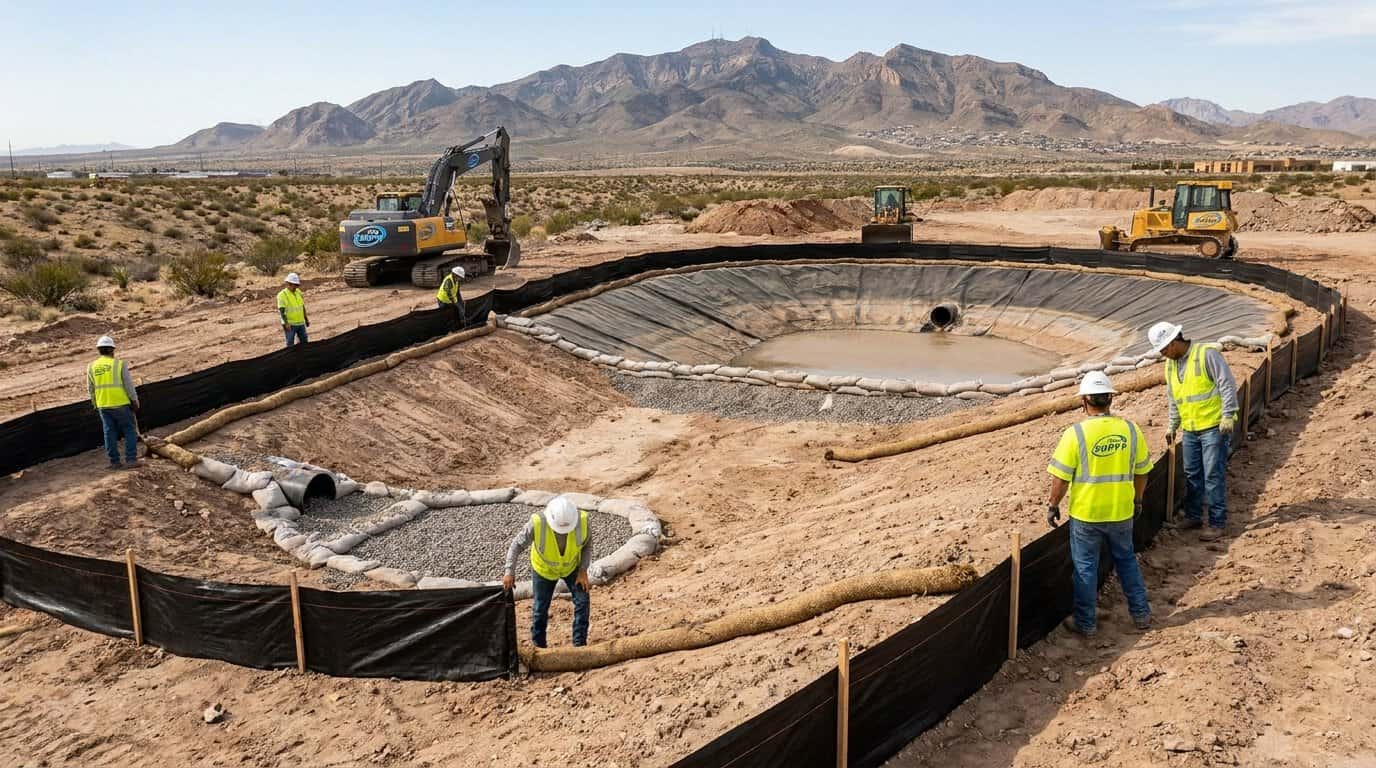
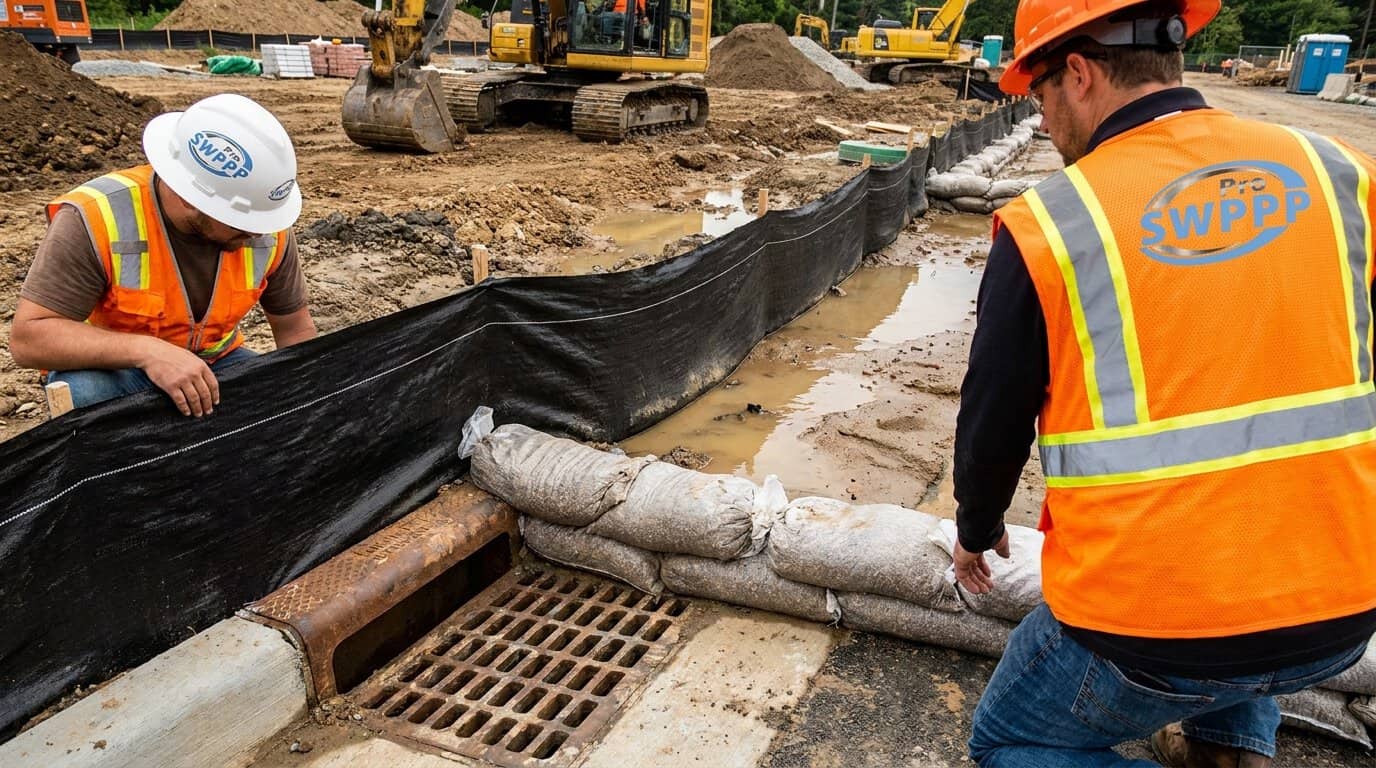
- Erosion and sediment controls: perimeter silt fence, inlet protection, stabilized construction entrances, sediment traps or basins, slope protection, and dust suppression for the Chihuahuan Desert climate
- Non-stormwater discharge controls: concrete washout, vehicle washing, dust-control water, and hydrant flushing
- Spill prevention: fuel and chemical storage, secondary containment, and cleanup procedures
- Inspection and recordkeeping: the chosen inspection interval, the qualified inspector, the log form, and the corrective action process
Which BMPs work in a desert climate?
El Paso averages under 10 inches of rain a year, and most of it arrives in short, high-intensity monsoon storms between July and September. Controls sized for gentle rainfall fail in that pattern, so plans lean on stabilized entrances, robust inlet protection, sediment traps at concentrated flow points, and aggressive dust control on exposed soil.
The plan specifies what gets built, where, and to what standard. Physical installation of BMPs is handled by your site contractor, and the plan is written so that crew can build from it without interpretation.
How do you file with TCEQ through STEERS, and what does it cost?
Large construction operators submit the Notice of Intent electronically through STEERS, the State of Texas Environmental Electronic Reporting System. STEERS accounts require registration and a signed participation agreement, which is the step that most often delays a first-time filer by a week or more.
The NOI identifies the operator, the site location and acreage, the receiving water, and the projected start and end dates, and it certifies that the SWP3 is already complete. TCEQ charges an application fee for the NOI, set in the agency fee schedule; confirm the current amount in STEERS at the time of filing rather than relying on a figure from an earlier project.
Authorization begins when TCEQ processes the NOI, not when it is submitted, so build that lag into the schedule. Changes to operator, acreage, or site boundaries require a Notice of Change before work continues under the original authorization.
Just want a number first?
Tell us about your project and we will send a written estimate, no obligation.
How often must an El Paso site be inspected?
TXR150000 offers two inspection schedules, and the operator picks one and writes it into the plan. Option one is an inspection at least once every 7 calendar days. Option two is an inspection at least once every 14 calendar days plus an inspection within 24 hours of the end of a storm event of 0.5 inches or greater.
The permit states the second option directly: at least once every fourteen (14) calendar days and within twenty-four (24) hours of the end of a storm event of 0.5 inches or greater. That language appears in the inspection schedule of TCEQ General Permit TXR150000. In a monsoon season where a single afternoon cell drops half an inch, option two can generate more inspections than the flat 7-day cycle, which is why many El Paso operators simply choose the weekly schedule.
When an inspection identifies a deficiency, the correction and the corresponding plan update are due within 7 calendar days. Areas where construction has permanently or temporarily ceased must have stabilization initiated immediately and completed within 14 days.
Why do records matter more than equipment?
Every inspection needs a written report: date, inspector name and qualification, weather and rainfall since the last visit, the condition of each control, deficiencies found, corrective actions taken, and completion dates. Those reports live with the plan.
A site with perfect controls and no logs is out of compliance. A missing 7-day interval cannot be recreated after the fact, and inspectors read gaps in a log as evidence that the inspections never happened.

Which mistakes cost El Paso contractors the most?
Assuming five acres is the trigger
The permit applies at one acre. A builder working three 0.5-acre lots inside a 20-acre subdivision is regulated under the common plan rule even though no individual lot is close to the threshold.
Treating dry weather as low risk
El Paso goes months without measurable rain and then takes 1 to 2 inches in a single monsoon event. Controls that were never maintained during the dry stretch fail on the first storm, and that storm also starts a 24-hour inspection clock under the 14-day option.
Filing the plan and never touching it again
The plan has to track the site. New subcontractor, relocated staging area, revised grading sequence, or an added discharge point all require an amendment, and the permit gives 7 calendar days after an inspection-identified change.
Skipping the Notice of Termination
A large construction authorization stays open until the NOT is filed through STEERS. An abandoned authorization keeps the inspection and recordkeeping obligations alive long after the crew has demobilized.
For how state rules interact with local requirements elsewhere in the state, see our guide to South Texas stormwater requirements and our Texas services page.
Who prepares the SWP3, and who builds the controls?
Pro SWPPP, LLC is a documentation firm. The deliverables are the SWP3 itself, the site map, BMP specifications and details, the STEERS NOI package, the site notice, inspection forms and logs, plan amendments, and the Notice of Termination. Every plan is prepared under Derek E. Chinners, CPESC, a Certified Professional in Erosion and Sediment Control with more than 20 years in construction stormwater.
Physical installation of BMPs is handled by your site contractor. Pro SWPPP does not place silt fence, build sediment basins, or perform any field construction, and the service does not replace the crew already mobilized. The plan defines the work; the contractor executes it.
Plans are prepared the same way for projects in Georgia and other states. Scope questions go through the contact page, and team background is on the about page.
What else do El Paso contractors ask about SWP3 requirements?
Do I need an SWP3 for a project under one acre?
Not on acreage alone, unless the parcel belongs to a larger common plan of development or sale totaling one acre or more. A 0.6-acre pad inside a platted commercial development is regulated. Local grading or drainage permits from the city or county may still apply below the federal threshold, so check before assuming the site is exempt.
Which TCEQ permit covers El Paso construction?
General Permit TXR150000, issued under the Texas Pollutant Discharge Elimination System. The current term runs from March 5, 2023 to March 5, 2028. Coverage is obtained by posting a site notice for projects of 1 to 4.99 acres, and by filing a Notice of Intent through STEERS plus posting the notice for projects of 5 acres or more.
How often do I have to inspect the site?
Choose one of two schedules and record the choice in the plan: once every 7 calendar days, or once every 14 calendar days plus within 24 hours of the end of a storm event of 0.5 inches or greater. Deficiencies found during an inspection must be corrected and documented within 7 calendar days.
Do I need a sediment basin?
On large construction sites, a sediment basin is required where feasible for each common drainage location serving 10 or more acres disturbed at one time. Smaller drainage areas may be handled with sediment traps, perimeter controls, and inlet protection sized to the flow. The plan has to justify whichever approach is used.
Can I use a template plan?
A template can supply structure, but the site description, map, drainage areas, control locations, and construction sequence must reflect the actual project. Reviewers and inspectors compare the map against the ground, and a plan whose outfalls and controls do not exist where drawn is treated as no plan at all.
What happens if I disturb ground without coverage?
Unauthorized discharge of construction stormwater violates the Clean Water Act and Texas water quality law. Enforcement typically starts with a notice of violation and a stop-work order from TCEQ or El Paso Water, and administrative penalties accrue while the site sits idle. The cost of the delay usually exceeds the cost of the permit.
Does Pro SWPPP install erosion controls?
No. Pro SWPPP prepares documentation: the SWP3, the site map, BMP specifications, the STEERS filing package, inspection forms, and closeout paperwork. Physical installation of BMPs is handled by your site contractor. Keeping the plan and the field work separate is also what lets the plan stay a neutral, reviewable record for TCEQ and El Paso Water.
Complicated site? Talk it through.
Speak directly with a CPESC-certified stormwater expert with 20+ years of experience.
Need a SWPPP for a El Paso project? Pro SWPPP writes CPESC-certified Stormwater Pollution Prevention Plans for El Paso and El Paso County construction sites — delivered in 72 hours or it’s free.