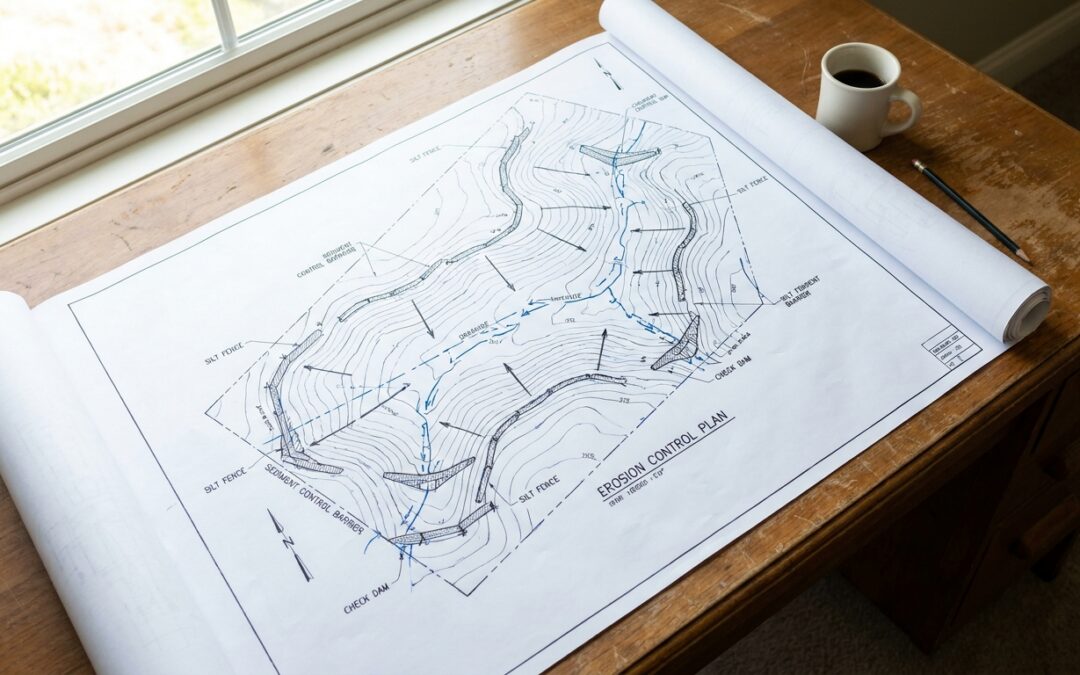
An Erosion and Sediment Control Plan is the plan showing how a construction project will prevent soil erosion and keep sediment from leaving disturbed areas. On a project permitted under the federal Construction General Permit there is no separate document to produce: the SWPPP is the erosion and sediment control plan. A handful of states additionally require their own separately approved or certified plan.
Pro SWPPP prepares stormwater plans for contractors nationwide.
Not sure whether your project needs a SWPPP? Take the SWPPP quiz.
What does an Erosion and Sediment Control Plan address for SWPPP compliance?
An E&S Plan typically identifies existing and proposed site conditions, including drainage patterns, slopes, soils, receiving waters, and areas to be cleared or graded. It shows the sequence and limits of earth-disturbing work so that controls can be installed before disturbance begins and adjusted as the project progresses.
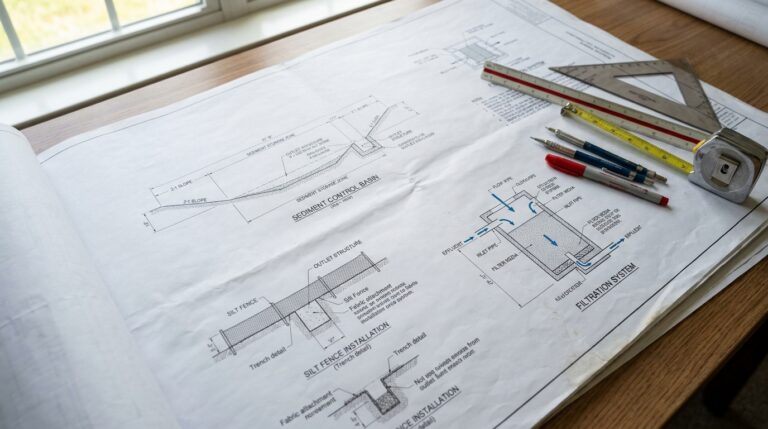
The plan specifies temporary and permanent erosion-control measures, such as stabilization, mulch, blankets, vegetation, slope protection, and stabilized conveyances. It also details sediment-control measures, including perimeter controls, sediment basins or traps, inlet protection, construction entrances, and controls for concentrated flows.
For each control, the E&S Plan provides locations, specifications, installation timing, inspection requirements, maintenance procedures, replacement criteria, and removal instructions. It also addresses final stabilization and restoration of disturbed areas once construction is complete.
Under EPA's 2022 Construction General Permit, operators must design, install, and maintain stormwater controls to minimize pollutant discharges from construction activity, specifically including controls that minimize soil erosion, sediment discharges, channel and streambank erosion, exposed soil, steep-slope disturbance, and sediment track-out. The 2022 CGP applies where EPA is the NPDES permitting authority and expires February 16, 2027.
The EPA CGP also requires operators to address precipitation, stormwater discharge characteristics, and soil conditions when designing and maintaining erosion and sediment controls. It requires natural buffers or equivalent controls for discharges to receiving waters within 50 feet of earth disturbance, subject to the permit's conditions and exceptions.
How does an Erosion and Sediment Control Plan relate to a SWPPP?
On most construction projects they are the same document. Under the EPA CGP there is no separate erosion and sediment control plan to produce: the SWPPP must describe the stormwater control measures that are installed or will be installed and maintained to meet the permit requirements, and those controls are the erosion and sediment control plan. Where a state or local authority requires its own certified plan, that plan is prepared alongside the SWPPP and the two must agree.
The SWPPP also covers subjects that may not be part of the E&S Plan itself, including pollution-prevention procedures, prohibited discharges, concrete washout, construction materials, dewatering, inspections, corrective action, documentation, and permit administration. The E&S Plan should therefore be coordinated with—not treated as a substitute for—the complete SWPPP.
In practice, the E&S Plan provides the drawings, details, specifications, phasing information, and maintenance requirements that turn erosion and sediment-control obligations into work to be installed and maintained on the project site. The SWPPP incorporates those controls and adds the administrative, inspection, and pollution-prevention elements required by the permit.
See the SWPPP plan request form.
Does an Erosion and Sediment Control Plan apply in every state for SWPPP purposes?
The EPA CGP applies only in areas where EPA is the NPDES permitting authority. States and certain other jurisdictions administer their own authorized construction stormwater programs and may use different permit names, plan requirements, technical standards, thresholds, forms, review procedures, and effective dates. The EPA CGP expires February 16, 2027, and applies only in EPA-administered jurisdictions and other locations specifically covered by the federal permit.
In New Jersey, construction activity disturbing one acre or more generally requires authorization under the state's construction general permit 5G3, while a Soil Erosion and Sediment Control Plan certification is obtained through the local Soil Conservation District. The state page states that permit authorization is in addition to local Soil Erosion and Sediment Control Plan certification.
Maryland requires erosion and sediment control plans to be reviewed and approved for earth-moving activity disturbing 5,000 square feet or more or 100 cubic yards or more of soil, under Code of Maryland Regulations 26.17.01.
New York projects covered by the state's SPDES construction general permit must develop and implement a SWPPP meeting state criteria, with practices consistent with the New York Standards and Specifications for Erosion and Sediment Control.
Before relying on an E&S Plan, identify the project's permitting authority, the applicable permit or rule version, whether separate plan approval is required, and any state or local erosion-and-sediment-control standards incorporated into the permit.
What information does an Erosion and Sediment Control Plan require for SWPPP development?
An E&S Plan requires site-specific information about existing conditions, proposed disturbance, and the controls that will protect the site and receiving waters. Existing conditions include topography, drainage patterns, slopes, soil types, vegetation, and the location and characteristics of nearby streams, wetlands, or other receiving waters.
Proposed conditions include the limits of disturbance, grading plans, final grades, drainage structures, impervious surfaces, and areas to be stabilized. The plan also shows the phasing of earth-disturbing work, so that controls can be installed before disturbance begins in each phase and adjusted as the project progresses.
Control details include the type, location, size, and specifications for each erosion and sediment control measure. The plan identifies which controls are temporary and which are permanent, when each control will be installed, how it will be maintained, and when it will be removed or converted to a permanent measure.
The plan should also address site access, material storage, concrete washout, dewatering, and other activities that may generate sediment or stormwater pollution. It should be consistent with the governing permit, approved plan, SWPPP, site conditions, and any applicable state or local standards.
Who prepares an Erosion and Sediment Control Plan for SWPPP compliance?
An E&S Plan is typically prepared by a qualified stormwater professional with knowledge of erosion and sediment control practices, site conditions, and the applicable regulatory requirements. Some jurisdictions require the plan to be prepared or certified by a licensed professional engineer, a Certified Professional in Erosion and Sediment Control (CPESC), or another credentialed individual.
The plan preparer should be familiar with the project's permitting authority, the applicable permit or rule version, and any state or local erosion-and-sediment-control standards incorporated into the permit. The plan should be coordinated with the project's SWPPP, grading plan, drainage plan, and other construction documents.
Pro SWPPP prepares Erosion and Sediment Control Plans and complete SWPPPs for contractors, ensuring that the plan is consistent with the governing permit, site conditions, and applicable standards. Customer crews install the controls; Pro SWPPP documents and inspects as required by the permit.
Request a project-specific SWPPP estimate.
How does an Erosion and Sediment Control Plan connect to SWPPP inspections?
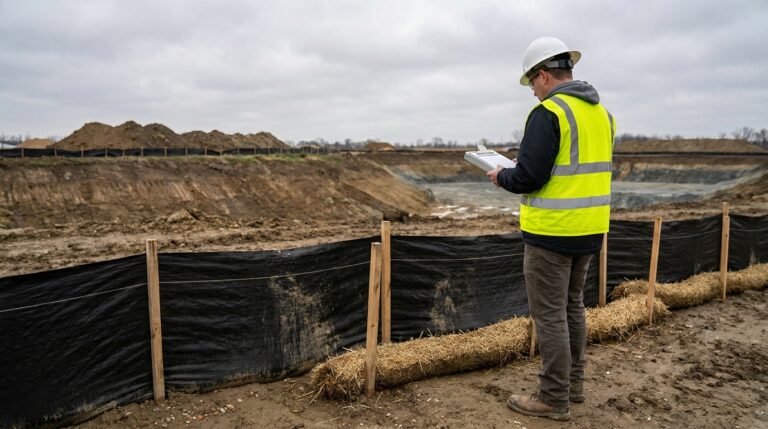
An E&S Plan provides the baseline for inspections by identifying the controls that should be in place, their locations, and their maintenance requirements. Inspectors use the plan to verify that controls are installed as specified, functioning as intended, and maintained in accordance with the plan and permit.
Inspections also identify when controls need to be repaired, replaced, or adjusted due to changing site conditions, weather events, or construction phasing. The plan should be updated to reflect any changes in controls, site conditions, or construction sequencing that occur during the project.
Under the EPA CGP and many state permits, construction sites must be inspected at least every seven calendar days and within 24 hours after a storm event of 0.25 inches or more. For a complete explanation of inspection frequency and triggers, see the SWPPP inspection frequency guide.
What else should contractors know about Erosion and Sediment Control Plans in SWPPP work?
Is an Erosion and Sediment Control Plan the same as a SWPPP?
Usually yes. Under the federal Construction General Permit the SWPPP is the erosion and sediment control plan: the controls, drawings, specifications and maintenance requirements sit inside it, alongside pollution-prevention procedures, prohibited discharges, concrete washout, construction materials, dewatering, inspections, corrective action, documentation, and permit administration. The exception is a state or local program that requires its own separately approved or certified erosion and sediment control plan, such as Maryland or New Jersey; there you need both, and the two must agree.
Does every construction project need an Erosion and Sediment Control Plan for SWPPP purposes?
Not every project needs a formal E&S Plan, but most projects that disturb soil need some form of erosion and sediment control. The requirement for a formal plan depends on the permitting authority, the amount of disturbance, and whether the project is part of a larger common plan of development or sale. For more on when a SWPPP is required, see the acreage and common-plan threshold guide.
Can an Erosion and Sediment Control Plan be updated during construction for SWPPP compliance?
Yes, and it often should be. The plan should be updated to reflect any changes in controls, site conditions, or construction sequencing that occur during the project. Updates may be required by the permit or by the local reviewing authority, and they should be documented in the SWPPP and inspection records.
What happens if erosion and sediment controls fail during SWPPP implementation?
If controls fail or are not functioning as intended, the operator must take corrective action as soon as practicable, typically by the end of the next work day to begin addressing it and within seven calendar days to complete the repair. Corrective action includes repairing or replacing the failed control, adjusting the control to address the cause of the failure, and documenting the failure and the corrective action in the inspection records.
Who is responsible for maintaining erosion and sediment controls under a SWPPP?
The operator identified in the permit is responsible for installing, maintaining, and removing erosion and sediment controls in accordance with the E&S Plan and the permit. In practice, the general contractor or site superintendent typically oversees day-to-day maintenance, while the SWPPP preparer or inspector verifies that controls are functioning and documents any needed corrective actions.
Discuss the SWPPP scope for your project.
By Derek E. Chinners, CPESC — Founder & Stormwater Consultant, Pro SWPPP, LLC
Related: What is a SWPPP? · When is a SWPPP required? One acre or common plan · Construction BMPs: what goes on the plan · SWPPP inspections: every 7 days or after quarter-inch rain