
What Are the SWP3 Requirements in Fort Worth, Texas?
Any construction project in Fort Worth that disturbs one acre or more needs a Stormwater Pollution Prevention Plan, called an SWP3 in Texas, under TCEQ Construction General Permit TXR150000. Sites of five acres or more also file a Notice of Intent through STEERS, and the City of Fort Worth requires a separate grading permit before dirt moves.
Who Needs an SWP3 in Fort Worth?
Every operator disturbing one acre or more of soil inside Fort Worth city limits needs an SWP3. That includes commercial pads, subdivisions, parking lots, road work, and utility trenching. Acreage is measured across the entire common plan of development, not one phase at a time.
Splitting a 12-acre subdivision into six 2-acre phases does not drop you below the threshold. The Texas Commission on Environmental Quality (TCEQ) counts the total planned disturbance under general permit TXR150000, so all six phases are treated as one 12-acre project.
Sites under one acre that stand alone do not need TXR150000 authorization, but they are not exempt from the City of Fort Worth. City grading and erosion control conditions still apply, and a Fort Worth inspector can red-tag a half-acre lot that tracks mud into a public street.
This page covers Fort Worth and Tarrant County specifically. For the broader picture across Dallas, Arlington, Plano, and the rest of the metroplex, read our Dallas-Fort Worth SWPPP requirements guide.
Not sure if you even need one?
Answer a few questions about your site and find out in under two minutes.
Why Does Texas Say SWP3 Instead of SWPPP?
TCEQ uses the abbreviation SWP3 for the Stormwater Pollution Prevention Plan throughout general permit TXR150000. It is the same document EPA calls a SWPPP, but every Fort Worth plan reviewer, inspector, and TCEQ form uses SWP3, so label your plan set that way.
Permit TXR150000 states the standard directly. TCEQ requires that the SWP3 shall be prepared in accordance with good engineering practices and must identify potential sources of pollution which may reasonably be expected to affect the quality of discharges from the construction site, per the TCEQ Construction General Permit.
Getting the name right matters at the counter. A submittal labeled SWPPP is still accepted, but Fort Worth checklists and TCEQ site notices reference the SWP3, and mismatched document names slow first-round review.
What Are the Acreage Thresholds Under TXR150000?
TXR150000 splits construction into two categories. Small construction covers 1 acre up to 5 acres. Large construction covers 5 acres and above and adds a Notice of Intent filed electronically through STEERS. Both categories require a complete SWP3 before soil disturbance begins.
| Disturbed Area | TCEQ TXR150000 | City of Fort Worth | Inspection Frequency |
|---|---|---|---|
| Under 1 acre, standalone | No TXR150000 authorization required | Grading permit and erosion controls per city conditions | As set by the city permit |
| 1 to under 5 acres (small construction) | SWP3 plus Construction Site Notice; no NOI | Grading permit; erosion control sheet reviewed with civil plans | Every 7 calendar days, or every 14 days plus within 24 hours of 0.5 inch of rain |
| 5 acres or more (large construction) | SWP3, NOI through STEERS, site notice, NOT at completion | Grading permit plus proof of TCEQ authorization | Every 7 calendar days, or every 14 days plus within 24 hours of 0.5 inch of rain |
A Low Erosivity Waiver is available under TXR150000 for small construction sites where the calculated rainfall erosivity factor is below 5 for the full period of construction. North Texas rainfall makes that waiver rare on projects running longer than a few weeks.
Because Fort Worth discharges to a regulated MS4, the operator of a 1-to-5-acre site also delivers a copy of the Construction Site Notice to the city as the MS4 operator, in addition to posting it at the site entrance.

What Does the City of Fort Worth Require on Top of TCEQ?
The City of Fort Worth runs its own stormwater ordinance as a TPDES-regulated MS4, which means TCEQ authorization alone does not let you break ground. You also need city approval of the grading and erosion control plan before a permit is issued.
Fort Worth reviews erosion and sediment control as part of the civil plan set, not as a separate afterthought. Grading, drainage study, and erosion control sheets move through Fort Worth Development Services together, and a deficiency on one sheet holds the whole submittal.
Regional design criteria come from the iSWM program administered through the North Central Texas Council of Governments (NCTCOG) and adopted by Fort Worth. Detention, water quality, and construction-phase controls are sized to those criteria rather than to a generic state template.
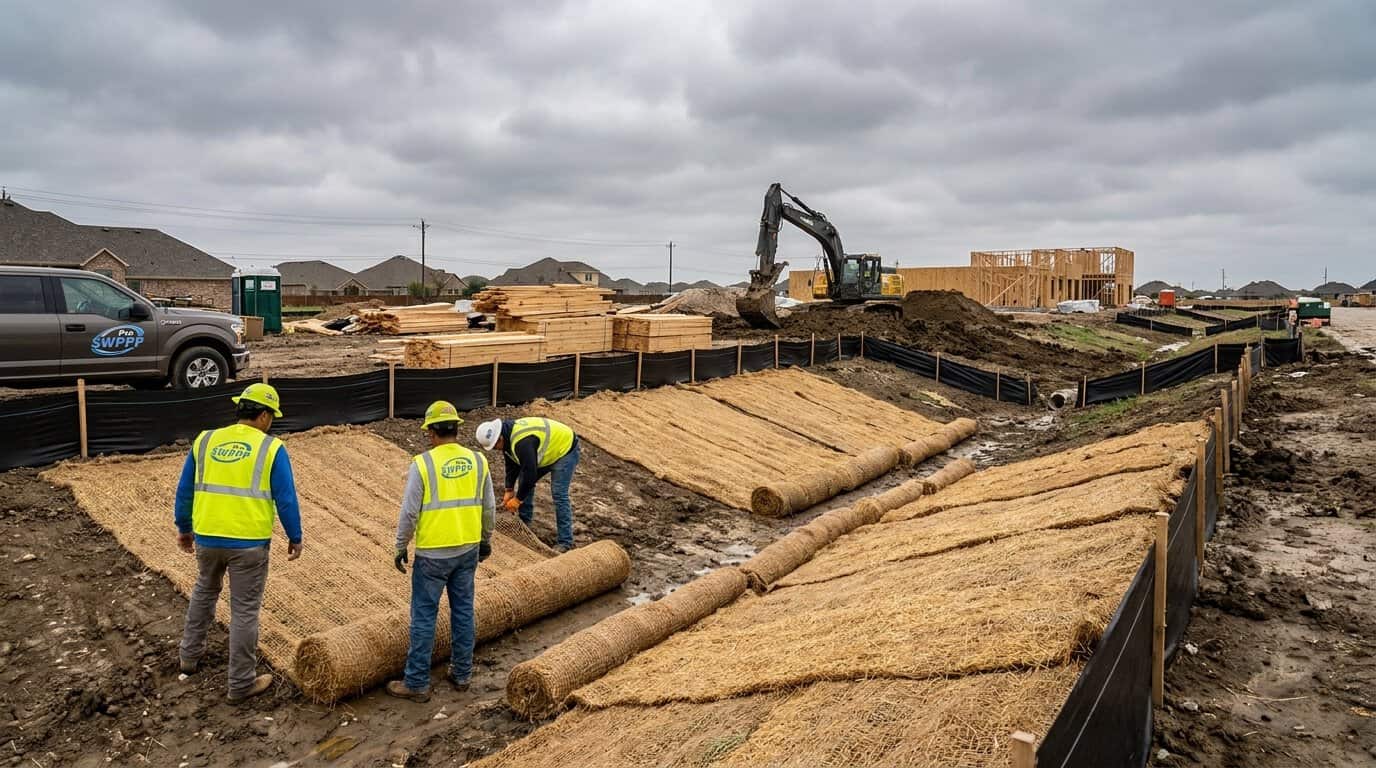
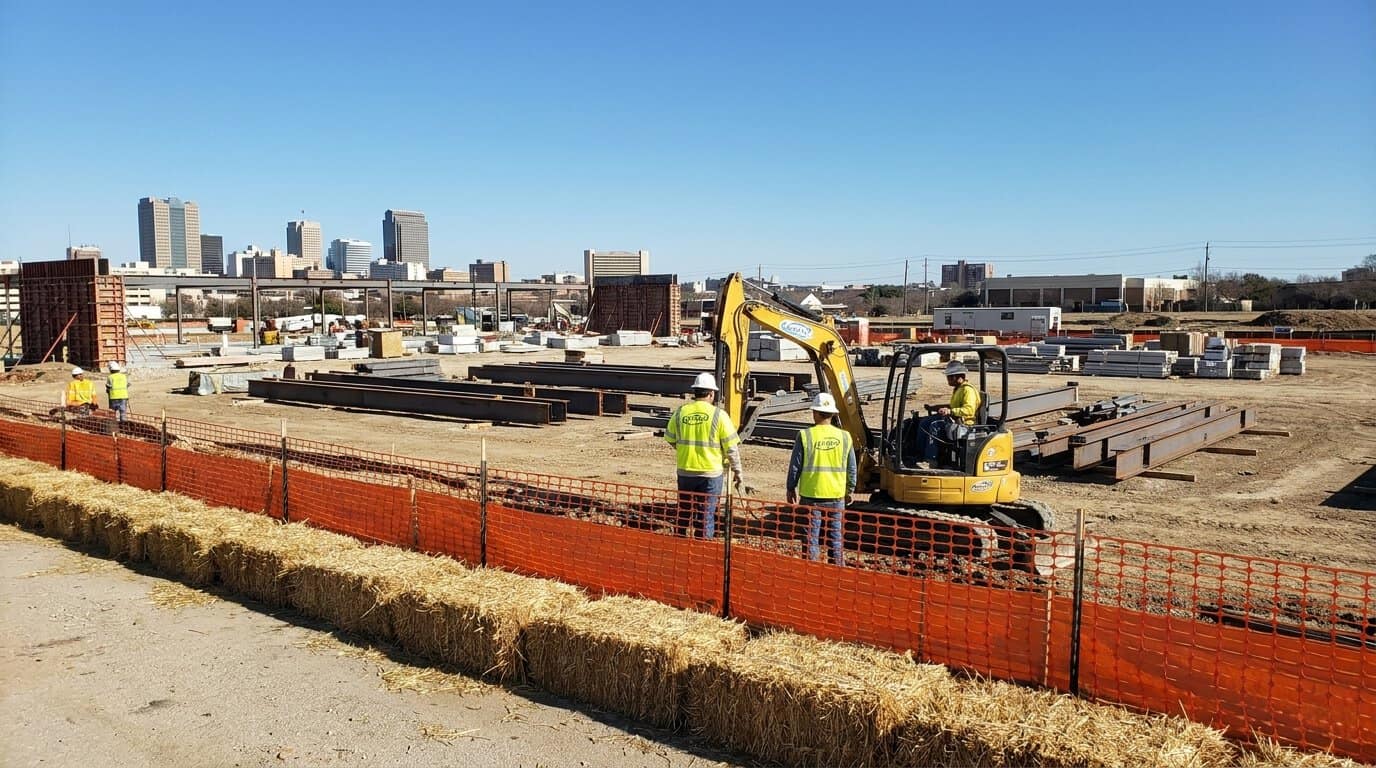
Fort Worth field inspectors focus on three things: a stabilized construction entrance at every access point, perimeter controls on the downgradient side, and inlet protection on every curb inlet within the limits of disturbance. Physical installation of BMPs is handled by your site contractor.
How Does Fort Worth Plan Review and Permitting Work Step by Step?
The sequence matters more than the paperwork volume. Doing these five steps out of order is the single most common cause of a stalled Fort Worth start date.
- Calculate total disturbance across the entire common plan of development, including stockpiles, haul roads, and staging.
- Prepare the SWP3 with a site map, phasing sequence, BMP schedule, and inspection log format.
- File the NOI through TCEQ STEERS if disturbance is 5 acres or more, and wait for authorization before disturbing soil.
- Submit grading, drainage, and erosion control plans to Fort Worth Development Services for permit review.
- Post the Construction Site Notice at a location visible from a public road and keep the SWP3 on site for the life of the job.
Keep the TCEQ authorization number and the city grading permit number on the same page in the front of the SWP3 binder. Fort Worth inspectors ask for both, and a missing permit number reads as no coverage at all.
How Often Must a Fort Worth SWP3 Site Be Inspected?
TXR150000 gives operators two options. Inspect at least once every 7 calendar days, or inspect at least once every 14 calendar days and within 24 hours of the end of a storm event of 0.5 inch or greater. Pick one schedule and document it in the SWP3.
Deficiencies found during an inspection must be corrected before the next anticipated storm event, or as soon as practicable if that timing is not feasible. Each inspection report records the date, the inspector, weather conditions, BMP condition, and the corrective actions taken.
Fort Worth adds its own field inspections tied to the grading permit. An inspection log that is three weeks stale is treated as evidence the plan is not being implemented, which is a permit violation independent of whether sediment actually left the site.
Areas that reach final stabilization drop out of the inspection rotation. Until then, the log runs continuously from the first day of soil disturbance.
What Does SWP3 Compliance Cost in Fort Worth and Tarrant County?
Budget for four separate line items: the SWP3 document itself, the TCEQ NOI application fee for sites 5 acres and above, City of Fort Worth grading and plan review fees, and the contractor cost of the physical BMPs shown on the plan.
TCEQ charges a nonrefundable NOI application fee for large construction, and Fort Worth grading permit fees are set by the city fee schedule and scale with disturbed area and valuation. Confirm current amounts on the TCEQ and City of Fort Worth fee pages before you bid, because both are updated on their own cycles.
The schedule cost is usually larger than the fee cost. A resubmittal on the erosion control sheet typically adds weeks to permit issuance, which on a Fort Worth commercial pad is far more expensive than the plan itself.
Just want a number first?
Tell us about your project and we will send a written estimate, no obligation.
How Is Tarrant County Different From the City of Fort Worth?
Counties in Texas do not have the ordinance-making authority that cities do. In unincorporated Tarrant County, there is no municipal grading permit equivalent to the Fort Worth process, so TXR150000 through TCEQ is usually the controlling requirement for a 1-acre-plus site.
That does not make unincorporated sites easier. With no city plan review acting as a checkpoint, operators often discover an SWP3 gap only when TCEQ or a downstream complaint triggers an inspection, at which point the violation already exists.
Projects inside other Tarrant County cities, including Arlington, Mansfield, Keller, and Haltom City, follow that city ordinance rather than Fort Worth. Confirm jurisdiction with Tarrant County before assuming the Fort Worth checklist applies, especially on parcels straddling an ETJ boundary.
What Are the Penalties for SWP3 Violations?
Under the Texas Water Code, administrative penalties can reach $25,000 per day per violation. Fort Worth can separately issue stop-work orders and suspend the grading permit, which halts every trade on site, not just earthwork.
The common violations are predictable: no SWP3 on site, an NOI filed after dirt was already moving, an inspection log with gaps, and BMPs shown on the plan that do not exist in the field. Each is documented in minutes by an inspector with a camera.
Sediment that reaches a storm drain or the Trinity River system adds cleanup liability on top of the penalty. Most general liability policies exclude gradual pollution events, so that cost lands directly on the operator.
Why Work With Pro SWPPP on a Fort Worth Project?
Pro SWPPP prepares the documentation layer: the SWP3 itself, the TCEQ NOI and STEERS filing support, the Construction Site Notice, inspection log templates, and the Notice of Termination at closeout. Plans are prepared under the direction of Derek E. Chinners, CPESC.
Plans are written to match what Fort Worth reviewers and TCEQ inspectors actually check, with a real site map, a phasing sequence, and a BMP schedule your contractor can build from. Physical installation of BMPs is handled by your site contractor.
Revisions are part of the job. When phasing shifts or the city returns comments, the SWP3 is updated rather than left frozen at the Day 1 version. Learn more about our team and services or contact us.
Federal background on the underlying program is available from the EPA NPDES construction stormwater page. Building elsewhere in Texas? See our South Texas SWPPP requirements guide and our Texas SWPPP services page.
Fort Worth SWP3 Frequently Asked Questions
Is an SWP3 the same thing as a SWPPP?
Yes. SWP3 is the abbreviation TCEQ uses in general permit TXR150000 for the Stormwater Pollution Prevention Plan, the same document EPA calls a SWPPP. Fort Worth reviewers and TCEQ forms both use SWP3, so Texas plan sets should carry that label to match the permit language and city checklists.
Do I need an SWP3 for a half-acre lot in Fort Worth?
Not under TXR150000 if the half acre is truly standalone, because TCEQ authorization starts at 1 acre. If that lot is one piece of a larger common plan of development totaling 1 acre or more, an SWP3 is required. The City of Fort Worth can still require erosion controls and a grading permit either way.
When do I file the NOI through STEERS?
File the Notice of Intent electronically through TCEQ STEERS for large construction sites of 5 acres or more, before any soil-disturbing activity begins. Authorization is not immediate on submission, so build that lead time into the schedule. Sites of 1 to under 5 acres post a Construction Site Notice instead of filing an NOI.
How often must a Fort Worth construction site be inspected?
TXR150000 allows either once every 7 calendar days, or once every 14 calendar days plus within 24 hours of the end of a storm event producing 0.5 inch or more of rain. Choose one option, state it in the SWP3, and keep written inspection reports on site for the full duration of construction.
Does TCEQ authorization replace the City of Fort Worth permit?
No. Fort Worth is a regulated MS4 with its own stormwater ordinance, so TCEQ authorization and the city grading permit are two separate approvals. You need both. The city reviews grading, drainage, and erosion control sheets together, and a deficiency on any one of them holds up permit issuance.
Where does the Construction Site Notice go?
Post it at a location on or near the site that is safely readable from a public road, along with the SWP3 location and contact information. Sites of 1 to under 5 acres in Fort Worth also provide a copy to the city as the MS4 operator. Keep the posted notice legible for the entire project.
When can I stop inspecting and close out the permit?
Inspections continue until final stabilization is reached across all disturbed areas. At that point temporary BMPs are removed by the contractor and a Notice of Termination is filed with TCEQ for sites that filed an NOI. Records should be retained after closeout in case the site is later reviewed.
Complicated site? Talk it through.
Speak directly with a CPESC-certified stormwater expert with 20+ years of experience.
Need a SWPPP for a Fort Worth project? Pro SWPPP writes CPESC-certified Stormwater Pollution Prevention Plans for Fort Worth and Tarrant County construction sites — delivered in 72 hours or it’s free.