Pro SWPPP – America’s #1 SWPPP Service helps auto salvage facilities stay compliant with stormwater rules. If you run a junkyard or auto recycling yard, the EPA and your state want to know how you’re keeping oil, metals, and fluids out of the rain drains. That means you need a SWPPP – a plan that shows what you do to stop pollution from leaving your property when it rains.
Here’s the thing: most auto salvage owners have no idea they need this plan until an inspector shows up. Then it’s scrambling time. Or worse, you get hit with fines before you even knew the rule existed. This guide walks you through everything – what a SWPPP is, who needs one, what’s changing in 2026, and how to get yours without the headache.
What Is a SWPPP and Why Do Auto Salvage Facilities Need One?
SWPPP stands for Stormwater Pollution Prevention Plan. It’s a written document that explains how your facility will manage rainwater runoff. When rain hits your yard, it can pick up oil, coolant, battery acid, rust, and metal shavings. All that gross stuff flows into storm drains, then straight into rivers and lakes. The Clean Water Act says you can’t do that.
Auto salvage facilities fall under Sector M of the EPA’s Multi-Sector General Permit (MSGP). That’s the federal rulebook for industrial stormwater. If you store cars, crush them, pull parts, or drain fluids outside, you’re an industrial activity. That means you need a SWPPP and a permit called a Notice of Intent (NOI).
States like Texas and Georgia run their own versions of the MSGP. In Texas, TCEQ calls it the Texas Pollutant Discharge Elimination System (TPDES) MSGP. Your SWPPP there is called a SWP3. Same idea, different name. You still need the plan, the NOI, and regular inspections.
Do You Need a SWPPP or Just an NOI?
You need both. The NOI is your application to be covered under the general permit. The SWPPP is your site-specific plan. Think of it this way: the NOI is like signing up for the permit, and the SWPPP is the actual homework you do to stay compliant.
Some facilities qualify for a No Exposure Certification (NEC) instead. That means all your industrial materials are completely covered – no exposure to rain or snow at all. If you can prove that, you file the NEC and skip the full MSGP. But here’s the catch: one loose battery or open drum voids your NEC. Then you need the full SWPPP and NOI within 30 days.
Most auto salvage yards can’t claim no exposure. Cars sit outside. You drain fluids in the open. You stack parts in the weather. That means you’re covered under the MSGP, and you need a SWPPP.
What’s in a SWPPP for Auto Salvage Facilities?
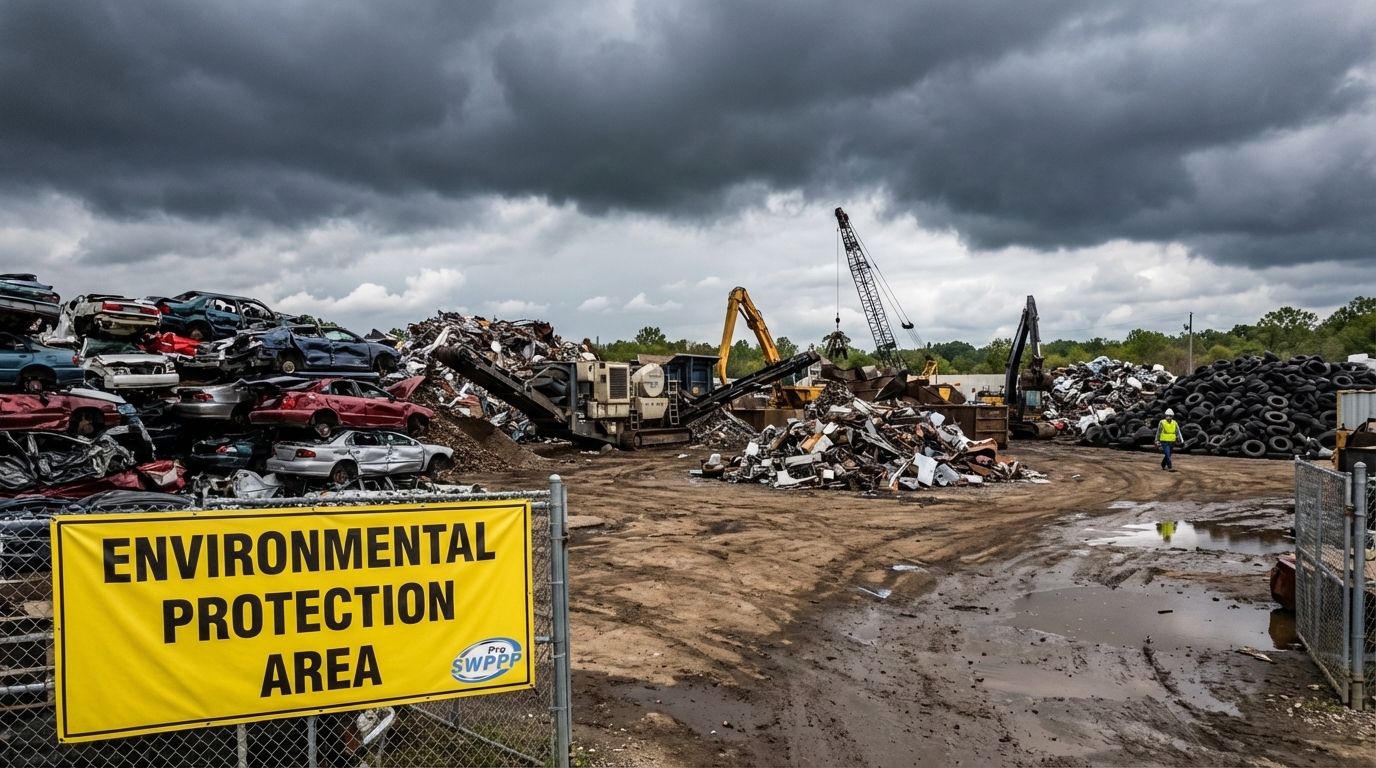
Your SWPPP has to include a site map, a list of pollutants, and a description of Best Management Practices (BMPs). BMPs are the controls you put in place to stop pollution. For auto salvage, that usually means:
- Covering fluid-draining areas with a roof or tarp
- Using drip pans and spill kits
- Installing berms or barriers to keep runoff away from storm drains
- Sweeping up metal shavings and debris before it rains
- Storing batteries and drums on pallets under cover
- Directing clean rainwater away from industrial areas
You also need to do quarterly visual assessments. That means looking at your stormwater discharge four times a year and checking for sheen, foam, discoloration, or floating junk. If you see any of that, you document it and fix the problem.
Sector M facilities also do benchmark monitoring. You collect water samples and test for metals like aluminum, copper, iron, lead, and zinc. If your numbers go over the benchmark levels, you have to take corrective action. That’s called Additional Implementation Measures (AIM) Level 1.
Pro SWPPP writes these plans for auto salvage yards every week. We know exactly what controls work, what EPA and state inspectors look for, and how to keep your facility off the enforcement radar.
What’s Changing in 2026?
The EPA is reissuing the MSGP in 2026. The current permit expires in February, so a new one is coming. The draft version includes some big changes for Sector M auto salvage facilities.
First, there’s new PFAS monitoring. PFAS stands for per- and polyfluoroalkyl substances. They’re chemicals that stick around forever in the environment. The EPA wants auto salvage and scrap recycling facilities to test for 40 different PFAS compounds using EPA Method 1633. You’ll do this quarterly starting in year one of your permit coverage.
Here’s the kicker: there are no benchmark levels for PFAS yet. If you detect any amount, you have to review your SWPPP and look for ways to reduce it. You document everything in your annual report.
Second, the new permit tightens up the corrective action process. If you have a benchmark exceedance, you now have 7 days to inspect your site and update your SWPPP. You also have to report all triggering events within 14 days. The 2021 permit gave you more wiggle room.
Third, the new permit adds language about climate resilience. Your BMPs need to handle bigger storms and more intense rain events. That means designing berms, drainage, and covers that won’t fail when a downpour hits.
States will adopt these changes after the EPA finalizes the 2026 MSGP. Texas TCEQ is already drafting its updated version. If you’re covered under a state permit, expect similar requirements to roll out in 2026 or early 2027.
Don’t want to mess with all the paperwork and requirements? Check out Order your SWPPP now with Pro SWPPP Professional CPESC Certified SWPPP Services.
Common Mistakes Auto Salvage Facilities Make
Mistake one: thinking you don’t need a permit because you’re small. Size doesn’t matter. If you’re in Sector M and you discharge stormwater, you need coverage.
Mistake two: assuming your parking lot or office area counts. The NPDES only cares about industrial activity areas. Your front office parking lot doesn’t need a SWPPP unless industrial materials are stored there.
Mistake three: filing an NOI but never writing the SWPPP. The NOI is step one. The plan is required. Inspectors will ask to see it. If you don’t have one, you’re out of compliance.
Mistake four: letting your SWPPP sit in a drawer. You have to follow it. If your plan says you’ll sweep the yard weekly and you don’t, that’s a violation. Keep records of inspections, monitoring, and maintenance.
Mistake five: not updating the SWPPP when you change operations. If you start crushing cars or add a new storage area, update the plan. Your SWPPP has to match what’s happening on the ground.
How to Get Your SWPPP Done Right
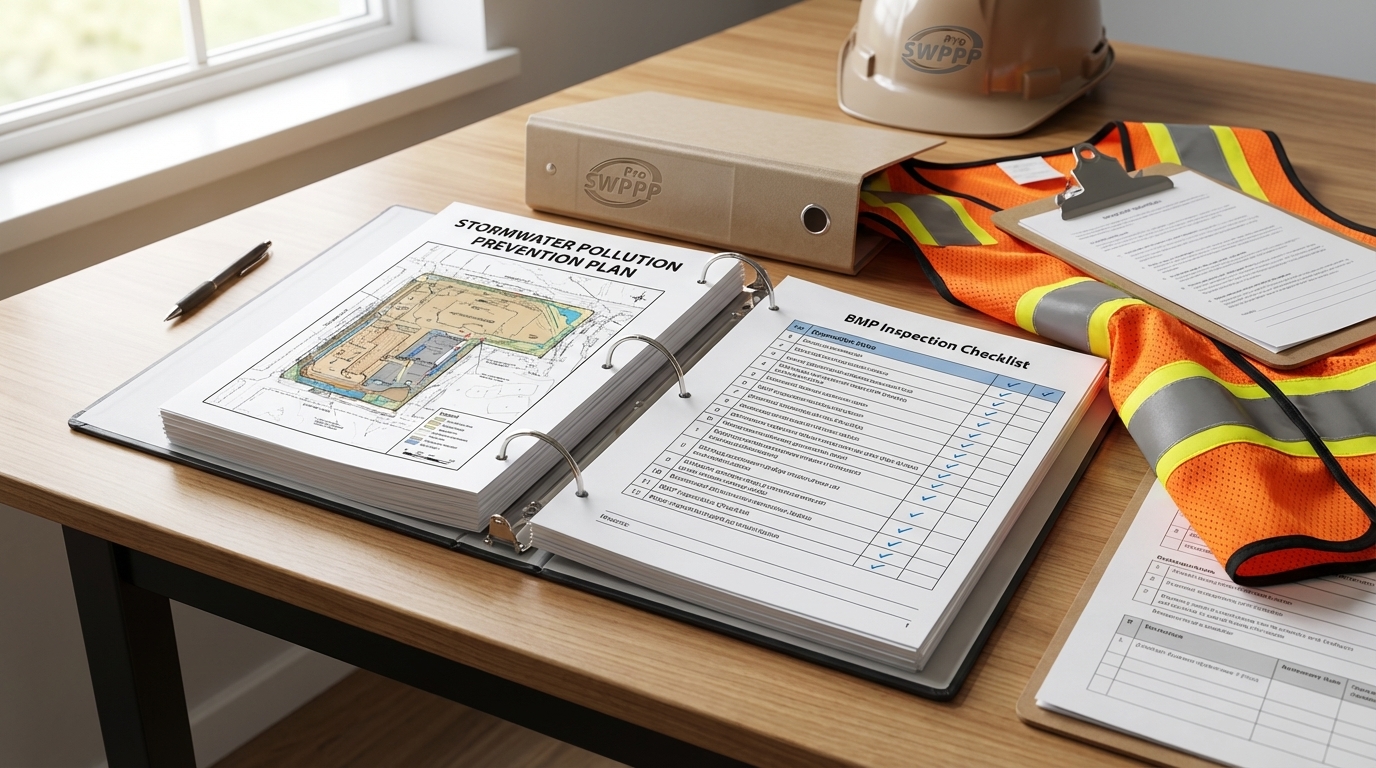
You can write your own SWPPP or hire someone. If you go the DIY route, use your state’s templates and EPA guidance. Read the MSGP. Walk your site and map out where pollutants are. List your BMPs. Set up your monitoring schedule.
Or you can call Pro SWPPP – America’s #1 SWPPP Service. We’re CPESC certified, which means we’re trained specifically in erosion control, sediment control, and stormwater management. We’ll visit your site, write the plan, help you file your NOI, and train your staff. You get a professional document that passes inspection the first time.
Our team knows the ins and outs of the Construction General Permit (CGP), the MSGP, and state programs run by agencies like TCEQ. We’ve worked with hundreds of facilities across the country, from small junkyards to big auto recycling operations.
We also handle updates when the rules change. When the 2026 MSGP comes out, we’ll revise your plan to include PFAS monitoring, the new AIM timelines, and climate resilience language. You don’t have to track every regulatory change – we do that for you.
Not sure what your project needs? Take our SWPPP Quiz or Schedule a Free SWPPP Consultation with CPESC Certified SWPPP Expert Derek E. Chinners.
State-Specific Notes: Texas and Georgia
If you’re in Texas, you fall under TCEQ. Your SWPPP is called a SWP3. You need to keep it onsite and make it available to inspectors. If your facility is in a city with a Municipal Separate Storm Sewer System (MS4) – like San Antonio – you also have to send a copy of your NOI or NEC to the MS4 operator. Some cities require a compliance letter before they’ll issue a business license.
Texas also has specific rules for motor vehicle crushing. Your SWP3 has to explain how you prevent fluids from discharging during crushing operations. That usually means draining all fluids before you crush, using a covered crush pad, and collecting any residual runoff.
If you’re in Georgia, you’re under the Georgia Environmental Protection Division (EPD). Georgia uses the federal MSGP structure but adds its own reporting system. You’ll file your NOI through EPD’s online portal and submit your annual reports there too.
Pro SWPPP – America’s #1 SWPPP Service handles state-specific requirements for you. We know what TCEQ inspectors look for and what Georgia EPD wants in your annual report. We make sure your plan meets both federal and state rules.
What Happens If You Don’t Have a SWPPP?
Fines. Lots of them. The Clean Water Act allows penalties up to tens of thousands of dollars per day for unpermitted discharges. State agencies can shut you down until you come into compliance.
Inspectors can show up anytime. If you don’t have a SWPPP, an NOI, or records of your inspections and monitoring, you’re in violation. They’ll issue a notice, and you’ll have a short window to fix it. If you don’t, enforcement escalates.
Even if you never get inspected, it’s not worth the risk. If a neighbor complains about dirty runoff, or if a spill reaches a creek, the state will investigate. You’ll wish you had the plan in place from day one.
Why Pro SWPPP Is Your Best Option
We’ve been doing this for years. Pro SWPPP specializes in industrial facilities, including auto salvage yards. We’re not a general consulting firm that dabbles in stormwater. This is all we do.
Our team includes CPESC-certified professionals. That stands for Certified Professional in Erosion and Sediment Control. It means we’re trained to design BMPs, understand hydrology, and apply erosion control and sediment control practices. We know how to keep pollutants onsite and inspectors happy.
We also offer ongoing support. Regulations change. Your facility changes. We update your SWPPP as needed and help you stay compliant year after year. You’re not just buying a document – you’re getting a partner.
Want to learn more about our process? Find out here or Contact Us directly. We’ll answer your questions and walk you through the next steps.
FAQs
Do I need a SWPPP if I only store a few cars?
Yes, if those cars are stored outside and you’re operating as an auto salvage facility. The number of cars doesn’t matter. What matters is whether you’re engaged in industrial activity and whether stormwater can contact pollutants.
Can I use the same SWPPP for multiple locations?
No. Each site needs its own SWPPP because every facility has a unique layout, different BMPs, and separate discharge points. You also need a separate NOI for each location.
How long does it take to get a SWPPP written?
With Pro SWPPP – America’s #1 SWPPP Service, most plans are completed within a few days after the site visit. We move fast so you can file your NOI and get covered under the permit.
What if I already have a SWPPP but it’s old?
You need to update it. The 2026 MSGP brings new requirements like PFAS monitoring. Even if you’re under a state permit, rules change. We can review your existing plan and revise it to meet current standards.
Do I need to hire an engineer to write my SWPPP?
No. You need someone who understands stormwater regulations and BMPs. A CPESC-certified professional is ideal. Engineers can write SWPPPs, but certification in erosion and sediment control is what really matters.
What’s the difference between a SWPPP and a Spill Prevention Control and Countermeasure (SPCC) plan?
A SWPPP covers stormwater runoff. An SPCC plan covers oil storage and spill prevention. If you store more than 1,320 gallons of oil products, you may need both. They’re separate requirements under different EPA programs.
Can I get a SWPPP exemption?
Only if you qualify for a No Exposure Certification. That means zero exposure of industrial materials to rain or snow. For most auto salvage yards, that’s impossible. You’ll need the full SWPPP.
Pro SWPPP is ready to help your auto salvage facility stay compliant, avoid fines, and handle the 2026 MSGP changes. Get your SWPPP done right the first time. Start on your SWPPP today.