Pro SWPPP – America’s #1 SWPPP Service helps contractors across the country avoid massive fines and project delays every single day. If you’re planning construction in Georgia and disturbing one acre or more, you’re about to face a critical question: do you need an ES&C Plan to get your Georgia EPD Construction Permit? The short answer is yes. The slightly longer answer is that you need an Erosion, Sedimentation, and Pollution Control Plan—and you need it done right, or your project sits idle while fines stack up.
What Exactly Is an ES&C Plan?
An ES&C Plan (sometimes called an ESPCP) is your blueprint for keeping mud, dirt, and pollutants out of Georgia’s waterways during construction. Think of it as the rulebook that tells you where to put silt fences, how to manage stormwater runoff, and what inspections you need to pass before the EPD gives you the green light.
Under the Clean Water Act and Georgia’s NPDES Construction Stormwater General Permits—GAR100001 for standalone projects and GAR100003 for common developments—any site disturbing one or more acres must have an approved ES&C Plan before a single shovel hits dirt. That plan must be prepared by a certified Design Professional, and it must be submitted electronically through GEOS, Georgia’s online portal. No paper. No shortcuts. No excuses.
Why Georgia EPD Takes This Seriously
Georgia EPD exists to protect water quality. Every time rain hits bare soil on a construction site, sediment washes into storm drains, creeks, and rivers. That sediment carries pollutants—fuel, fertilizers, construction debris—that harm fish, wildlife, and drinking water sources. The EPD enforces strict rules under the Georgia Erosion and Sedimentation Act (O.C.G.A. § 12-7-1 et seq.) to stop that pollution before it starts.
If you skip the ES&C Plan or submit a sloppy one, the EPD can halt your project, issue fines, and force you to redo everything. That’s why working with Pro SWPPP makes sense. Our CPESC-certified professionals know exactly what Georgia EPD expects, and we build plans that pass inspection the first time.
What Goes Into a Compliant ES&C Plan
Your ES&C Plan isn’t just a stack of generic templates. It’s a site-specific document that covers every detail of your project. Here’s what Georgia EPD requires inside every plan:
- Site Description: Location, acreage, soil types, nearby waterways, and business hours for inspections.
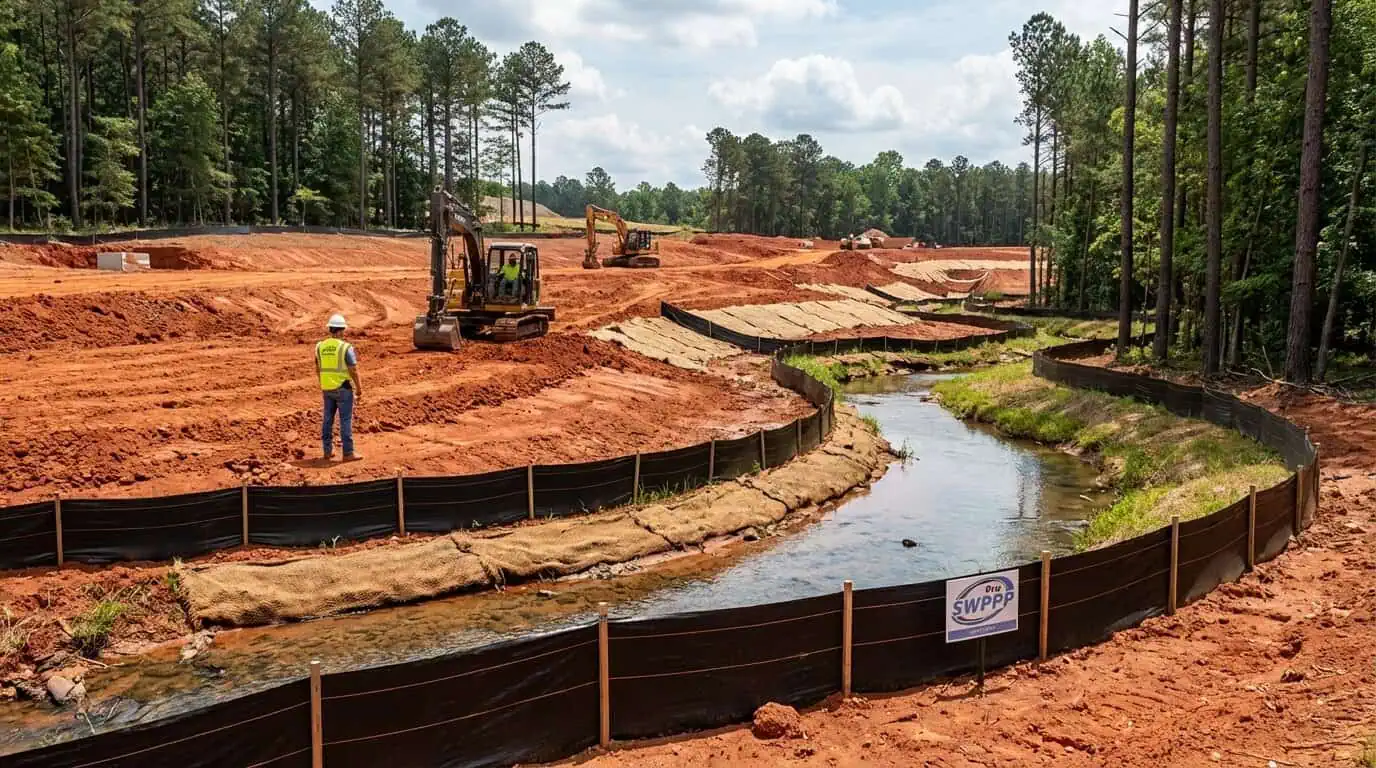
- Best Management Practices (BMPs): Perimeter controls like silt fences and sediment basins, inlet protection, stabilized construction entrances, and dust control measures.
- Inspection Schedule: Who inspects, how often, and what gets documented in the reports.
- Certification: Signed statements from the Design Professional and the contractor confirming the plan meets all regulations.
For projects disturbing fifty acres or more, the requirements get even tougher. You’ll need prior approval from the EPD District Office, enhanced sediment basins sized at 3,600 cubic feet per acre for sites over 150 acres, doubled vegetated buffers along State waters, and Design Professional inspections with seven-day turnaround reports during intermediate and final phases. Solar facilities face extra scrutiny—full stabilization before panel installation is mandatory.
Don’t want to mess with all the paperwork and requirements? Check out Order your SWPPP now with Pro SWPPP Professional CPESC Certified SWPPP Services.
How to Submit Your ES&C Plan and Get Permit Coverage
Once your ES&C Plan is complete, you submit a Notice of Intent (NOI) through GEOS, the Georgia Environmental Online Services portal. The NOI tells EPD who you are, where you’re building, and how you’ll control erosion and sediment. Your ES&C Plan attaches to that NOI electronically—no paper copies, no CDs, no mailing anything to an office.
Secondary permittees (subcontractors or other parties sharing responsibility) don’t file a separate NOI under GAR100003. Instead, they submit a signed addendum to the primary permittee, certifying they’ll follow the ES&C Plan. Primary and tertiary permittees handle the GEOS submissions.
After EPD reviews your NOI and ES&C Plan, you receive permit coverage. You must post the permit certificate on-site and keep your ES&C Plan available for inspections. When construction wraps up, you file a Notice of Termination (NOT) within fourteen days of final stabilization.
Common Mistakes That Delay Permits and Cost Money
Even experienced contractors trip over Georgia’s ES&C Plan requirements. Here are the biggest mistakes we see at Pro SWPPP:
Disturbing fifty or more acres without prior approval: You can’t just start clearing. Submit a detailed request to the correct EPD District Office before you disturb that much ground. Include technical justification, a site map, total acreage, owner and operator details, project description with latitude and longitude, and a list of certified inspectors. If you skip this step, your permit coverage is void.
Using paper or CD submittals: Since 2023, GEOS is the only acceptable method. Some contractors still try to mail in plans or drop off CDs at the local EPD office. That doesn’t work anymore. Electronic submission is mandatory.
Forgetting to update the plan: Your ES&C Plan isn’t a one-and-done document. If your site conditions change—new phases, different drainage patterns, additional acreage—you must revise the plan and notify EPD. Inspectors will check for plan updates during site visits.
Skipping certified inspections: Georgia requires inspections by a certified professional at specific intervals. If you don’t log those inspections and submit reports on time, you’re out of compliance. That’s an automatic red flag for EPD enforcement.
Not sure what your project needs? Take our SWPPP Quiz or Schedule a Free SWPPP Consultation with CPESC Certified SWPPP Expert Derek E. Chinners.
What About MS4 Phase I Permits?
If your project falls inside a Municipal Separate Storm Sewer System (MS4) Phase I jurisdiction—Atlanta, for example—you face an extra layer of enforcement. MS4 permits (GAS000XXX series) require local governments to review 100 percent of site plans, conduct inspections per the Manual for Erosion and Sediment Control in Georgia, and ensure all staff and builders hold GSWCC certifications.
MS4 jurisdictions track violations, issue warnings, and escalate to stop-work orders or penalties if you don’t comply. They also conduct annual high-volume property inspections and file detailed enforcement reports. Bottom line: if you’re building in an MS4 area, your ES&C Plan must meet both EPD and local government standards.
How Pro SWPPP Simplifies Georgia Compliance
We’ve helped contractors nationwide get permits fast and avoid costly mistakes. Here’s how we make Georgia ES&C Plans painless:
- CPESC-Certified Experts: Our team knows Georgia regulations inside and out. We prepare site-specific plans that pass EPD review the first time.
- GEOS Submission Assistance: We handle the electronic filing process so you don’t waste time learning a new portal.
- Large-Site Approvals: If you’re disturbing fifty or more acres, we prepare the technical justification, BMP designs, and inspector lists EPD requires for approval.
- Inspection Support: We coordinate certified inspections, prepare seven-day reports, and keep your documentation audit-ready.
- Ongoing Updates: When your site changes, we revise your ES&C Plan and notify EPD on your behalf.
Whether you’re building a subdivision, a solar farm, or a commercial development, Pro SWPPP gives you a compliance partner you can trust. We’ve seen every scenario—steep topography, trout streams, MS4 enforcement—and we know how to get your permit without delays.
Key Takeaways for 2026
Georgia’s ES&C Plan requirements aren’t going away. If anything, EPD is tightening enforcement and expanding electronic reporting. Here’s what you need to remember:
- One acre or more disturbed = ES&C Plan required before construction starts.
- All submissions go through GEOS. No paper, no exceptions.
- Fifty-plus-acre sites need prior EPD approval, enhanced BMPs, and Design Professional inspections.
- MS4 jurisdictions add local enforcement on top of EPD rules.
- Certified inspections and seven-day reports are mandatory for large sites.
- Solar projects must achieve full stabilization before installing panels.
If you’re also working in Texas, the process is similar but run by TCEQ under the Texas Construction General Permit. Same core principles—NPDES compliance, Best Management Practices, erosion and sediment control—but different forms and agencies. Pro SWPPP handles both states seamlessly, so you can focus on construction instead of paperwork.
How to Get Started Today
Step one: figure out if you need an ES&C Plan. If your project disturbs one acre or more in Georgia, the answer is yes. Step two: decide whether you want to tackle the plan yourself or hand it off to professionals who do this every day. Step three: submit your NOI through GEOS and get permit coverage before breaking ground.
Or skip all three steps and let Pro SWPPP handle everything. We prepare your ES&C Plan, submit your NOI, coordinate inspections, and keep you compliant from start to finish. You get back to building. We handle the compliance headaches. For more information, visit our contact page or reach out to our team today.
FAQ
Do I need an ES&C Plan for projects under one acre?
Generally no, unless your project is part of a larger common plan of development that totals one acre or more. If five separate lots each disturb half an acre but share the same developer, the entire project counts as one disturbance and requires an ES&C Plan.
Can I use a template ES&C Plan from another state?
No. Georgia EPD requires site-specific plans prepared by a certified Design Professional. Templates from other states don’t meet Georgia’s BMP standards, inspection schedules, or GEOS submission format.
What happens if I start construction before getting permit coverage?
EPD can issue stop-work orders, assess civil penalties of up to $50,000 per day under the Georgia Water Quality Control Act (O.C.G.A. 12-5-52), and require you to stabilize the site immediately. A separate and later incident within a 12-month period raises that ceiling to $100,000 per day. Your local issuing authority can assess its own penalty of up to $2,500 per day under the Erosion and Sedimentation Act (O.C.G.A. 12-7-15) on the same site, because the NPDES permit and your land-disturbing activity permit are enforced on two separate tracks. You’ll also need to submit a corrective action plan before resuming work.
How long does it take to get EPD permit coverage?
Once you submit a complete NOI and ES&C Plan through GEOS, EPD typically reviews within a few business days. Incomplete or incorrect submissions take longer. Working with Pro SWPPP speeds up the process because we get it right the first time.
Do I need separate permits for erosion control and stormwater?
In Georgia, the ES&C Plan covers both erosion control and stormwater pollution prevention under the NPDES Construction Stormwater General Permit. You don’t file two separate permits—one ES&C Plan handles both requirements.
What’s the difference between GAR100001 and GAR100003?
GAR100001 covers standalone projects. GAR100003 covers common developments where multiple operators share responsibility. Secondary permittees under GAR100003 submit addendums to the primary permittee instead of filing separate NOIs.
Can I get approval to disturb more than fifty acres at once?
Yes, but you must submit a detailed request to the EPD District Office before clearing. Approvals are capped at 400 acres disturbed at any one time unless EPD grants an exception. You’ll need enhanced BMPs, Design Professional inspections, and doubled buffers along State waters.
Get your Georgia ES&C Plan handled by Pro SWPPP – America’s #1 SWPPP Service today at https://proswppp.com.