A No Exposure Certification (NEC) lets an industrial facility skip its stormwater permit and SWPPP entirely, legally, if every industrial material and activity is kept under a roof and away from rain, snowmelt, and runoff. It is filed under 40 CFR 122.26(g), it is free in most states, and it must be renewed every five years. Most contractors dread the paperwork, inspections, and cost that come with industrial stormwater permits and SWPPP requirements, and the NEC is the one completely legal way to avoid them. If your facility keeps all industrial materials and activities under a roof and away from rain, you can skip the industrial permit and the SWPPP altogether. This guide shows you exactly how NEC works, who enforces it, what it costs, and how to stay legal across the U.S.
What Is a No Exposure Certification and Why Does It Matter?
A No Exposure Certification is a simple concept: if you keep every piece of industrial material, every process, and every activity completely sheltered from rain, snow, and stormwater runoff, the EPA and most states will let you avoid an industrial stormwater permit. No permit means no SWPPP, no quarterly inspections, and no lab reports. You just file a form once every five years that proves nothing is exposed.
The catch? “No exposure” has to be real. One uncovered drum, one open loading area, or one pile of scrap metal sitting in the rain, and your NEC is invalid. If an inspector finds exposure, you will be ordered to get a permit immediately, and you may face fines for every day you discharged stormwater without coverage. That is why Pro SWPPP helps contractors and facility operators understand the rules before they file.
What Counts as Industrial Materials and Activities
The federal definition under 40 CFR 122.26 includes raw materials, intermediate products, by-products, final products, waste, machinery, material handling equipment, loading and unloading areas, storage areas, and process areas. If stormwater can touch any of these, you have exposure. EPA and state agencies use checklists that ask yes-or-no questions: Is any material stored outside? Are loading docks open to the sky? Is there equipment or waste in the yard? A single “yes” disqualifies you from NEC.
Storm-Resistant Shelter: What You Can and Cannot Leave Outside
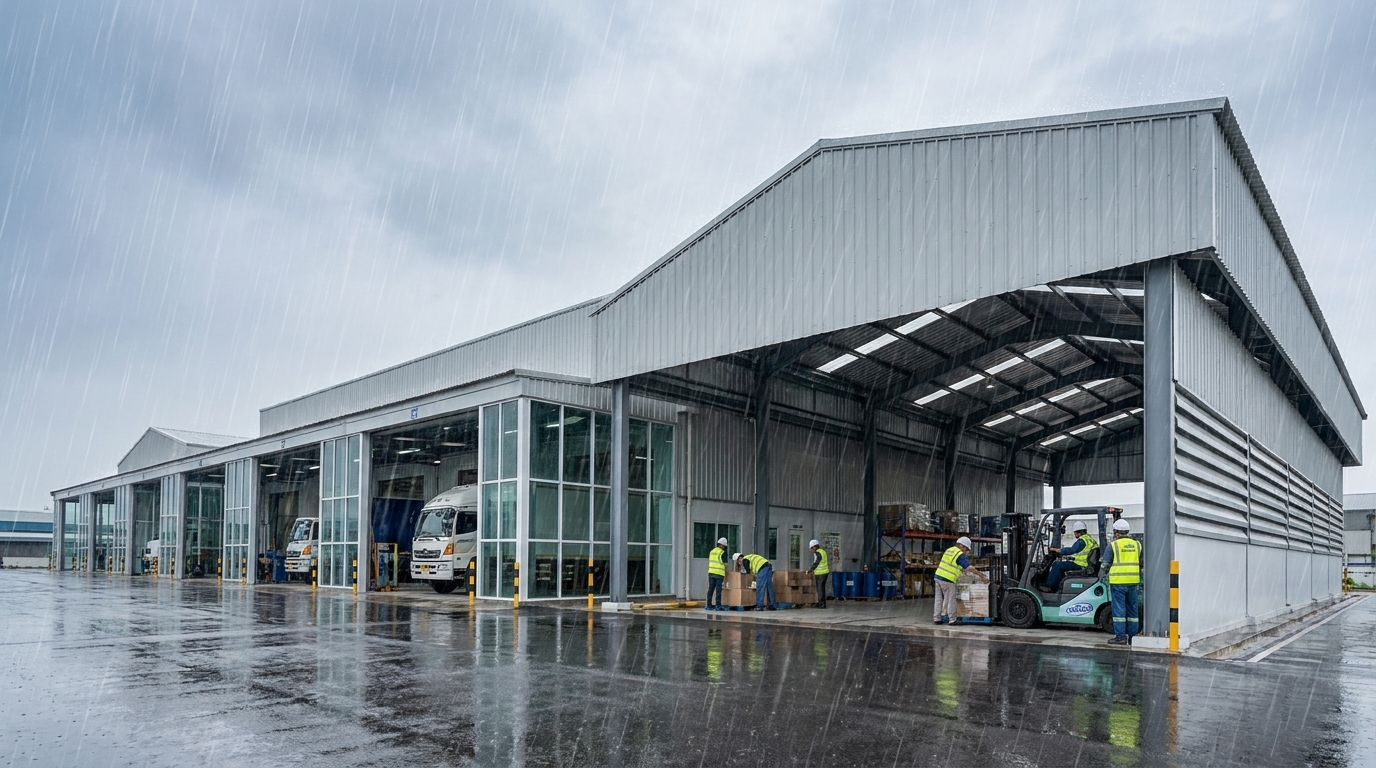
Storm-resistant shelter means a roof and walls that keep out rain, snow, and runoff. Most facilities use enclosed buildings, but covered bays with proper side closures also work. A few things are allowed outside without breaking NEC:
- Sealed containers: Drums, barrels, tanks, and totes that are tightly banded or secured with no operational taps, leaks, or visible deterioration.
- Closed dumpsters: Non-leaking solid waste dumpsters that are kept closed and maintained.
- Maintained vehicles: Forklifts, trucks, and trailers used for material handling, as long as they are not leaking and are part of active operations.
- Non-mobilizable final products: Finished goods like steel beams or concrete blocks that will not wash off or dissolve in rain. This does not include rock salt, wood chips, fertilizers, or powders.
If precipitation can contact product residue on the outside of containers, if secondary containment is not properly sealed, or if piping runs outside, you lose your no-exposure status. Pro SWPPP reviews your facility layout and tells you exactly what needs to move inside before you file NEC.
How NEC Avoids SWPPP Requirements Step by Step
Most industrial facilities that discharge stormwater to U.S. waters need coverage under an NPDES industrial stormwater permit. In areas where EPA is the permitting authority, that means the Multi-Sector General Permit (MSGP). States that run their own NPDES programs issue similar general permits. Every one of these permits requires a detailed SWPPP that includes site maps, best management practices, inspection schedules, employee training records, and corrective action plans.
NEC is a conditional exclusion from that entire framework. When you file a valid NEC, you are certifying that your facility meets the no-exposure criteria and therefore does not need a stormwater permit. No permit means no SWPPP, no quarterly inspections, no visual monitoring, and no annual reports. Your main obligation becomes maintaining physical no-exposure conditions and keeping your NEC current. Pro SWPPP helps clients weigh whether moving operations indoors is cheaper than years of SWPPP compliance.
The All-or-Nothing Rule
NEC is facility-wide, not per outfall. You cannot claim no exposure for one part of your site while running exposed activities elsewhere. If any industrial material or activity is exposed anywhere onsite, the entire facility is ineligible for NEC and must obtain permit coverage. This means you cannot split your operations into “clean” and “dirty” zones and file NEC for only the clean zone. EPA and state agencies reject partial NEC claims.
Construction Activity Is Not Eligible
NEC is available only for industrial facilities. Large construction activity (disturbing one acre or more) and construction stormwater discharges must use construction stormwater permits and construction SWPPPs. There is no NEC option for construction sites. If you are a contractor building a project, you need a Construction General Permit or state equivalent, not an industrial NEC. Pro SWPPP handles both construction and industrial SWPPPs nationwide.
Don’t want to mess with all the paperwork? Order your SWPPP now with Pro SWPPP Professional CPESC Certified SWPPP Services.
Who Enforces NEC and How Federal and State Programs Differ
The federal baseline for NEC is set in 40 CFR 122.26(g) and EPA’s MSGP Appendix K. In states and territories where EPA is the NPDES authority, you submit your NEC electronically through EPA’s NPDES eReporting Tool (NeT-MSGP). Regional EPA offices and local municipal separate storm sewer systems (MS4s) can inspect your facility and verify that no exposure exists.
Most states have EPA-authorized NPDES programs and run their own industrial stormwater permits. These states issue their own NEC forms and instructions, but the substantive criteria remain the same: all industrial materials and activities must be sheltered, and you must recertify at least every five years. Where state programs differ is in procedures, portals, and oversight.
State-Specific NEC Processes
Here are three examples of how state programs handle NEC:
- Texas (TCEQ): Texas Commission on Environmental Quality requires facilities to submit NEC through its online portal. The state has detailed guidance on what constitutes storm-resistant shelter and acceptable outdoor storage. Facilities already holding a Multi-Sector General Permit must file a Notice of Termination along with the NEC. TCEQ inspectors routinely verify no-exposure claims during site visits.
- Georgia (EPD): Georgia Environmental Protection Division issues its own industrial general permit and NEC form. Facilities submit NEC via email or online form, and EPD requires that sealed containers be truly sealed, with no operational valves or taps. Georgia also expects secondary containment for outdoor tanks and totes even if they are sealed.
- California (SWRCB): California State Water Resources Control Board has one of the strictest industrial stormwater programs in the country. The state’s Industrial General Permit includes a no-exposure certification option, but California’s definition of exposure is narrower than the federal baseline. Outdoor final products must be truly non-mobilizable, and inspectors look closely at residue on container exteriors and vehicle wash areas.
For contractors and facility operators working in multiple states, the takeaway is simple: the core no-exposure concept is federal, but forms, portals, fees, and inspection practices vary. Always check with the state environmental agency before filing NEC. Pro SWPPP tracks requirements nationwide and ensures your NEC is filed correctly with the right authority.

The Five-Year Recertification Cycle and What It Means for You
NEC is not a one-time filing. Federal rules and every state program require that you recertify your no-exposure status at least every five years. This means you must review your facility, confirm that all industrial materials and activities are still sheltered, and submit a fresh NEC form before the old one expires. If you miss the deadline, your facility is considered to have no stormwater coverage, and every discharge becomes an unpermitted discharge subject to penalties.
Many facilities set calendar reminders four and a half years after the initial NEC filing to begin the recertification process. During the five-year period, you must also maintain the no-exposure condition every single day. If you add new equipment, change your process, or start storing materials outside, you lose NEC eligibility immediately and must apply for a stormwater permit before the next rain event.
Inspections During the NEC Period
EPA and state agencies treat NEC as a legal certification, not a free pass. Inspectors can visit your facility at any time to verify that no exposure exists. They will walk the site, photograph outdoor areas, check loading docks, and review your drainage. If they find any industrial material or residue exposed to stormwater, they will issue a notice of violation and require you to obtain permit coverage immediately. In some cases, they will also impose civil penalties for each day the facility operated without a valid permit or NEC.
Pro SWPPP recommends that clients conduct internal audits every six months to confirm that no-exposure conditions are maintained. A single forgotten drum or one uncovered scrap pile can cost tens of thousands of dollars in fines and force you into emergency SWPPP development.
What It Really Costs to Maintain No Exposure
Filing an NEC form is usually free or carries a nominal state administrative fee. The real cost is in the infrastructure and operational changes needed to achieve and maintain no exposure. These costs vary widely depending on your current facility layout and the type of materials you handle.
Capital Costs
Most facilities need to invest in physical structures to achieve no exposure. Common capital expenses include:
- Building or expanding roofed storage areas: Constructing new buildings, adding roof extensions, or installing canopies with side walls to cover material storage zones.
- Enclosing loading docks: Installing roll-up doors, walls, or weather curtains around truck bays so that loading and unloading happen under cover.
- Secondary containment systems: Installing berms, sumps, or lined containment pallets under outdoor tanks and totes to catch spills and prevent stormwater contact.
- Drainage improvements: Modifying site grading and drainage to ensure that any water that contacts industrial areas is routed to an industrial wastewater system, not to stormwater outfalls.
Depending on the facility size and complexity, these projects can range from a few thousand dollars for small warehouses to hundreds of thousands for large manufacturing sites. However, these are typically one-time or infrequent investments. Once the infrastructure is in place, the cost to maintain no exposure is primarily operational.
Operational Costs
Maintaining no exposure requires changes to how you handle materials and manage your site. Common operational costs include:
- Staff training: Ensuring that employees understand the no-exposure rules and do not place materials outside, even temporarily.
- Housekeeping and inspections: Regular sweeps of outdoor areas to remove any industrial residue, spills, or windblown debris that could be mobilized in stormwater.
- Material handling adjustments: Scheduling deliveries and shipments to occur under cover, which may limit truck access or require changes to logistics.
- Documentation and record-keeping: Maintaining photos, inspection logs, and updated site maps to prove no exposure in the event of an agency inspection or NEC recertification.
For many facilities, these operational costs are still less than the long-term cost of maintaining a SWPPP under an industrial stormwater permit. SWPPP compliance involves quarterly visual inspections, analytical monitoring, corrective action plans, and annual reporting. Lab fees alone can run several thousand dollars per year. Pro SWPPP helps clients calculate the total cost of ownership for both NEC and permit coverage, so you can choose the option that makes financial sense.
Comparing NEC Costs to SWPPP Compliance
A typical industrial stormwater permit under EPA’s MSGP or a state general permit requires:
- Initial SWPPP development: $2,000 to $10,000 depending on complexity.
- Annual SWPPP updates and amendments: $500 to $2,000.
- Quarterly visual inspections: staff time or consultant fees, often $200 to $500 per quarter.
- Analytical monitoring (if required): $500 to $2,000 per sampling event, often quarterly or semi-annual.
- Corrective actions and BMP installation: highly variable, from hundreds to tens of thousands of dollars.
- Training and recordkeeping: ongoing staff time.
Over five years, full SWPPP compliance can easily cost $20,000 to $50,000 or more. If moving your operations indoors costs less than that, NEC is the clear winner. If your business model inherently requires outdoor material handling or processing, then a permit and SWPPP are unavoidable, and you should focus on efficient compliance rather than trying to force an NEC.
Not sure what your project needs? Schedule a Free SWPPP Consultation with CPESC Certified SWPPP Expert Derek E. Chinners.
What Happens When Exposure Occurs or NEC Is Filed Incorrectly
Filing an NEC when your facility does not truly have no exposure is a serious mistake. NEC is a legal certification signed by an authorized representative of the company. If an inspector finds exposure, the agency can treat every stormwater discharge since the NEC was filed as an unpermitted discharge. Penalties under the Clean Water Act can reach tens of thousands of dollars per day per violation, and false certification can trigger additional liability.
Loss of NEC Eligibility
The moment any industrial material or activity becomes exposed to precipitation, your facility loses its NEC eligibility. EPA and state rules are clear: you must obtain NPDES industrial stormwater permit coverage immediately. In practice, this means filing a Notice of Intent (NOI) and developing a SWPPP before the next rain event. One important exception applies right now: in jurisdictions where EPA is the permitting authority, new NOIs cannot be submitted while the 2021 MSGP sits administratively continued. A facility that loses no-exposure status there follows EPA’s No Action Assurance instead, which took effect March 1, 2026, terminates at 11:59 p.m. Eastern on February 28, 2027 or 120 days after the next MSGP takes effect, and requires you to email Appendix G of the 2021 MSGP to [email protected] before discharging. Read it carefully, because the No Action Assurance does not grant permit coverage. Some states allow a brief window to correct exposure caused by unforeseen events like equipment failure or storm damage, but only if you notify the agency within 24 hours and fix the problem before the next discharge.
For example, Indiana’s program allows NEC facilities to remain eligible if an unforeseen spill or malfunction causes temporary exposure, as long as the facility reports it within 24 hours and re-establishes no exposure before the next stormwater discharge. Other states have no such grace period and require immediate permit coverage if any exposure occurs. Pro SWPPP tracks these state-by-state variations and helps clients respond quickly when exposure incidents happen.
Enforcement Actions and Penalties
Inspectors from EPA regional offices, state environmental agencies, and local MS4 programs routinely visit NEC facilities to verify no-exposure claims. If they find exposure, they will issue a notice of violation and may impose civil penalties. Penalty amounts vary case by case, but the inflation-adjusted Clean Water Act maximums in 40 CFR 19.4 are steep: $27,378 per violation for an administrative Class I penalty (capped at $68,445), $342,218 for a Class II penalty, and $68,445 per day for judicial penalties. In addition, false statements on NEC forms can lead to criminal liability under federal and state environmental enforcement statutes.
Enforcement actions typically include:
- Immediate order to obtain permit coverage: The agency will require you to file an NOI and develop a SWPPP within a short timeframe, often 30 days or less.
- Retroactive violations: Agencies may calculate penalties starting from the date exposure began, which could be months or years before the inspection.
- Corrective action requirements: You may be required to install structural controls, conduct sampling, or implement specific best management practices as part of a consent order.
- Public disclosure: Enforcement actions are often posted online, which can damage your company’s reputation and affect future bids and contracts.
The best way to avoid these outcomes is to be honest about exposure when you file NEC. If your facility cannot truly achieve no exposure, do not file an NEC. Instead, obtain permit coverage and implement a SWPPP. Pro SWPPP provides fast, affordable SWPPP development so you can stay legal without disrupting your operations. For contractors and operators in Texas and Georgia, we deliver 72-hour turnaround on full compliance packages.
How to File NEC Correctly: Federal and State Procedures
Filing NEC is straightforward if you follow the right steps and use the correct forms and portals. The process differs slightly depending on whether EPA or your state is the NPDES permitting authority, but the basic workflow is the same.
Step 1: Determine Your Permitting Authority
Check whether EPA or your state environmental agency is the NPDES authority for industrial stormwater in your area. In most states, the state runs the program. In a few states and territories, EPA is the permitting authority and issues MSGP coverage. You can find this information on the EPA stormwater website or by contacting your state environmental agency.
Step 2: Verify Eligibility Using the NEC Checklist
Use the NEC form and guidance documents from EPA or your state to answer a series of yes-or-no questions about exposure. Common questions include:
- Are any raw materials, intermediate products, by-products, or final products stored or handled outdoors?
- Are loading or unloading areas open to the sky?
- Are there any industrial waste piles, scrap, or debris outside?
- Do you have any outdoor process equipment, tanks, or machinery?
- Could stormwater contact industrial materials on the exterior of containers or equipment?
If you answer “yes” to any of these, you are not eligible for NEC. If you answer “no” to all of them and have storm-resistant shelter over all industrial materials and activities, you may proceed.
Step 3: Complete and Submit the NEC Form
EPA and state NEC forms require similar information: facility name and address, SIC or NAICS codes, operator contact information, receiving waters, and a detailed description of how no exposure is maintained. You must also include a signed certification statement. The signatory must be an authorized representative of the company, such as a principal executive officer, ranking elected official, or duly authorized representative.
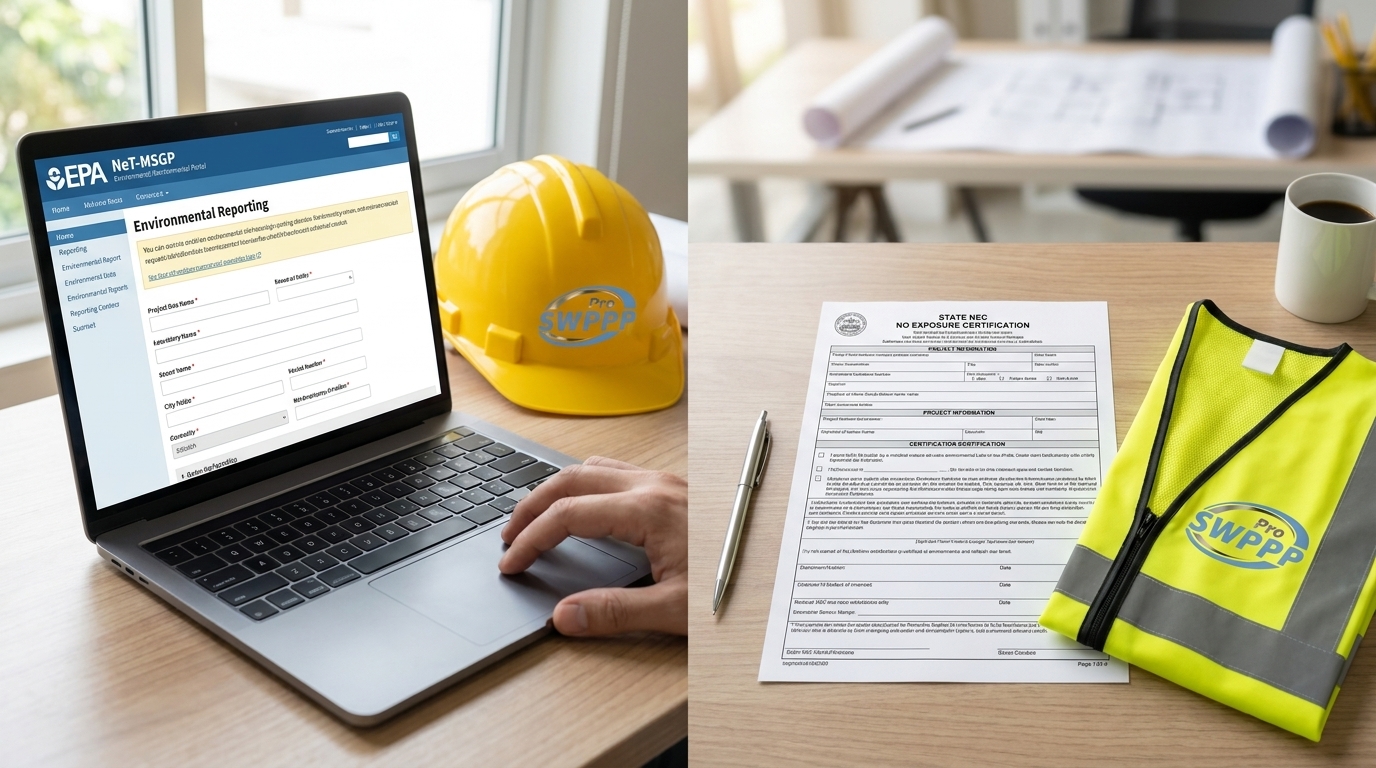
For EPA MSGP areas, submit the NEC electronically through the NPDES eReporting Tool (NeT-MSGP) via the EPA’s Central Data Exchange portal. For state programs, follow the state’s instructions, which may include online portals, email submission, or mailing paper forms to a designated permit section. Pro SWPPP helps clients navigate these portals and ensures that all required fields are completed correctly.
Step 4: Retain Documentation Onsite
Keep a copy of your signed NEC, site maps, photos, and any supporting documentation onsite for at least five years. If an inspector visits, they will ask to see these records. You must also provide a copy of your NEC to your local MS4 operator if they request it.
Step 5: Recertify Every Five Years
Set a reminder to recertify at least six months before your NEC expires. Review your facility for any changes, update your documentation, and submit a new NEC form using the same process. If your facility’s conditions have changed and exposure now exists, do not recertify. Instead, file an NOI for permit coverage and develop a SWPPP.
Recent Changes to NEC Rules and What They Mean for You
NEC rules have been relatively stable over the past decade, but EPA and states have made incremental updates that affect how you file and maintain no exposure. The most significant recent changes relate to EPA’s 2021 MSGP and proposed 2026 MSGP, as well as state-level updates to electronic filing and inspection practices.
EPA’s 2021 MSGP and NEC
EPA’s 2021 Multi-Sector General Permit took effect March 1, 2021 and expired February 28, 2026. EPA did not reissue it before that date, so the 2021 MSGP has been administratively continued under 40 CFR 122.6 and stays in force only for facilities that already held coverage when it expired. The NEC provisions in Appendix K are unchanged, and facilities that meet the no-exposure criteria can still file.
The practical difference matters more than most operators realize: the expiration does not touch NEC filing, but it does close NOI filing. EPA confirms that new, renewed and updated No Exposure Certifications are all still accepted through NeT-MSGP, while the Change NOI function is disabled and new facilities cannot obtain MSGP coverage at all until EPA issues a new permit. In an EPA-permitted jurisdiction, a facility that can genuinely reach no exposure currently has the cleaner path to a legal answer.
One notable change is that EPA now requires all NEC submissions to be made electronically via NeT-MSGP unless the facility obtains a waiver for electronic reporting. This means paper NEC forms are no longer accepted in most cases. Pro SWPPP helps clients set up NeT-MSGP accounts and submit NEC forms electronically, ensuring compliance with the new requirements.
Proposed 2026 MSGP
EPA proposed a 2026 MSGP in December 2024 (docket EPA-HQ-OW-2024-0481, published in the Federal Register December 13, 2024). The comment period, reopened once, closed May 19, 2025. As of September 2026 the permit has not been finalized and EPA has announced no effective date, which is why the 2021 permit is running on administrative continuance. A proposed Appendix K No Exposure Certification form sits among the proposal documents, and the core no-exposure criteria are not proposed for change. Nothing in the proposal is binding until EPA issues the final permit, so file against the 2021 Appendix K form today.
State Program Updates
Many states have updated their NEC forms and guidance in the past few years. Common updates include:
- Mandatory electronic submission: States like Ohio and California now require NEC forms to be submitted through online portals, with paper submissions allowed only in hardship cases.
- Clarified exposure definitions: Some states have issued updated guidance documents that define “sealed container,” “storm-resistant shelter,” and “final products” more narrowly than the federal baseline.
- Increased inspection frequency: Several states have increased the number of NEC facility inspections in response to water quality impairments and enforcement priorities.
For contractors working in multiple states, the key takeaway is that NEC is still available and widely used, but documentation and oversight are getting stricter. Work with a professional service like Pro SWPPP to ensure your NEC filing meets both federal and state requirements.
Building a Practical NEC Compliance Strategy
Achieving and maintaining no exposure is not just a paperwork exercise. It requires a deliberate compliance strategy that integrates facility design, operations, training, and documentation. Here is a step-by-step approach that Pro SWPPP recommends to clients:
Conduct a Baseline Exposure Assessment
Walk your entire facility and identify every area where industrial materials or activities occur. Use a checklist to document outdoor storage, loading zones, equipment yards, waste areas, and process areas. Take photos and mark locations on a site map. If you find any exposed materials or activities, note what changes would be needed to achieve no exposure.
Engineer Physical Controls
Based on your assessment, design and implement structural controls to eliminate exposure. This may include building new roofs, enclosing loading docks, installing secondary containment, or moving storage indoors. Prioritize high-risk areas where spills or leaks are most likely to occur. Work with a qualified engineer or contractor to ensure that shelters and containment systems meet storm-resistant standards.
Update Standard Operating Procedures
Revise your facility’s material handling, maintenance, and housekeeping procedures to reflect no-exposure requirements. Make it clear that no employee is allowed to place industrial materials outside, even temporarily, without approval from a designated compliance manager. Include NEC compliance in new employee orientation and annual refresher training.
Develop a Spill and Incident Response Plan
Even with the best controls, spills and equipment failures can happen. Develop a written plan that specifies how employees should respond if industrial materials are accidentally exposed. Include notification procedures, cleanup steps, and timeframes for re-establishing no exposure. In states that allow temporary exposure due to unforeseen events, ensure that your plan meets the 24-hour notification and corrective action requirements.
Document Everything
Maintain detailed records of your no-exposure controls, including site maps, photos, equipment maintenance logs, and training records. Update documentation whenever you make facility changes. Keep all records onsite and readily available for inspections. Pro SWPPP provides templates and checklists to help clients organize their NEC documentation.
Schedule Regular Internal Audits
Conduct internal inspections at least twice a year to verify that no-exposure conditions are maintained. Use the same checklist that agency inspectors would use. If you find any issues, correct them immediately and document the corrective action. Regular audits help you catch small problems before they become violations.
Track Your Five-Year Recertification Date
Set calendar reminders and assign responsibility for NEC recertification to a specific person or department. Begin the recertification process at least six months before your NEC expires. Review all documentation, update site maps and photos, and verify that no changes have occurred that would disqualify your facility from no exposure.
By following this structured approach, you can maintain valid NEC status and avoid the cost and complexity of industrial SWPPP compliance. For help with any step in this process, get a free SWPPP estimate and speak with a CPESC-certified expert.
Why Pro SWPPP is the SWPPP Service Contractors Trust
Pro SWPPP – America’s #1 SWPPP Service – helps contractors, facility operators, and developers nationwide stay legal with stormwater permits, SWPPPs, and NEC filings, backed by 180+ five-star reviews. Our team is led by CPESC-certified stormwater experts with 20+ years of experience in federal and state NPDES programs. We understand the nuances of NEC eligibility, state-specific forms, and how to design no-exposure controls that actually work.
Derek E. Chinners holds the Certified Professional in Erosion and Sediment Control (CPESC) credential and leads a team that prepares NEC filings and industrial SWPPPs nationwide, with 72-hour turnaround, flat-rate pricing, and support through inspections and five-year recertification. Whether you need Texas SWPPP services, Georgia SWPPP services, or coverage in any other state, you can read more about the team on Pro SWPPP’s About page.
FAQ
Can I file an NEC if I have outdoor containers that are sealed?
Yes, sealed containers are allowed outside under NEC rules, but they must be truly sealed. This means banded or otherwise secured with no operational taps, valves, or visible leaks. If precipitation can contact product residue on the exterior of the container or if the container is deteriorated, it does not qualify as sealed. Inspectors will look closely at container condition, so keep them clean and well maintained.
What happens if I file an NEC and then have a spill that causes temporary exposure?
If a spill or equipment failure causes temporary exposure, you may lose your NEC eligibility unless your state allows a grace period for unforeseen events. For example, Indiana allows facilities to remain eligible if they notify the state within 24 hours and re-establish no exposure before the next stormwater discharge. Other states require immediate permit coverage if any exposure occurs. Check your state’s NEC guidance and have a spill response plan ready.
Do I need to recertify my NEC every year?
No, NEC must be recertified at least every five years, not annually. However, you must maintain no-exposure conditions every single day during that five-year period. Many facilities conduct internal inspections twice a year to confirm no exposure and catch any issues before an agency inspector finds them.
Can I use NEC for construction sites?
No, NEC is not available for construction activity. Large construction projects (disturbing one acre or more) and construction stormwater discharges must obtain coverage under a Construction General Permit or state equivalent and develop a construction SWPPP. NEC applies only to industrial facilities that are not engaged in construction activity.
Is NEC available in all states?
NEC is available in all states that have EPA-authorized NPDES programs and in areas where EPA is the permitting authority. The federal baseline is the same everywhere, but state forms, submission procedures, and oversight vary. Check with your state environmental agency or contact Pro SWPPP to confirm NEC availability and requirements in your area.
How long does it take to get NEC approval?
NEC is a self-certification, not a permit application. Once you submit a complete and accurate NEC form, it becomes effective immediately. There is no formal approval process or waiting period. However, agencies can and do inspect NEC facilities to verify no-exposure claims, so you must be confident that your facility meets the criteria before you submit.
What is the penalty if I file an NEC incorrectly?
If an inspector finds exposure after you file an NEC, you can be cited for unpermitted stormwater discharges and false certification. Penalties under the Clean Water Act can reach tens of thousands of dollars per day per violation. You will also be required to obtain permit coverage immediately and may face additional corrective action requirements. The best way to avoid penalties is to be honest about exposure and work with a professional service like Pro SWPPP to verify eligibility before you file.
Not sure whether your facility qualifies for No Exposure? Take the 60-second SWPPP quiz.
Need a number for the industrial SWPPP instead? Get a free SWPPP estimate.
Ready to get started? Order your SWPPP now or schedule a free consultation with Pro SWPPP.
By Derek E. Chinners, CPESC — Founder & Stormwater Consultant, Pro SWPPP, LLC
Related: Industrial SWPPP Requirements · MSGP SWPPP Requirements · What Is a SWPPP? · When Is a SWPPP Required?