
Pittsburgh SWPPP requirements are set by the Pennsylvania Department of Environmental Protection (PA DEP) under 25 Pa. Code Chapter 102 and administered locally by the Allegheny County Conservation District (ACCD). Any earth disturbance of 5,000 square feet or more requires a written E&S Plan. One acre or more requires NPDES permit coverage under PAG-02, plus a separate PCSM Plan.
Last verified: August 2026 against PA DEP, the Allegheny County Conservation District, the City of Pittsburgh Code, and the U.S. EPA.
Pittsburgh and Allegheny County Stormwater Requirements at a Glance
| Requirement | Pittsburgh / Allegheny County value |
|---|---|
| NPDES permitting authority | PA DEP (Pennsylvania is a delegated NPDES state); Chapter 102 plan review is delegated to the Allegheny County Conservation District |
| Pennsylvania’s term for a SWPPP | E&S Plan (Erosion and Sediment Control Plan) plus PCSM Plan (Post-Construction Stormwater Management Plan) |
| Construction General Permit | PAG-02 for earth disturbance of 1 acre or more; PAG-01 for eligible small construction under 5 acres; Individual NPDES permit in special protection watersheds |
| PAG-02 permit term | Effective December 8, 2024; expires December 7, 2029 |
| Written E&S Plan threshold | 5,000 square feet of earth disturbance |
| NPDES permit threshold | 1 acre, including any stage of a larger common plan of development or sale |
| City of Pittsburgh SWM Site Plan threshold | 10,000 square feet of cumulative earth disturbance, or 5,000 square feet of new impervious area |
| ACCD non-NPDES E&S review fee | $2,100 flat; $6,300 for expedited review |
| ACCD NPDES filing fees | $500 administrative filing fee (PAG-01/PAG-02) or $1,500 (Individual), plus $100 per disturbed acre rounded to the nearest whole acre |
| Filing system | Notice of Intent (NOI) with E&S Module 1 and PCSM Module 2, submitted to ACCD |
| Inspection frequency | Weekly visual site inspections, plus within 24 hours of any rainfall of 0.25 inch or more, plus corrective-action follow-ups |
| Inspector qualification | Only a qualified site inspector may complete PAG-02 weekly visual site inspections, effective December 8, 2025 |
| Industrial stormwater permit | PAG-03, Pennsylvania’s Multi-Sector General Permit equivalent; effective March 24, 2023, expires March 23, 2028 |
| Maximum civil penalty | Up to $10,000 per day per violation under The Clean Streams Law |
Do I Need a SWPPP in Pittsburgh?
Yes, if a Pittsburgh project disturbs 5,000 square feet or more of earth, a written E&S Plan is required under Chapter 102. At 1 acre or more, the project also needs NPDES permit coverage under PAG-02 and a separate PCSM Plan. Inside city limits, a City of Pittsburgh SWM Site Plan is triggered at 10,000 square feet of disturbance or 5,000 square feet of new impervious area. Pennsylvania does not use the term “SWPPP” in its regulations, but the E&S Plan and PCSM Plan together serve the same function as a construction SWPPP in other states. If the terminology is new, start with what an SWPPP actually is, then compare it to the statewide rules in the Pennsylvania construction and industrial SWPPP guide.
Pro SWPPP – America’s #1 SWPPP Service helps contractors across the country figure out one simple thing: what do you actually need to break ground legally? In Pittsburgh and Allegheny County, the answer is not as simple as “get a permit.” You might need an Erosion and Sediment Control Plan, a Post-Construction Stormwater Management Plan, or both. Sometimes you need local approvals on top of state permits. Let’s cut through the confusion.
Most contractors assume stormwater rules are the same everywhere. They are not. Pennsylvania has its own system under Chapter 102, and Pittsburgh has local rules that can be stricter than the state. If you miss a requirement, your project stops. Inspectors show up. Fines happen. That is why you need to know exactly what applies to your site before you move one yard of dirt.
This guide will walk you through the E&S and PCSM plan requirements in Pittsburgh and Allegheny County. You will learn what triggers each plan, what goes in them, and how to avoid the most common mistakes. This guide also shows how Pro SWPPP – America’s #1 SWPPP Service can handle the paperwork so you can focus on building.
What Is an E&S Plan and When Do You Need One?
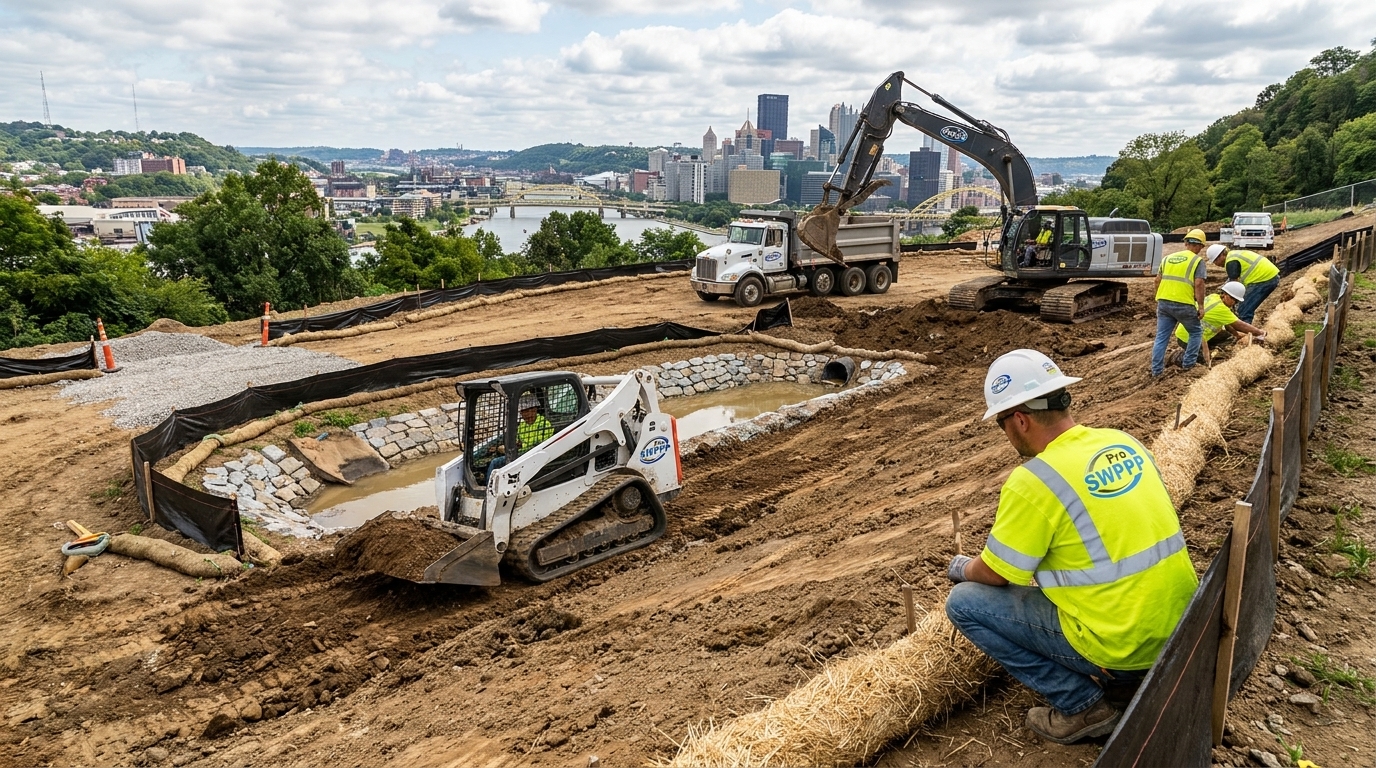
An Erosion and Sediment Control Plan (E&S Plan) is your written game plan for keeping soil on your site during construction. Pennsylvania Chapter 102 requires a written E&S Plan for any project that disturbs 5,000 square feet or more of earth. That is about the size of a small house lot. If you are grading, digging, or clearing vegetation over that threshold, you need an E&S Plan.
The plan must show how you will prevent soil from washing into streets, storm drains, and streams. It includes things like silt fences, inlet protection, construction entrances, and temporary seeding. These are called Best Management Practices (BMPs) for erosion control and sediment control. The goal is to keep dirt on your site while you build.
In Allegheny County, the Conservation District reviews E&S Plans for projects between 5,000 square feet and 0.99 acres. As of the fee schedule effective April 16, 2026, that review costs a flat $2,100 for non-NPDES projects, or $6,300 for expedited review. If your project is one acre or larger, you need an NPDES construction stormwater permit from the Pennsylvania Department of Environmental Protection. That permit requires both an E&S Plan and a separate Post-Construction Stormwater Management Plan.
Timber harvesting is a special case. All timber operations in Allegheny County need an E&S Plan, no matter the size. If you are harvesting less than 25 acres, you do not need a permit, but you still need the plan. For more on Pennsylvania stormwater rules, check out our guide on construction and industrial SWPPP requirements in Pennsylvania.
What Is a PCSM Plan and How Is It Different?
A Post-Construction Stormwater Management Plan (PCSM Plan) is not the same as an E&S Plan. The E&S Plan covers temporary controls during construction. The PCSM Plan covers permanent stormwater controls that stay in place after construction is done. Think of the E&S Plan as your short-term fix and the PCSM Plan as your long-term solution.
PCSM Plans are required for projects one acre or larger that need an NPDES construction permit. The plan must be separate from the E&S Plan unless DEP approves otherwise. It must be labeled “PCSM” or “Post Construction Stormwater Management Plan” on the cover sheet. The plan must show the finished condition of the site, not just construction-phase controls.
What goes in a PCSM Plan? You need site topography, soil types, land use history, calculations for stormwater volume and rate changes, details on receiving waters, BMP design specs, construction sequencing, and a long-term operation and maintenance schedule. The person who prepares the plan must be trained and experienced in PCSM design methods. This is not a job for someone who has never done stormwater work before.
Volume Control, Water Quality, and Peak Rate Management
PCSM Plans must address three things: volume control, water quality, and peak rate management. Volume control means you capture and infiltrate stormwater on-site so less runoff leaves your property. Water quality means you filter pollutants before stormwater reaches streams. Peak rate management means you slow down stormwater so it does not cause flooding downstream.
Most projects need a stormwater analysis under Pennsylvania Chapter 102.8(g). You calculate pre-construction runoff and post-construction runoff. Then you design BMPs to meet state standards. The Pennsylvania Stormwater BMP Manual is the main technical reference. DEP approves alternatives only if they are legally authorized.
Don’t want to mess with all the paperwork and requirements? Check out Order your SWPPP now with Pro SWPPP Professional CPESC Certified SWPPP Services.
Do Pittsburgh’s Local Stormwater Rules Go Beyond Pennsylvania’s?
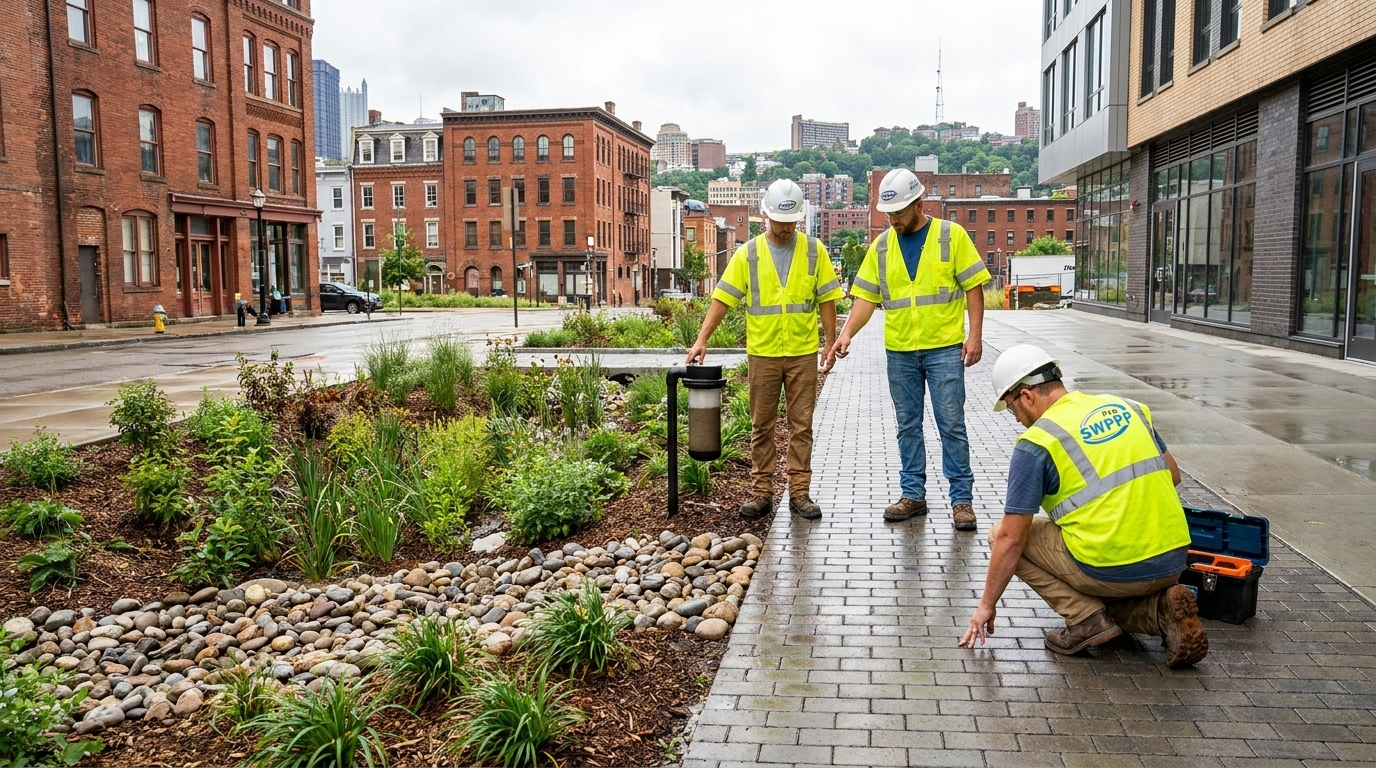
The City of Pittsburgh has its own stormwater ordinance that can be stricter than state rules. If your project disturbs 10,000 square feet or more, or creates 5,000 square feet of new impervious area, Pittsburgh’s stormwater rules apply. Lower thresholds apply in designated riverfront and Uptown districts.
Pittsburgh is also updating its stormwater code to reflect climate risk. The new rules use climate change projections specific to Pittsburgh. They include Public Health and Safety Release Rate Areas and a two-step plan approval system. The goal is to make stormwater systems more resilient to future flooding and heavy rainfall.
If you are working in Pittsburgh, you need to check both state and local requirements. The state sets the baseline, but the city can add more. Allegheny County’s Act 167 stormwater management plan also shapes local rules. DEP approved the county plan in 2018, and county model ordinances continue to guide municipal volume and peak-rate controls.
What Are the Most Common Pittsburgh Stormwater Compliance Mistakes?
One mistake is thinking erosion control is enough. E&S Plans cover temporary construction controls. PCSM Plans cover permanent stormwater management. You need both for projects one acre or larger. Do not assume one plan covers both.
Another mistake is combining E&S and PCSM into one generic plan. DEP review comments explicitly require the PCSM Plan to be separate from the E&S Plan. The PCSM Plan must be the final construction plan set. Label it clearly. Keep it separate.
Long-term ownership obligations are often overlooked. DEP requires recording an instrument for properties with PCSM stormwater control measures (SCMs). That instrument must notify future owners that operation and maintenance is a covenant running with the land. If you sell the property, the new owner must maintain the BMPs. If you skip this step, DEP can stop your project.
Incomplete PCSM Calculations
Many projects fail because they do not clearly document pre-construction hydrology, post-construction hydrology, volume control, and peak-rate compliance. Do not wait until grading plans are done to start your stormwater analysis. Build the calculations early in design. That way you can adjust the site layout if needed to meet stormwater standards.
Not sure what your project needs? Take our SWPPP Quiz or Schedule a Free SWPPP Consultation with CPESC Certified SWPPP Expert Derek E. Chinners.
Post-Construction Maintenance Gaps
Your PCSM Plan must include a long-term operation and maintenance schedule. Who will mow the rain garden? Who will clean the storm drains? Who will fix erosion if a pipe breaks? Assign a responsible owner. Record the maintenance obligation. Include maintenance triggers in your project closeout. Do not leave this to chance.
Which Pittsburgh Approval Path Does Your Project Need?
The most efficient way to avoid delays is to screen early. Ask these questions:
- How much earth disturbance is there?
- How much new impervious area will be created?
- Is the site in Pittsburgh or another Allegheny County municipality?
- Are there High Quality or Exceptional Value waters nearby?
- Is this a timber harvesting operation?
- Are there local ordinances beyond state rules?
If you disturb less than 5,000 square feet, you likely do not need a written E&S Plan. If you disturb 5,000 square feet to 0.99 acres, you need an E&S Plan reviewed by the Allegheny County Conservation District. If you disturb one acre or more, you need an NPDES permit, an E&S Plan, and a PCSM Plan. If you are in Pittsburgh, you may also need local stormwater approval.
Do not assume county review is optional everywhere under one acre. Local ordinances, special protection waters, and permit-linked projects can still require review or approval even when state threshold triggers are not met. Check with the local municipality early.
How to Get Compliant: E&S Plan, PCSM Plan, and Your NPDES NOI
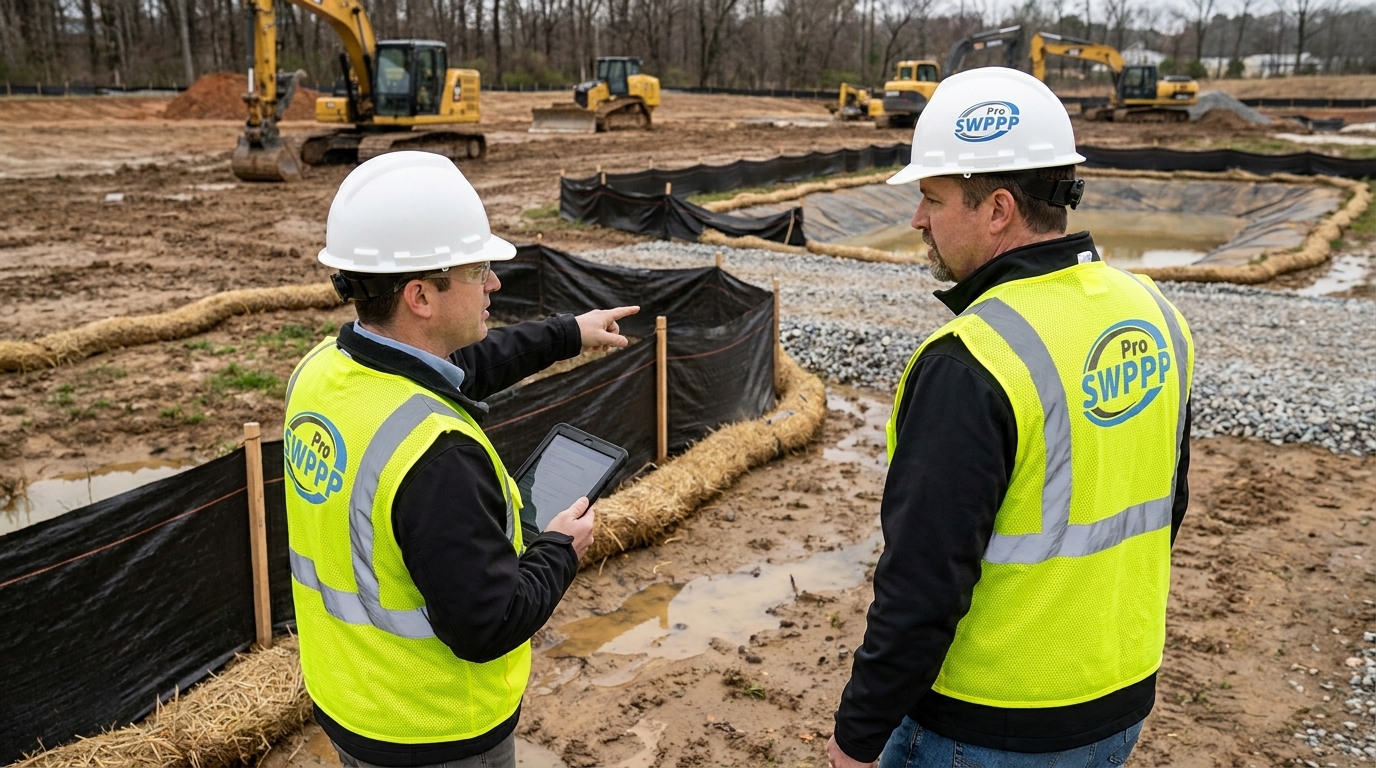
Compliance in Pittsburgh follows a defined sequence. Skipping a step is the most common cause of a stalled submission at the Allegheny County Conservation District. Pro SWPPP runs this sequence for contractors statewide through its Pennsylvania SWPPP services.
- Confirm the disturbance figure. Measure total earth disturbance across every phase, including any larger common plan of development or sale. The 5,000 square foot and 1 acre thresholds are cumulative, not per phase.
- Screen the receiving water. Projects draining to High Quality or Exceptional Value waters lose PAG-02 eligibility and need an Individual NPDES permit.
- Prepare the E&S Plan. Chapter 102 sets the content requirements: site and soils mapping, runoff calculations, BMP sizing, construction sequencing, and stabilization criteria.
- Prepare a separate PCSM Plan. For projects of 1 acre or more, the PCSM Plan must be a distinct plan set labeled “PCSM” and address volume control, water quality, and peak rate management.
- Complete the PNDI receipt and municipal and county notifications. Acts 14, 67, 68, and 127 receipts are part of a complete application package.
- File the Notice of Intent with ACCD. Submit the NOI, E&S Module 1, PCSM Module 2, plan drawings, and fees. Budget $500 plus $100 per disturbed acre for a PAG-02 general permit, or $1,500 plus $100 per disturbed acre for an Individual permit.
- Add City of Pittsburgh approval if applicable. Inside city limits, a separate SWM Site Plan approval is required before regulated activity begins.
- Run inspections and keep records. Weekly visual site inspections by a qualified site inspector, post-storm inspections within 24 hours of 0.25 inch of rain, and documented corrective actions.
- Record the PCSM maintenance instrument so operation and maintenance runs with the land, then close the permit with a Notice of Termination.
Official Stormwater Resources
- U.S. EPA — Stormwater Discharges from Construction Activities
- PA DEP — Construction Stormwater (Chapter 102, PAG-01 and PAG-02)
- PA DEP — Industrial Stormwater (PAG-03)
- Allegheny County Conservation District — NPDES Construction Stormwater Program
- Allegheny County Conservation District — Non-NPDES E&S Plan Review and Fees
- City of Pittsburgh Code — Stormwater Management Standards
What Are the Industrial SWPPP Requirements in Pittsburgh? (PAG-03)
Industrial facilities in Pittsburgh are permitted separately from construction sites. Pennsylvania runs its own Multi-Sector General Permit equivalent, PAG-03, rather than relying on the EPA 2021 MSGP. The current PAG-03 became effective March 24, 2023 and expires March 23, 2028, and it was rewritten to align more closely with the federal MSGP.
PAG-03 coverage applies to facilities with stormwater discharges associated with industrial activity, sorted by sector and SIC code. Typical Pittsburgh sectors include metal fabrication and steel-related operations, scrap and recycling yards, transportation and vehicle maintenance facilities, chemical and petroleum handling, landfills, and manufacturing plants. Covered facilities file a Notice of Intent, maintain a written Preparedness, Prevention and Contingency (PPC) plan and stormwater pollution prevention documentation, conduct routine visual inspections, and complete sector-specific benchmark and effluent monitoring with electronic DMR reporting.
A construction permit does not cover industrial operations, and PAG-03 does not cover earth disturbance. A site that builds and then operates needs both.
Pittsburgh SWPPP Penalties and Fines
Enforcement in Pennsylvania runs through The Clean Streams Law. Civil penalties reach $10,000 per day for each violation, assessed per day the violation continues. PA DEP and the Allegheny County Conservation District can also issue notices of violation, compliance orders, and cessation orders that stop earth disturbance entirely until deficiencies are corrected.
The expensive failures are rarely dramatic. They are missing weekly inspection reports, an E&S Plan that no longer matches field conditions, an unrecorded PCSM maintenance covenant, and discharge of sediment to a storm sewer or stream. Each of those is documentable, each is a separate violation, and each accrues daily. A stop-work order on an active Pittsburgh site typically costs more in schedule than the penalty itself.
What Is Changing in Pittsburgh and Allegheny County Stormwater Rules?
Pittsburgh is using climate-informed design assumptions instead of relying only on historic rainfall patterns. The city’s update materials show area-specific release-rate standards and Public Health and Safety Release Rate Areas. This is a shift toward more resilient stormwater codes.
DEP is also moving toward more uniform submittal packages. The 2026 SCM suite planning tool and related permit forms indicate clearer eligibility screening and more structured PCSM documentation. This should make the review process faster and more predictable.
There is also a trend toward stronger lifecycle accountability. The combination of separate PCSM plans, recorded maintenance covenants, inspections at critical stages, and transfer notifications shows Pennsylvania is moving toward asset-management-style stormwater compliance. This is not just about one-time plan approval. It is about ongoing performance and documentation.
Monthly photo documentation, annual reports, and rapid repair expectations for BMP and SCM failures are becoming standard. If you want to stay compliant, you need a system for tracking inspections, repairs, and maintenance over the life of the project.
For contractors working in other states, Pro SWPPP – America’s #1 SWPPP Service also serves Texas and Georgia. Pro SWPPP handles the regional differences so you do not have to.
How Pro SWPPP Helps with Pittsburgh E&S and PCSM Plans
Pro SWPPP – America’s #1 SWPPP Service takes the stress out of stormwater compliance. Pro SWPPP prepares E&S Plans, PCSM Plans, and NPDES permit applications for projects in Pittsburgh and across Pennsylvania. The Pro SWPPP team includes CPESC certified experts who know the state rules, county requirements, and local ordinances.
Pro SWPPP handles the calculations, drawings, BMP specifications, sequencing, and long-term maintenance schedules. Pro SWPPP makes sure your plan is labeled correctly, separated correctly, and submitted correctly. Pro SWPPP also coordinates with the Conservation District and PA DEP so you do not have to chase down reviewers or fix resubmittals.
You get a complete, compliant plan that passes review the first time. You also get support during construction if inspectors have questions or if you need to update the plan for field conditions. Pro SWPPP is not just a document factory. Pro SWPPP is a compliance partner from start to finish.
Learn more about our process at our About page or contact us to discuss your project.
Real-World Pittsburgh Compliance Tips
Start early. Do not wait until the week before you need to submit your permit application to think about stormwater. Run the calculations while you are still designing the site layout. That way you can adjust grading, drainage, and impervious areas to meet stormwater standards without redesigning the whole project.
Document everything. Take photos at critical stages. Keep inspection logs. Record maintenance activities. If DEP or the Conservation District asks for proof of compliance, you want to be able to hand over a folder of documentation, not scramble to recreate it from memory.
Assign a responsible party for long-term maintenance before you close the project. Do not leave it vague. Name a person or company. Put it in writing. Record it with the deed. Future owners need to know who is responsible for mowing the rain garden, cleaning the storm drains, and fixing erosion.
Use the Pennsylvania Stormwater BMP Manual as your design reference. Do not try to reinvent the wheel. The manual has design specs, performance standards, and maintenance schedules for every common BMP. If you follow the manual, your plan is more likely to pass review.
Pittsburgh SWPPP FAQ
Do I need an E&S Plan if I disturb less than one acre?
Yes, if you disturb 5,000 square feet or more. Pennsylvania Chapter 102 requires a written E&S Plan for any project that disturbs 5,000 square feet or more of earth. Projects under 5,000 square feet may still need erosion controls, but a written plan is not required.
What is the difference between an E&S Plan and a PCSM Plan?
An E&S Plan covers temporary erosion and sediment controls during construction. A PCSM Plan covers permanent stormwater management controls that stay in place after construction is done. You need both for projects one acre or larger.
Who reviews my E&S Plan in Allegheny County?
The Allegheny County Conservation District reviews E&S Plans for projects between 5,000 square feet and 0.99 acres. For projects one acre or larger, DEP reviews the plan as part of the NPDES permit application.
Do I need a separate PCSM Plan or can I combine it with my E&S Plan?
You need a separate PCSM Plan unless DEP approves otherwise. DEP review comments explicitly require the PCSM Plan to be separate from the E&S Plan. The PCSM Plan must be labeled “PCSM” or “Post Construction Stormwater Management Plan” on the cover sheet.
What happens if I do not record a maintenance covenant for my PCSM BMPs?
DEP requires recording an instrument for properties with PCSM stormwater control measures. If you do not record the covenant, DEP can stop your project. The covenant must notify future owners that operation and maintenance is a covenant running with the land.
Does Pittsburgh have stricter stormwater rules than the state?
Yes, Pittsburgh has its own stormwater ordinance that applies to projects disturbing 10,000 square feet or more, or creating 5,000 square feet of new impervious area. Lower thresholds apply in designated riverfront and Uptown districts. Check both state and local requirements before you start.
Can Pro SWPPP help with both E&S and PCSM Plans?
Yes, Pro SWPPP – America’s #1 SWPPP Service prepares both E&S Plans and PCSM Plans for projects in Pittsburgh and across Pennsylvania. Pro SWPPP handles the calculations, drawings, BMP specifications, and coordination with PA DEP and the Allegheny County Conservation District.
Ready to get started? Order your SWPPP now or schedule a free consultation with Pro SWPPP.
Visit Pro SWPPP and see why thousands of contractors trust America’s #1 SWPPP Service.
Get Your Pittsburgh SWPPP in 72 Hours
Pro SWPPP prepares Pittsburgh E&S Plans, PCSM Plans, and PAG-01, PAG-02, and PAG-03 Notice of Intent packages remotely, with standard turnaround in 72 hours. Pro SWPPP also provides ongoing inspection documentation and recordkeeping so weekly and post-storm reports are complete when PA DEP or the Allegheny County Conservation District asks for the file. Pro SWPPP is a compliance and documentation firm and does not install BMPs in the field.
Order your Pittsburgh SWPPP now or schedule a free SWPPP consultation.
Derek E. Chinners — Founder & Stormwater Consultant, CPESC · 833-GET-SWPPP
Related SWPPP Compliance Resources
- Pennsylvania SWPPP Requirements: Construction and Industrial Compliance Guide
- Pennsylvania SWPPP Services
- What Is an SWPPP?
- How Much Does an SWPPP Cost?
- Texas SWPPP Services
- Georgia SWPPP Services
Sources
- PA DEP, Construction Stormwater — Chapter 102 thresholds, PAG-01, PAG-02, Individual NPDES
- PA DEP, Industrial Stormwater — PAG-03
- Allegheny County Conservation District, NPDES program — $500 / $1,500 filing fees, $100 per disturbed acre, review timelines
- Allegheny County Conservation District, Non-NPDES program — $2,100 standard and $6,300 expedited E&S review fees
- City of Pittsburgh Code, Stormwater Management Standards — 10,000 sq ft and 5,000 sq ft impervious thresholds
- 25 Pa. Code Chapter 102, Erosion and Sediment Control
- The Clean Streams Law — civil penalties up to $10,000 per day
- U.S. EPA, Stormwater Discharges from Construction Activities