The TCEQ TXR050000 Multi-Sector General Permit expired on August 14, 2026. TCEQ’s 2026 MSGP took effect the same day, and every Texas facility holding a 2021 authorization must file a renewal Notice of Intent (Form INOI-R) or renewal No Exposure Certification (Form INEC-R) in STEERS by November 12, 2026, with a $100 fee and an SWP3 updated to the 2026 permit.
When did the TXR050000 permit expire?
The 2021 TXR050000 Multi-Sector General Permit expired on August 14, 2026, at the end of its five-year term. TCEQ’s 2026 MSGP took effect the same day. The 2026 MSGP runs a five-year term and expires August 14, 2031.
Facilities covered under the expired permit get one window to move to the new one. TCEQ states on its Assistance Tools for Industrial Stormwater General Permit page: “Existing permittees will have a 90-day grace period to renew their authorizations.” That grace period ends November 12, 2026. A facility that has not renewed by then has no authorization under the 2026 permit, and industrial stormwater it discharges after that date is unpermitted.
Renewal is not a paperwork formality. The 2026 permit lowers six benchmark concentrations, narrows the substantially similar outfall exception, and extends MS4 notification to every receiving MS4. A SWP3 written to the 2021 permit does not satisfy the 2026 permit, even if nothing at your facility changed.
TXR050000 renewal timeline
| Date | Milestone |
|---|---|
| August 14, 2021 | 2021 TXR050000 MSGP issued, five-year term |
| November 14, 2025 | Notice of the proposed 2026 MSGP published in the Texas Register |
| August 14, 2026 | 2026 MSGP takes effect; the 90-day renewal window opens in STEERS |
| September 1, 2026 | Last day to terminate unneeded coverage and avoid the $200 annual water quality fee (passed) |
| November 12, 2026 | Renewal window closes. Unrenewed 2021 authorizations are not carried into the 2026 permit. |
| August 14, 2031 | 2026 MSGP expires (five-year term) |
Not sure if you even need one?
Answer a few questions about your site and find out in under two minutes.
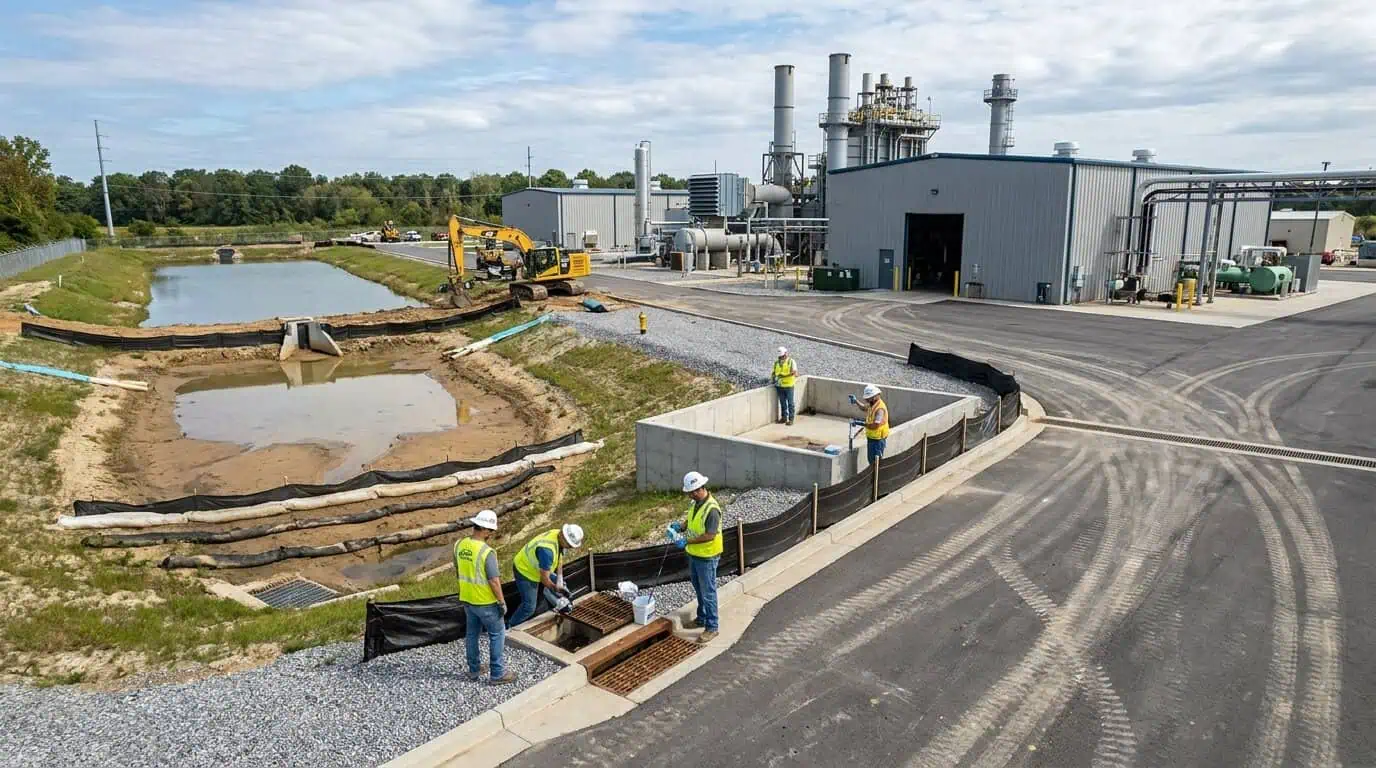
What must every TXR050000 permittee do before November 12, 2026?
Four things, and they are sequential. The SWP3 must be updated before the renewal is submitted, so starting with the STEERS form is the most common and most expensive mistake.
| Requirement | What it means for your facility |
|---|---|
| Renewal NOI or NEC | Form INOI-R (renewal NOI) or Form INEC-R (renewal No Exposure Certification), filed through STEERS by November 12, 2026. Each carries a $100 fee. The NEC is an option only if every industrial material and activity is fully sheltered. |
| Updated SWP3 | A plan written to the 2026 permit: updated site map, pollutant inventory, BMPs, the six lower benchmarks, and outfall monitoring under the narrower similar-outfall exception. Your 2021 plan does not carry over. |
| Quarterly inspections | Routine facility inspections and quarterly visual assessments of stormwater discharges, documented and retained on site with the SWP3. |
| Employee training | Personnel responsible for BMPs, spill response, inspections, and monitoring must be trained, with training records kept on site. |
Every one of these is filtered through your SIC code. The MSGP divides industrial facilities into sectors, and each sector carries its own benchmark parameters, monitoring obligations, and sector-specific BMPs. A concrete plant, a scrap yard, and a chemical warehouse doing the same four steps produce four very different documents.
Getting the sector wrong means monitoring the wrong parameters against the wrong benchmarks. It is one of the most common findings in TCEQ inspections.
How long do you have to renew TXR050000 coverage?
You have until November 12, 2026. TCEQ states: “The renewal period is available from August 14 – November 12, 2026.” Renewal NOIs (Form INOI-R) and renewal No Exposure Certifications (Form INEC-R) are filed through STEERS/ePermits, and each carries a $100 application fee.
The 90 days are for filing, not for starting the plan. TCEQ’s 2026 MSGP renewal notice requires you to develop and implement an updated SWP3 before you renew. Leave time for STEERS account problems, such as a missing certifying official or an expired login, which are a common reason filings slip past the deadline.
What happens if you miss the November 12 deadline?
The facility loses its authorization. There is no late renewal: a facility that misses November 12 must apply as a new applicant under the 2026 permit, and every industrial stormwater discharge before new coverage is issued is an unpermitted discharge.
Unauthorized discharges expose the facility to notices of violation, administrative penalties, and orders to stop discharging. If you are unsure of your status, call TCEQ’s Small Business and Local Government Assistance hotline at 800-447-2827 or check the TCEQ Stormwater MSGP for Industrial Facilities page.
Facilities that no longer need coverage should file a Notice of Termination instead. The September 1, 2026 cutoff to avoid this year’s $200 annual water quality fee has passed, so any facility with active coverage on September 1 will be invoiced.
What is the TXR050000 MSGP?
The Texas Pollutant Discharge Elimination System Multi-Sector General Permit (MSGP) TXR050000 covers stormwater discharges from industrial activities. If your facility makes products, stores materials outdoors, or handles chemicals that can wash into nearby water, you need this permit. It applies to dozens of industries, from concrete plants to scrap yards to chemical manufacturers.
The permit is issued by the Texas Commission on Environmental Quality. In Texas the plan document itself is called a Stormwater Pollution Prevention Plan, abbreviated SWP3, not SWPPP. TCEQ inspectors, permit text, and STEERS forms all use SWP3. Construction sites use a different permit, TXR150000, covered in our SWP3 Texas guide.
Who needs MSGP coverage?
Your facility needs the MSGP if it:
- Discharges stormwater associated with industrial activity to surface waters or a municipal separate storm sewer system (MS4) in Texas
- Falls under a covered Standard Industrial Classification (SIC) code or industrial activity code (HZ, LF, SE, TW)
- Is subject to federal effluent guidelines under 40 CFR Parts 400 to 471
Common examples include manufacturing plants, chemical storage, vehicle maintenance yards, and material recycling operations. If you are not sure which SIC code applies to your site, check your business license or your prior NOI. Getting the code wrong leads to the wrong benchmarks and missed monitoring requirements.
What is the No Exposure option?
Some facilities avoid the full MSGP program by certifying no exposure. No exposure means every industrial material and activity is sheltered from rain, snow, and runoff, with nothing outdoors that could touch stormwater. Qualifying facilities file a No Exposure Certification (the renewal form is INEC-R) instead of an NOI and do not maintain an SWP3, inspections, or monitoring. Our No Exposure Certification guide walks through the checklist.
Most industrial sites do not qualify. Outdoor raw material storage, open loading docks, or an uncovered waste pile disqualifies you. The exclusion is also conditional: if a tarp blows off or a bay door stays open during a storm, the exclusion is lost and full MSGP coverage is required immediately.
What changed in the 2026 Texas MSGP?
The 2026 permit is stricter than the 2021 version in four ways. Each one changes what your SWP3 has to say.
Lower benchmark concentrations for six parameters
Benchmarks are reduced for zinc, iron, nitrate plus nitrite nitrogen, ammonia nitrogen, cyanide, and phosphorus. More facilities will exceed. Every exceedance triggers a required BMP review and documented corrective action in your SWP3, which means more sampling, more paperwork, and in some cases additional structural controls for your contractor to build.
MS4 notification to every receiving MS4
The 2026 permit clarifies that MS4 notification applies to discharges to any receiving MS4, not only those TCEQ regulates. Expect to track down local stormwater contacts and document receipt of each notice.
A narrower substantially similar outfall exception
The 2021 permit let many facilities sample one outfall to represent others that were substantially similar. The 2026 permit narrows that exception for outfalls subject to Water Quality Monitoring Requirements, so more of those outfalls must be sampled individually. For a facility with six such outfalls, that can mean six sets of lab fees where one previously sufficed.
A new prohibition and NOI certification
The permit prohibits coverage for stormwater discharges associated with the disposal or storage of high-level radioactive waste and adds a matching certification to the NOI. Most facilities answer no, but the certification still has to be completed correctly in STEERS.
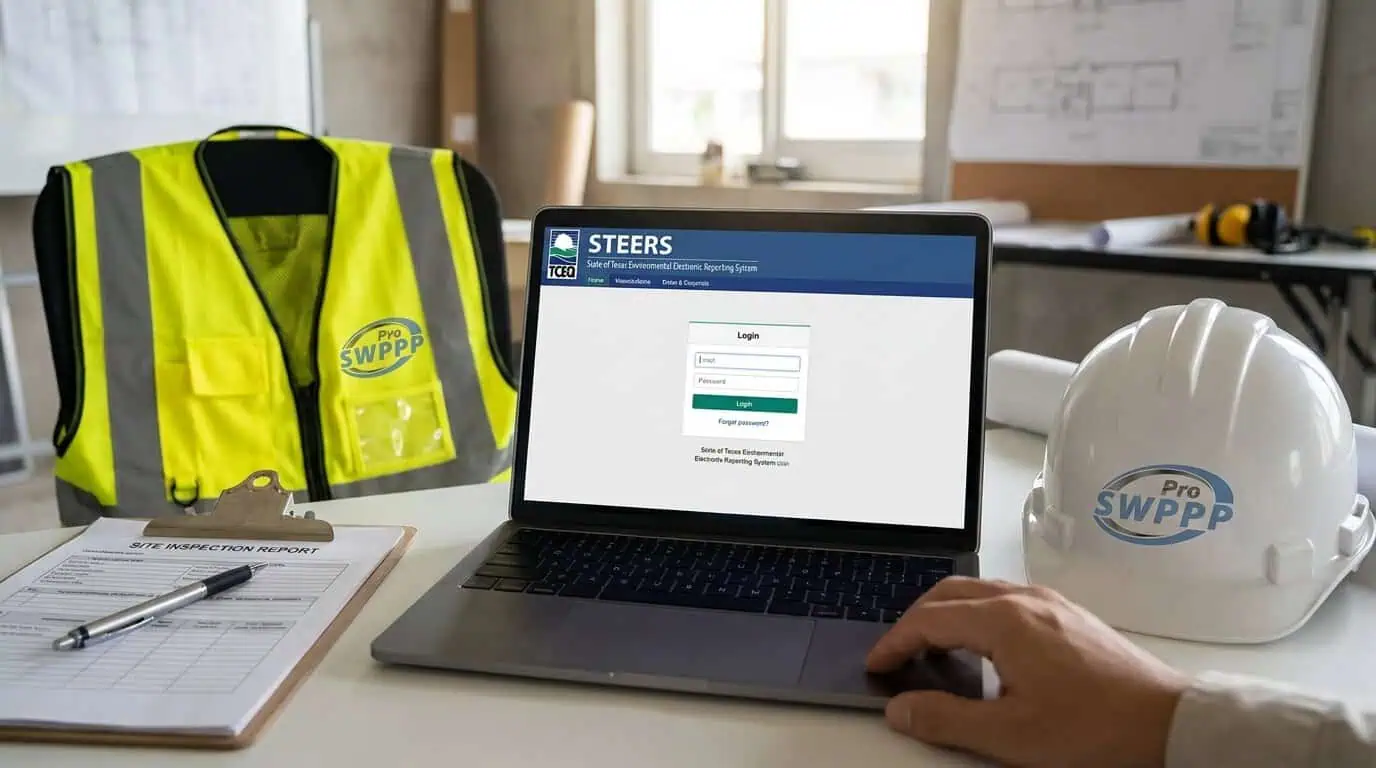
How do you renew coverage under the 2026 permit?
- Step 1: Confirm your sector. Verify your SIC code and industrial activity code, and review your discharge points. If site conditions changed and you now have zero exposure, renew with an INEC-R instead.
- Step 2: Update the SWP3. Site map, pollutant inventory, BMP descriptions, inspection schedule, monitoring procedures, and corrective action protocol, all built to the 2026 benchmarks and your sector’s requirements. This comes before the STEERS filing.
- Step 3: File the renewal in STEERS by November 12, 2026. Submit Form INOI-R or Form INEC-R. Verify your certifying official and contact information early, because account problems discovered on deadline day cost coverage.
- Step 4: Pay the fees. Renewal NOI: $100. Renewal NEC: $100. Annual water quality fee: $200, invoiced each year your coverage is active on September 1.
- Step 5: Run the program. Quarterly inspections, employee training, benchmark monitoring, and recordkeeping continue under the 2026 permit. Keep every record on site with the SWP3.
Your SWP3 is never filed with TCEQ. It stays at the facility, and inspectors can ask to see it at any time. A missing plan is itself a violation.
Just want a number first?
Tell us about your project and we will send a written estimate, no obligation.
What mistakes cost facilities their coverage?
Assuming coverage rolls over automatically
It does not. The 90-day grace period protects only facilities that file. If you do not submit a renewal NOI or NEC by November 12, 2026, your authorization is not renewed.
Reusing the 2021 SWP3
The plan must be written to the 2026 permit. New benchmarks, the narrower outfall exception, and expanded MS4 notification all change the document. Inspectors compare the plan to the permit and to the site, and mismatches are among the most common findings.
Skipping quarterly inspections and training
These are permit conditions, not best practices. Missing inspection forms and missing training logs are cited on their own, independent of whether your discharges met benchmarks.
Wrong sector classification
The wrong SIC code means the wrong benchmarks and the wrong sector-specific requirements. Verify your classification before filing, not after a deficiency notice.
Claiming no exposure without qualifying
Every condition on the no-exposure checklist must be met, continuously. One uncovered material pile ends the exclusion and requires immediate MSGP coverage.
Why work with Pro SWPPP?
Pro SWPPP is America’s #1 SWPPP company and the paperwork, permitting, and inspection-documentation expert. Our CPESC-certified team updates your sector-specific SWP3, files your renewal NOI or NEC in STEERS, builds your quarterly inspection schedule, and sets up your training documentation. Physical installation of BMPs is handled by your site contractor.
You get a plan matched to your SIC code, facility layout, materials, and discharge points, including site maps, BMP checklists, inspection forms, and training records. When regulations change, we update your plan at no extra charge.
For federal context, see the EPA NPDES Industrial Stormwater page and our 2026 MSGP compliance guide. For a deeper dive into Texas requirements, see our South Texas SWPPP requirements guide.
TXR050000 renewal FAQ
When is the TXR050000 renewal deadline?
November 12, 2026. TCEQ’s renewal period runs from August 14 to November 12, 2026, the 90 days after the 2026 Multi-Sector General Permit took effect. Renewal NOIs (Form INOI-R) and renewal No Exposure Certifications (Form INEC-R) are filed in STEERS with a $100 fee.
Is my 2021 TXR050000 authorization still valid?
No. The 2021 TXR050000 permit expired August 14, 2026. TCEQ gives existing permittees a 90-day grace period to renew, ending November 12, 2026. If you file a renewal NOI or NEC by then, your coverage moves to the 2026 permit. If you do not, your authorization is not renewed and discharges after that date are unauthorized.
What happens if I miss the November 12, 2026 deadline?
There is no late renewal. A facility that misses November 12 must apply as a new applicant under the 2026 permit, and industrial stormwater discharged before new coverage is in place is unauthorized, which draws notices of violation and administrative penalties.
Can I keep using my 2021 SWP3?
No. The 2026 permit lowers six benchmark concentrations, narrows the substantially similar outfall exception, and extends MS4 notification to every receiving MS4. TCEQ requires an updated SWP3 to be developed and implemented before you renew, even if nothing at your facility changed.
What inspections does the 2026 MSGP require?
Routine facility inspections plus quarterly visual assessments of stormwater discharges, documented and kept on site with your SWP3. Frequency and monitoring parameters vary by sector, so your SIC code determines your exact schedule.
Who has to complete employee training?
Personnel responsible for implementing BMPs, conducting inspections, performing monitoring, and responding to spills. Training must be documented and the records retained on site with the SWP3, where inspectors can review them.
What does TXR050000 renewal cost?
The renewal NOI fee is $100 and the renewal NEC fee is $100. TCEQ also invoices a $200 annual water quality fee each year your coverage is active on September 1. Facilities that no longer need coverage should file a Notice of Termination to stop future annual fees.
When does the 2026 Texas MSGP expire?
The 2026 TXR050000 permit took effect August 14, 2026 and runs a five-year term, setting its expiration at August 14, 2031. Covered facilities will face another renewal window when TCEQ reissues the permit.
Complicated site? Talk it through.
Speak directly with a CPESC-certified stormwater expert with 20+ years of experience.
By Derek E. Chinners, CPESC — Founder & Stormwater Consultant, Pro SWPPP, LLC
Related: What is a SWPPP? · Industrial SWPPP requirements · 2026 MSGP compliance guide · No Exposure Certification · Texas SWPPP requirements