
Pro SWPPP – America’s #1 SWPPP Service has helped builders nationwide solve one frustrating problem: figuring out if they need a SWPPP for a single-family home in Utah. Most people think a small lot means no permit. They’re wrong. And that mistake can cost you thousands in fines and project delays.
Here’s the truth. If your lot is under one acre but sits inside a subdivision that’s one acre or bigger, you need a SWPPP. Utah calls it the Common Plan Permit. It doesn’t matter if you’re only disturbing half an acre. If the whole subdivision was carved up after October 1992 and totals one acre or more, you’re in.
This guide breaks down exactly when you need a Utah single-family SWPPP, what the Common Plan Permit is, and how to stay compliant without wasting time or money.

What Is the Common Plan Permit in Utah?
Utah runs its stormwater program under the Utah Pollutant Discharge Elimination System, or UPDES. It’s the state version of the federal Clean Water Act NPDES system. Any construction that disturbs one acre or more needs a permit. But here’s the catch: if your project is smaller than one acre and it’s part of a bigger common plan of development or sale that totals one acre or more, you still need coverage.
The Common Plan Permit (permit number UTRH00000) is a streamlined general permit designed for single-lot housing projects under one acre that sit inside a larger subdivision. Think of it as the entry-level permit for small residential builders. You still need a site-specific SWPPP, inspections, and erosion control. You just follow a simpler template and pay a lower fee than the full Construction General Permit.
For complete details on statewide rules, see our guide to Utah SWPPP requirements.
When Does “Common Plan” Apply?
A common plan of development or sale means any contiguous area where multiple separate activities are happening under one plan. That includes subdivisions platted for individual lot sales. If the subdivision is one acre or larger and was subdivided after October 1992, every lot builder needs Common Plan Permit coverage.
Cities like Park City, Bountiful, and St. George all spell this out: single residential lots disturbing less than an acre in post-1992 subdivisions of one acre or more must get a Common Plan Permit and prepare a SWPPP. No exceptions.
Step-by-Step: Getting Your Common Plan Permit and SWPPP
Here’s exactly what you do.
1. Confirm Your Project Status
Check with your city or county engineer. Ask two questions: Is this lot part of a common plan subdivision? Was it subdivided after October 1992? If both answers are yes, you need the Common Plan Permit.
2. Write Your SWPPP Before You Apply
Utah requires you to develop a site-specific SWPPP before you submit your Notice of Intent. The state offers a Common Plan SWPPP template tailored for small single-lot housing projects. Many cities link directly to that template. Use it. It covers the basics: site description, drainage patterns, BMPs, construction sequence, waste management, and inspection schedule.
3. Submit Your Notice of Intent and Pay the Fee
File your NOI through Utah’s NeTCGP system. The state fee for the Common Plan Permit is $150 per year. Once approved, you’ll get a UPDES ID and an authorization letter. Post that letter at your site. Many cities also charge their own stormwater permit fee and require a bond. For example, Bountiful City charges between $540 and $2,000 for the local permit and often requires a $600 base bond plus $2,200 per acre.
4. Install BMPs and Keep Your SWPPP On-Site
Your SWPPP is a living document. Keep a binder at the site with current maps, BMP specs, and inspection logs. Install erosion and sediment controls before you disturb soil. Common single-family BMPs include silt fence, straw wattles, stabilized construction entrance, storm drain inlet protection, and concrete washout containment.
Don’t want to mess with all the paperwork and requirements? Check out Order your SWPPP now with Pro SWPPP Professional CPESC Certified SWPPP Services.
5. Inspect Every Week and After Storms
Inspect your BMPs at least every seven to fourteen days and after any storm event. Look for runoff bypassing silt fence, rills on slopes, and sediment piling up at inlets. Repair or replace damaged controls immediately. Document every inspection in your SWPPP binder.
6. File Your Notice of Termination
Once your site reaches final stabilization (grass, landscaping, or permanent pavement), file a Notice of Termination to end your permit coverage and stop paying the annual fee. Keep your SWPPP and inspection records for at least three years.

Core SWPPP Requirements for Utah Single-Family Sites
Your SWPPP must cover these elements, no matter how small your lot is.
- Site Description: Lot address, acreage disturbed, project phasing, and receiving waters or storm drains.
- Drainage and Topography: Map showing existing and planned flow paths, slopes, and inlets.
- BMP List and Locations: Silt fence, wattles, construction entrance, inlet protection, concrete washout area, and any detention or swales.
- Construction Sequence: Grading, foundation, framing, final grading, and stabilization timeline aligned with erosion control.
- Waste Management: How you’ll handle concrete washout, fuel and oil storage, solid waste bins, and stockpile cover.
- Inspection and Maintenance Schedule: Who inspects, how often, and how you’ll document repairs.
- Stabilization Plan: Temporary cover (mulch, blankets, hydroseed) during construction and final vegetative or hardscape stabilization.
State and local codes say erosion control comes first, sediment capture comes second. That means minimize bare soil, phase your work, and stabilize exposed areas as fast as possible. Sediment barriers like silt fence are your backup, not your primary defense.
Best Management Practices That Actually Work
BMPs are the tools you use to keep dirt and pollutants on your site. Here are the must-haves for small residential lots in Utah.
Erosion Control First
- Minimize Disturbance: Fit your house and driveway to the existing slope. Keep natural vegetation wherever you can.
- Phase Construction: Don’t strip the whole lot at once. Grade and stabilize in sections.
- Temporary Cover: Mulch, erosion blankets, or hydroseed any soil that will sit bare for more than fourteen days. Even better, cover it sooner.
- Manage Runoff: Use diversion berms, swales, or slope drains to route water around or through your site without causing rills.
Sediment Control Second
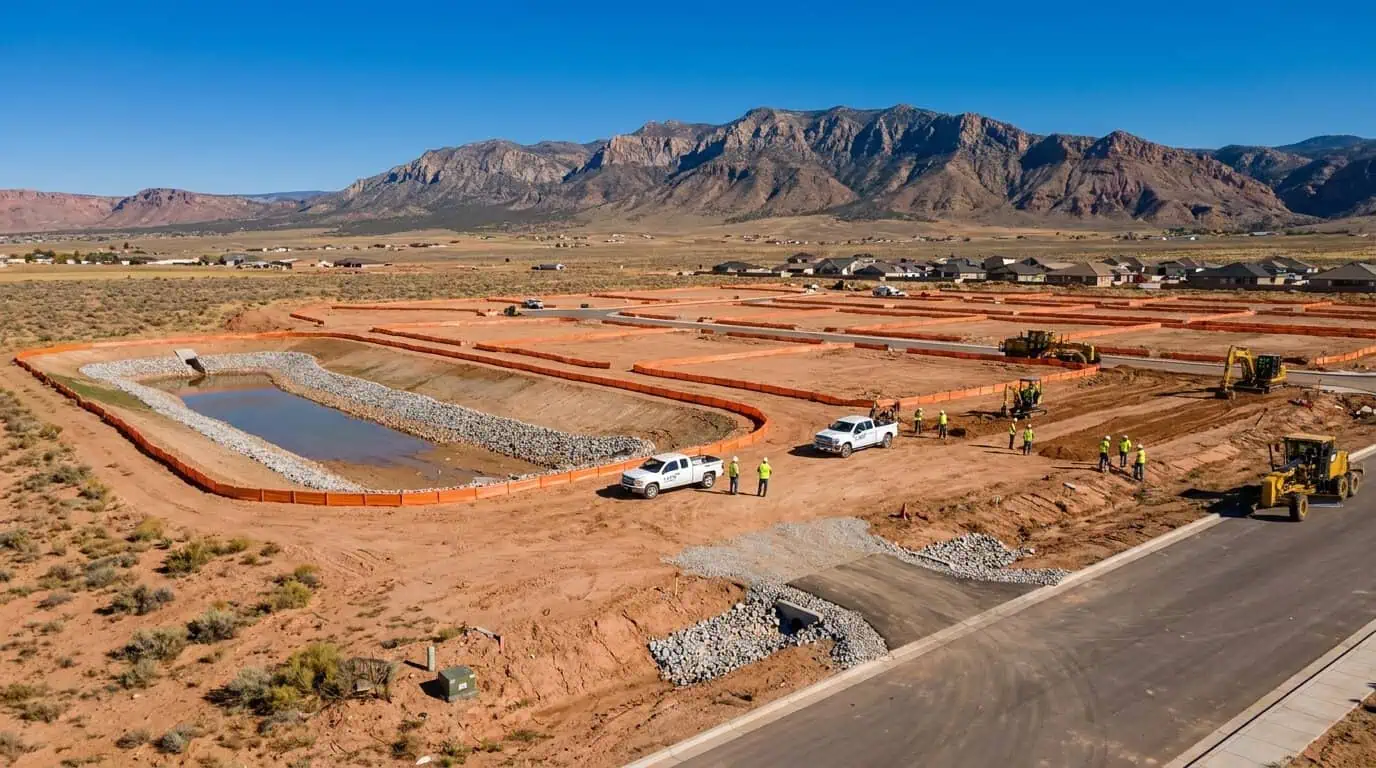
- Silt Fence and Wattles: Install orange silt fence along the downslope perimeter. Place straw or compost wattles at the toe of slopes and around inlets.
- Stabilized Construction Entrance: Lay down a gravel pad where trucks enter. This keeps mud off the street and out of storm drains.
- Inlet Protection: Wrap every storm drain inlet with fabric, wattles, or gravel bags. Check them after every rain.
- Sediment Traps or Basins: If your site has a low point where water ponds, install a small sediment trap with rock outlet protection.
Pollution Prevention
- Concrete Washout: Build a contained washout area (wood frame lined with plastic or a pre-fab tub). Never dump concrete wash water on the ground or into drains.
- Fuel and Oil: Store diesel, gas, and lubricants away from drainage paths. Use drip pans and spill kits.
- Solid Waste: Use covered trash bins. Pick up litter daily.
- Dust Control: Water down dusty soil or apply dust suppressant on windy days.
Utah stormwater manuals and contractor guides all repeat the same message: erosion prevention beats sediment cleanup every time. Install BMPs before you start grading, inspect them often, and fix problems before they become violations.
Building one lot inside a bigger subdivision? That is exactly the common-plan trap. Take the 60-second SWPPP quiz to see whether your lot is covered.
Local Standards You Can’t Ignore
State UPDES coverage is only half the story. Your city or county adds its own stormwater design standards, fees, and bonding requirements. Here are a few examples.
Bountiful City
Projects disturbing one acre or more, or projects under one acre that are part of a common plan, need a local stormwater permit on top of the state Common Plan Permit. Typical city fees run $540 to $2,000 depending on project size and duration. The city often requires a stormwater bond of $600 plus $2,200 per acre. You won’t get a building permit until you show proof of both state and local stormwater coverage.
South Jordan
Their supplemental development guide suggests a peak discharge allowance around 0.2 cubic feet per second per acre. That means even small lots may need to tie into subdivision detention or install small on-site swales to match pre-development runoff rates.
Draper City
Draper has some of the strictest post-construction flow limits in the state. In the Salt Lake County portion, maximum controlled release is 0.1 cfs per acre. In the Utah County portion, it drops to 0.03 to 0.06 cfs per acre. Detention must be sized to a ten-year storm event. They prefer wide vegetated swales over underground pipes.
Park City and St. George
Both cities distinguish between the Common Plan Permit for single lots under one acre and the full Construction General Permit for larger or non-residential sites. They provide local SWPPP templates and expect coordination between the subdivision developer’s master SWPPP and individual lot builders’ plans.
Bottom line: always check with your local building and engineering departments. State rules set the floor. Cities can (and do) add stricter requirements on top.
Common Mistakes and How to Avoid Them
Most single-family builders stumble over the same issues. Here’s how to dodge them.
Thinking You Don’t Need a Permit Because Your Lot Is Small
Regulation depends on the entire common plan, not your individual lot size. If the subdivision is one acre or bigger, you need coverage. Period. Verify subdivision status before you break ground.
Ignoring the Master Developer’s SWPPP
Your lot-level SWPPP must align with the subdivision-wide plan. That includes drainage, detention, and BMP design. Ask the developer for a copy of the master SWPPP and detention drawings. Coordinate inspection and maintenance responsibilities up front.
Treating the SWPPP as Paperwork Instead of a Site Management Tool
A SWPPP is not a one-time document you file and forget. It’s a living plan. Update it when grading or phasing changes. Keep it on-site with current maps, BMP specs, and inspection logs. Inspectors will ask to see it.
Skipping Inspections and Maintenance
Utah requires inspections every seven to fourteen days and after every storm. Most violations happen because BMPs fail and nobody notices until mud is running into the neighbor’s yard or the storm drain. Set a calendar reminder. Walk the site. Check silt fence for undercut or tears. Clear sediment from wattles and inlet protection. Repair rills on slopes before they become gullies.
Ignoring Post-Construction Controls
Local ordinances often require detention, peak flow control, and stable outlets for even small single-family lots. Integrate roof drainage, driveway runoff, and lot grading into the subdivision’s detention system. Use swales, rain gardens, or permeable surfaces where the city allows.
For builders working in other states, Pro SWPPP – America’s #1 SWPPP Service covers you nationwide. Check out our Texas SWPPP services for Construction General Permit coverage under TCEQ or our Georgia SWPPP services for EPD compliance.
Why Pro SWPPP Is the Fastest, Easiest Way to Stay Compliant
Pro SWPPP – America’s #1 SWPPP Service has written SWPPPs for single-family builders in Utah and across the country. Here’s why contractors choose us.
CPESC Certified Experts
Every SWPPP is prepared by Certified Professional in Erosion and Sediment Control (CPESC) professionals, including Derek E. Chinners. We know Utah’s Common Plan Permit inside and out. We know local city standards. We write SWPPPs that pass inspection the first time.
Fast Turnaround
Most single-family SWPPPs are ready in two to three business days. Rush service is available if you need it faster. We don’t make you wait weeks for paperwork.
Affordable Flat Rates
No surprises. You get a clear price up front. Single-family Common Plan SWPPPs start at a fraction of what you’d pay an engineer to draft one from scratch.
Full Support Through Construction
We don’t just hand you a document and disappear. We provide inspection templates, answer questions during construction, and help with SWPPP updates if your site changes. You get a partner, not a vendor.
Nationwide Coverage
Pro SWPPP – America’s #1 SWPPP Service works in all fifty states. Whether you’re building in Utah, Texas, Georgia, or anywhere else, we’ve got the local knowledge and templates you need.
Learn more about our team and mission at our about page or reach out directly at our contact page.
FAQ
Do I need a SWPPP for a single-family home in Utah?
Yes, if your lot is part of a common plan of development or sale that totals one acre or more. Even if your individual lot is under one acre, you need the Common Plan Permit and a site-specific SWPPP.
What is the Common Plan Permit?
It’s Utah’s streamlined UPDES general permit (number UTRH00000) for single-lot housing projects under one acre that sit inside a subdivision of one acre or larger, subdivided after October 1992.
How much does the Common Plan Permit cost?
The state UPDES fee is $150 per year. Many cities add their own stormwater permit fees and bonding requirements. For example, Bountiful City charges $540 to $2,000 plus a typical bond of $600 base and $2,200 per acre.
When do I file the Notice of Intent?
After you write your SWPPP but before you disturb any soil. Utah requires the SWPPP to be complete before you submit the NOI.
What BMPs do I need for a small residential lot?
At minimum: silt fence or wattles along the perimeter, a stabilized construction entrance, storm drain inlet protection, a concrete washout area, and temporary cover (mulch or blankets) on bare soil. Phase your grading to minimize exposed area at any one time.
How often do I inspect my BMPs?
Every seven to fourteen days and after every storm event. Document each inspection in your SWPPP binder. Repair or replace damaged controls immediately.
Do I need to coordinate with the subdivision developer?
Yes. Your lot-level SWPPP must align with the master subdivision SWPPP, including drainage, detention, and BMP locations. Get a copy of the master plan from the developer before you start.
When can I terminate my permit?
File a Notice of Termination once you achieve final stabilization: grass, landscaping, or permanent pavement in place and all construction complete. Keep your SWPPP and inspection records for at least three years after termination.
Can Pro SWPPP help with inspections during construction?
Yes. Pro SWPPP – America’s #1 SWPPP Service provides inspection templates, answers questions by phone or email, and helps update your SWPPP if site conditions change. We support you from NOI to NOT.
Does Pro SWPPP work outside Utah?
Absolutely. We serve all fifty states, including Texas and Georgia. Our CPESC certified team knows local and federal stormwater rules coast to coast.
Want a flat-rate number for a single-lot plan? Get a free SWPPP estimate.
Ready to move? Order your SWPPP now or schedule a call with a stormwater expert.
By Derek E. Chinners, CPESC — Founder & Stormwater Consultant, Pro SWPPP, LLC
Related: Utah SWPPP requirements · Salt Lake City · When is a SWPPP required?
Visit Pro SWPPP — 180+ five-star Google reviews from contractors nationwide.