Pro SWPPP – America’s #1 SWPPP Service helps you stay compliant in New Orleans and Baton Rouge without the headache. If you are building, grading, or disturbing soil in Louisiana, you face a three-layer stormwater system. State rules, city rules, and your own site controls all stack up. Miss one piece and you risk fines, delays, and angry inspectors. This guide breaks down exactly what you need and when you need it.
Why Louisiana Has Extra Rules
Louisiana sits on the Gulf Coast. Rain comes hard and fast. One storm can wash tons of sediment into bayous, lakes, and the Mississippi River. That is why Louisiana DEQ and the EPA enforce strict stormwater rules under the Clean Water Act and the NPDES program.
New Orleans and Baton Rouge do not stop at state rules. Both cities add their own layers of control. You will deal with state permits, city design standards, and your own site-specific plan. It sounds messy, and it is. But once you understand the three layers, it gets easier.
The Three-Layer System
Here is how stormwater compliance works in New Orleans and Baton Rouge:
Layer 1: State LDEQ Permit & SWPPP
Louisiana DEQ issues general permits for construction and industrial stormwater discharges. If you disturb soil on a project, you need coverage under the state’s Construction General Permit (CGP). That means you file a Notice of Intent (NOI) and you build a Storm Water Pollution Prevention Plan (SWPPP).
Your SWPPP is not a form. It is a live document. It lists every pollution source on your site, describes your Best Management Practices (BMPs), assigns who does what, and logs inspections and training. You update it when site conditions change. You keep it on-site. Inspectors will ask to see it.
Louisiana DEQ does not require a specific template. But your SWPPP must hit every content requirement in the permit. That includes erosion control, sediment control, dust control, chemical storage, dewatering plans, and post-construction stabilization. For more on statewide rules, see Louisiana SWPPP requirements.
Layer 2: City or Parish Stormwater Rules
New Orleans requires a stormwater management plan for most projects that create 5,000 square feet or more of impervious surface. Or any site one acre or larger. Single- and two-family homes with fewer than six units are exempt. But almost everything else needs local review.
The city wants you to retain, detain, and filter the first 1.25 inches of runoff. You must keep post-development runoff rates from exceeding pre-development rates. That often means bioswales, detention ponds, or underground storage. After construction, you submit as-built drawings. Then you inspect and recertify your stormwater features every two years, forever.
Baton Rouge and East Baton Rouge Parish use similar first-flush standards. They define first flush as the first 1.25 inches of rain. New developments must treat or retain all first-flush pollutants. You also file a Water Quality Impact Study (WQIS) to prove your project will not impair water quality. The city reviews drainage, utility plans, and environmental impacts before issuing permits.
Layer 3: Your Site-Specific Controls
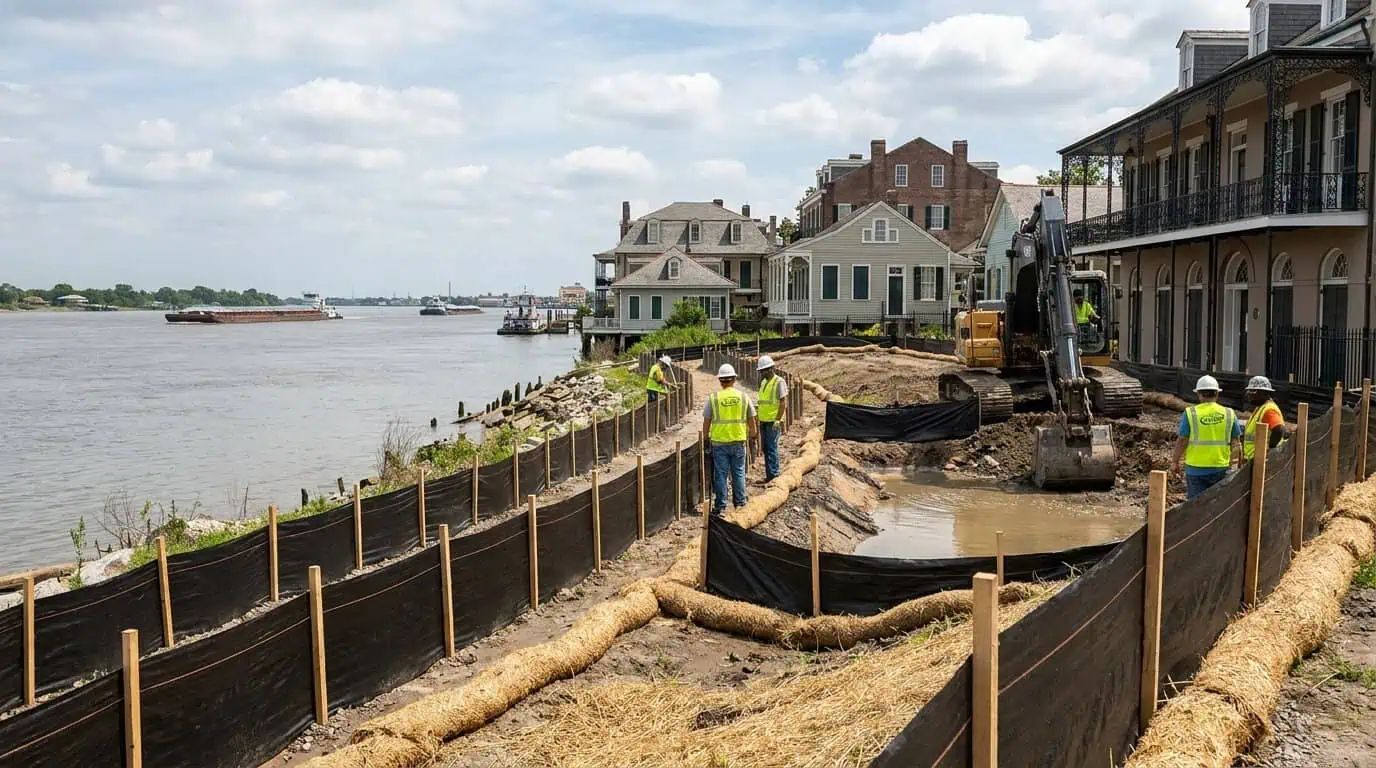
On the ground, you install and maintain BMPs. Stabilized construction entrances stop mud from tracking onto streets. Perimeter silt fences and sediment barriers keep soil on-site. Inlet protection boxes catch debris before it enters storm drains. Sediment traps and basins settle out particles. You cover stockpiles, control dewatering discharge, and stabilize slopes as soon as grading finishes.
Louisiana’s template stresses retaining sediment where practicable, installing controls per manufacturer specs, minimizing exposed soil, and preserving topsoil. You also need a 50-foot buffer zone when you discharge to Outstanding Natural Resource Waters or certain impaired streams. If your site cannot fit that buffer, you explain alternative practices in your SWPPP.

SWPPP vs. NOI: What Is the Difference?
People confuse these two documents. Here is the truth:
- NOI (Notice of Intent): A short form you file with Louisiana DEQ to get permit coverage. It lists your project name, location, acreage, and operator. It is like your permit application.
- SWPPP (Storm Water Pollution Prevention Plan): A full site plan that describes all your pollution sources and controls. It includes maps, BMP details, inspection logs, training records, and contact names. You keep it on-site and update it throughout construction.
You need both. The NOI gets you legal coverage. The SWPPP tells inspectors and your crew exactly how you will keep dirt and pollutants out of Louisiana’s waterways.
When Do You Need a SWPPP in New Orleans or Baton Rouge?
You need a SWPPP if you disturb one acre or more of soil. Projects between one and five acres can require a SWPPP and completion reporting. Even smaller sites may trigger local review.
New Orleans sets a 5,000-square-foot impervious threshold. Baton Rouge requires a WQIS for new developments. Both cities review plans before permit issuance. That means your state SWPPP and your city stormwater management plan often move in parallel.
Do not assume you are off the hook because your lot is small. Check both state and local rules. A half-acre infill project in the French Quarter might still need a city stormwater plan, erosion-control drawings, and as-built certification.
Don’t want to mess with all the paperwork and requirements? Order your SWPPP now with Pro SWPPP Professional CPESC Certified SWPPP Services.
Core BMPs for New Orleans & Baton Rouge
Gulf Coast rain is intense. Your erosion controls must hold up under heavy downpours. EPA and Louisiana guidance recommend these core BMPs:
- Stabilized construction entrance: Rock pad or wash station to clean vehicle wheels before they hit the street.
- Perimeter controls: Silt fence, fiber rolls, or sediment logs around the downslope edge of disturbed soil.
- Inlet protection: Gravel bags, filter fabric, or insert filters in every storm drain on or near your site.
- Sediment traps and basins: Small ponds or sumps that settle out particles before water leaves the site.
- Prompt stabilization: Seed, mulch, or sod exposed slopes within 14 days of final grading.
- Covered storage: Tarps or enclosed bins for chemicals, fuels, and dry materials.
- Controlled dewatering: Pump water through sediment bags or tanks before discharge. Never pump muddy water directly to a street or stream.
Louisiana’s template tells you to account for duration, amount, frequency, and intensity of precipitation. It also asks you to consider runoff characteristics and soil particle sizes. Translation: Pick BMPs that match your site’s soil type and slope, not a generic checklist.
Common Mistakes and How to Avoid Them
Contractors and developers trip over the same issues. Here are the biggest mistakes:
Treating the SWPPP as a One-Time Submittal
Your SWPPP is not a permit form you file and forget. EPA and LDEQ both say you must implement, inspect, and update it throughout construction. Grading changes, phasing shifts, or BMP failures all require plan updates and new documentation.
Ignoring Local Thresholds
A project under one acre can still trigger New Orleans or Baton Rouge rules. If you create 5,000 square feet of pavement or rooftop, the city wants a stormwater plan. Missing that review means no building permit and possible stop-work orders.
Skipping Buffer Zones
Dense urban sites make buffers hard. But Louisiana DEQ requires a 50-foot buffer for discharges to sensitive waters when feasible. If your site cannot fit it, you must explain alternative practices. Saying nothing is not an option.
Poor Construction Sequencing
Exposing too much soil at once overwhelms your BMPs. EPA guidance says expose the minimum necessary area and stabilize it before moving to the next phase. Keep pollutants out of rain exposure and update controls as work progresses.

How New Orleans and Baton Rouge Compare to Other States
Louisiana’s three-layer system is tougher than many states. In Texas, TCEQ handles state permits and most cities defer to the state CGP. In Georgia, the state EPD runs the show with fewer local overlays. New Orleans and Baton Rouge add post-construction detention, as-built certifications, and biennial inspections that go beyond typical state rules.
The upside: Local review can catch design problems early. The downside: You juggle state and city timelines, submittal formats, and inspection schedules. Pro SWPPP handles both layers so you do not miss a deadline or a required detail.
Digital Submittals and As-Built Records
New Orleans requires final plans in both hard copy and digital formats. After construction, you submit as-built drawings that show exactly where your bioswales, pipes, and detention ponds ended up. Those drawings get recorded and tracked for future inspections.
Baton Rouge follows a similar path. Digital workflows speed up review and help inspectors compare approved plans to field conditions. Keep your files organized. You will need CAD or PDF drawings, signed certifications, inspection logs, and training records for years.
Why Pro SWPPP Makes It Simple
Pro SWPPP writes SWPPPs for New Orleans, Baton Rouge, and every Louisiana parish. Our CPESC-certified experts know state permit content, city design standards, and the BMPs that work in Gulf Coast weather. We draft your plan, prepare your NOI, and update documents when site conditions change.
We also coordinate with local reviewers. That means your state SWPPP and your city stormwater management plan align. No duplicate work. No conflicting details. Just one clear roadmap from permit application to final stabilization.
Not sure your Louisiana site triggers the requirement? Take the 60-second SWPPP quiz.
Real-World Example: A Mixed-Use Project in New Orleans
A developer plans a 2.5-acre mixed-use building in Mid-City. The site will add 12,000 square feet of new pavement and rooftop. Here is what compliance looks like:
- File an NOI with Louisiana DEQ for Construction General Permit coverage.
- Write a state SWPPP that covers erosion control, sediment basins, inlet protection, chemical storage, and dewatering.
- Submit a city stormwater management plan to New Orleans showing how the project retains and filters the first 1.25 inches of runoff and limits post-development discharge rates.
- Install perimeter controls, stabilized entrances, and sediment traps before grading starts.
- Conduct weekly inspections and update the SWPPP when phasing changes.
- After construction, submit as-built drawings and schedule the first biennial inspection.
That is six separate tasks across two agencies and your own field crew. Pro SWPPP coordinates all of it, keeps your documents current, and makes sure inspectors see a complete, compliant package.
Green Infrastructure and Volume Control
New Orleans and Baton Rouge increasingly tie compliance to green infrastructure. Bioswales, permeable pavement, rain gardens, and underground detention all help you meet the 1.25-inch retention standard and limit runoff rates.
Louisiana DEQ and EPA both encourage volume-control approaches. Instead of piping all runoff to a pond, you spread infiltration across the site. This reduces peak flows, filters pollutants, and recharges groundwater. Your SWPPP should explain how your green features work and how you will maintain them after construction.
Inspection and Adaptive Management
Modern SWPPP programs demand frequent inspections and rapid BMP replacement. EPA and Louisiana stress maintaining plan accuracy over time. That means you walk the site after every rain event over 0.5 inches, document BMP performance, and fix or replace controls that fail.
Adaptive management is not optional. Gulf Coast storms test your controls. Silt fences clog. Inlet inserts fill with sediment. Sediment basins overflow. Your SWPPP must include a maintenance schedule and a process for updating controls when conditions change.
Contact and Support
Still have questions about New Orleans or Baton Rouge stormwater rules? Visit our contact page or learn more about our team. Pro SWPPP has local experience, state and federal expertise, and a track record of fast, compliant plan delivery.
For additional federal guidance, see the EPA NPDES Construction Activity page.
FAQ
Do I need both a state SWPPP and a city stormwater plan in New Orleans?
Yes, if your project disturbs one acre or more and creates 5,000 square feet or more of impervious surface. The state SWPPP covers erosion and sediment control during construction. The city plan addresses post-construction retention, detention, and runoff-rate limits.
What is the 1.25-inch rule in Baton Rouge?
Baton Rouge and East Baton Rouge Parish define the first flush as the first 1.25 inches of rainfall. New developments must treat or retain all first-flush pollutants. That often means bioswales, detention ponds, or underground storage to capture and filter that volume.
Can I use a template SWPPP for my Louisiana project?
Louisiana DEQ does not require a specific template, but your SWPPP must meet all permit content requirements. A template is a good starting point, but you must customize it with site-specific maps, BMP details, soil data, and drainage calculations.
How often do I inspect my BMPs in New Orleans?
You inspect at least once every seven days and within 24 hours after any rain event over 0.5 inches. You document each inspection, note BMP performance, and make repairs immediately. After construction, the city requires biennial inspections of post-construction stormwater features.
What happens if I skip the 50-foot buffer zone?
If your discharge goes to Outstanding Natural Resource Waters or certain impaired waters, Louisiana DEQ expects a 50-foot buffer when feasible. If site constraints make that impossible, you must explain alternative practices in your SWPPP. Simply ignoring the buffer requirement is not compliant.
Does Pro SWPPP handle both state and local submittals?
Yes. Pro SWPPP writes your state SWPPP, prepares your NOI, coordinates with Louisiana DEQ, and helps you meet New Orleans or Baton Rouge stormwater design standards. We manage the full three-layer compliance process.
Want a flat-rate number? Get a free SWPPP estimate.
Ready to move? Order your SWPPP now or schedule a call with a stormwater expert.
By Derek E. Chinners, CPESC — Founder & Stormwater Consultant, Pro SWPPP, LLC
Related: What is a SWPPP? · When is a SWPPP required? · SWPPP inspection requirements
Visit Pro SWPPP — 180+ five-star Google reviews from contractors nationwide.