Pro SWPPP – America’s #1 SWPPP Service has helped contractors across California file their stormwater paperwork fast. But here’s the problem: most people don’t even know if they need a Notice of Intent (NOI) or a full SWPPP until they’re already behind schedule. Let’s fix that right now.
If you’re starting a construction project in California and you plan to move dirt, you need to understand two things. First, you might need a SWPPP. Second, you might need to file an NOI. Sometimes you need both. Sometimes you need neither. The key is knowing which rules apply to your site.
This guide will show you exactly when you need each document. No guessing. No stress. Just clear answers so you can get back to work.
What Is a Notice of Intent (NOI)?
An NOI is a short electronic form you submit to the State Water Board. It tells them you’re about to start work and you promise to follow stormwater rules. Think of it like raising your hand and saying, “Yes, I’m here, and I’ll play by the rules.”
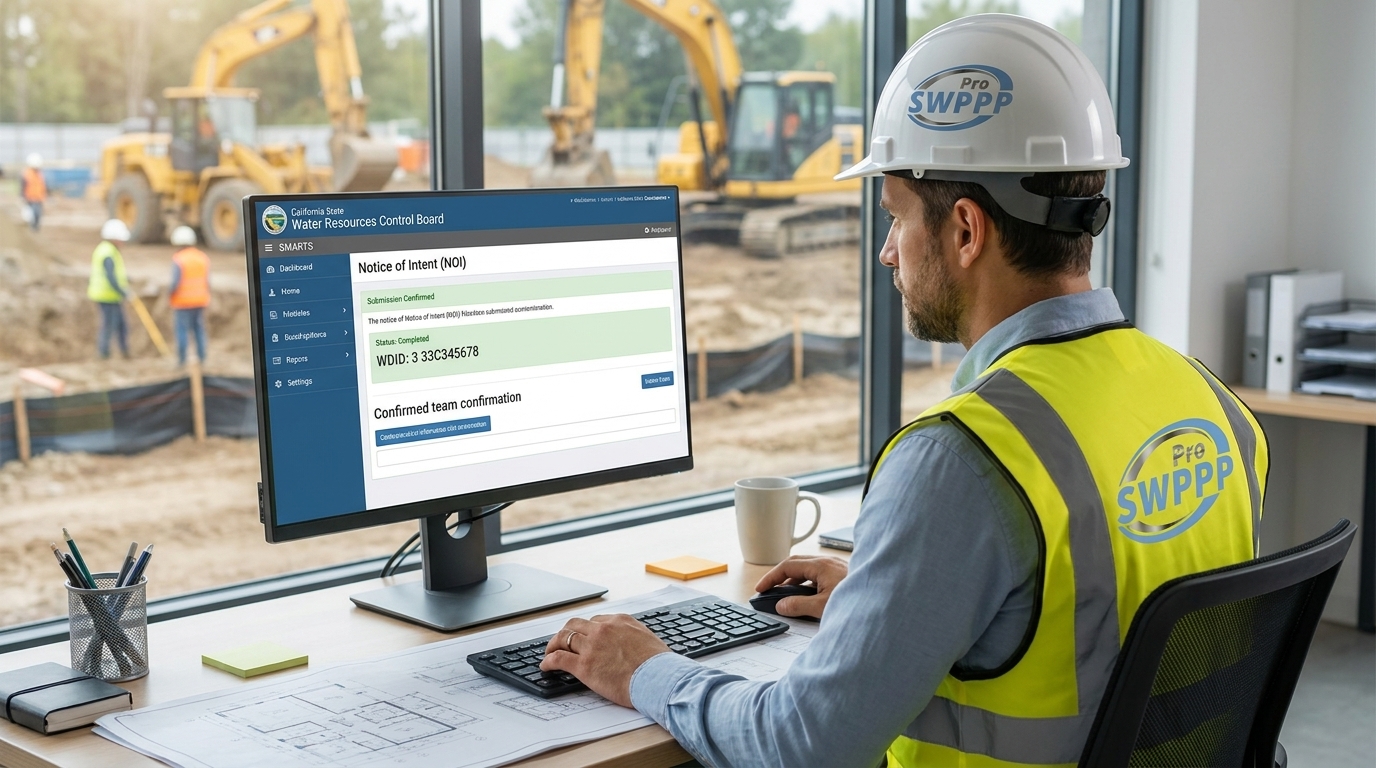
You file the NOI through a system called SMARTS. That stands for Stormwater Multiple Application and Report Tracking System. It’s the state’s online portal for all stormwater permits. SMARTS works best in Chrome or Edge, so don’t try this on an old browser.
Here’s what happens after you file your NOI. The state gives you a WDID number. That’s your Waste Discharge Identification number. You need that number before you break ground. No WDID, no digging.
Who Must File an NOI?
California’s Construction General Permit requires an NOI whenever your project disturbs one acre or more, or disturbs less and forms part of a larger common plan of development or sale. That threshold and the common-plan trap are covered in full in When Is a SWPPP Required? This guide assumes you have already cleared that test and focuses on the SMARTS filing itself.
What makes California different is not the threshold. It is what the state demands before it will issue coverage at all. California will not release a WDID until a complete set of Permit Registration Documents, including the finished SWPPP itself, is uploaded and certified in SMARTS. In most states the NOI goes in first and the plan simply stays on site. Here, an incomplete plan means no permit, and no permit means no digging.
Construction activity includes clearing, grading, excavation, and stockpiling. It also covers any ground disturbance that could wash sediment into a storm drain. Routine maintenance that only restores the original line and grade doesn’t count.
What Is a SWPPP?
A SWPPP is your Stormwater Pollution Prevention Plan. It’s a detailed document that explains how you’ll keep sediment and pollutants out of the water. Your SWPPP describes your site, your BMPs (Best Management Practices), and your inspection schedule.
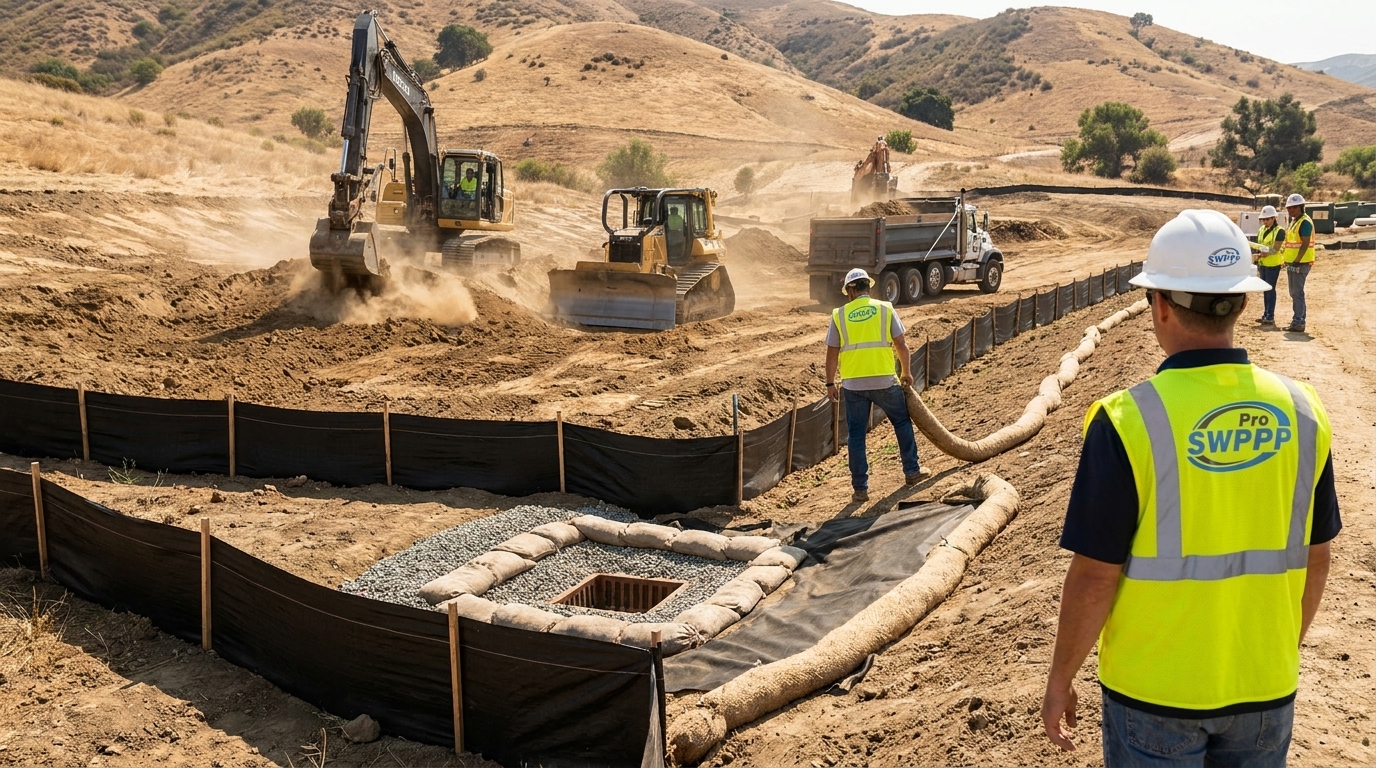
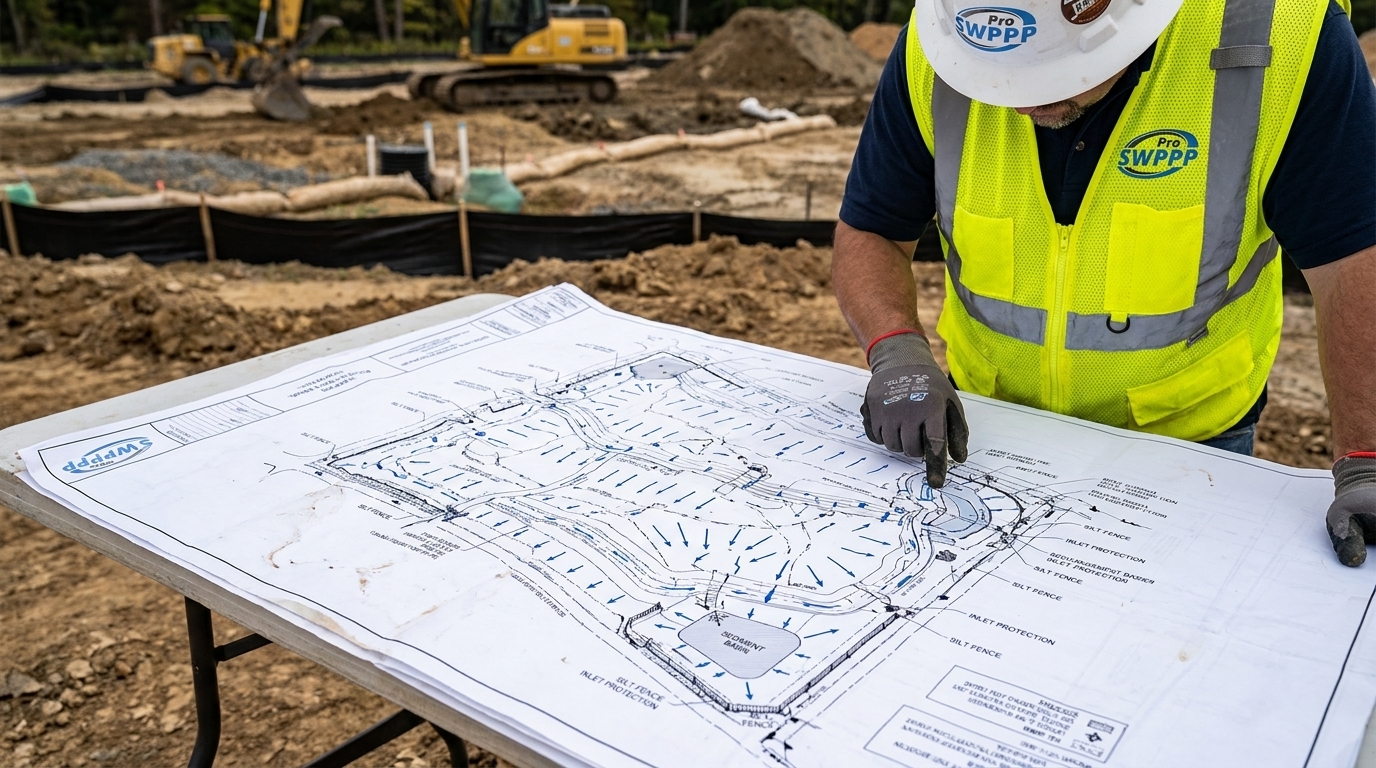
BMPs are the tools and techniques you use to control erosion and sediment. Think silt fences, gravel bags, inlet protection, and stabilized construction entrances. Your SWPPP lists every BMP you’ll use and shows where you’ll put them on a site map.
The SWPPP also includes a risk assessment. California’s 2022 Construction General Permit (Order 2022-0057-DWQ, effective September 1, 2023) requires you to classify your project as Risk Level 1, 2, or 3. Higher risk means stricter controls and more paperwork. You can learn more about these state-level requirements at California SWPPP Requirements.
When Do You Need a SWPPP?
You need a SWPPP whenever you need an NOI. They go together. In fact, your SWPPP is part of your Permit Registration Documents (PRDs). You can’t file a complete NOI without a SWPPP.
Here’s the list of PRDs you must submit:
- Certified Notice of Intent
- Stormwater Pollution Prevention Plan
- Site map showing drainage and BMPs
- Risk assessment for your project
- Post-construction water quality calculations
- Application fee payment
All of these go into SMARTS. You upload your SWPPP and site map as PDFs. You fill out the risk assessment and project details in the online form. Then you pay your fee and certify everything.
Pro SWPPP prepares all of these documents for you. We write the SWPPP, draw the site map, calculate your risk level, and get everything ready for upload. You just log into SMARTS and click submit.
How to File Your NOI in SMARTS
Filing your NOI is not hard. But you have to follow the steps in order. If you skip one, SMARTS will lock you out until you fix it. Here’s the step-by-step process.
Step 1: Create Your SMARTS Account
Go to the SMARTS website and register. You’ll need to choose a role. The three roles are Legally Responsible Person (LRP), Duly Authorized Representative (DAR), and Data Entry Person (DEP).
Only the LRP or DAR can certify and submit your NOI. The DEP can fill out the form but can’t hit the final submit button. Most contractors make the company owner or project manager the LRP.
Step 2: Start a New Application
Log into SMARTS and click “Start a New Application.” Choose “Construction Permits,” then select “Statewide Construction (NOI/Waiver/NONA).” Pick “Notice of Intent” from the next menu.
SMARTS will ask you some pre-application questions. Answer them honestly. These questions help the system route your application to the right place.
Step 3: Fill Out All Tabs
SMARTS breaks your NOI into tabs. You’ll see Project Information, Risk Assessment, SWPPP Details, Site Map, Post-Construction BMPs, and Billing. Work through each tab one by one.
Don’t rush. SMARTS has a lot of required fields. If you miss one, you can’t move forward. Use the completion check button to find any errors before you certify.
Step 4: Upload Your SWPPP and Site Map
Under the SWPPP tab, you’ll upload your full SWPPP document. Make sure it’s a PDF. The file can’t be bigger than 20 MB. If it is, you’ll need to compress it or split it into parts.
Your site map goes in the same tab. The map must show your property boundaries, drainage patterns, discharge points, and BMP locations. SMARTS won’t let you skip this.
Don’t want to mess with all the paperwork and requirements? Check out Order your SWPPP now with Pro SWPPP Professional CPESC Certified SWPPP Services.
Step 5: Pay Your Fee
California charges a fee for CGP coverage. The amount depends on how much land you disturb. You pay through SMARTS using a credit card or e-check. You can’t mail a check anymore.
Step 6: Certify and Submit
Once all tabs are complete, go to the Certification tab. The LRP or DAR must read the certification statement, answer a security question, and enter their SMARTS password. Then click “Certify Application.”
SMARTS will give you a confirmation page and a WDID number. Print that page and keep it on site. You’ll need it for inspections.
What About Industrial Facilities?
If you run an industrial facility, you might also need an NOI. California’s Industrial General Permit (IGP) covers manufacturing plants, transportation hubs, waste facilities, and recycling centers. If your facility is listed in Attachment A of the IGP, you must file an NOI.
The process is similar to construction. You log into SMARTS, choose “Industrial Permits,” and start a “Statewide Industrial NOI.” You’ll enter your facility information, upload your SWPPP and site map, and certify the application.
One difference: industrial NOIs require an e-Authorization form with a wet signature. You mail that form to the State Water Board along with your fee check if you’re not paying electronically.
Industrial facilities must submit their PRDs at least seven days before starting operations. That’s a hard deadline. If you miss it, you could face fines.
Common Mistakes When Filing an NOI
Most NOI mistakes happen because people rush. They try to file on the same day they want to start work. That’s too late. Here are the top mistakes we see.
Mistake 1: Wrong User Role
Only the LRP or DAR can certify your NOI. If you assign a DEP to do everything, they’ll get stuck at the certification step. Set up your roles before you start the application.
Mistake 2: Incomplete SWPPP
SMARTS will accept any PDF you upload. But if your SWPPP is missing required sections, an inspector will red-tag your site. Pro SWPPP makes sure every SWPPP meets California’s 2022 CGP standards.
Mistake 3: Wrong Browser
SMARTS works best in Chrome or Edge. If you use Safari or Firefox, you might see weird errors. Switch browsers before you start.
Mistake 4: No Site Map
Your site map must show drainage patterns, discharge points, and BMP locations. A property survey is not the same thing. You need a stormwater-specific map.
Mistake 5: Filing Too Late
Don’t wait until the day before mobilization. Give yourself at least one week to file your NOI and get your WDID. If SMARTS has technical problems, you’ll need that buffer.
Not sure what your project needs? Take the 60-second SWPPP quiz, get a free estimate, or Schedule a Free SWPPP Consultation with CPESC Certified SWPPP Expert Derek E. Chinners.
How Pro SWPPP Makes This Easy
Pro SWPPP handles your NOI and SWPPP from start to finish. We prepare every document, draw your site map, calculate your risk level, and get everything ready for SMARTS. You just log in and click submit.
We work with contractors across California, Texas, Georgia, and nationwide. Our team is CPESC certified and knows exactly what each state requires. No guessing. No delays.
We also provide annual reports, inspection forms, and on-site training. Everything you need to stay compliant from start to finish. To be clear about scope: your crews install and maintain the controls in the field. Pro SWPPP writes the plan, files the permit, performs the inspections and keeps the records. Get a free estimate and we will price your California filing before you commit.
Why You Can’t Skip the NOI
Some contractors think they can skip the NOI if they just put up a few silt fences. That’s not how it works. The NOI is your legal permission to discharge stormwater. Without it, you’re breaking federal and state law.
The Clean Water Act says any discharge of pollutants into U.S. waters is illegal unless you have an NPDES permit. The CGP is a general NPDES permit. Your NOI is how you get covered under that permit.
If you start work without an NOI you are discharging without a permit, and the Clean Water Act judicial civil penalty for that reaches $68,445 per day of violation under the inflation-adjusted table at 40 CFR 19.4 currently in effect. That is not a scare tactic. That is the statutory maximum. Inspectors check for WDID numbers. If you don’t have one, they’ll shut you down.
For guidance on what the EPA expects, see the EPA’s stormwater construction page.
FAQ
Do I need an NOI if my project is less than one acre?
Usually no. California’s CGP applies to sites that disturb one acre or more. If your project is smaller and not part of a larger common plan, you don’t need an NOI. But check with your local jurisdiction. Some cities have stricter rules.
Can I file an NOI myself or do I need a consultant?
You can file it yourself if you understand SMARTS and have all your PRDs ready. But most contractors hire Pro SWPPP because we prepare everything and make sure it’s correct the first time. That saves you time and avoids costly mistakes.
How long does it take to get my WDID after filing the NOI?
SMARTS issues your WDID immediately after you certify your NOI. You’ll see it on your confirmation page. Print that page and keep it on site. You need it before you start any ground disturbance.
What if I make a mistake on my NOI?
You can log back into SMARTS and update your information. But some changes require a new certification. If you’re not sure, contact the SMARTS help desk at [email protected] or call the toll-free number.
Do I need a new NOI if I change contractors mid-project?
Yes. If the Legally Responsible Person changes, you must file a new NOI or an amendment. The LRP is the entity legally responsible for stormwater compliance. If that changes, the state needs to know.
What happens if I don’t file an NOI and get caught?
You’ll face enforcement action from the State Water Board or Regional Water Board. That can include stop-work orders, mandatory corrective actions, and fines. Penalties can reach tens of thousands of dollars per day. It’s not worth the risk.
Can I use the same NOI for multiple projects?
No. Each project needs its own NOI and WDID. Even if you’re the same contractor working in the same city, each site is a separate discharge location. You must file a new NOI for every project that disturbs one acre or more.
Ready to get started? Order your SWPPP now or schedule a free consultation with Pro SWPPP.
Contractors nationwide have left Pro SWPPP 180+ five-star Google reviews. Get a free estimate or schedule a call with a stormwater expert.
By Derek E. Chinners, CPESC — Founder & Stormwater Consultant, Pro SWPPP, LLC
Related: What Is a SWPPP? · When Is a SWPPP Required? The 1-Acre Rule and Common Plans · California SWPPP Requirements · California QSD vs QSP: Who Can Sign and Inspect · How to File a Notice of Termination