If you’re running a waterline project and disturbing soil, you need to know whether you’re legally required to get a Stormwater Pollution Prevention Plan. That’s where Pro SWPPP comes in to make compliance simple. The answer is straightforward. A linear waterline needs a SWPPP when it disturbs one acre or more of land (including trench, spoils, access roads, and staging areas) and discharges stormwater to waters of the U.S. or a municipal storm sewer system. There’s no special exemption for utility lines. If you meet the threshold, you need NPDES construction stormwater permit coverage, and that means you need a SWPPP before you even file your Notice of Intent.
This guide breaks down exactly when your waterline project triggers the federal and state permit requirements, how to calculate your disturbed area, what goes into a linear-project SWPPP, and how to avoid costly enforcement actions. We’ll walk you through the rules nationwide, the BMPs that matter most for trenches and dewatering, and the recent changes contractors need to know heading into 2024 and beyond.

When Does a Linear Waterline Need a SWPPP?
Under the federal Clean Water Act, the EPA’s NPDES Construction General Permit applies to any construction activity that disturbs one acre or more and discharges stormwater to waters of the United States. Linear waterlines, sewer lines, and other utility trenches are construction activities with no exemptions. If your waterline job meets both the acreage threshold and the discharge requirement, you must obtain permit coverage and prepare a SWPPP before breaking ground.
Most states run their own EPA-authorized programs that mirror or exceed these federal rules. Whether you’re pulling a permit from EPA directly (in a handful of states like Massachusetts or New Hampshire) or from a state agency like TCEQ in Texas, Georgia EPD, or California’s regional boards, the core triggers remain the same. Disturb one acre, discharge stormwater off-site, and you need a SWPPP. Period.
The One-Acre Threshold and Common Plan of Development
One acre sounds like a lot, but for a linear waterline it adds up fast. The disturbed area includes the trench surface, the width of excavation equipment tracks, all spoil piles, access roads, bore pits, staging yards, and any area where soil is exposed by grading or traffic. If you’re trenching through subdivisions or connecting multiple phases of a water system, all those segments can count toward a single “common plan of development” that totals over one acre even if each individual segment is smaller.
For example, a developer installing water service to 50 new lots might trench 200 feet per lot. That’s 10,000 linear feet of trench. If the trench plus spoils averages six feet wide, you’re already over one acre before counting access roads and staging. Pro SWPPP helps contractors calculate disturbed area correctly so you know up front whether you need permit coverage.
Discharge to Waters of the U.S. or MS4
The second trigger is discharge. If stormwater from your site flows to a creek, river, wetland, or into a city storm drain that eventually reaches a water body, you have a discharge to waters of the U.S. and permit coverage is required. If all your runoff is captured on-site, infiltrated, or evaporated with no off-site discharge, you typically don’t need NPDES permit coverage (though local erosion control ordinances may still apply).
In practice, most linear waterline projects in rights-of-way or developed areas will discharge to a municipal separate storm sewer system (MS4). That counts as a discharge to waters of the U.S. for NPDES purposes. So if you’re trenching along city streets and stormwater can reach the curb and gutter, you’re discharging and you need a SWPPP if you hit the acreage threshold.
How to Calculate Disturbed Area for a Linear Waterline Project
Contractors often underestimate how much soil they’re disturbing on a linear utility job. The EPA and state agencies look at more than just the footprint of the trench itself. You need to count every square foot of ground where vegetation is removed, soil is moved, or equipment causes compaction or rutting that changes drainage patterns.
Here’s what to include in your disturbed-area calculation:
- Trench surface area: Length times width of the open trench, including laterals and service taps.
- Spoil and stockpile areas: Wherever excavated soil is temporarily stored on bare ground (not pavement).
- Equipment traffic zones: Tracks, ruts, and compacted areas where backhoes, trenchers, dump trucks, and other machinery operate.
- Access roads and haul routes: Any temporary or improved roads built to reach the work site, if they involve grading or clearing.
- Staging and laydown yards: Areas cleared for pipe storage, tool trailers, and crew parking.
- Bore pits and vault excavations: For horizontal directional drilling or larger structures.
You do not count spoils temporarily placed on existing pavement (asphalt or concrete) if they’re returned to the trench or hauled off daily and the pavement surface itself isn’t disturbed. But be honest. If your spoil pile sits on dirt or grass for more than a few hours, it’s disturbed area.
Example Calculation: 2-Mile Waterline in a City Right-of-Way
Let’s say you’re installing a 12-inch water main along two miles of city streets. The trench is 18 inches wide and spoils are placed in a 3-foot-wide strip along the trench. Equipment tracks and temporary fencing add another foot on each side. That’s roughly 6 feet of total disturbed width.
Two miles is 10,560 feet. Multiply by 6 feet of width: 63,360 square feet, or about 1.45 acres. You’re over the one-acre threshold, so you need NPDES permit coverage and a SWPPP. Add in a staging yard, two bore pits for road crossings, and a few access points, and you might be closer to 2 acres of total disturbance. Pro SWPPP walks you through this math and documents it in your SWPPP so there’s no question during an inspection.
What If Conditions Change Mid-Project?
Maybe you thought your job was under one acre, so you didn’t get a permit. Then unexpected rain causes rutting, you add temporary access, or the owner extends the waterline route. If your disturbed area now exceeds one acre, you’re required to apply for permit coverage immediately and comply with all SWPPP requirements going forward. Regulators don’t give you a pass just because you started before you hit the threshold. Get ahead of it. If you’re anywhere close to one acre, treat the project as needing a SWPPP from day one.
Don’t want to mess with all the paperwork? Order your SWPPP now with Pro SWPPP Professional CPESC Certified SWPPP Services.
Federal EPA CGP vs. State Construction Stormwater Permits
The federal EPA Construction General Permit sets the national baseline for construction stormwater requirements. Most states, however, run their own NPDES programs under EPA authorization and issue their own construction stormwater general permits. These state permits must be at least as strict as EPA’s CGP, and many are stricter. A handful of states and territories (Massachusetts, New Hampshire, New Mexico, Idaho, some tribal lands, and federal facilities) still fall under the EPA CGP directly.
For a nationwide linear waterline contractor, this means you need to check the rules in every state where you work. The core one-acre threshold and SWPPP requirement are consistent, but stabilization deadlines, inspection frequencies, and dewatering standards vary. Texas TCEQ, Georgia EPD, and California’s regional water boards each have their own permit forms, fee structures, and BMP design standards. Pro SWPPP operates nationwide and knows the local differences so your SWPPP meets the exact permit requirements for your project location.
What the 2022 EPA CGP Changed for Linear Projects
In 2022, EPA updated its Construction General Permit with several provisions that directly affect linear waterline work. The revised CGP strengthened requirements for dewatering trenches and excavations. Operators must now minimize pollutant discharges from dewatering and treat groundwater pumped from trenches to remove sediment before discharge. The permit also clarified expectations for describing linear disturbances in the SWPPP, including total project length, maximum disturbed length at any one time, and how representative inspections will be conducted.
Buffer requirements near waters of the U.S. were refined. For disturbances within 50 feet of a stream or wetland, linear projects can retain as much natural buffer as feasible and supplement with additional erosion and sediment controls (silt fence plus wattles, for example) where the full buffer width isn’t possible. These updates make it clear that linear utilities aren’t exempt and must meet the same environmental protection standards as other construction sites.
What Goes Into a Linear Waterline SWPPP
Your SWPPP is the written plan that describes your site, identifies potential pollution sources, and details the best management practices you’ll use to control stormwater runoff and other discharges. For a linear waterline project, the SWPPP must be completed before you submit your Notice of Intent and must be kept on-site (or at a nearby field office) throughout construction. Inspectors will ask to see it, and if you don’t have one or it’s incomplete, you’re in violation.
A compliant linear waterline SWPPP includes the following elements:
- Project description: Nature of construction, total disturbed area, linear project length, and maximum length disturbed at one time.
- Site map: Showing the waterline route, access roads, staging areas, dewatering discharge points, nearby waters, and locations of BMPs.
- Sequence of construction: Timeline and phasing of excavation, backfill, and stabilization so you limit active disturbance.
- Erosion and sediment control BMPs: Silt fence, wattles, sediment basins, inlet protection, and stabilization measures.
- Dewatering management: How trench water will be pumped, treated, and discharged without violating turbidity or sediment benchmarks.
- Pollution prevention: Fueling, equipment maintenance, concrete washout, and spill response procedures.
- Inspection and maintenance plan: Who will inspect, how often, and how deficiencies will be corrected.
- Final stabilization and termination: Criteria for completing work and submitting a Notice of Termination.
Pro SWPPP prepares SWPPPs for linear waterline projects in 72 hours or less, with all permit-required sections, site-specific maps, and BMP details ready to go. Our CPESC-certified professionals know what inspectors look for and how to document phased construction so you stay compliant from NOI to final stabilization.
Linear-Project-Specific Provisions
EPA and state permits recognize that linear utilities present access and layout challenges. The CGP allows representative inspections for linear projects. Instead of walking every foot of trench, your qualified inspector can visit access points and inspect a quarter mile up and down from each point, as long as the SWPPP documents this approach and the inspections are representative of overall site conditions.
Posting requirements are also flexible. If there’s no main entrance gate, you can post the SWPPP notice at a publicly accessible location near the active work area, such as where the waterline crosses a public road or at the staging yard entrance. These flexibilities don’t reduce your compliance burden. They just acknowledge the realities of linear construction and give you practical ways to meet permit requirements.
BMPs That Matter Most for Linear Waterline Construction
Choosing the right BMPs and installing them correctly is the difference between a clean site and a violation. For linear waterline projects, the BMPs you select must control erosion from open trenches, manage sediment in runoff, treat dewatering discharges, and stabilize completed segments quickly. Here are the core practices that work for most waterline jobs.
Phased Construction and Disturbance Limits
Don’t open up more trench than you can backfill and stabilize in a short time frame. Many state permits limit the length of open trench or the total disturbed acreage at any one time. Even if your permit doesn’t specify a number, best practice is to keep active disturbance to the minimum needed for efficient work. Excavate, lay pipe, backfill, and restore in short segments (often a few hundred feet or one block at a time). This reduces the window for rain to hit bare soil and minimizes the area that needs active BMPs at any given moment.
Trench and Spoils Management
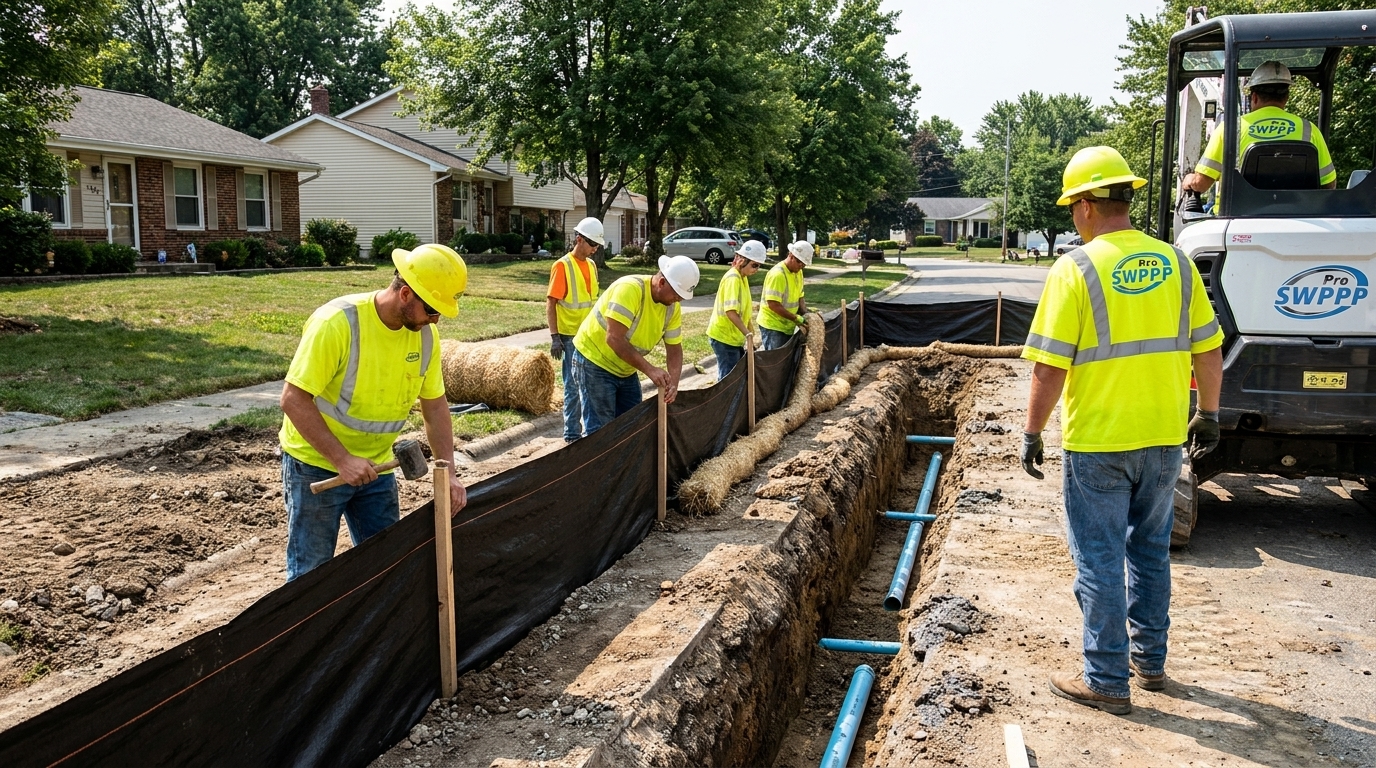
Place spoil piles on the uphill side of the trench where possible, away from storm drain inlets and curbs. Install silt fence or fiber rolls on the downslope side of spoils and along the trench perimeter to intercept sediment-laden runoff before it reaches pavement or waterways. If spoils will sit for more than a day or two, cover them with tarps or apply temporary seed and mulch. As soon as the trench is backfilled, restore topsoil, seed, mulch, and use erosion control blankets or sod to achieve final stabilization as quickly as possible.
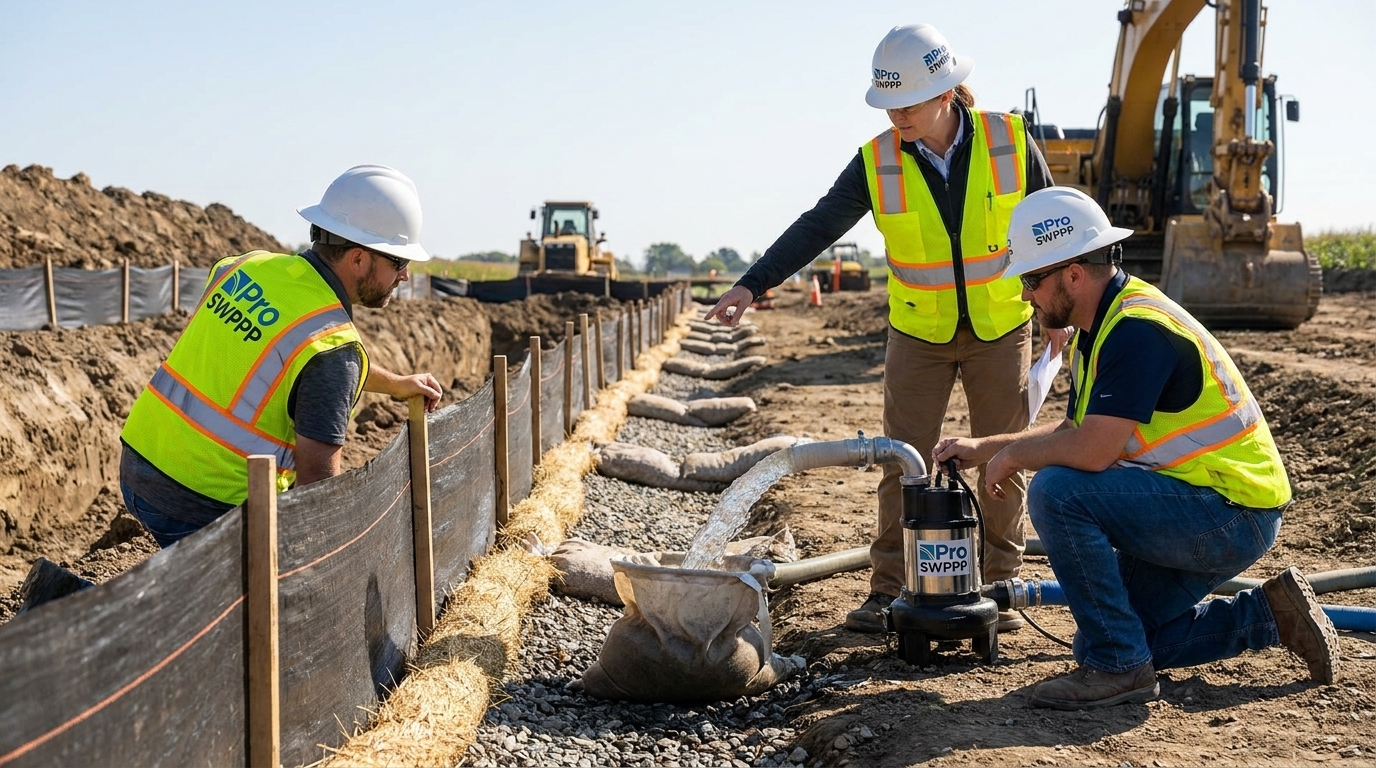
Dewatering Controls and Sampling
Trench dewatering is a major compliance issue for waterline projects. You cannot pump muddy water directly into a storm drain, ditch, or stream. The 2022 EPA CGP and most state permits require you to treat dewatering discharges to remove sediment. Typical BMPs include sediment tanks or Baker tanks, dewatering bags, sand or gravel filters, and discharge to well-vegetated areas away from surface waters. If you’re discharging significant volumes, you may need to sample for turbidity or total suspended solids and document that you’re meeting numeric benchmarks (often 50 mg/L monthly average TSS).
Pro SWPPP includes site-specific dewatering management procedures in every linear waterline SWPPP, with BMP selection, discharge points, and sampling protocols tailored to your permit requirements. We make sure you know what to do before the first pump starts running.
Stream and Wetland Crossings
If your waterline crosses a creek, river, or wetland, you’ll need extra BMPs and often separate permits (Section 404, state stream crossing permits, etc.). For stormwater SWPPP purposes, minimize the time the crossing is open, use cofferdams or flumes to isolate work from flowing water, and install streambank stabilization (erosion control blankets, rock, bioengineering) immediately after backfill. Provide or supplement buffers within 50 feet of the water body, using additional silt fence, wattles, or sediment traps if you can’t maintain the full natural buffer width.
Access Roads and Staging Areas
Stabilize construction entrances with aggregate (rock pads) and wheel-wash stations or rumble strips to prevent tracking mud onto public roads. Direct runoff from staging areas and laydown yards to sediment traps or vegetated filter strips. Keep fuels, lubricants, and chemicals in secondary containment, and set up a lined concrete washout area well away from storm drains. These housekeeping measures prevent spills and non-stormwater discharges that can trigger immediate violations.
Inspections, NOI Filing, and Keeping Records
Once your SWPPP is complete, you submit a Notice of Intent to the permitting authority (EPA or state agency). Most states use online portals and require payment of permit fees. EPA’s NOI is submitted electronically and typically must be filed at least seven days before you start construction. State lead times vary. Some require 14 or even 30 days, and a few states review SWPPPs before granting coverage. Check the specific permit instructions for your location.
After your NOI is approved and you receive permit coverage, you must post a notice at the site (or near the active work area for linear projects) and keep a copy of the SWPPP, NOI, and permit on-site at all times. Inspectors from EPA, the state, or the local MS4 can show up unannounced and ask to see these documents. If you can’t produce them, you’re in violation before they even look at your BMPs.
Inspection Frequency and Documentation
Construction stormwater permits require routine inspections at a set frequency (typically every 7 or 14 days) and after qualifying rain events (usually storms of 0.25 or 0.5 inches or more). For linear projects, you can conduct representative inspections by visiting access points and inspecting segments around those points rather than walking the entire length. Your SWPPP must describe this approach, and your inspection reports must document which segments were inspected and any deficiencies found.
Inspection reports must include the date, weather conditions, a summary of BMP performance, and any corrective actions taken or needed. Keep these reports with the SWPPP for at least three years after permit termination. Failing to inspect or failing to document inspections is one of the most common violations EPA and states cite during enforcement.
Updating the SWPPP
Your SWPPP isn’t a one-time document. If your route changes, you add segments, your BMPs aren’t working, or field conditions differ from the plan, you must update the SWPPP and document those changes. Amendments must be made whenever there’s a change in design, construction, operations, or maintenance that affects the discharge of pollutants. All amendments become part of the SWPPP and must be available on-site. Pro SWPPP provides SWPPP amendment support so you can adapt quickly to field conditions and stay in compliance.
Not sure what your project needs? Schedule a Free SWPPP Consultation with CPESC Certified SWPPP Expert Derek E. Chinners.
What Happens If You Don’t Get a SWPPP When You Need One
Ignoring SWPPP requirements or hoping you won’t get caught is a bad bet. EPA, state agencies, and local MS4 programs actively inspect construction sites. Linear waterline projects are high on the enforcement radar because of their visibility, length, and proximity to surface waters. If you’re caught without permit coverage or without a compliant SWPPP, the consequences are immediate and expensive.
Types of Violations and Enforcement Actions
Common violations for linear waterline projects include failure to obtain permit coverage, no SWPPP or an inadequate SWPPP, BMPs not installed or not maintained, sediment discharges to waters or storm drains, improper dewatering, and missing or inadequate inspections. Any of these can trigger a Notice of Violation or an administrative order requiring immediate corrective action.
EPA and states have formal enforcement policies with standardized penalty calculations. EPA’s Construction Stormwater Expedited Settlement Agreement program caps the penalty for cases resolved through the expedited process at the maximum Class I administrative penalty, which the current 40 CFR 19.4 table sets at $68,445, with higher penalties for serious or repeat violations. States have similar frameworks. California, for example, can assess civil penalties up to $10,000 per day per violation. Texas and Georgia have comparable ranges. The actual penalty depends on factors like days of violation, environmental harm, economic benefit, and your compliance history.
Real-World Consequences
Beyond fines, enforcement actions can shut down your project until you achieve compliance, delay tie-ins and system commissioning, damage your reputation with owners and municipalities, and put you on EPA’s public enforcement database (ECHO). Being listed in ECHO affects prequalification, bonding, and future project opportunities. It’s far cheaper and easier to get the SWPPP right up front than to deal with an enforcement action mid-project.
Pro SWPPP helps contractors avoid violations by delivering compliant, permit-ready SWPPPs in 72 hours, with ongoing support for inspections, amendments, and any compliance questions that come up during construction. We’ve worked linear utility projects nationwide for 20+ years and know how to keep you out of trouble.
Recent Changes and What’s Coming in 2024 and Beyond
Federal and state stormwater programs continue to evolve. The 2022 EPA CGP brought the most significant updates in years, and states are revising their permits to match or exceed the new federal standards. Here’s what contractors installing linear waterlines need to know about recent changes and upcoming trends.
2022 EPA CGP Dewatering and Stabilization Updates
The 2022 CGP strengthened dewatering requirements, making it explicit that trench and excavation dewatering must be managed to minimize pollutant discharges. Numeric turbidity and TSS benchmarks apply in many regions, and weekly sampling is required when dewatering discharges are significant. Stabilization deadlines were clarified. Temporary stabilization (seed and mulch) must be initiated within 7 or 14 days (depending on the permit and region) for areas that won’t be worked for 14 days or more. Final stabilization must achieve uniform perennial vegetative cover or equivalent permanent stabilization before you can submit a Notice of Termination.
State Permit Revisions
Many authorized states are updating their construction stormwater general permits to align with the 2022 CGP. Texas TCEQ, Georgia EPD, and California’s regional boards have either updated or are in the process of updating permits with shorter stabilization deadlines, stricter dewatering management, and enhanced buffer and inspection requirements. Some states are adding mandatory training or certification for SWPPP preparers and inspectors, similar to California’s Qualified SWPPP Developer and Qualified SWPPP Practitioner requirements.
Increased Enforcement Transparency
EPA’s ECHO database and annual enforcement reports have increased visibility of construction stormwater violations nationwide. This transparency pushes contractors to formalize stormwater compliance programs. Larger contractors are increasingly hiring third-party SWPPP services like Pro SWPPP to ensure every job meets permit requirements and to avoid the reputational damage of a public enforcement action. For more information on EPA enforcement and compliance, visit the EPA NPDES construction stormwater page.
Step-by-Step: Getting Your Linear Waterline SWPPP Done Right
Here’s the practical process to follow for any linear waterline project that might need a SWPPP:
- Step 1: Calculate total disturbed area. Include trench, spoils, access, staging, and all equipment-traffic areas. Use the math we covered earlier. If you’re at or near one acre, assume you need a SWPPP.
- Step 2: Confirm discharge. Will stormwater leave the site to a water body or MS4? If yes, and you’re over one acre, you need NPDES permit coverage.
- Step 3: Identify the permitting authority. Is it EPA or a state agency? Get the correct Construction General Permit document and read the linear-project sections.
- Step 4: Prepare the SWPPP. Describe the project, map the route, select BMPs, and document dewatering, inspections, and stabilization procedures. This must be done before you submit the NOI.
- Step 5: Submit the NOI and pay fees. Use the online portal (EPA or state). Wait for confirmation of coverage.
- Step 6: Post the notice and implement BMPs. Keep the SWPPP on-site, install erosion controls before excavation, and start your inspection schedule.
- Step 7: Maintain BMPs and update the SWPPP as needed. Fix deficiencies within the permit timeframe (often 7 days) and document all corrective actions.
- Step 8: Achieve final stabilization and file the NOT. Once the site is permanently stabilized and BMPs are removed, submit a Notice of Termination to close out permit coverage.
Pro SWPPP handles Steps 4, 5, and 7 for you, delivering a compliant SWPPP in 72 hours and supporting you through final termination. We make sure every step is done right so you can focus on laying pipe, not paperwork.
Why Pro SWPPP is the SWPPP Service Contractors Trust
Pro SWPPP is America’s #1 SWPPP Service for a reason. We’re a family-owned firm with 20+ years in stormwater compliance, serving contractors nationwide with 180+ five-star Google reviews behind us. Our team is led by CPESC-certified professionals who know the federal EPA CGP and every major state program inside and out. We don’t use templates or cookie-cutter plans. Every SWPPP we prepare is custom-built for your specific site, route, and permit requirements.
CPESC Certified and Experienced
Our founder and lead SWPPP expert, Derek E. Chinners, is a Certified Professional in Erosion and Sediment Control (CPESC). That means he’s passed rigorous exams and maintained continuing education in stormwater management, erosion control design, and regulatory compliance. When you work with Pro SWPPP, you’re getting a SWPPP reviewed and signed by a nationally recognized expert, not an intern or a software algorithm.
72-Hour Turnaround
We know construction schedules are tight. That’s why we guarantee a 72-hour turnaround on every SWPPP. You send us your project details, and within three business days you have a permit-ready SWPPP with maps, BMP specifications, inspection forms, and NOI guidance. Need it faster? Rush service is available. We’ve never missed a deadline, and we’re not about to start now.
Nationwide Coverage, Local Expertise
Pro SWPPP operates nationwide, from Texas to Georgia to California and everywhere in between. We know the differences between TCEQ requirements, Georgia EPD permit conditions, and California’s regional board expectations. We know when EPA’s CGP applies and when a state permit controls. You get one service with nationwide reach and local regulatory knowledge. Visit our Texas SWPPP Services and Georgia SWPPP Services pages to see how we support contractors in those states.
Ongoing Support
Your SWPPP isn’t a one-and-done document. We provide inspection training, help with SWPPP amendments when field conditions change, and answer compliance questions throughout your project. If an inspector shows up and has questions, you can call us. We’re in your corner from NOI to final termination. Learn more about our team and approach on our About page.
180+ Five-Star Reviews, Zero Violations
We’ve prepared SWPPPs for construction projects nationwide, including hundreds of linear waterline, sewer, and utility jobs. Our clients have never had a SWPPP-related enforcement action when they follow our plans and BMP guidance. That track record speaks for itself. When you need a SWPPP you can trust, Pro SWPPP is the service contractors choose.
If you have questions or want to discuss your specific project, contact us anytime. We’re here to help.
FAQ
Do I need a SWPPP for a waterline project under one acre?
If your waterline project disturbs less than one acre and is not part of a larger common plan of development that will disturb one acre or more, you typically do not need NPDES construction stormwater permit coverage or a SWPPP. However, local erosion control ordinances may still require erosion and sediment control BMPs. Always check with the local jurisdiction to confirm.
How do I calculate disturbed area for a linear waterline?
Include the trench surface area, spoil piles, equipment traffic zones, access roads, staging areas, bore pits, and any area where soil is exposed or vegetation is removed. Multiply the length of disturbance by the width (trench plus spoils plus equipment tracks) to get square footage, then divide by 43,560 to convert to acres. Pro SWPPP can help you calculate this accurately.
What BMPs are required for dewatering a waterline trench?
You must treat trench dewatering to remove sediment before discharge. Common BMPs include sediment tanks, dewatering bags, sand or gravel filters, and discharge to well-vegetated areas away from waters. You may also need to sample for turbidity or total suspended solids and meet numeric benchmarks. Your SWPPP must describe the dewatering management procedures and BMP locations.
How long does it take to get a SWPPP for a linear waterline?
Pro SWPPP delivers a complete, permit-ready SWPPP in 72 hours or less. Some state or EPA NOI processes require additional lead time (7 to 30 days), so plan accordingly. We provide all the documentation you need to submit your NOI as soon as your SWPPP is complete.
Can I use the same SWPPP for multiple waterline projects?
No. Each project site requires its own site-specific SWPPP that describes the location, disturbed area, BMPs, and site conditions unique to that project. If you have multiple segments of a larger common plan, they can be covered under a single SWPPP and NOI, but the SWPPP must address all segments. Reusing a generic SWPPP from another project is a violation.
What happens if I get a violation during a waterline project?
If you receive a Notice of Violation or are cited for a SWPPP or BMP deficiency, you must correct the violation immediately (often within 7 days) and document the corrective action. Serious violations can result in administrative penalties, project shutdowns, and being listed in EPA’s ECHO enforcement database. The best approach is to avoid violations by having a compliant SWPPP and implementing BMPs correctly from the start.
Do linear waterline projects qualify for any permit exemptions?
No. Linear waterlines and other utility trenches do not qualify for any special exemptions under the NPDES construction stormwater program. If you meet the one-acre threshold and discharge stormwater, you need permit coverage and a SWPPP, just like any other construction site. Some permits provide flexibilities for representative inspections and posting requirements, but these do not reduce your compliance obligations.
Not sure whether your linear project crosses the threshold? Take the 60-second SWPPP quiz, or see when a SWPPP is required for the acreage and common-plan rules.
Want a flat-rate number for your waterline job? Get a free SWPPP estimate.
Ready to move? Order your SWPPP now or schedule a call with a stormwater expert.
By Derek E. Chinners, CPESC — Founder & Stormwater Consultant, Pro SWPPP, LLC
Related: What is a SWPPP? · Highway construction SWPPP · SWPPP inspection requirements · Notice of Intent
Visit Pro SWPPP and see why contractors nationwide rely on America’s #1 SWPPP Service.