Pro SWPPP – America’s #1 SWPPP Service knows that filing a Notice of Intent (NOI) with the Oklahoma Department of Environmental Quality can feel like stepping into a maze. You’re standing at the job site, ready to break ground, and someone says “Did you file your NOI?” Most contractors freeze. What is an NOI? When do you need one? How do you actually submit it? Let’s answer every question and get you authorized fast.
What Is a Notice of Intent (NOI)?
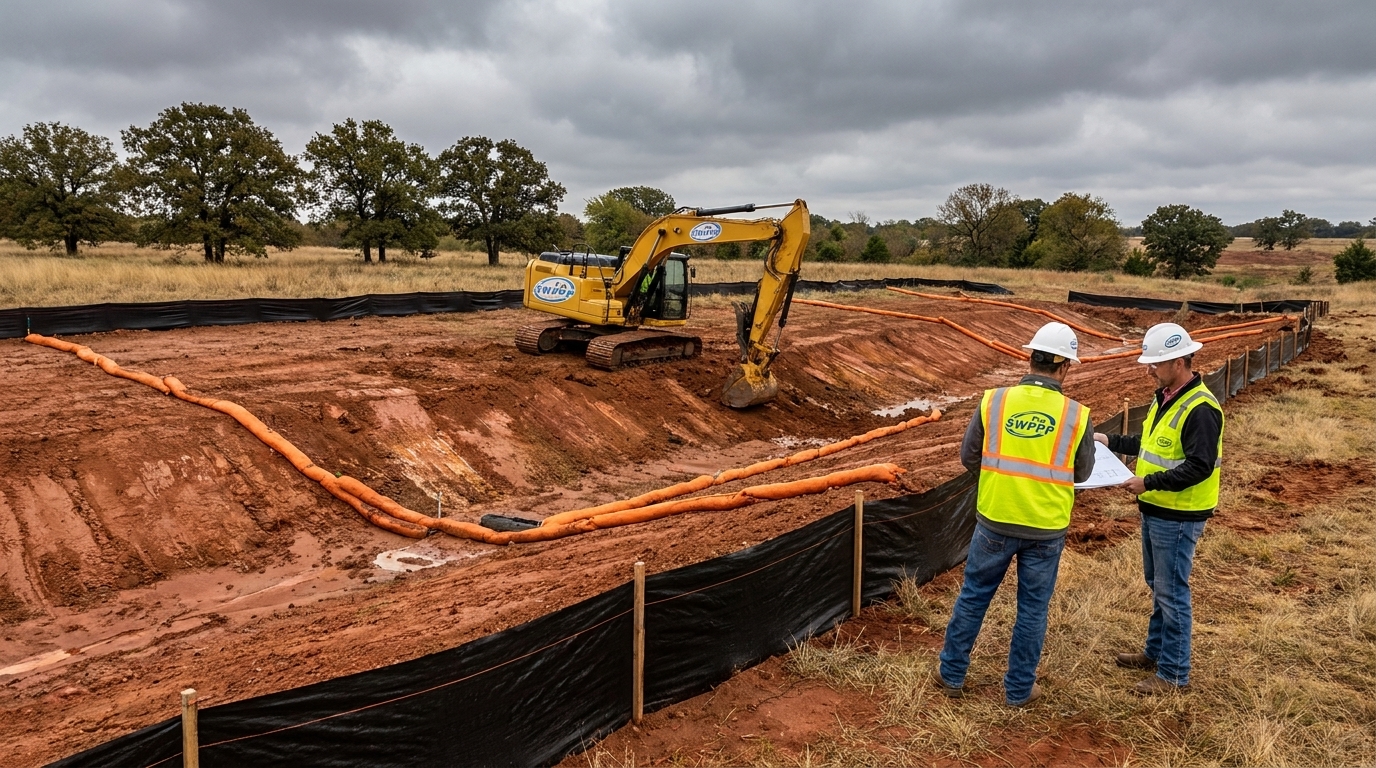
A Notice of Intent is your formal application for stormwater permit coverage in Oklahoma. Think of it as a registration form that tells the Oklahoma DEQ you’re about to disturb soil and you have a plan to keep polluted runoff out of creeks, rivers, and lakes.
The Clean Water Act requires anyone disturbing one acre or more to get a permit under the National Pollutant Discharge Elimination System. In Oklahoma, that permit is called an OPDES permit. Instead of writing a custom permit for every construction site, Oklahoma uses general permits that cover most projects. You “join” that general permit by filing an NOI.
Two permits matter most:
- OKR10 – Construction Stormwater General Permit
- OKR05 – Industrial Stormwater General Permit
If you’re building homes, roads, shopping centers, or any project that digs up dirt, you need OKR10. If you operate a manufacturing plant, concrete batch plant, or other industrial facility with outdoor materials, you need OKR05. This article focuses on OKR10 because that’s what most contractors need.
When Do You Need an NOI in Oklahoma?
The one-acre threshold, and the common-plan rule that pulls smaller lots in alongside it, are covered in full in When Is a SWPPP Required? This guide assumes you have cleared that test and focuses on what Oklahoma does differently.
What is specific to Oklahoma is the watershed screening. Before you can finish the form you have to determine whether your site drains to a Sensitive Water, a Sensitive Watershed, or a Scenic River Watershed. Those designations carry additional requirements, and they are the reason two otherwise identical Oklahoma sites can end up with very different permit conditions.
Oklahoma law prohibits discharging stormwater from construction sites without an OPDES permit. Filing your NOI is how you get that permit. No NOI means no legal authority to disturb soil. Inspectors can shut you down and fines can stack up fast.
What You Must Do Before Filing Your NOI
The Oklahoma DEQ will not accept an incomplete NOI. You need to gather specific information and prepare a Stormwater Pollution Prevention Plan before you click submit. Here’s your pre-flight checklist:
- Read the current OKR10 permit requirements (the 2022 version expires in 2027)
- Identify the latitude and longitude of your site entrance
- Identify the receiving water body (creek, stream, river, or lake)
- Check if your site drains to a Sensitive Water, Sensitive Watershed, or Scenic River Watershed
- Prepare or update your Stormwater Pollution Prevention Plan (SWPPP)
- Calculate total site acreage and estimated disturbed acreage
- Calculate pre-construction and post-construction impervious area
- Describe construction Best Management Practices (BMPs) and post-construction BMPs
- Prepare a site map showing project boundaries, stormwater controls, and outfalls
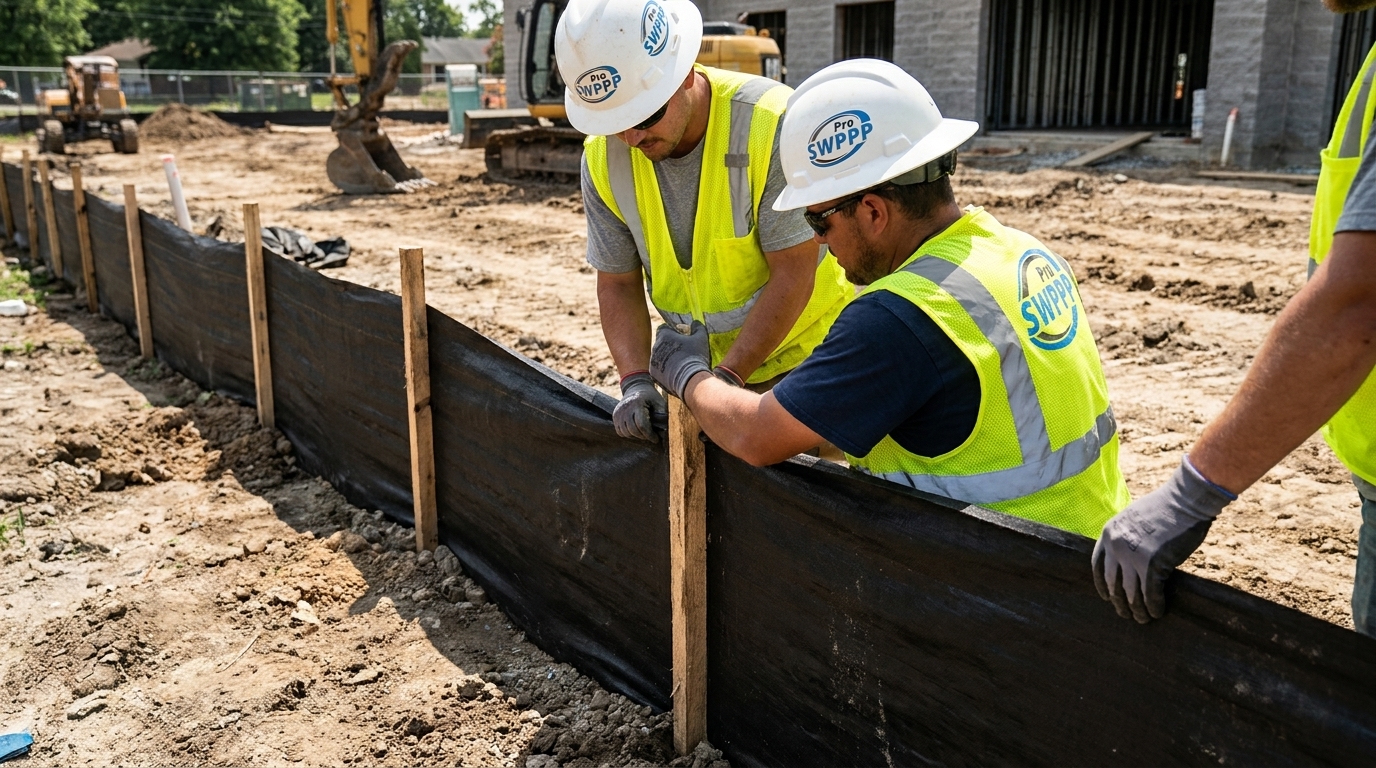
Yes, you need a SWPPP before you file your NOI. The permit requires it. Your SWPPP describes how you will control erosion and sediment during construction. It lists your BMPs like silt fences, inlet protection, and stabilized entrances. It shows where runoff goes and how you’ll prevent mud from washing into storm drains.
Pro SWPPP prepares SWPPPs for contractors across Oklahoma. We know what the DEQ wants to see and we build plans that pass inspection the first time, which is a large part of why contractors have left us 180+ five-star Google reviews.
How to File Your NOI (Step by Step)
Once your SWPPP is ready, filing your NOI takes three steps: complete the form, pay the fees, and submit everything to the DEQ.
Step 1: Complete DEQ Form 606-002A
Download the Construction Stormwater NOI form from the Oklahoma DEQ website. The form asks for operator contact information, estimated construction start and end dates, total and disturbed acreage, impervious area, runoff coefficients, soil descriptions, and a summary of your BMPs.
Recent updates added more fields. The DEQ wants to know if your site discharges to a Municipal Separate Storm Sewer System (MS4). They want post-construction runoff coefficients. They want detailed BMP descriptions. Fill out every blank. Incomplete forms get kicked back and delay your authorization.
Step 2: Pay the Fees
For a new construction NOI, expect to pay around $447.71 total. That breaks down to a $100 application fee plus a $347.71 annual permit fee. Renewal NOIs only pay the $100 application fee because the DEQ invoices annual fees separately.
Payment methods depend on how you submit. Online submissions accept credit cards (Visa or MasterCard). Mailed submissions take checks payable to Oklahoma DEQ. Keep your receipt. You’ll need proof of payment if questions arise.
Step 3: Submit Your NOI Package
You have four submission options:
- Online – Use the DEQ nFORM system or Online NOI portal on the Construction Stormwater page. Upload your completed form and site map, pay by credit card, and get instant confirmation.
- Email – Send your signed NOI and maps to [email protected]. Print the form, sign it in ink, scan it, and attach it. Typed signatures don’t count unless you use the official online system.
- Mail – Mail to Stormwater Unit of ECLS, Oklahoma DEQ, 707 N Robinson Ave, P.O. Box 1677, Oklahoma City, OK 73101-1677.
- Fax – Fax to (405) 702-6226.
Online is fastest. Most contractors get authorization within days. Mail can take weeks. Plan ahead. File your NOI at least fourteen days before you plan to start construction. You cannot legally disturb soil until you receive your authorization notice from the DEQ.
Don’t want to mess with all the paperwork and requirements? Check out Order your SWPPP now with Pro SWPPP Professional CPESC Certified SWPPP Services.
What Happens After You File?
The DEQ reviews your NOI. If everything checks out, they issue an authorization notice by email or mail. That notice is your permit. Keep a copy on site. Inspectors will ask to see it.
If your NOI has errors or missing information, the DEQ sends it back with instructions. Fix the problems and resubmit. Every day you wait is a day you can’t start construction. That’s why getting it right the first time matters.
Some cities require an extra step. Oklahoma City and Edmond both ask you to submit a copy of your NOI and SWPPP to their local stormwater divisions. Check with your city before you file. You might need to coordinate state and local permits at the same time. For more on state-level requirements, see our guide on Oklahoma SWPPP requirements.
Common Mistakes and How to Avoid Them
Waiting Until the Last Minute
Contractors often file their NOI the week they want to start grading. By the time the DEQ processes the application, the project is already behind schedule. File early. Give yourself two weeks minimum.
Skipping the SWPPP
You can’t get permit coverage without a SWPPP. Some contractors try to file the NOI first and write the plan later. The DEQ rejects those NOIs. Prepare your SWPPP first, then use it to fill out your NOI.
Guessing on Acreage and Coordinates
Rough estimates get flagged. Use GIS tools or survey data to get accurate disturbed acreage, impervious area, and GPS coordinates. The DEQ cross-checks your numbers against aerial maps.
Forgetting About the Common Plan Rule
Even small lots need permits if they’re part of a larger development. A half-acre house lot in a ten-acre subdivision still requires an NOI. Evaluate the total disturbance of the entire project, not just your piece.
Using a Typed Signature on Email Submissions
The DEQ wants a real ink signature when you email an NOI outside the online portal. Print, sign, scan, then attach. Or use the online system, which has built-in electronic certification.
Not sure what your project needs? Take the 60-second SWPPP quiz, get a free estimate, or Schedule a Free SWPPP Consultation with CPESC Certified SWPPP Expert Derek E. Chinners.

Why Pro SWPPP Is Your Best Choice
Pro SWPPP handles Oklahoma NOI packages week in and week out. We know every field on the form. We know which BMPs the DEQ expects. We know how to describe your site so inspectors understand your plan at a glance.
When you work with Pro SWPPP, you get:
- A complete, DEQ-compliant SWPPP written by CPESC-certified professionals
- Accurate site maps with latitude, longitude, receiving waters, and BMP locations
- Pre-filled NOI form with all required data and calculations
- Guidance on submission method and fee payment
- Fast turnaround so you can file on time
We also serve contractors in Texas and Georgia, where stormwater rules are just as strict. Our team understands regional variations and keeps up with every permit modification and rule change.
What About Industrial Sites?
If you operate an industrial facility, you file an NOI under OKR05 instead of OKR10. The process is similar but the form and requirements differ. You need to identify every stormwater outfall, calculate exposed industrial area, and describe industrial activities and materials stored outdoors.
Industrial NOIs also require a SWPPP before submission. That SWPPP must address specific industrial pollutants, good housekeeping practices, spill prevention, and employee training. The annual fee structure is the same: $100 application fee plus $347.71 annual permit fee.
Pro SWPPP prepares industrial SWPPPs for concrete plants, asphalt facilities, metal fabricators, and other operations across Oklahoma. We know how to write plans that satisfy both the DEQ and your insurance carrier.
Staying Current With Oklahoma Stormwater Rules
Oklahoma’s 2022 OKR10 permit took effect October 18, 2022 and expires at midnight on October 17, 2027. The DEQ recently modified the permit to clarify language and update forms. Existing permit holders don’t need to reapply because of the modification. Coverage continues automatically.
The DEQ has shifted toward electronic NOI submission. Forms moved out of the permit text and onto standalone web pages. Online portals replaced paper processes. Check the DEQ Construction Stormwater page for the latest submission instructions. Systems and platforms change as the DEQ upgrades technology.
New NOI forms now ask for more detail on impervious surfaces, runoff coefficients, and post-construction BMPs. That reflects a trend toward quantitative, watershed-focused permitting. The DEQ wants to see numbers that prove your site won’t increase flooding or pollution downstream.
Coordinating With Local Jurisdictions
Many Oklahoma cities have their own erosion and sediment control ordinances. Oklahoma City, Edmond, Tulsa, and Norman all require local permits or plan reviews in addition to your state NOI. Contact your city’s stormwater or public works department early. Ask what they need and when they need it.
Some cities want a copy of your NOI and SWPPP before they issue a grading permit. Others require site inspections or local BMP approvals. Coordinate state and local requirements at the same time to avoid delays. To be clear about scope: your crews install and maintain the controls in the field. Pro SWPPP writes the plan, files the permit, performs the inspections and keeps the records. Get a free estimate and we will price your Oklahoma filing before you commit.
Tips for a Smooth NOI Process
- Use the online NOI system whenever possible. It’s faster and eliminates signature issues.
- Compile all data before you start the form. Have acreage, coordinates, receiving water, and BMP descriptions ready.
- Keep copies of everything you submit. Store your NOI, SWPPP, site maps, authorization notice, and fee receipts in one project file.
- Build lead time into your schedule. File at least two weeks before planned construction start.
- Check for Sensitive Waters, Sensitive Watersheds, and Scenic River Watersheds. Those designations trigger extra requirements.
- If disturbed acreage increases during construction, submit a modified NOI to the DEQ and any relevant city.
Pro SWPPP handles all of this for you. We build the SWPPP, fill out the NOI, prepare the maps, and guide you through submission. You focus on running your job. We handle the paperwork.
FAQ
Do I need an NOI if I’m only clearing trees and not grading?
Yes. Clearing, grubbing, and tree removal count as land disturbance. If your project totals one acre or more, you need an NOI and a SWPPP.
Can I start work as soon as I submit my NOI?
No. You must wait for the DEQ to issue your authorization notice. Starting construction before authorization violates the permit and can result in fines and stop-work orders.
What if my project is less than one acre?
If your project is part of a larger common plan that totals one acre or more, you still need an NOI. Evaluate the entire development, not just your individual lot.
How long does it take to get authorization?
Online submissions typically get processed within a few days. Mailed NOIs can take two to three weeks. File early to avoid delays.
Do I need to renew my NOI every year?
No. Your NOI covers your project from start to completion. You pay an annual permit fee, but you don’t submit a new NOI each year. When construction is finished and the site is stabilized, you file a Notice of Termination (NOT).
What happens if I make a mistake on my NOI?
The DEQ sends it back with instructions. Fix the errors and resubmit. Delays stack up fast, so get it right the first time or hire Pro SWPPP to handle it.
Can I use the same SWPPP for multiple projects?
No. Every site is unique. Your SWPPP must describe the specific conditions, BMPs, and receiving waters for that project. Copy-paste plans get rejected during inspections.
What if my project crosses into Texas or another state?
You need separate NOIs for each state. Oklahoma permits don’t cover work in other states. Each state has its own forms, fees, and requirements.
Ready to get started? Order your SWPPP now or schedule a free consultation with Pro SWPPP.
Contractors nationwide have left Pro SWPPP 180+ five-star Google reviews. Get a free estimate or schedule a call with a stormwater expert.
By Derek E. Chinners, CPESC — Founder & Stormwater Consultant, Pro SWPPP, LLC
Related: What Is a SWPPP? · When Is a SWPPP Required? The 1-Acre Rule and Common Plans · Oklahoma SWPPP Requirements · Oklahoma City SWP3 Requirements · How to File a Notice of Termination