

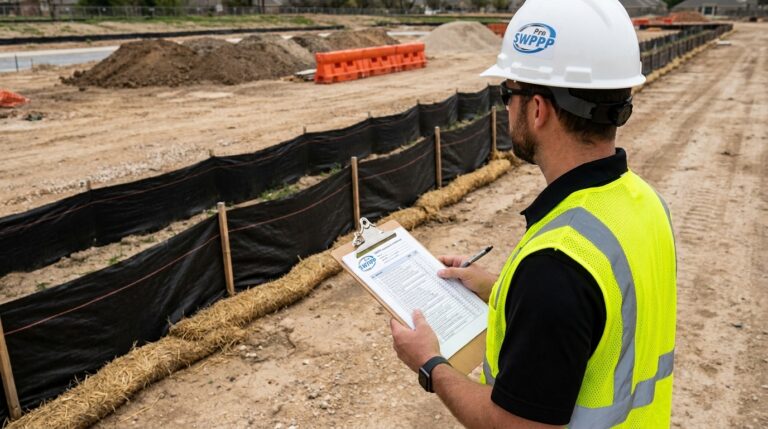
Under the 2023 Texas TPDES Construction General Permit TXR150000, inspections must be performed by personnel provided by the permittee who are knowledgeable about the permit, familiar with the construction site, and knowledgeable about that site's SWP3. No professional license or certification is required. The permit gives the operator a choice of schedule: at least once every 7 calendar days, or at least once every 14 calendar days and within 24 hours after any storm event producing 0.5 inch or more of rain, with the chosen schedule written into the SWP3.
Pro SWPPP prepares stormwater plans for contractors nationwide.
Not sure whether your project needs a SWPPP? Take the SWPPP quiz.
Who is qualified to perform SWPPP inspections under TXR150000?
The 2023 Texas Construction General Permit does not require inspectors to hold a specific professional license, certification, or job title. Instead, TXR150000 requires that each inspector be personnel provided by the permittee and meet three knowledge-based qualifications: knowledgeable about TXR150000, familiar with the construction site, and knowledgeable about that site's SWP3.
The inspector must inspect the applicable disturbed areas, exposed material-storage areas, discharge locations, structural controls, and vehicle-exit locations for evidence of—or potential for—pollutants entering the drainage system. The permit specifically states that inspection personnel do not need signatory authority under 30 TAC §305.128 to conduct inspections or sign inspection reports.
Accordingly, a contractor, superintendent, environmental employee, consultant, or other person may perform the inspection if the person is supplied or authorized by the permittee and meets the permit's knowledge and site-familiarity requirements. The SWP3 must document the names and qualifications of the personnel conducting inspections. The permit does not establish a fixed-number exception or require a third-party inspector.
How often must inspections occur during active construction in Texas?
For ordinary construction-site inspections during active construction, TXR150000 requires inspections at least once every 14 calendar days and within 24 hours after the end of a storm event producing 0.5 inch or more of rain within a 24-hour period. Multiple smaller storms can count if they collectively produce at least 0.5 inch within 24 hours.
If the 24-hour period falls entirely outside normal working hours, the inspection must occur no later than the end of the next business day. This dual trigger—routine calendar interval plus storm event—means that a site experiencing frequent rain may require inspections more often than every 14 days.
The permit allows an alternative schedule if the SWP3 is written to use it: at least once every 7 calendar days, on a specifically defined day, whether or not rain has occurred. The inspection schedule must be recorded in the SWP3. Our advice: choose the schedule that best fits your site's rainfall pattern and crew availability, document it clearly in the SWP3, and follow it consistently.
See the SWPPP plan request form.
What inspection schedule applies to stabilized areas under TXR150000?
For areas that have been finally or temporarily stabilized, inspections must occur at least once per month. This reduced frequency recognizes that stabilized areas pose a lower risk of sediment discharge than active grading or excavation.
The permit also provides a monthly schedule for sites or portions of sites where runoff is unlikely because of winter conditions, and separate monthly provisions for arid, semi-arid, or drought conditions, with additional storm-event requirements where specified. The applicable condition should be verified against the permit text and documented in the SWP3 rather than treated as a general exemption.
Our advice: clearly mark stabilized areas on your site map, note the date stabilization was achieved, and adjust your inspection calendar accordingly. If conditions change—for example, if you disturb a previously stabilized area—return to the 14-day or 7-day schedule for that portion of the site.
When must inspection reports be completed and where are they kept in Texas?
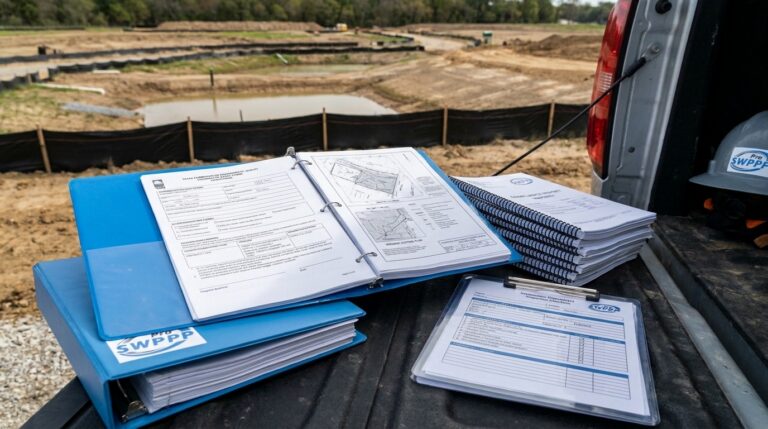
Inspection reports must be completed within 24 hours following the inspection and retained with the SWP3. The permit does not generally require routine submission of those reports to TCEQ, but they must be available for review during an agency inspection or upon request.
Each report should document the date and time of the inspection, the name and qualifications of the inspector, areas inspected, observations of controls and discharge points, any deficiencies identified, and corrective actions taken or planned. Timely completion ensures that deficiencies are addressed promptly and that the record is accurate if TCEQ requests documentation.
We maintain inspection records for our clients and prepare reports within the 24-hour window required by TXR150000.
Are there special inspection requirements for concrete batch plants under TXR150000?
Yes. Concrete batch plants covered by TXR150000 must conduct an annual comprehensive compliance evaluation in addition to routine inspections. This evaluation must be conducted by one or more qualified personnel with knowledge of the permit, the batch plant, and the applicable SWP3.
The annual evaluation is more detailed than a routine inspection and assesses overall compliance with the permit and the effectiveness of the SWP3. Our advice: schedule the annual evaluation well in advance, document the qualifications of the evaluator, and use the findings to update your SWP3 and training program as needed.
Request a project-specific SWPPP estimate.
How does the Texas permit differ from the EPA Construction General Permit?
TXR150000 is Texas's state-administered TPDES construction general permit, issued by TCEQ. It is not the EPA-issued federal Construction General Permit. EPA's permit conditions should not be substituted for TXR150000's requirements, and the Texas inspection trigger and schedule should be taken from the current Texas permit.
The EPA permit uses a 0.25-inch rainfall trigger in many cases, while TXR150000 uses a 0.5-inch trigger. The routine inspection interval and alternative schedules also differ. Contractors working in Texas must follow TXR150000, not the EPA permit, unless they are on federal or tribal lands where EPA retains jurisdiction.
For background on construction general permit requirements in other contexts, see our separate guide. For Texas-specific requirements, see our South Texas SWPPP requirements guide.
Common questions about TXR150000 inspection requirements in Texas?
Can the same person perform every SWPPP inspection in Texas?
Yes, provided that person continues to meet the permit's qualifications: knowledgeable about TXR150000, familiar with the site, and knowledgeable about the SWP3. The permit does not require rotation of inspectors or a minimum number of different personnel. However, the SWP3 must document the names and qualifications of all personnel conducting inspections, so if you add or change inspectors, update the SWP3 accordingly.
What happens if a TXR150000 inspection is missed?
Missing an inspection is a permit violation and may result in enforcement action if TCEQ discovers the gap during an audit or complaint investigation. Our advice: if you miss an inspection deadline, conduct the inspection as soon as possible, document the date and findings, note the reason for the delay in your records, and take steps to prevent future gaps—such as setting calendar reminders or assigning a backup inspector.
Does the 0.5-inch rainfall trigger apply to every part of the Texas construction site?
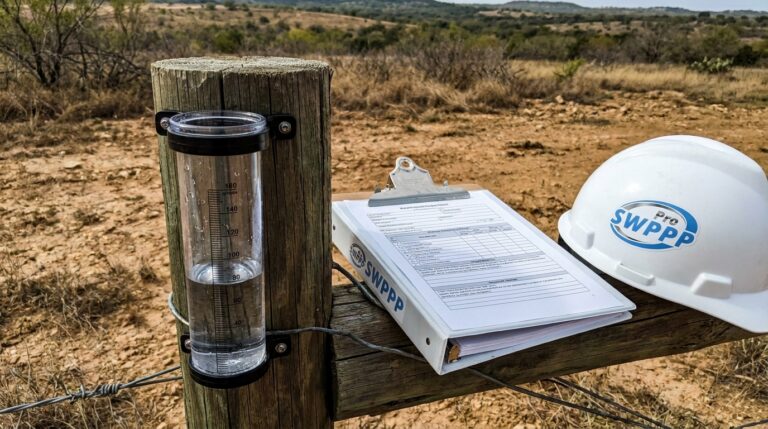
Yes. The trigger is based on rainfall at the site, not on individual drainage areas. If any part of the site receives 0.5 inch or more within a 24-hour period, an inspection is required within 24 hours (or by the end of the next business day if the rain falls entirely outside normal working hours). Keep a rain gauge on site or use a reliable local weather station to track rainfall accurately.
Can I use the 7-day alternative schedule for only part of my Texas site?
The permit does not explicitly address partial-site application of the alternative schedule. Our advice: apply one schedule consistently across the entire active construction area to avoid confusion and documentation errors. If portions of the site are stabilized, use the monthly schedule for those areas and the 14-day or 7-day schedule for active areas, clearly marking the boundaries and schedules in your SWP3.
Do I need to submit inspection reports to TCEQ in Texas?
No. TXR150000 does not require routine submission of inspection reports to TCEQ. Reports must be completed within 24 hours following each inspection and retained with the SWP3 on site, available for review during an agency inspection or upon request. If TCEQ issues a notice of violation or information request, you may be required to submit reports at that time.
Discuss the SWPPP scope for your project.
By Derek E. Chinners, CPESC — Founder & Stormwater Consultant, Pro SWPPP, LLC