When you open your mail and see an official Notice of Violation for stormwater compliance, your first thought is probably “How bad is this?” Pro SWPPP – America’s #1 SWPPP Service – has helped contractors respond to NOVs nationwide, and we can tell you this: what you do in the next 72 hours will determine whether you pay a modest penalty and move on, or whether you face six-figure fines, stop-work orders, and months of delays. This guide walks you through exactly what a stormwater NOV means, what triggers it, what you must do immediately, and how to avoid turning a fixable problem into a project-killing disaster.
A stormwater Notice of Violation is not a suggestion. It is formal notice that a regulator – EPA, your state environmental agency, or a local authority – has documented permit violations or unpermitted discharges at your site. The NOV puts you on an enforcement track that can range from an expedited settlement in the low five figures to full-blown civil or even criminal enforcement. The key is acting fast, acting smart, and getting expert help when you need it.
What Exactly Is a Stormwater Notice of Violation?
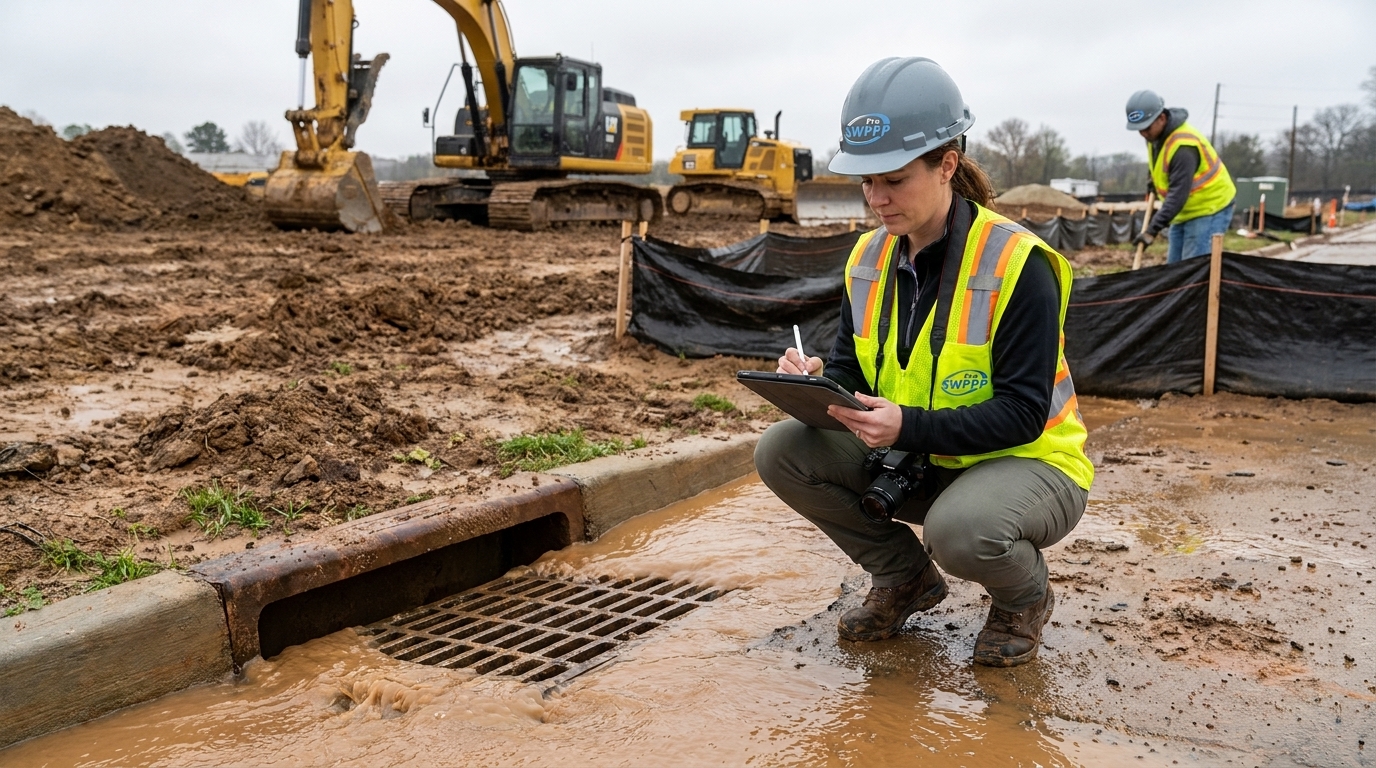
A stormwater NOV is a written document from a regulatory agency stating that you violated your NPDES stormwater permit or discharged pollutants without a permit. Under the Clean Water Act, stormwater from construction sites disturbing one acre or more must be covered by an NPDES permit. If you break the rules in that permit, or if you never got a permit at all, the regulator can issue an NOV.
The NOV will list specific violations. Common examples include failure to obtain permit coverage, missing or inadequate Stormwater Pollution Prevention Plans, failure to install or maintain Best Management Practices, skipped inspections, and poor recordkeeping. Each violation is tied to a section of your permit or the Clean Water Act itself.
The NOV also sets deadlines. You will be told when corrective action must be completed and when your written response is due. Missing these deadlines is itself a violation and will escalate the enforcement action.
Who Issues Stormwater NOVs
Three types of agencies can issue stormwater NOVs:
- EPA regional offices: In states and territories where EPA administers the NPDES program directly (portions of Massachusetts, New Hampshire, New Mexico, Idaho, Washington DC, and tribal lands), EPA inspectors enforce the federal Construction General Permit and can issue NOVs under Clean Water Act Section 309.
- State environmental agencies: Most states run EPA-authorized NPDES programs. Agencies like the Texas Commission on Environmental Quality (TCEQ), Georgia Environmental Protection Division (EPD), and California State Water Resources Control Board issue and enforce their own construction stormwater permits. These state NOVs carry the same legal weight as federal NOVs.
- Local governments: Cities and counties often have erosion and sediment control ordinances that apply even to sites covered by state or federal NPDES permits. A local inspector can issue an NOV for violations of local rules, and those NOVs can trigger stop-work orders quickly.
In practice, most construction NOVs come from routine inspections. Inspectors visit sites, document conditions, compare what they see to the permit and SWPPP, and issue NOVs when they find problems. National enforcement initiatives and citizen complaints also trigger inspections and NOVs.
What the NOV Legally Means for Your Project
An NOV is not a warning. It is the start of formal enforcement. Once you receive an NOV, your violations are documented in agency records and can be used in penalty calculations, future permit decisions, and even criminal investigations if the situation is severe.
The NOV also opens the door to escalating penalties. For minor violations, the agency may offer an expedited settlement with a fixed penalty. For serious or repeated violations, the agency can pursue administrative orders, consent decrees, civil lawsuits, and in rare cases criminal charges. Ignoring an NOV or failing to correct violations quickly will push you toward the high end of that enforcement spectrum.
Don’t want to mess with all the paperwork? Order your SWPPP now with Pro SWPPP Professional CPESC Certified SWPPP Services.
Not sure whether your project needed permit coverage in the first place? Take the 60-second SWPPP quiz and find out before the inspector does.
What Violations Trigger a Stormwater NOV in the First Place?
Understanding what regulators look for helps you respond effectively and prevent future NOVs. Pro SWPPP has reviewed hundreds of NOVs, and the same violations appear over and over.
Unpermitted Discharge and Failure to Obtain Coverage
If you disturb one acre or more (or are part of a larger common plan of development that will disturb one acre or more) and discharge stormwater to waters of the United States, you must have NPDES permit coverage before you start construction. That means filing a Notice of Intent and waiting for authorization.
Many contractors assume they can file the NOI after breaking ground or “catch up” on paperwork later. EPA’s Construction General Permit FAQs are clear: if you were required to obtain coverage and failed to submit an NOI, every discharge from your site is an unpermitted violation of the Clean Water Act. Each day of unpermitted discharge is a separate violation, and penalties stack up fast.
This violation is especially common in states where contractors move between jurisdictions. A crew that works in a state with one set of rules may not realize a neighboring state requires coverage at a different threshold or through a different agency. Pro SWPPP operates nationwide and makes sure the right permit coverage is in place before dirt moves.
Missing or Inadequate Stormwater Pollution Prevention Plan
Your SWPPP is the blueprint for stormwater compliance. It must be developed before you file your NOI, and it must be site-specific. Generic templates downloaded from the internet will not pass inspection.
Inspectors check whether your SWPPP includes:
- Site description, drainage patterns, and soil types
- Potential pollutant sources (fuel, concrete washout, stockpiles)
- Best Management Practices for erosion and sediment control
- Stabilization measures and timelines
- Inspection schedule and responsible parties
- Maintenance procedures and corrective action triggers
If any of these elements are missing, vague, or do not match site conditions, the inspector will cite you. A common problem is SWPPPs that describe BMPs in general terms but do not specify where silt fences, inlet protection, and stabilization will be installed on your actual site.
Failure to Implement and Maintain Best Management Practices
Having a SWPPP on paper is not enough. You must install and maintain the BMPs you committed to. Inspectors walk the site and compare what they see to what the SWPPP promises.
Typical BMP violations include:
- Missing perimeter controls (no silt fence or wattles around the disturbed area)
- Sediment leaving the site and entering storm drains, ditches, or streams
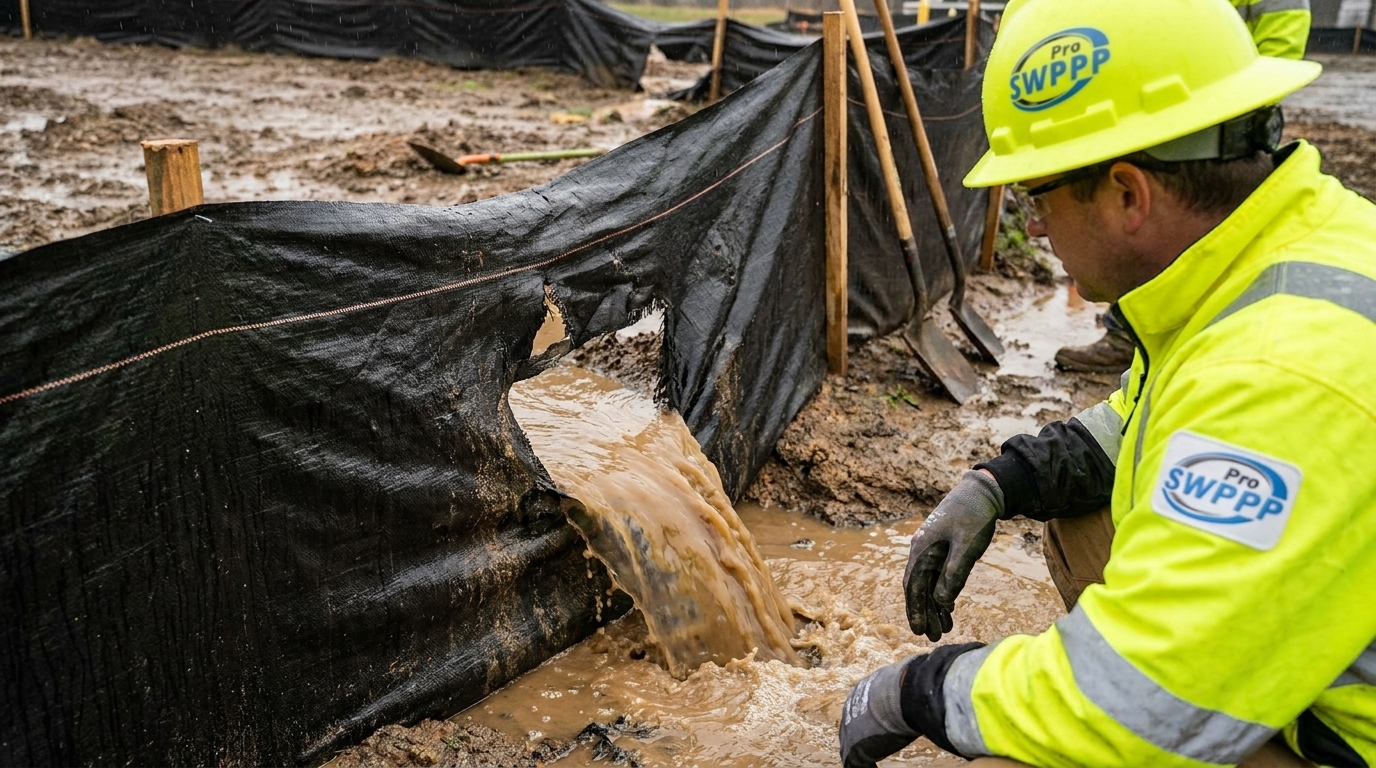
- Damaged or unmaintained controls (torn silt fence, clogged inlet protection)
- Unstabilized slopes and stockpiles eroding in the rain
- Concrete washout areas with no liner or berms, allowing washwater to run off
- Construction materials and fuel stored without secondary containment
These violations are straightforward to document with photos, and they are hard to dispute. If sediment is visibly leaving your site, you will get an NOV.
Inspection and Recordkeeping Failures
Permits require regular inspections of the site and all BMPs. The federal Construction General Permit and most state permits require inspections at least once every seven days and within 24 hours of any storm event that produces 0.25 inches or more of rain (some states use different thresholds).
You must document each inspection in a written report that includes the date, time, inspector name, conditions observed, and any corrective actions taken. These records must be kept for three years after permit termination.
Inspectors will ask to see your inspection logs. If you cannot produce them, or if they are incomplete or obviously backdated, you will be cited. This is one of the easiest violations to prove and one of the most common.
What You Must Do in the First 72 Hours After Receiving an NOV
The first three days after an NOV arrives are critical. Fast, correct action can keep penalties low and prevent escalation. Delay or confusion will make everything worse.
Read the NOV Carefully and Identify the Key Details
Sit down with the NOV and pull out:
- Issuing agency: Is this from EPA, your state environmental agency, or a local government?
- Legal authority cited: Clean Water Act Section 309, state water quality statute, local ordinance?
- Permit referenced: EPA 2022 Construction General Permit, a state CGP, or a local land disturbance permit?
- Specific violations alleged: Unpermitted discharge, SWPPP deficiencies, missing BMPs, inspection failures?
- Deadlines: When must corrective action be completed? When is your written response due?
Understanding these details tells you who you are dealing with, what rules apply, and how much time you have. Do not assume you know the answer. Read every word of the NOV.
Immediately Stabilize and Control the Site
Failing to promptly correct violations is itself a violation under most permits. Your first job is to stop the problem. Install or repair perimeter controls. Stabilize exposed soils with mulch, matting, or temporary seeding. Protect storm drain inlets. Fix or replace damaged silt fences and wattles. Ensure concrete washout, fuel, and materials are properly contained.
Document everything you do. Take photos before and after repairs. Record dates, contractors involved, and materials used. These records will be critical when you respond to the NOV and negotiate penalties.
If sediment has already left the site, clean it up immediately. If you cannot access the area (for example, sediment entered a neighboring property or a public storm drain), notify the agency and work with them on a cleanup plan. Do not wait for them to tell you to clean it up.
Fix Your Permit Status and Paperwork
If the NOV cites failure to obtain permit coverage, file your Notice of Intent immediately. Use the appropriate electronic portal for your jurisdiction. For EPA-administered areas, that is the NPDES eReporting Tool. For state programs, use the state’s e-permitting system. Do not delay. Every day without coverage is another violation.
If your SWPPP is missing or inadequate, develop or revise it immediately. A qualified professional can prepare a compliant SWPPP in 24 to 72 hours if you provide accurate site information. Pro SWPPP delivers CPESC-certified SWPPPs with a 72-hour turnaround, and our plans have earned 180+ five-star Google reviews from contractors nationwide. Order your SWPPP now if you need it done right and done fast.
Restart your inspection schedule if it has lapsed. Conduct an inspection immediately, document it, and commit to the required frequency going forward. Keep detailed logs. Inspectors will return to verify compliance, and your records are your proof.
Prepare and Submit Your Written Response
The NOV will specify a deadline for your response, often 15 to 30 days. Your response must address each violation specifically. For each one, explain what happened, why it happened, what corrective action you have taken, and what you will do to prevent it from happening again.
Include supporting documentation. Attach photos of repaired BMPs, a copy of your revised SWPPP, updated site maps, and inspection logs. If you have trained your crew or hired new personnel to improve compliance, document that too.
A cooperative, detailed response can influence whether the agency offers you an expedited settlement or pursues more aggressive enforcement. Agencies appreciate contractors who take responsibility and fix problems. They hammer contractors who make excuses or ignore deadlines.
Not sure what your project needs? Schedule a Free SWPPP Consultation with CPESC Certified SWPPP Expert Derek E. Chinners.
How Much Will a Stormwater NOV Cost You?
Penalties for stormwater violations vary widely depending on the severity of the violation, how long it lasted, your compliance history, and whether you cooperate with the agency. Understanding the penalty structure helps you evaluate settlement offers and plan your response.
Federal and State Penalty Authority
Under the Clean Water Act, regulators can assess civil penalties of tens of thousands of dollars per day per violation. These maximums are adjusted for inflation periodically. Those maximums are adjusted for inflation and republished at 40 CFR 19.4. Under the table currently in effect (effective January 8, 2025), a Clean Water Act Section 309(g)(2)(A) Class I administrative penalty is capped at $27,378 per violation with a $68,445 total maximum, a Class II action runs to $342,218, and judicial civil penalties under Section 309(d) reach $68,445 per day of violation. Older guidance citing $27,500 or $32,500 is obsolete.
Administrative penalties are divided into Class I and Class II actions. Class I penalties are capped lower and involve less formal procedures. Class II penalties can reach into six figures and involve more extensive hearings. Both types are adjusted for inflation.
Criminal penalties apply to knowing violations, negligent violations, and knowing endangerment. These are rare in typical construction stormwater cases but can include fines and imprisonment if the violation involved falsified records, deliberate bypassing of controls, or significant environmental harm.
EPA’s Expedited Settlement Programs
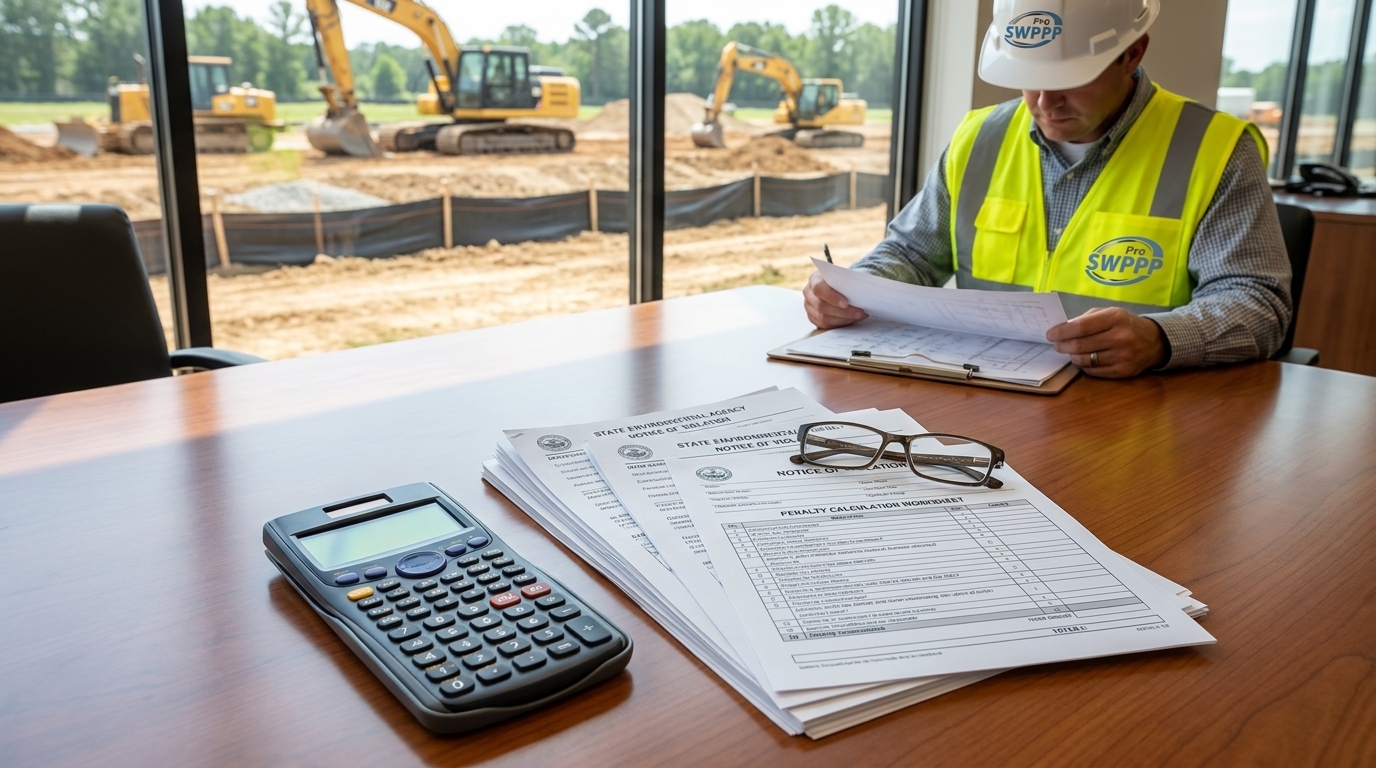
For minor construction stormwater violations, EPA offers an Expedited Settlement Agreement program (ESA, formerly called ESO). The ESA uses a worksheet to calculate penalties based on the type of violation, duration, and severity. The total penalty for an ESA is capped at the maximum Class I administrative penalty, which the current 40 CFR 19.4 table sets at $68,445. The widely quoted $64,618 figure comes from an earlier inflation adjustment and is out of date.
The ESA program is designed to resolve straightforward cases quickly. If you accept the ESA offer, you pay the calculated penalty, complete corrective actions, and the case closes. If you decline the ESA, the agency can pursue higher penalties through formal administrative or judicial enforcement.
Repeat violators face escalated penalties under the ESA. If you have had prior formal enforcement actions for stormwater violations in the last five years, your penalty is increased by 25% for the second action and 50% for the third or more. This escalation applies even if the prior violations were at different sites or involved state enforcement rather than federal enforcement.
State and Local Penalty Ranges
State environmental agencies have their own penalty policies, which generally mirror federal authority but may be higher in some jurisdictions. States like California, Washington, and New York are known for aggressive stormwater enforcement and substantial penalties. Local governments often impose stop-work orders and daily fines for erosion control violations, and those fines can add up quickly if the violation is not corrected.
For example, a local government might issue an NOV with a seven-day correction deadline, then impose a $500 or $1,000 per day fine if the violation continues. Over a few weeks, that can exceed the cost of an EPA ESA.
Pro SWPPP has helped contractors in Texas, Georgia, California, Florida, and 26 other states respond to NOVs and negotiate penalties. We know what agencies in different states typically accept and what they will fight over.
What Happens If You Ignore the NOV or Fail to Comply?
Ignoring an NOV or failing to correct violations quickly escalates the situation. Agencies have a range of enforcement tools, and they will use them if you do not respond.
Stop-Work Orders and Permit Suspension
Local and state authorities can issue stop-work orders that halt all construction activity except corrective measures. You cannot pour concrete, grade new areas, or install utilities until the violations are corrected and the order is lifted. This can delay your project by weeks or months, costing you far more than any penalty.
Repeated noncompliance can lead to permit suspension or revocation. If your permit is revoked, you must apply for a new one and demonstrate that you have fixed the problems and have systems in place to prevent recurrence. Owners and lenders do not tolerate permit revocation, and it can put your contract at risk.
Administrative Orders and Consent Decrees
EPA and state agencies can issue administrative orders requiring specific corrective actions and compliance schedules. These orders are legally binding, and failure to comply can result in additional penalties and court enforcement.
For more serious violations, the agency may propose a Consent Agreement and Final Order (CAFO) that includes assessed penalties, corrective actions, and sometimes third-party audits or monitoring. A CAFO is a formal settlement that becomes part of your compliance record.
Civil Judicial Enforcement and Criminal Referrals
For significant or repeated violations, EPA or the state can file a civil lawsuit in federal or state court seeking injunctive relief and higher penalties. Judicial cases can result in penalties in the hundreds of thousands of dollars, especially if the violations caused environmental harm or involved multiple sites.
Criminal referrals are rare but possible. If the agency finds evidence of knowing violations, falsified records, or deliberate attempts to avoid compliance, they may refer the case for criminal prosecution. Criminal penalties can include fines and imprisonment, and they create permanent records that affect your ability to bid future work.
How Stormwater Enforcement Varies Across the U.S.
While the federal Clean Water Act sets a baseline, enforcement practices and permit requirements vary significantly from state to state and even county to county.
EPA-Administered Areas vs. State-Authorized Programs
In EPA-administered areas, you work directly with EPA regional offices and follow the federal Construction General Permit. EPA inspectors enforce the CGP and issue NOVs under Clean Water Act Section 309. The 2022 CGP is the current federal permit and applies in portions of Massachusetts, New Hampshire, New Mexico, Idaho, Washington DC, tribal lands, and a few other jurisdictions.
In the other 46 states, EPA has authorized the state to run its own NPDES program. These states issue their own construction general permits and enforce them through state law. The state permits must be at least as stringent as the federal CGP, but many states go further with more detailed BMP requirements, stricter stabilization deadlines, and higher inspection frequencies.
For example:
- Texas (TCEQ): Requires rain gauge installation, detailed inspection reports, and specific turbidity monitoring in some regions.
- Georgia (EPD): Enforces strict local erosion and sediment control ordinances in addition to the state CGP, and local inspectors can issue stop-work orders quickly.
- California (SWRCB): Divides the state into nine regional boards, each with additional requirements and aggressive enforcement programs. California has some of the highest penalties and most prescriptive BMP standards in the country.
Local Erosion and Sediment Control Ordinances
Even if you have state or federal NPDES permit coverage, you must also comply with local erosion and sediment control rules. Cities and counties adopt ordinances that set BMP standards, inspection schedules, and penalties. Local inspectors can issue NOVs and stop-work orders independently of state or federal enforcement.
In practice, local enforcement is often faster and more immediate than state or federal action. A local inspector can red-tag your site the same day they observe a violation. Correcting the violation and getting back to work requires coordinating with the local agency, which may have its own permitting and inspection process.
Why Multi-Layered Enforcement Is a Trap for Contractors
Because stormwater compliance involves federal, state, and local rules, a single problem on your site can trigger multiple NOVs from different agencies. For example, sediment leaving your site might violate your state NPDES permit (triggering a state NOV), a local erosion control ordinance (triggering a local NOV and stop-work order), and federal law if the sediment reaches a federally regulated water body (triggering an EPA NOV or citizen suit).
Each NOV must be responded to separately, and each agency may impose its own penalties and corrective action requirements. This is why it is critical to prevent violations in the first place and to act immediately when a problem is identified.
What Has Changed in Stormwater Enforcement Over the Last Three Years?
Stormwater enforcement has evolved significantly since 2021, with stricter penalties, more sophisticated tracking of repeat violators, and continued national emphasis on construction site compliance.
The 2022 EPA Construction General Permit
EPA issued a new Construction General Permit in 2022 that applies in EPA-administered areas. The 2022 CGP clarifies that discharges before you obtain permit coverage are unpermitted violations, even if you eventually file an NOI. It also strengthens SWPPP requirements and inspection protocols. States are updating their permits to align with or exceed the 2022 CGP standards.
Updated Expedited Settlement Program
In 2023, EPA updated its Construction Stormwater ESA program. The penalty cap is tied to the inflation-adjusted Class I administrative penalty limit, currently $68,445. The program now includes escalation factors for repeat violators: 25% for the second formal enforcement action in five years and 50% for the third or more.
The definition of “repeat violator” now explicitly includes prior enforcement by both EPA and state agencies, even at different sites. This means contractors operating in multiple states must track all enforcement actions centrally, because an NOV in Texas can increase penalties for a later violation in Georgia.
National Enforcement Priorities and Increased Inspections
Stormwater compliance remains a national enforcement priority for EPA. Regional offices conduct targeted sweeps of construction sites, often focusing on large projects, repeat violators, and sites near impaired waters. States have followed suit with their own inspection initiatives.
Inspectors use detailed protocols and checklists developed by EPA. They are trained to document violations with photos, GPS coordinates, and precise permit citations. This makes NOVs harder to dispute and increases the pressure to settle quickly.
For more information on EPA’s current enforcement policies, visit the EPA Water Enforcement page.
How to Prevent Future Stormwater NOVs and Stay Compliant
The best way to handle an NOV is to avoid getting one in the first place. Pro SWPPP helps contractors build compliance systems that work in the real world, on real construction sites.
Obtain Permit Coverage Before Breaking Ground
Never assume you can file the NOI later or that coverage is automatic. Determine whether your project triggers NPDES requirements (one acre or more of disturbance, or part of a larger common plan). File your Notice of Intent and wait for authorization before starting construction. If you are working in multiple states, verify the threshold and process for each jurisdiction.
Develop a Site-Specific, Compliant SWPPP
Generic SWPPP templates fail inspections. Your SWPPP must describe your actual site, drainage patterns, soil types, and planned BMPs. It must include maps showing where controls will be installed, a realistic stabilization schedule, and a clear inspection and maintenance plan. Pro SWPPP writes SWPPPs that match your site and meet the specific requirements of your state and local rules. Our CPESC-certified planners know what inspectors look for and how to document your compliance.
Implement and Maintain BMPs as Written
Install perimeter controls before you disturb soil. Protect inlets and establish sediment traps or basins. Stabilize soils as soon as grading is complete. Inspect and maintain BMPs throughout the project. Replace damaged silt fences immediately. Clean out sediment basins before they lose capacity. Keep concrete washout areas functional and contained.
Conduct and Document Inspections on Schedule
Assign a qualified person to inspect the site at least weekly and after every storm event that meets the permit threshold. Document each inspection in writing with date, time, conditions, and corrective actions. Keep logs current and accessible. If an inspector shows up, you must be able to hand over complete records immediately.
Train Your Crews and Subcontractors
Your field crews must understand stormwater requirements and their role in compliance. Conduct regular toolbox talks on BMP installation, inspection, and maintenance. Make sure subcontractors know the rules and the consequences of violations. Many NOVs result from subcontractors who do not understand or care about stormwater controls.
Pro SWPPP offers training and consulting services to help contractors build effective compliance programs. Get a free estimate and we will scope the response with you.
Why Pro SWPPP is the SWPPP Service Contractors Trust
Pro SWPPP – America’s #1 SWPPP Service – is a family-owned firm with 20+ years in stormwater compliance, delivering CPESC-certified SWPPPs and compliance support nationwide. When you receive a stormwater NOV, you need expert help fast, and you need plans and documentation that will pass inspection the first time. To be clear about scope: your crews install and maintain the controls in the field. Pro SWPPP writes the plan, files the permits, performs the inspections, and keeps the records that prove compliance.
CPESC Certified Expertise You Can Trust
Our SWPPPs are prepared by Certified Professional in Erosion and Sediment Control (CPESC) professionals who understand federal, state, and local requirements. CPESC certification is the gold standard in stormwater compliance, and it means our planners have the training and experience to design effective BMPs and navigate complex regulations. When an inspector reviews your SWPPP, they see a document prepared by a qualified professional, not a generic template.
Fast Turnaround When You Need It Most
We deliver compliant SWPPPs in 72 hours or less. When you receive an NOV citing a missing or inadequate SWPPP, you do not have weeks to fix it. You need a plan ready to submit with your response, and you need it to be right. Pro SWPPP has the systems and staff to turn around plans quickly without sacrificing quality.
Nationwide Experience, State by State
Stormwater rules vary from state to state and even county to county. Pro SWPPP has prepared plans and responded to NOVs in Texas, Georgia, California, Florida, North Carolina, Colorado, and more than two dozen other states. We know the differences between EPA’s CGP, TCEQ requirements, Georgia EPD rules, and California regional board standards. We know which states require rain gauges, which require turbidity monitoring, and which local governments will shut you down for a single missing silt fence.
When you work with Pro SWPPP, you get a partner who understands your jurisdiction and your risks. Visit our About page to learn more about our team and experience.
Full-Service Support Beyond the SWPPP
We do not just write plans and disappear. Pro SWPPP offers NOI filing assistance, inspection report templates, training for your crews, and consulting to help you respond to NOVs and negotiate with regulators. If you need someone to walk you through every step of the enforcement process, we have done it hundreds of times and we know what works.
FAQ
What should I do first when I receive a stormwater Notice of Violation?
Read the NOV carefully to identify the issuing agency, specific violations, and deadlines. Then immediately stabilize your site by installing or repairing BMPs, stopping sediment discharges, and documenting all corrective actions with photos and records. Fix your permit status and paperwork next, including filing your NOI if you do not have coverage and revising or creating your SWPPP. Finally, prepare a detailed written response addressing each violation and submit it by the deadline. Acting within the first 72 hours can prevent escalation and reduce penalties.
How much will a stormwater NOV cost me in penalties?
Penalties vary widely depending on the violation, duration, your compliance history, and the agency. For minor violations, EPA’s Expedited Settlement Agreement program caps the total at the Class I administrative maximum, currently $68,445 under 40 CFR 19.4. State and local penalties can be lower or higher depending on jurisdiction. Repeat violators face escalated penalties of 25% or 50% depending on prior enforcement actions in the last five years. Serious or repeated violations can result in six-figure penalties, stop-work orders, and even criminal charges in extreme cases. Cooperating with the agency and correcting violations quickly generally results in lower penalties.
Can I get a stop-work order from a stormwater NOV?
Yes. Local and state agencies can issue stop-work orders that halt all construction activity except corrective measures. Stop-work orders are common when violations are not corrected within the deadline specified in the NOV or when violations pose an immediate environmental threat. The order remains in effect until you correct the violations, submit documentation, and the agency lifts the order. Stop-work orders can delay your project by weeks or months and trigger liquidated damages clauses in your contract.
Do I need a lawyer to respond to a stormwater NOV?
For minor violations and expedited settlements, you may not need a lawyer if you act quickly, correct the violations, and prepare a thorough written response. However, if the NOV involves large penalties, repeated violations, potential stop-work orders, or threats of criminal enforcement, consult an environmental attorney experienced in Clean Water Act cases. An attorney can negotiate with the agency, evaluate settlement offers, and protect your rights. Pro SWPPP can help you prepare the technical response and documentation, and we can coordinate with your attorney if needed. Pro SWPPP is a compliance consultancy, not a law firm, and does not provide legal advice.
What is the difference between an EPA NOV and a state NOV?
An EPA NOV is issued by a regional EPA office under Clean Water Act Section 309 and applies in areas where EPA administers the NPDES program directly. A state NOV is issued by your state environmental agency under the state’s EPA-authorized NPDES program. Both carry the same legal weight and can result in civil or criminal penalties. The main difference is which agency you respond to and which permit requirements apply. In EPA-administered areas, you follow the federal Construction General Permit. In state-authorized programs, you follow the state’s construction stormwater permit, which is often more stringent than the federal CGP.
Can Pro SWPPP help me respond to a stormwater NOV?
Yes. Pro SWPPP has helped hundreds of contractors respond to NOVs nationwide. We can prepare or revise your SWPPP to meet compliance requirements, assist with NOI filing, provide inspection report templates, and offer consulting to help you develop your written response and corrective action plan. Our CPESC-certified professionals understand what regulators expect and how to demonstrate that you have corrected violations and implemented systems to prevent recurrence. We deliver plans and documentation fast, so you can meet tight deadlines and avoid escalation.
What happens if I ignore a stormwater Notice of Violation?
Ignoring an NOV escalates enforcement. The agency can issue administrative orders requiring corrective action, assess higher penalties, file a civil lawsuit seeking injunctive relief and six-figure fines, or issue stop-work orders that shut down your project. In serious cases involving falsified records or knowing violations, the agency may refer the case for criminal prosecution. Ignoring an NOV also eliminates your opportunity to negotiate an expedited settlement with lower penalties. The longer you wait, the worse it gets. Respond immediately and correct violations as fast as possible.
Ready to get started? Order your SWPPP now or schedule a free consultation with Pro SWPPP.
Contractors nationwide have left Pro SWPPP 180+ five-star Google reviews. Get a free estimate or schedule a call with a stormwater expert.
By Derek E. Chinners, CPESC — Founder & Stormwater Consultant, Pro SWPPP, LLC
Related: What Is a SWPPP? · When Is a SWPPP Required? The 1-Acre Rule and Common Plans · SWPPP Inspections: How Often and Who Can Perform Them · How to File a Notice of Termination · California SWPPP Requirements