If you’re breaking ground on a construction project in Birmingham, Alabama, you’ve probably heard two acronyms thrown around: SWPPP and CBMPP. Most contractors freeze when they hear those letters. The rules feel confusing. The paperwork looks endless. And one mistake can stop your job cold. That’s where Pro SWPPP – America’s #1 SWPPP Service comes in. We cut through the noise and get you compliant fast.
Agency: Alabama Department of Environmental Management (ADEM) ·
Permit: ALR100000 Construction General Permit (eff. 4/1/2026 – 3/31/2031) ·
Plan: CBMPP — Construction Best Management Practice Plan ·
Threshold: 1 acre, including common plans of development ·
Roles: a QCP prepares and certifies the plan (CPESC qualifies); a QCI performs site inspections ·
Filing: Notice of Intent submitted through AEPACS ·
Inspections: monthly, plus within 72 hours of any rain event over 0.75″ (5 days for linear projects)
Here’s the truth: in Alabama, you don’t just need a Storm Water Pollution Prevention Plan (SWPPP). You also need a Construction Best Management Practices Plan (CBMPP). Both are required under state law. Both have to be site-specific. And both must be signed off by a Qualified Credentialed Professional (QCP). Skip either one, and you’re looking at fines, stop-work orders, and serious headaches.
This guide walks you through what a CBMPP is, why Alabama demands it, and how Pro SWPPP makes the whole process simple. Let’s get you back to building.

What Is a CBMPP and Why Does Alabama Require It?
A CBMPP is a detailed plan that shows exactly how your construction site will control erosion, sediment, and pollution. Think of it as your playbook for protecting nearby streams, wetlands, and water bodies from mud, trash, chemicals, and runoff.
Alabama’s rules (Ala. Admin. Code r. 335-6-12-.21) are crystal clear. You cannot start work or keep working unless you have effective Best Management Practices (BMPs) in place. Those BMPs must be spelled out in a CBMPP that’s prepared and certified by a QCP. No certification, no compliance. For a full breakdown of state-level requirements, see our guide on Alabama SWPPP and CBMPP requirements.
Here’s what makes Alabama different from many other states. In places like Texas or Georgia, a SWPPP alone might cover everything. But in Alabama, the SWPPP handles your stormwater permit compliance under the Clean Water Act and NPDES (National Pollutant Discharge Elimination System). The CBMPP goes deeper. It specifies your erosion control, sediment control, runoff management, and pollution prevention measures, complete with hydrologic analysis and engineering design.
SWPPP vs. CBMPP: What’s the Difference?
A lot of contractors think these two plans are the same thing. They’re not. Here’s the quick breakdown:
- SWPPP: Focuses on stormwater discharge permits and overall pollution prevention. It covers who inspects the site, how you report, and your general erosion and sediment control strategy.
- CBMPP: A more technical, site-specific document. It details every BMP you’ll install, how they’re sized and designed, and how you’ll maintain them. It must include hydrologic calculations and be certified by a QCP.
Both are required for most construction projects that disturb soil and might discharge pollutants to state waters. Alabama does not accept generic templates. Every SWPPP and CBMPP must be tailored to your site. That means you can’t just download a form, fill in the blanks, and call it good.
Don’t want to mess with all the paperwork and requirements? Check out Order your SWPPP now with Pro SWPPP Professional CPESC Certified SWPPP Services.
Core CBMPP Requirements in Birmingham and Alabama
The Alabama Department of Environmental Management (ADEM) sets the rules. ADEM’s CBMPP template is your starting point. But here’s the catch: you must modify that template to fit your project. You can’t submit a generic checklist. You have to show how your plan addresses every state requirement and matches your site’s topography, soil type, drainage, and nearby water bodies.

What Goes Into a Compliant CBMPP?
Every CBMPP must cover these key areas:
- Site assessment: Identify all pollution sources. This includes unstable soil, fueling areas, material storage, concrete washout, temporary bathrooms, and vehicle maintenance zones.
- BMP selection and design: Choose erosion and sediment control measures like silt fence, sediment basins, mulching, and slope stabilization. Add runoff and flow control BMPs to prevent scour and protect drainage structures. Include spill control for fuel, oil, chemicals, and wash water.
- Pollutant management: Show how you’ll contain and dispose of construction materials, concrete washout, paint, trash, debris, fertilizers, pesticides, and sanitary waste. Require stabilized entrances and exits to stop mud from tracking onto roads.
- Stabilization: Temporarily stabilize any area where work stops for more than 13 days. Permanently stabilize all disturbed areas before you get a Certificate of Occupancy or finish the project.
Your CBMPP must meet or exceed the standards in the Alabama Handbook for Erosion Control, Sediment Control, and Stormwater Management on Construction Sites and Urban Areas (often called the “Blue Book”). This handbook sets detailed BMP sizing and performance criteria. ADEM and local governments across Alabama rely on it.
Who Can Certify Your CBMPP?
Only a Qualified Credentialed Professional (QCP) can sign off on your CBMPP. In most cases, that means a licensed engineer or similarly qualified professional. The QCP leads BMP selection, hydrologic modeling, and design. They make sure everything meets ADEM and ALDOT (Alabama Department of Transportation) criteria.
If your project is an ALDOT job, you’ll need a CBMPP for every construction project needing NPDES stormwater coverage. The plan communicates environmental concerns, commitments, and contract requirements to everyone involved, from designers to contractors to inspectors.
Inspection and Maintenance: The Operational Heart of CBMPP Compliance
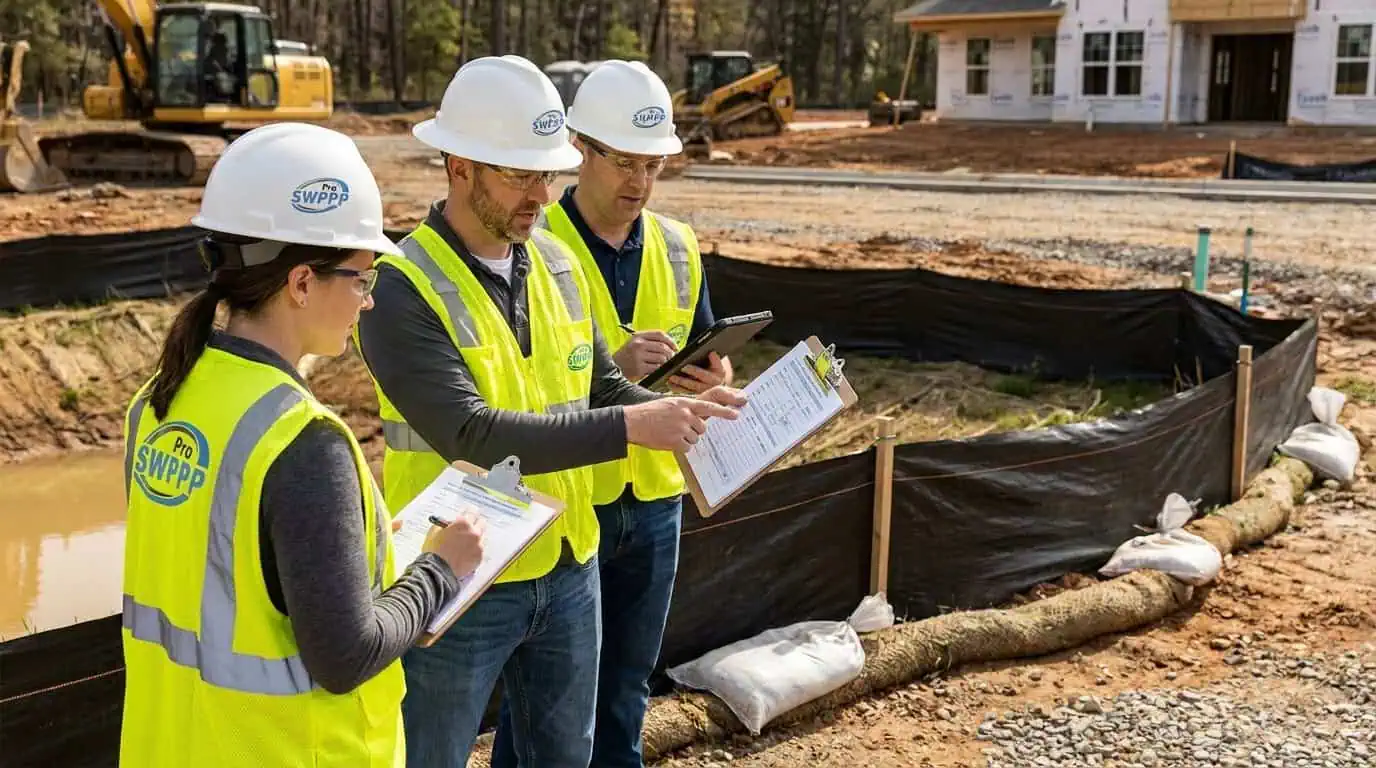
Getting your CBMPP approved is only step one. Keeping it compliant is where most contractors stumble. Alabama’s rules require frequent inspections and constant maintenance. Miss an inspection or let a silt fence collapse, and you’re out of compliance.
SWPPP and CBMPP Inspection Schedules
- SWPPP inspections: At least monthly or after any rainfall of 0.5 inches or more, whichever comes first. Every inspection must be documented.
- CBMPP inspections: At least quarterly. If site conditions or BMP performance change, you’ll need more frequent checks.
- Daily observation: ADEM guidance emphasizes daily walkthroughs and checks of BMPs, with maintenance after every rain event to prevent off-site impacts.
For priority construction sites (those disturbing 10 or more acres of erodible material), you also need turbidity monitoring. This tracks how much sediment is leaving your site in runoff. ALDOT projects flag these priority sites in the CBMPP and specify monitoring locations and thresholds.
Not sure what your project needs? Take our SWPPP Quiz (link) or Schedule a Free SWPPP Consultation with CPESC Certified SWPPP Expert Derek E. Chinners.
Common Inspection and Maintenance Mistakes
Here are the top pitfalls contractors fall into:
- Underestimating the inspection burden: Many crews don’t realize they need to inspect after every half-inch of rain plus conduct monthly and quarterly checks. That adds up fast, especially during wet months.
- Treating BMPs as “set and forget”: Silt fences tear. Sediment basins fill up. Inlet protection clogs. If you don’t maintain them, they stop working. Then you’re discharging dirty water straight into a creek.
- Poor record-keeping: Alabama requires you to document every inspection, every corrective action, and every plan revision. If ADEM shows up and you can’t produce those records, you’re in trouble.
The solution? Build inspection scheduling into your project management software. Assign clear responsibility. Take photos. Log everything. And treat BMPs as performance-based systems that need constant tuning, not one-time installations.
How to Build a CBMPP That Actually Works
A good CBMPP isn’t just a paper exercise. It’s a tool that keeps your project on schedule, protects the environment, and saves you money by avoiding fines and rework. Here’s how to do it right.
Step 1: Pre-Construction Planning
Start with a site survey. Map your topography, drainage patterns, wetlands, streams, and setbacks. Local jurisdictions (like Baldwin County) require a plot plan showing disturbance areas, streams, and buffers. Get this done early. It drives your entire BMP design.
Step 2: QCP-Led Design
Bring in a QCP as early as possible. They’ll run hydrologic models, size your sediment basins and silt fences, and make sure your BMPs can handle the flows you’ll see during construction. This is not a DIY job. A QCP knows ADEM’s expectations and can certify your plan.
Step 3: Implementation and Training
Train your contractors and crew on CBMPP requirements. Walk them through BMP installation, maintenance, and inspection procedures. Make sure everyone knows what to do when a silt fence sags or a basin fills with sediment. Good training up front prevents costly mistakes later.
Step 4: Monitoring and Adaptation
Use your inspection findings and turbidity monitoring data to adjust BMPs. If a basin isn’t capturing sediment, resize it or add more measures upstream. When your construction phasing changes, update the CBMPP. Keep records of inspections, corrective actions, training, and plan revisions. ADEM can audit you at any time.
Why Pro SWPPP Is Your Best Choice for Birmingham CBMPP Compliance
Let’s be honest. Most contractors don’t want to become CBMPP experts. You want to pour concrete, frame buildings, and finish on time. That’s where Pro SWPPP shines. We handle the entire compliance process so you can focus on what you do best.
CPESC-Certified Expertise
Our team is led by CPESC-certified professionals who know Alabama’s rules inside and out. We prepare site-specific CBMPPs and SWPPPs that pass ADEM review the first time. No generic templates. No guesswork. Just solid engineering and regulatory know-how.
Fast Turnaround
We know construction schedules are tight. We deliver compliant plans quickly so you can get your permit and start work. Speed without sacrificing quality. That’s the Pro SWPPP difference.
Ongoing Support
Compliance doesn’t end when you get your plan approved. We provide inspection templates, maintenance checklists, and on-call support throughout your project. If ADEM has questions or your site conditions change, we’re here to help you adapt and stay compliant.
Want to learn more about our process? Visit our About page or Contact Us anytime.
Real-World Example: ALDOT Priority Construction Site
Imagine you’re working on a highway widening project in Birmingham. The project disturbs 15 acres of erodible soil. Under ALDOT rules, this is a priority construction site. That means your CBMPP must include turbidity monitoring locations, thresholds, and corrective action triggers. You’ll also need to integrate environmental commitments (protected habitats, water quality measures) into your contract administration.
Your QCP designs sediment basins sized for the two-year, 24-hour storm. You install stabilized entrances at every access point. You train your crew to check turbidity after every rain event. You log every inspection and corrective action in a digital system. Result? The project stays on schedule. ADEM has no issues. And you avoid thousands in fines and delays.
That’s what a well-executed CBMPP looks like. And that’s what Pro SWPPP delivers every single time.
Avoid These Common CBMPP Pitfalls
Even experienced contractors make mistakes. Here are the biggest ones to watch out for:
- Using a generic template: Alabama will reject it. Every CBMPP must be customized to your site.
- Waiting until the last minute: If you develop your CBMPP late, your grading and phasing might conflict with BMP installation. Start early and integrate the plan with your civil design and construction schedule.
- Skipping hydrologic analysis: Guessing BMP sizes doesn’t cut it. You need calculations that prove your measures can handle the expected flows.
- Ignoring maintenance: BMPs fail when they’re not maintained. After every storm, walk your site and fix problems immediately.
FAQ
Do I need both a SWPPP and a CBMPP in Alabama?
Yes. Alabama requires a SWPPP for stormwater permit compliance under NPDES and a CBMPP for detailed erosion, sediment, and pollution control. Both must be site-specific and certified by a QCP.
Can I use a generic CBMPP template?
No. ADEM explicitly rejects generic templates. Your CBMPP must be tailored to your site’s topography, soil, drainage, and pollution sources. A QCP must customize the plan and certify it.
How often do I need to inspect my BMPs?
SWPPP inspections are required at least monthly or after any rainfall of 0.5 inches or more. CBMPP inspections are required at least quarterly. ADEM also recommends daily observation and maintenance after every rain event.
What happens if I don’t have a CBMPP?
You cannot legally start or continue construction without a compliant CBMPP. ADEM can issue stop-work orders, fines, and penalties. You could also face liability for water quality violations under the Clean Water Act.
Who qualifies as a QCP in Alabama?
A Qualified Credentialed Professional is typically a licensed engineer or similarly qualified professional with expertise in erosion and sediment control. They must be able to design BMPs, perform hydrologic analysis, and certify compliance with Alabama regulations.
How does Pro SWPPP help with CBMPP compliance?
Pro SWPPP prepares site-specific CBMPPs and SWPPPs that meet ADEM standards. Our CPESC-certified team handles hydrologic analysis, BMP design, QCP certification, and ongoing support. We make compliance fast, easy, and stress-free.
Final Thoughts: Get Compliant and Stay Compliant
Building in Birmingham means playing by Alabama’s rules. A CBMPP isn’t optional. It’s the law. And it’s your best defense against fines, delays, and environmental damage. When you partner with Pro SWPPP – America’s #1 SWPPP Service, you get a team that knows Alabama’s regulations, delivers fast, and supports you from permit to closeout.
Stop guessing. Stop worrying. Let the experts at Pro SWPPP handle your CBMPP and SWPPP so you can focus on building. For more information on stormwater compliance and best management practices, visit the EPA’s NPDES Construction Stormwater page.
Ready to get started? Order your SWPPP now or schedule a free consultation with Pro SWPPP.
Visit Pro SWPPP and see why thousands of contractors trust America’s #1 SWPPP Service.
More Alabama stormwater guidance
This guide is part of our Alabama compliance cluster. Start with the hub: Alabama SWPPP & CBMPP Services.
- Mobile CBMPP Guide for Contractors
- Montgomery CBMPP Guide for Contractors
- ALR100000 Guide
- CPESC Certified CBMPP Inspections
Need your Alabama CBMPP?
Pro SWPPP are the paperwork and permitting experts. CBMPP prepared by a CPESC-certified QCP and your Notice of Intent filed with ADEM through AEPACS — in 72 hours, or it’s free. Physical installation of BMPs is handled by your site contractor.